
User Behavior Data
Growth Analytics
+ 4 more ...
Designing Roadmaps Around User Behavior: The Data-Driven Playbook

23 Dec 2025
by Nadiy, Senior Content Writer
Contributor - Titi Hartinah, Product Growth Analyst
23 Dec 2025
by Nadiy, Senior Content Writer
Contributor - Titi Hartinah, Product Growth Analyst
User Behavior Data
Growth Analytics
Data Analytics
Roadmap
Mobile App Development
Software Development
Designing Roadmaps Around User Behavior: The Data-Driven Playbook
Table of contents
Contact us
We will get back to you in the next 48 hours.

A roadmap built on assumptions is a roadmap built on risk. This article breaks down how user behavior data reshapes product strategy, reveals what truly matters to customers, and helps teams prioritise with confidence. If you want to build products that evolve with your users—not against them—this is your starting point.
key takeaways
A product roadmap should feel like a guidepost, not a gamble. Yet many teams still build roadmaps based on assumptions, internal opinions, or the pressure to ship more features. The result? Products that look good on paper but fail to match how users actually behave. User behavior tells a more honest story—what people use, what they ignore, where they struggle, and what keeps them coming back. When you design your roadmap around real patterns rather than predictions, you shift from guessing to building with precision and confidence. In this fifth and final instalment of our Growth Analytics series, we break down how product teams can transform raw behavioral data into a strategic, adaptive, and customer-centric product roadmap.
Be sure to check out the previous four installments in this Growth Analytics series:
Why Traditional Roadmaps Fall Short
Traditional roadmapping sounds good in theory: set timelines, decide features, execute. In reality, it often leads to three major issues:
Rigid Timelines That Don’t Reflect Reality
Once dates are locked in, teams often prioritize delivery over value. If a user needs to shift mid-cycle, the roadmap becomes outdated before it’s even executed.
Feature Overload
Without data to validate what matters, roadmaps often become wishlists filled with features that dilute focus rather than strengthen impact.
Poor User Alignment
Planning without behavioral insights is costly. Resources go into building features that aren’t adopted, while real user problems remain unsolved. The real cost? Time, money, and missed opportunities that could have been avoided with earlier user validation.
The Case for Data-Driven Roadmapping
A data-driven roadmap adapts to user behavior rather than forcing users to adapt to the roadmap. The benefits go far beyond analytics.
Adaptability
User needs evolve. A data-driven roadmap shifts with them, giving teams the agility to course-correct quickly.
Relevance
When decisions are grounded in real behavior, you build features people actually want to use.
Customer Alignment
Behavioral evidence keeps teams laser-focused on delivering measurable value.
Smarter Resource Planning
Data highlights where high effort yields low impact—and vice versa—allowing teams to allocate budgets, time, and talent more intelligently.
Behavioral Analytics Validates Direction
Instead of debating opinions, analytics acts as your reality check. It confirms whether your product is moving in the right direction or whether it’s time to revisit assumptions.
What User Behavior Data Reveals
Behavioral analytics gives product teams clarity on what is working, what isn’t, and what deserves priority.
Usage Frequency
Which features users return to repeatedly—an indicator of core value. It shows how often users interact with specific features or return to your product over time. It helps identify what truly delivers value versus what exists only in theory. Features that are used frequently often form the core of the product experience and should be protected, optimised, and scaled.
Low usage frequency, on the other hand, may signal poor discoverability, unclear value, or a mismatch with user needs. By analysing how often users engage with different parts of the product, teams can decide where to double down, what needs improvement, and which features may no longer justify further investment.
Drop-Off Points
Drop-off points reveal where users abandon a flow, task, or journey within the product. These moments often highlight friction, confusion, or unmet expectations. Common drop-off areas include onboarding steps, sign-up forms, checkout processes, or complex workflows.
Understanding where and why users leave allows teams to prioritise experience improvements that directly impact conversion, retention, and satisfaction. Instead of guessing what’s “broken,” drop-off data provides clear evidence of where users struggle most—and where small changes can create outsized gains.
Feature Adoption Patterns
Feature adoption patterns show how users discover, try, and continue using specific features over time. This data helps teams distinguish between features that are immediately valuable and those that require better onboarding, positioning, or refinement.
Strong adoption indicates clear value and good usability, while weak adoption may point to poor timing, insufficient education, or unnecessary complexity. By analysing adoption trends across user segments, teams can make informed decisions about which features to enhance, reposition, sunset, or prioritise in the roadmap—ensuring development effort aligns with real user demand.
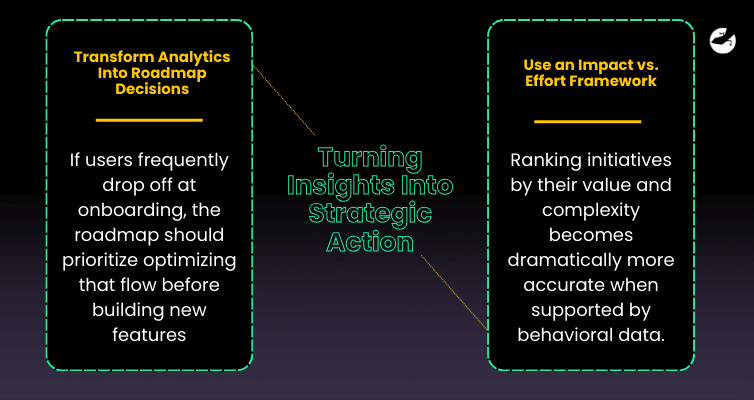
Turning Insights Into Strategic Action
Data alone is not the strategy. The value emerges when teams translate insight into decisions.
Transform Analytics Into Roadmap Decisions
If users frequently drop off at onboarding, the roadmap should prioritize optimizing that flow before building new features. If an under-promoted feature gets unexpected traction, it may deserve more investment.
Use an Impact vs. Effort Framework
Ranking initiatives by their value and complexity becomes dramatically more accurate when supported by behavioral data. High-impact, low-effort tasks rise to the top, while low-impact work gets deprioritized—removing guesswork from the process.
Balancing Vision with Validation
A product roadmap needs both long-term vision and short-term responsiveness.
Combine Big-Picture Goals with Real-Time Feedback
Your vision guides the destination; user data guides the path. Together, they prevent teams from drifting too far in either direction.
Avoid Data Paralysis
Teams often get overwhelmed by too much data. Focus on key behavioral signals—the ones that affect activation, retention, and conversion. Prioritizing the right metrics ensures progress without analysis overload.
Want to find out how much it costs to build your dream app or web app?


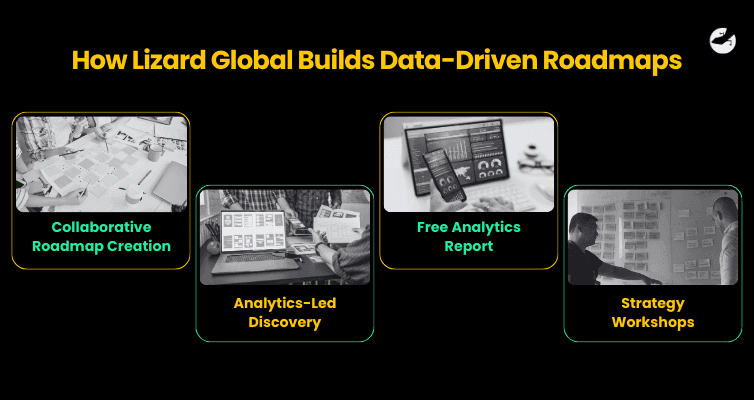
How Lizard Global Builds Data-Driven Roadmaps
At Lizard Global, data-driven product development isn’t a buzzword—it’s part of our DNA. We combine strategy, analytics, and collaboration to help clients make confident roadmap decisions.
Strategy Workshops
Our OKR Strategy Workshop helps teams define clear product goals, align on priorities, and translate objectives into actionable next steps. This ensures everyone understands the milestones and responsibilities from day one.
Analytics-Led Discovery
We begin every engagement with deep analytics discovery—looking at user flows, behavior patterns, drop-off points, and feature usage. These insights guide what should be built, improved, or removed.
Free Analytics Report
We provide clients with a comprehensive analytics report early in the process to highlight the product’s strengths and weaknesses. This becomes the foundation for smarter roadmap planning.
Collaborative Roadmap Creation
Clients and our team co-create the roadmap together. We bring data, experience, and strategy; clients bring product context. The result is a plan grounded in evidence and aligned on expectations. When you combine strategy, analytics, and collaboration, you get a roadmap that’s not only achievable—but genuinely user-centric.
How Lizard Global Can Support Your Product Journey
Designing a roadmap around user behavior removes the guesswork and replaces it with clarity, confidence, and measurable impact. At Lizard Global, we help product teams turn complex user data into actionable strategies through OKR workshops, analytics-driven discovery, and collaborative roadmap planning.

Whether you’re redefining your product vision, improving user experience, or scaling intelligently, our team is equipped to guide you with proven frameworks and data-first decision-making. When your roadmap is built on real user behavior, your product doesn’t just grow—it grows in the right direction.
A roadmap built on assumptions is a roadmap built on risk. This article breaks down how user behavior data reshapes product strategy, reveals what truly matters to customers, and helps teams prioritise with confidence. If you want to build products that evolve with your users—not against them—this is your starting point.
A product roadmap should feel like a guidepost, not a gamble. Yet many teams still build roadmaps based on assumptions, internal opinions, or the pressure to ship more features. The result? Products that look good on paper but fail to match how users actually behave. User behavior tells a more honest story—what people use, what they ignore, where they struggle, and what keeps them coming back. When you design your roadmap around real patterns rather than predictions, you shift from guessing to building with precision and confidence. In this fifth and final instalment of our Growth Analytics series, we break down how product teams can transform raw behavioral data into a strategic, adaptive, and customer-centric product roadmap.
Be sure to check out the previous four installments in this Growth Analytics series:
Why Traditional Roadmaps Fall Short
Traditional roadmapping sounds good in theory: set timelines, decide features, execute. In reality, it often leads to three major issues:
Rigid Timelines That Don’t Reflect Reality
Once dates are locked in, teams often prioritize delivery over value. If a user needs to shift mid-cycle, the roadmap becomes outdated before it’s even executed.
Feature Overload
Without data to validate what matters, roadmaps often become wishlists filled with features that dilute focus rather than strengthen impact.
Poor User Alignment
Planning without behavioral insights is costly. Resources go into building features that aren’t adopted, while real user problems remain unsolved. The real cost? Time, money, and missed opportunities that could have been avoided with earlier user validation.
The Case for Data-Driven Roadmapping
A data-driven roadmap adapts to user behavior rather than forcing users to adapt to the roadmap. The benefits go far beyond analytics.
Adaptability
User needs evolve. A data-driven roadmap shifts with them, giving teams the agility to course-correct quickly.
Relevance
When decisions are grounded in real behavior, you build features people actually want to use.
Customer Alignment
Behavioral evidence keeps teams laser-focused on delivering measurable value.
Smarter Resource Planning
Data highlights where high effort yields low impact—and vice versa—allowing teams to allocate budgets, time, and talent more intelligently.
Behavioral Analytics Validates Direction
Instead of debating opinions, analytics acts as your reality check. It confirms whether your product is moving in the right direction or whether it’s time to revisit assumptions.
What User Behavior Data Reveals
Behavioral analytics gives product teams clarity on what is working, what isn’t, and what deserves priority.
Usage Frequency
Which features users return to repeatedly—an indicator of core value. It shows how often users interact with specific features or return to your product over time. It helps identify what truly delivers value versus what exists only in theory. Features that are used frequently often form the core of the product experience and should be protected, optimised, and scaled.
Low usage frequency, on the other hand, may signal poor discoverability, unclear value, or a mismatch with user needs. By analysing how often users engage with different parts of the product, teams can decide where to double down, what needs improvement, and which features may no longer justify further investment.
Drop-Off Points
Drop-off points reveal where users abandon a flow, task, or journey within the product. These moments often highlight friction, confusion, or unmet expectations. Common drop-off areas include onboarding steps, sign-up forms, checkout processes, or complex workflows.
Understanding where and why users leave allows teams to prioritise experience improvements that directly impact conversion, retention, and satisfaction. Instead of guessing what’s “broken,” drop-off data provides clear evidence of where users struggle most—and where small changes can create outsized gains.
Feature Adoption Patterns
Feature adoption patterns show how users discover, try, and continue using specific features over time. This data helps teams distinguish between features that are immediately valuable and those that require better onboarding, positioning, or refinement.
Strong adoption indicates clear value and good usability, while weak adoption may point to poor timing, insufficient education, or unnecessary complexity. By analysing adoption trends across user segments, teams can make informed decisions about which features to enhance, reposition, sunset, or prioritise in the roadmap—ensuring development effort aligns with real user demand.
Turning Insights Into Strategic Action
Data alone is not the strategy. The value emerges when teams translate insight into decisions.
Transform Analytics Into Roadmap Decisions
If users frequently drop off at onboarding, the roadmap should prioritize optimizing that flow before building new features. If an under-promoted feature gets unexpected traction, it may deserve more investment.
Use an Impact vs. Effort Framework
Ranking initiatives by their value and complexity becomes dramatically more accurate when supported by behavioral data. High-impact, low-effort tasks rise to the top, while low-impact work gets deprioritized—removing guesswork from the process.
Balancing Vision with Validation
A product roadmap needs both long-term vision and short-term responsiveness.
Combine Big-Picture Goals with Real-Time Feedback
Your vision guides the destination; user data guides the path. Together, they prevent teams from drifting too far in either direction.
Avoid Data Paralysis
Teams often get overwhelmed by too much data. Focus on key behavioral signals—the ones that affect activation, retention, and conversion. Prioritizing the right metrics ensures progress without analysis overload.
Want to find out how much it costs to build your dream app or web app?
How Lizard Global Builds Data-Driven Roadmaps
At Lizard Global, data-driven product development isn’t a buzzword—it’s part of our DNA. We combine strategy, analytics, and collaboration to help clients make confident roadmap decisions.
Strategy Workshops
Our OKR Strategy Workshop helps teams define clear product goals, align on priorities, and translate objectives into actionable next steps. This ensures everyone understands the milestones and responsibilities from day one.
Analytics-Led Discovery
We begin every engagement with deep analytics discovery—looking at user flows, behavior patterns, drop-off points, and feature usage. These insights guide what should be built, improved, or removed.
Free Analytics Report
We provide clients with a comprehensive analytics report early in the process to highlight the product’s strengths and weaknesses. This becomes the foundation for smarter roadmap planning.
Collaborative Roadmap Creation
Clients and our team co-create the roadmap together. We bring data, experience, and strategy; clients bring product context. The result is a plan grounded in evidence and aligned on expectations. When you combine strategy, analytics, and collaboration, you get a roadmap that’s not only achievable—but genuinely user-centric.
How Lizard Global Can Support Your Product Journey
Designing a roadmap around user behavior removes the guesswork and replaces it with clarity, confidence, and measurable impact. At Lizard Global, we help product teams turn complex user data into actionable strategies through OKR workshops, analytics-driven discovery, and collaborative roadmap planning.
Whether you’re redefining your product vision, improving user experience, or scaling intelligently, our team is equipped to guide you with proven frameworks and data-first decision-making. When your roadmap is built on real user behavior, your product doesn’t just grow—it grows in the right direction.
FAQs

What is a data-driven product roadmap?
Why do traditional product roadmaps fail?
How does user behavior data improve product planning?
What types of user behavior data should teams track?
How do you turn behavioral insights into roadmap decisions?
How do you balance long-term product vision with short-term data insights?
What is “data paralysis,” and how can teams avoid it?
How do analytics-led discovery processes work?
How does Lizard Global help teams build data-driven roadmaps?
Why is behavior-driven prioritization more effective than intuition-based planning?
What tools are commonly used for behavioral analytics?
similar reads