

08 Jan 2026
by Nadiy, Senior Content Writer
08 Jan 2026
by Nadiy, Senior Content Writer
Budgeting for Scale: App Development ROI in 2026
Table of contents
Why App Development Costs in 2026 Are About ROI, Not Just Price
How Much Does It Cost to Build an App in 2026?
Why App Development Costs Must Be Evaluated Through ROI
Core Cost Drivers in App Development
Common Budgeting Mistakes That Reduce App ROI
How Lizard Global Helps Clients Build Scalable, ROI-Driven Apps
Contact us
We will get back to you in the next 48 hours.
App development in 2026 is no longer about launch costs alone. This guide breaks down what it really costs to build a scalable app, where budgets often go wrong, and how to plan for long-term ROI instead of short-term savings.
key takeaways
Building an app is no longer just a technical investment — it’s a business decision with long-term financial consequences. In 2026, the question isn’t simply “How much does it cost to build an app?” but “How do I budget for an app that can scale, adapt, and deliver ROI over time?”
Markets move faster, user expectations are higher, and AI-driven discovery engines now evaluate digital products based on relevance, authority, and real value. That means your app budget must account for far more than development hours. It must support growth, performance, and strategic outcomes.
This guide breaks down app development costs in 2026 through an ROI-focused lens — helping scale-ups and enterprises budget smarter, avoid common cost traps, and build products that grow with the business.
Want to find out how much it costs to build your dream app or web app?


Why App Development Costs in 2026 Are About ROI, Not Just Price
The biggest budgeting mistake companies make is treating app development as a one-off expense. In reality, apps are evolving business platforms.
In 2026, cost discussions must factor in:
- Long-term scalability
- Maintenance and optimisation
- Integration with existing systems
- Data, Artificial Intelligence (AI), and automation readiness
- The cost of not planning properly
A cheaper app that cannot scale often becomes more expensive than a well-planned investment upfront. ROI comes from longevity, adaptability, and user retention — not from the lowest initial quote.
How Much Does It Cost to Build an App in 2026?
The cost of building an app in 2026 depends on complexity, scalability requirements, and the role the app plays within the business.
While exact costs vary by region, complexity, and strategy, app development pricing in 2026 typically falls into these ranges:
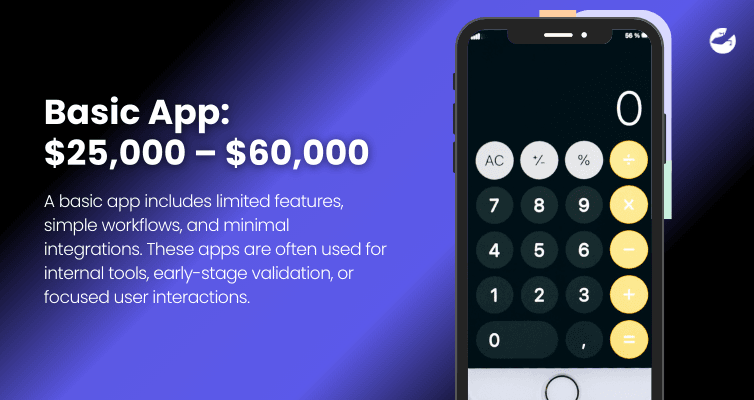
Basic App: $25,000 – $60,000
A basic app includes limited features, simple workflows, and minimal integrations. These apps are often used for internal tools, early-stage validation, or focused user interactions.
Suitable for:
- Simple functionality
- Limited user flows
- Minimal integrations
Best for:
- Proofs of concept
- Internal tools
- Early-stage MVPs with clear validation goals
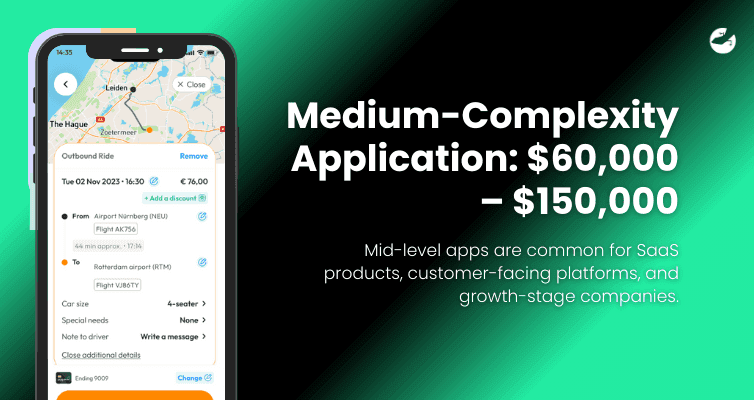
Medium-Complexity Application: $60,000 – $150,000
Mid-level apps are common for SaaS products, customer-facing platforms, and growth-stage companies.
Includes:
Best for:
- Scale-ups testing product-market fit
- Customer-facing apps
- SaaS platforms entering growth stage
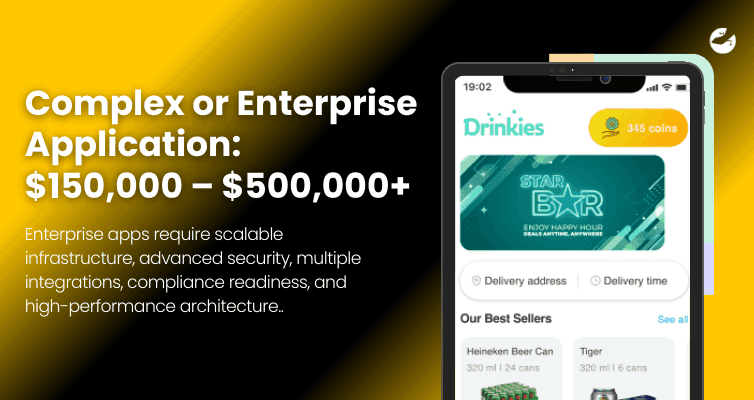
Complex or Enterprise Application: $150,000 – $500,000+
Enterprise apps require scalable infrastructure, advanced security, multiple integrations, compliance readiness, and high-performance architecture. These products are built to support long-term growth and operational reliability.
Cost increases as risk tolerance decreases and performance expectations rise.
Includes:
- Advanced architecture
- High-traffic readiness
- Multiple integrations
- Security and compliance
- AI-enabled features
Best for:
- Enterprises
- Regulated industries (FinTech, Logistics, Health)
- Products built for long-term market leadership
The key takeaway: cost scales with ambition and risk tolerance, not just features.
Why App Development Costs Must Be Evaluated Through ROI
Budgeting for app development without defining ROI leads to overspending or underbuilding.
Return on investment in app development may include:
- Revenue generation through subscriptions or transactions
- Reduced operational costs through automation
- Increased customer engagement and retention
- Faster internal workflows and decision-making
- Data insights that improve strategic planning
Apps built without ROI alignment often require expensive rework or fail to scale when demand increases.
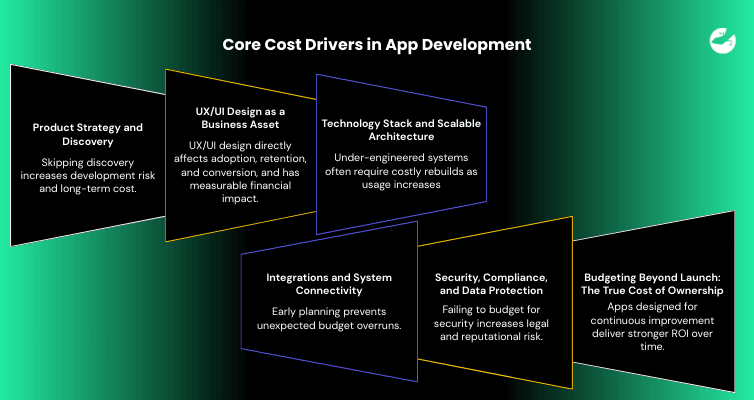
Core Cost Drivers in App Development
Understanding cost drivers allows organisations to control budgets while protecting quality and future growth.
Product Strategy and Discovery
Discovery and product strategy defines what to build and what not to build. It reduces uncertainty by validating assumptions early. Skipping discovery increases development risk and long-term cost.
This phase clarifies:
- Target users and use cases
- Feature prioritisation
- Technical feasibility
- Business objectives and KPIs
UX/UI Design as a Business Asset
UX/UI design directly affects adoption, retention, and conversion, and has measurable financial impact.
In 2026, effective design focuses on:
- Reducing cognitive load
- Guiding user behaviour
- Improving onboarding efficiency
- Supporting business goals through interaction design
Technology Stack and Scalable Architecture
The choice of technology determines how well an app handles growth. Under-engineered systems often require costly rebuilds as usage increases.
Scalable architecture includes:
- Modular backend systems
- Cloud-based infrastructure
- API-first development
- Performance optimisation from day one
Integrations and System Connectivity
Most modern apps connect with external systems such as CRMs, ERPs, payment providers, or analytics tools. Early planning prevents unexpected budget overruns.
Each integration adds:
- Development effort
- Security considerations
- Ongoing maintenance costs
Security, Compliance, and Data Protection
Security and compliance are integral to app development in 2026. Failing to budget for security increases legal and reputational risk.
Applications must account for:
- Data protection regulations (GDPR, PDPA)
- Secure authentication
- Industry-specific compliance requirements
Budgeting Beyond Launch: The True Cost of Ownership
Launching an app does not end the investment cycle. Annual maintenance typically accounts for 15–25% of the initial development cost. Apps designed for continuous improvement deliver stronger ROI over time.
Ongoing costs include:
- Maintenance and infrastructure
- Performance optimisation
- Platform updates
- Feature improvements based on user data
Common Budgeting Mistakes That Reduce App ROI
Many organisations overspend without seeing returns due to avoidable mistakes:
- Building features before validating user demand
- Prioritising speed over scalability
- Treating design as cosmetic rather than strategic
- Underestimating post-launch costs
- Choosing technology without long-term planning
Avoiding these mistakes improves both cost efficiency and product outcomes.
How Lizard Global Helps Clients Build Scalable, ROI-Driven Apps
Lizard Global approaches app development as a long-term business investment.
We help scale-ups and enterprises:
- Define clear product and ROI strategies
- Design user experiences that drive adoption
- Build scalable, secure, and maintainable systems
- Integrate complex platforms and data sources
- Continuously optimise products based on real usage data
Want to find out how much it costs to build your dream app or web app?
From discovery and design to development and ongoing optimisation, Lizard Global ensures app budgets support growth, performance, and measurable business impact — not just delivery.
FAQs

Which are the top software development companies in the Netherlands in 2026?
Is the Netherlands a good country for software development?
How much does it cost to hire a software development company in the Netherlands?
What services do software development companies in the Netherlands provide?
Are Dutch software development companies suitable for startups and scale-ups?
similar reads

Case Studies & Interviews
Lereng Tanah: Developing a Direct Booking Platform Malaysian Boutique Villa
29 January 2026

Case Studies & Interviews
Tactlink: How a Malaysian Entrepreneur Turned Networking Chaos into a Digital Community
22 January 2026

Software Development
Who Are the Top Software Development Vendors in Amsterdam for 2026?
26 August 2026
Stuck between a great idea and the right team to build it?Let's talk.
We work with corporate innovation teams and ambitious scale-ups across the Netherlands, Singapore, and Australia, and wherever great software needs to be built. Drop us a message and we'll get back to you within one business day.


Markus Monnikendam
Global Commercial Director
hello@lizard.global