From Data to Decisions: How AI Supercharges Business Analytics

09 Dec 2025
by Nadiy, Senior Content Writer
Contributor - Titi Hartinah, Product Growth Analyst
09 Dec 2025
by Nadiy, Senior Content Writer
Contributor - Titi Hartinah, Product Growth Analyst
From Data to Decisions: How AI Supercharges Business Analytics
Table of contents
Contact us
We will get back to you in the next 48 hours.
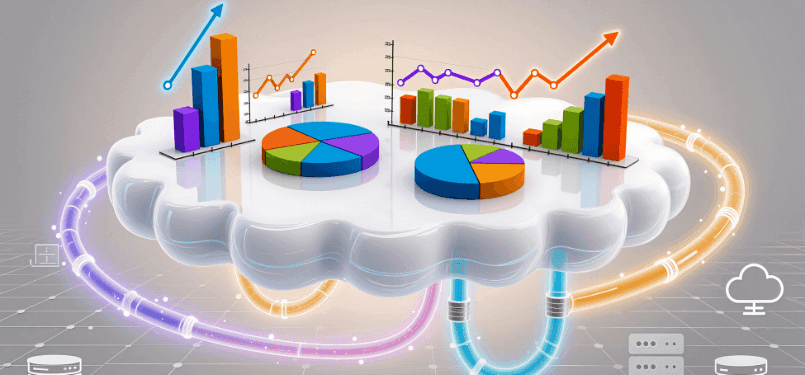
From Data to Decisions How AI Supercharges Business Analytics
Businesses don’t fail from lack of data—they fail from lack of clarity. Learn how AI transforms business analytics from static reports into real-time intelligence, helping teams make faster, smarter, and more confident decisions.
key takeaways
By now in our Growth Analytics series, one thing is clear: having more data doesn’t automatically lead to better decisions. In the first two installment, we covered how growth analytics defines development and product strategy and how analytics-driven iteration transforms insights into action. But even with the right setup, many teams still struggle to cut through the noise and act fast enough.
Traditional reporting simply can’t keep pace. Insights arrive late. Patterns get buried. Decisions slow down. This is where AI reshapes the picture. In this third installment, we explore how AI turns overwhelming data into clear direction, delivers real-time insight, and helps teams move from reactive to truly proactive decision-making. Because the real advantage today isn’t having data — it’s knowing what to do with it, instantly.
The Quiet Struggle Behind Data-Driven Decisions
Most companies collect mountains of data. Sales reports, customer behavior, campaign metrics—every department has its own stack. Yet, when it’s time to make a big decision, leaders often find themselves waiting days (or even weeks) for meaningful insights.
Why? Because traditional analytics, though valuable, have limitations that slow everything down. Manual reporting eats up time. Data silos block visibility between teams. And by the time the analysis is done, the insight might already be outdated.
It’s like driving while looking in the rearview mirror—you can see where you’ve been, but not what’s coming next. That’s where Artificial Intelligence (AI) changes the game.
The Limitations of Traditional Analytics
Let’s face it: spreadsheets and static dashboards can only take us so far. Before we dive into what AI brings to the table, let’s look at the limitations of the current analytics.
- Manual Reporting – Teams spend hours crunching numbers, reconciling data, and creating reports instead of analyzing them.
- Data Silos – Marketing, sales, and operations often work with separate datasets, leading to fragmented insights.
- Slow Insights – Traditional models take too long to deliver actionable information, leaving decision-makers reacting instead of anticipating.
These limitations don’t just slow down progress—they directly impact accuracy, agility, and confidence in strategic choices.
Want to find out how much it costs to build your dream app or web app?


What AI Brings to the Table
AI doesn’t just make analytics faster; it makes them smarter. By integrating machine learning, natural language processing (NLP), and predictive algorithms, AI systems can uncover patterns and trends that humans might overlook.
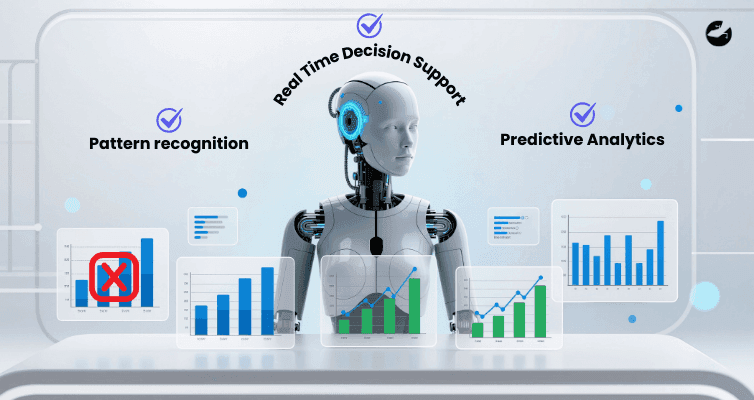
Here’s how AI supercharges analytics:
- Automated Pattern Recognition and Forecasting: AI scans vast data sets to spot relationships and predict outcomes with remarkable precision.
- Real-Time Decision Support: Instead of waiting for the next reporting cycle, teams can act on insights as they emerge.
- Predictive Analytics: AI helps businesses look forward, not backward—forecasting demand, customer churn, and market shifts.
Think of AI-driven dashboards that flag anomalies before they become problems, or algorithms that anticipate customer needs before they’re even been expressed. That’s the power of modern analytics.
Turning Data Overload into Direction
The challenge today isn’t a lack of data—it’s too much of it. Businesses are drowning in information from apps, sensors, websites, and social channels. The real question is: how do you turn that chaos into clarity?
AI acts as a smart filter. It sifts through the noise, highlights what matters most, and recommends next steps.
For example:
- Product teams gain clarity on which features drive engagement.
- Marketing teams understand intent and personalize campaigns in real time.
- Leadership teams see patterns that reveal new growth opportunities.
Turning Data Overload into Direction
The volume and diversity of data available to companies today is staggering — website clicks, purchase histories, social media sentiment, IoT sensor readings, external data like weather or local events.
Without structure, that data is noise. It can overwhelm teams rather than help them. AI becomes the filter, the signal extractor, turning overload into strategic direction. Here are ways this plays out in real life:
Filtering noise and prioritizing what matters.
AI doesn’t treat all data equally. It can highlight unusual trends, detect anomalies, or flag patterns that human analysts might miss simply because they cannot monitor everything all the time.
For example, a case study done by Debut Infotech shows that retailers use AI to flag anomalies in transactions—such as unexpectedly large returns or sudden spikes in refunds—which could indicate fraud or operational issues. This allows them to act quickly rather than discovering problems weeks later.
Enabling product and marketing teams to focus.
When marketing campaigns run, many variations and channels generate a flood of data: opens, clicks, interactions, engagement, drop-offs. AI tools can analyze which segments are responding best, which offers are resonating, and which user behaviors predict conversion.
A great example of this is Nike. They use predictive modeling and behavior analytics to send highly personalized emails based on a customer’s app usage, browsing, and purchase history—leading to higher repeat purchase rate and more relevant interactions.
Real-time decision support for leadership.
Leadership often needs to know what to prioritize now: which product line is underperforming, which market segment is heating up, when to adjust pricing or inventory. AI dashboards that aggregate across data silos (sales, operations, marketing) and produce real-time signals help leaders make decisions before something becomes a bigger issue.
For instance, Walmart uses AI models to predict local demand by combining real-time sales, seasonality, local events, and weather. This helps with replenishment and minimizing out-of-stock situations.
Reducing decision fatigue and accelerating action.
As AI filters out irrelevant data and surfaces actionable insights, teams spend less time gathering, cleaning, or discussing what data means, and more time acting. That means faster product iterations, quicker marketing optimizations, and operations can adjust more rapidly to external changes (e.g. demand spike).
So “Turning Data Overload into Direction” isn’t just about being more efficient—it’s about being more strategic, agile, and aligned.
Use Cases Across Business Functions
AI-powered analytics isn’t limited to one department. It’s transforming how organizations operate across the board. Here are examples, grounded in real-company cases, showing how different business functions are benefiting from AI-powered analytics.
Product Function
Predicts user behavior, personalizes recommendations, and optimizes product roadmaps based on real-time feedback.
- User prediction and personalization. Netflix and Amazon are perhaps the most cited examples. Netflix analyzes viewing history, rating patterns, and other user behavior to suggest content that matches user tastes. This not only increases engagement but reduces churn because users feel the product is “tuned to them.”
- Personalization in retail products. Sephora is well known for using AI to power its “Virtual Artist” tool (which allows customers to try makeup virtually), its skin and beauty advisors (which recommend products based on skin type, preferences, past behavior), and custom-product recommendations based on browsing and purchase history. This improves conversion, reduces returns, and increases customer satisfaction.
Marketing Function
Segments audiences, target intent, and adjust campaigns dynamically to boost ROI and engagement.
- Segmentation and intent targeting. AI helps marketers split their audiences not just by demographics but by behavior, predicted intent, and engagement. For example, Shopify’s tools helped the brand Airsign identify core customer segments (urban design-conscious shoppers; younger customers moving to suburbs; older customers valuing high-quality appliances). With those insights, Airsign ran specific targeted campaigns and optimized fulfillment strategy. The result: conversion lift, lower shipping cost, more efficient operations.
- Personalized messaging and content optimization. Nike’s email campaigns are a good example: by using AI to understand user behavior (what someone has browsed, what they’ve purchased, what their app usage looks like), Nike customizes subject lines, offers, content layout, etc. The relevance of the message increases conversion and engagement.
- Dynamic advertising and campaign optimization. Companies like Amazon use machine learning to place more relevant ads, based on browsing behavior, purchase history, demographic signals, etc., thus improving ROI. Netflix similarly uses predictive models to decide what content to promote to which segments.
Operations & Supply Chain
Forecasts demand, manage resources efficiently, and minimize waste through intelligent planning.
- Demand forecasting and inventory optimization. Walmart uses AI models to forecast demand at a local store level by accounting for factors like weather, events, local sales trends. This reduces stock shortages or overstocking.
- Resource allocation and pricing. AI helps in dynamic pricing, adjusting prices in response to changing demand, competitor pricing, inventory levels, etc. Also, operational resources such as staffing, warehousing, or delivery routes can be optimized based on predictive insights. For example, Amazon’s logistics operations (including warehouse management and route planning) employ AI to optimize movements and allocations.
- Anomaly detection & risk monitoring. Operations often suffer when unanticipated events occur: sudden drop in supply, fraud, inventory miscounts, equipment anomalies. AI tools can continuously monitor for patterns that deviate from norms, alerting teams early. For example, 7-Eleven uses real-time anomaly detection in its point-of-sale systems to catch unusual sales spikes or refund patterns.
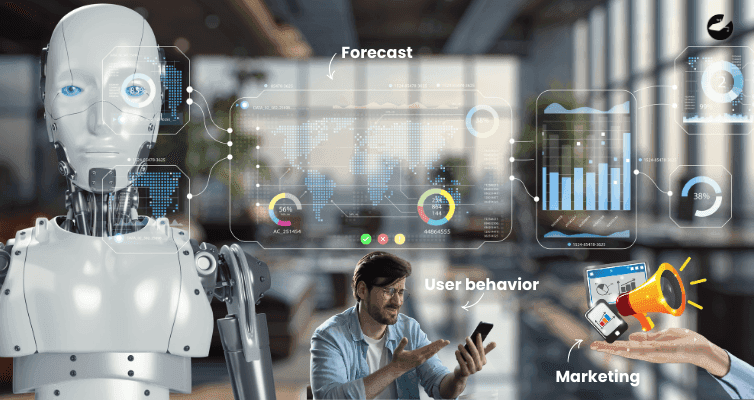
The Human Element: AI as a Partner, Not a Replacement
Despite its sophistication, AI doesn’t replace human judgment—it enhances it.
AI can process more information in seconds than a person could in a lifetime, but it lacks context, empathy, and vision. That’s where humans come in.
The best organizations find balance:
- They automate repetitive analysis.
- They use AI insights to guide decision-making.
- They rely on human experience to interpret the “why” behind the “what.”
AI empowers teams to think more creatively, act more strategically, and focus on the decisions that truly matter.
How Lizard Global Integrates AI Into Business Analytics
At Lizard Global, we help businesses bridge the gap between data and decisions.
We leverage analytics tools to:
- Streamline data collection and visualization
- Identify growth opportunities faster
- Predict trends and prevent risks before they surface
- Enable smarter, faster decision-making across departments

Whether you’re building a digital product, optimizing marketing campaigns, or improving operational efficiency, our team ensures your data works harder for you. Let’s turn your data into decisions that matter. WhatsApp Us Today!
Join 2000+ subscribers
Stay in the loop with everything you need to know
From Data to Decisions How AI Supercharges Business Analytics
Businesses don’t fail from lack of data—they fail from lack of clarity. Learn how AI transforms business analytics from static reports into real-time intelligence, helping teams make faster, smarter, and more confident decisions.
By now in our Growth Analytics series, one thing is clear: having more data doesn’t automatically lead to better decisions. In the first two installment, we covered how growth analytics defines development and product strategy and how analytics-driven iteration transforms insights into action. But even with the right setup, many teams still struggle to cut through the noise and act fast enough.
Traditional reporting simply can’t keep pace. Insights arrive late. Patterns get buried. Decisions slow down. This is where AI reshapes the picture. In this third installment, we explore how AI turns overwhelming data into clear direction, delivers real-time insight, and helps teams move from reactive to truly proactive decision-making. Because the real advantage today isn’t having data — it’s knowing what to do with it, instantly.
The Quiet Struggle Behind Data-Driven Decisions
Most companies collect mountains of data. Sales reports, customer behavior, campaign metrics—every department has its own stack. Yet, when it’s time to make a big decision, leaders often find themselves waiting days (or even weeks) for meaningful insights.
Why? Because traditional analytics, though valuable, have limitations that slow everything down. Manual reporting eats up time. Data silos block visibility between teams. And by the time the analysis is done, the insight might already be outdated.
It’s like driving while looking in the rearview mirror—you can see where you’ve been, but not what’s coming next. That’s where Artificial Intelligence (AI) changes the game.
The Limitations of Traditional Analytics
Let’s face it: spreadsheets and static dashboards can only take us so far. Before we dive into what AI brings to the table, let’s look at the limitations of the current analytics.
- Manual Reporting – Teams spend hours crunching numbers, reconciling data, and creating reports instead of analyzing them.
- Data Silos – Marketing, sales, and operations often work with separate datasets, leading to fragmented insights.
- Slow Insights – Traditional models take too long to deliver actionable information, leaving decision-makers reacting instead of anticipating.
These limitations don’t just slow down progress—they directly impact accuracy, agility, and confidence in strategic choices.
Want to find out how much it costs to build your dream app or web app?
What AI Brings to the Table
AI doesn’t just make analytics faster; it makes them smarter. By integrating machine learning, natural language processing (NLP), and predictive algorithms, AI systems can uncover patterns and trends that humans might overlook.
Here’s how AI supercharges analytics:
- Automated Pattern Recognition and Forecasting: AI scans vast data sets to spot relationships and predict outcomes with remarkable precision.
- Real-Time Decision Support: Instead of waiting for the next reporting cycle, teams can act on insights as they emerge.
- Predictive Analytics: AI helps businesses look forward, not backward—forecasting demand, customer churn, and market shifts.
Think of AI-driven dashboards that flag anomalies before they become problems, or algorithms that anticipate customer needs before they’re even been expressed. That’s the power of modern analytics.
Turning Data Overload into Direction
The challenge today isn’t a lack of data—it’s too much of it. Businesses are drowning in information from apps, sensors, websites, and social channels. The real question is: how do you turn that chaos into clarity?
AI acts as a smart filter. It sifts through the noise, highlights what matters most, and recommends next steps.
For example:
- Product teams gain clarity on which features drive engagement.
- Marketing teams understand intent and personalize campaigns in real time.
- Leadership teams see patterns that reveal new growth opportunities.
Turning Data Overload into Direction
The volume and diversity of data available to companies today is staggering — website clicks, purchase histories, social media sentiment, IoT sensor readings, external data like weather or local events.
Without structure, that data is noise. It can overwhelm teams rather than help them. AI becomes the filter, the signal extractor, turning overload into strategic direction. Here are ways this plays out in real life:
Filtering noise and prioritizing what matters.
AI doesn’t treat all data equally. It can highlight unusual trends, detect anomalies, or flag patterns that human analysts might miss simply because they cannot monitor everything all the time.
For example, a case study done by Debut Infotech shows that retailers use AI to flag anomalies in transactions—such as unexpectedly large returns or sudden spikes in refunds—which could indicate fraud or operational issues. This allows them to act quickly rather than discovering problems weeks later.
Enabling product and marketing teams to focus.
When marketing campaigns run, many variations and channels generate a flood of data: opens, clicks, interactions, engagement, drop-offs. AI tools can analyze which segments are responding best, which offers are resonating, and which user behaviors predict conversion.
A great example of this is Nike. They use predictive modeling and behavior analytics to send highly personalized emails based on a customer’s app usage, browsing, and purchase history—leading to higher repeat purchase rate and more relevant interactions.
Real-time decision support for leadership.
Leadership often needs to know what to prioritize now: which product line is underperforming, which market segment is heating up, when to adjust pricing or inventory. AI dashboards that aggregate across data silos (sales, operations, marketing) and produce real-time signals help leaders make decisions before something becomes a bigger issue.
For instance, Walmart uses AI models to predict local demand by combining real-time sales, seasonality, local events, and weather. This helps with replenishment and minimizing out-of-stock situations.
Reducing decision fatigue and accelerating action.
As AI filters out irrelevant data and surfaces actionable insights, teams spend less time gathering, cleaning, or discussing what data means, and more time acting. That means faster product iterations, quicker marketing optimizations, and operations can adjust more rapidly to external changes (e.g. demand spike).
So “Turning Data Overload into Direction” isn’t just about being more efficient—it’s about being more strategic, agile, and aligned.
Use Cases Across Business Functions
AI-powered analytics isn’t limited to one department. It’s transforming how organizations operate across the board. Here are examples, grounded in real-company cases, showing how different business functions are benefiting from AI-powered analytics.
Product Function
Predicts user behavior, personalizes recommendations, and optimizes product roadmaps based on real-time feedback.
- User prediction and personalization. Netflix and Amazon are perhaps the most cited examples. Netflix analyzes viewing history, rating patterns, and other user behavior to suggest content that matches user tastes. This not only increases engagement but reduces churn because users feel the product is “tuned to them.”
- Personalization in retail products. Sephora is well known for using AI to power its “Virtual Artist” tool (which allows customers to try makeup virtually), its skin and beauty advisors (which recommend products based on skin type, preferences, past behavior), and custom-product recommendations based on browsing and purchase history. This improves conversion, reduces returns, and increases customer satisfaction.
Marketing Function
Segments audiences, target intent, and adjust campaigns dynamically to boost ROI and engagement.
- Segmentation and intent targeting. AI helps marketers split their audiences not just by demographics but by behavior, predicted intent, and engagement. For example, Shopify’s tools helped the brand Airsign identify core customer segments (urban design-conscious shoppers; younger customers moving to suburbs; older customers valuing high-quality appliances). With those insights, Airsign ran specific targeted campaigns and optimized fulfillment strategy. The result: conversion lift, lower shipping cost, more efficient operations.
- Personalized messaging and content optimization. Nike’s email campaigns are a good example: by using AI to understand user behavior (what someone has browsed, what they’ve purchased, what their app usage looks like), Nike customizes subject lines, offers, content layout, etc. The relevance of the message increases conversion and engagement.
- Dynamic advertising and campaign optimization. Companies like Amazon use machine learning to place more relevant ads, based on browsing behavior, purchase history, demographic signals, etc., thus improving ROI. Netflix similarly uses predictive models to decide what content to promote to which segments.
Operations & Supply Chain
Forecasts demand, manage resources efficiently, and minimize waste through intelligent planning.
- Demand forecasting and inventory optimization. Walmart uses AI models to forecast demand at a local store level by accounting for factors like weather, events, local sales trends. This reduces stock shortages or overstocking.
- Resource allocation and pricing. AI helps in dynamic pricing, adjusting prices in response to changing demand, competitor pricing, inventory levels, etc. Also, operational resources such as staffing, warehousing, or delivery routes can be optimized based on predictive insights. For example, Amazon’s logistics operations (including warehouse management and route planning) employ AI to optimize movements and allocations.
- Anomaly detection & risk monitoring. Operations often suffer when unanticipated events occur: sudden drop in supply, fraud, inventory miscounts, equipment anomalies. AI tools can continuously monitor for patterns that deviate from norms, alerting teams early. For example, 7-Eleven uses real-time anomaly detection in its point-of-sale systems to catch unusual sales spikes or refund patterns.
The Human Element: AI as a Partner, Not a Replacement
Despite its sophistication, AI doesn’t replace human judgment—it enhances it.
AI can process more information in seconds than a person could in a lifetime, but it lacks context, empathy, and vision. That’s where humans come in.
The best organizations find balance:
- They automate repetitive analysis.
- They use AI insights to guide decision-making.
- They rely on human experience to interpret the “why” behind the “what.”
AI empowers teams to think more creatively, act more strategically, and focus on the decisions that truly matter.
How Lizard Global Integrates AI Into Business Analytics
At Lizard Global, we help businesses bridge the gap between data and decisions.
We leverage analytics tools to:
- Streamline data collection and visualization
- Identify growth opportunities faster
- Predict trends and prevent risks before they surface
- Enable smarter, faster decision-making across departments
Whether you’re building a digital product, optimizing marketing campaigns, or improving operational efficiency, our team ensures your data works harder for you. Let’s turn your data into decisions that matter. WhatsApp Us Today!
Join 2000+ subscribers
Stay in the loop with everything you need to know
FAQs

What is AI in business analytics?
How does AI improve business decision-making?
What are the limitations of traditional business analytics?
How can AI-powered analytics benefit different departments?
Is AI replacing human analysts?
How does AI handle large amounts of business data?
What are some examples of AI tools used in analytics?
What is the difference between AI analytics and predictive analytics?
Why should businesses adopt AI-driven analytics now?
similar reads

Case Studies & Interviews
Lereng Tanah: Developing a Direct Booking Platform Malaysian Boutique Villa
29 January 2026

Case Studies & Interviews
Tactlink: How a Malaysian Entrepreneur Turned Networking Chaos into a Digital Community
22 January 2026

Case Studies & Interviews
PropTech Innovation: How Custom Software Development Transformed Homes In Asia
18 June 2026
Stuck between a great idea and the right team to build it?Let's talk.
We work with corporate innovation teams and ambitious scale-ups across the Netherlands, Singapore, and Australia, and wherever great software needs to be built. Drop us a message and we'll get back to you within one business day.


Markus Monnikendam
Global Commercial Director
hello@lizard.global