
How to Identify Your Highest-ROI AI Workflow Before Spending a Cent

31 Aug 2026
by Nadiy, Senior Content Writer
31 Aug 2026
by Nadiy, Senior Content Writer
How to Identify Your Highest-ROI AI Workflow Before Spending a Cent
Table of contents
Why Starting With Business Outcomes Beats Tool-First AI Adoption
What Are the Three Structural Forces of a High-Value AI Candidate?
How Do You Calculate Your Pre-AI Baseline Metrics Accurately?
How Can You Validate Workflow Logic Before Writing Any Code?
How Does Lizard Global Turn Verified Workflows Into Scalable Custom Software?
Ready to Turn Your High-ROI AI Vision Into Custom Software?
Contact us
We will get back to you in the next 48 hours.
Many organizations jump into artificial intelligence by purchasing expensive tools or building complex custom models without validating where AI adds real monetary value. This approach often leads to wasted engineering budgets, low adoption rates, and unclear business outcomes. To maximize return on investment, teams must evaluate operational workflows, measure decision density, capture baseline metrics, and run low-fidelity prototypes before writing any code. In this comprehensive guide, we walk you through a step-by-step framework to audit your internal processes, calculate potential returns, test assumptions without technical debt, and build scalable AI solutions that drive measurable business impact.
key takeaways
How to Identify Your Highest-ROI AI Workflow Before Spending a Cent
To identify your highest-ROI AI workflow before spending a single dollar, you must trace your business outcomes backward to high-density cognitive bottlenecks rather than starting with AI tools. You find your best candidate by targeting repetitive decisions that require scattered system context, measuring your pre-AI baseline metrics, and validating the workflow logic manually.
At Lizard Global, we see enterprises rush to implement artificial intelligence simply because the technology is available. They buy expensive licenses or kick off massive custom software builds, only to find that the automated workflow barely moves the needle on business performance. Real return on investment does not come from adopting algorithms; it comes from fixing expensive operational friction. By auditing your processes up front, you ensure that every dollar invested in custom development generates clear, defensible returns.
Why Starting With Business Outcomes Beats Tool-First AI Adoption
We often observe business leaders fall into the capability trap. They see a demonstration of autonomous agents or large language models and immediately ask what their organization can build with it. This backward logic forces teams to design artificial intelligence features before understanding where leverage actually exists in their operations. When you prioritize technology over problem definition, you build expensive solutions that search for a problem to solve.
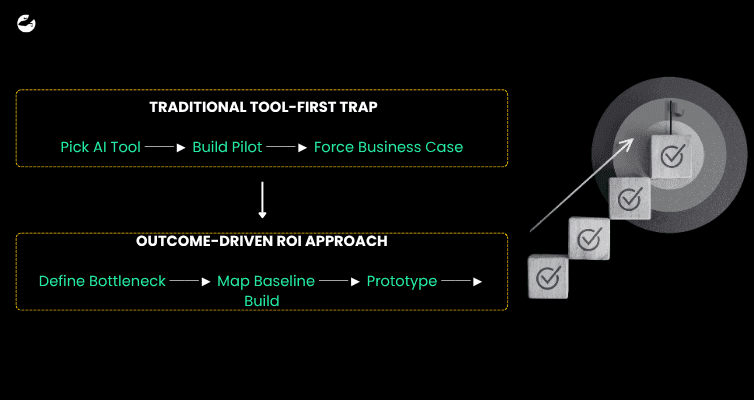
When we work with clients to build high-impact custom software development solutions, we begin by identifying the exact delta your business needs to achieve. A meaningful outcome means making an operational process faster, cheaper, more accurate, or significantly more scalable. If you cannot express the desired change as a concrete business metric, the process is not ready for automation.
We recommend shifting your focus entirely to key performance indicators that matter to leadership. Instead of asking how many prompts your team can run, ask which decision bottleneck slows down revenue generation or inflates operating costs. Starting with clear operational goals ensures that your eventual software implementation delivers measurable economic value from day one.
What Are the Three Structural Forces of a High-Value AI Candidate?
Not all repetitive tasks qualify as strong candidates for automation. We look for workflows that sit directly at the intersection of three operational characteristics: decision density, context richness, and economic asymmetry. Evaluating your processes against these criteria highlights exactly where intelligence adds massive leverage.
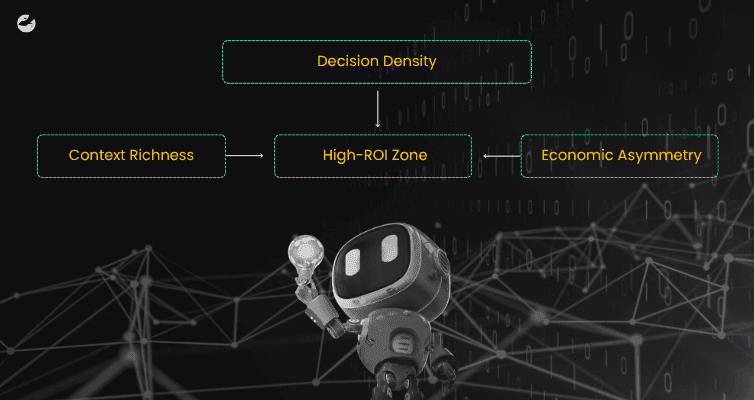
- Decision Density: The specific task requires human judgment applied hundreds or thousands of times per week rather than once per quarter. For example, platforms like Compeasy AI optimize complex evaluation workflows into seamless automated processes.
- Context Richness: Making the correct decision requires synthesizing unstructured data from multiple documents, CRMs, or legacy databases. We helped build Pipeline Pre-Commissioning (PPC) to streamline intricate data management and operations.
- Economic Asymmetry: A small improvement in processing speed or decision accuracy yields massive financial upside or risk reduction.
When highly trained employees spend hours triaging support tickets, summarizing legal contracts, or cross-referencing vendor quotes, they are caught in cognitive choke points. These tasks require human reasoning not because they are visionary, but because your legacy software cannot synthesize scattered context.
If a task follows rigid, deterministic rules without requiring contextual judgment, simple software integration is cheaper and more reliable than artificial intelligence. We reserve intelligence layer integration for complex, context-heavy operational pathways where flexible reasoning delivers outsized productivity gains.
How Do You Calculate Your Pre-AI Baseline Metrics Accurately?
Before writing a single line of code or signing a vendor contract, you must capture the exact cost of your workflow as it runs today. Most failed implementations suffer from missing baseline data, making it impossible to evaluate true business impact after deployment.
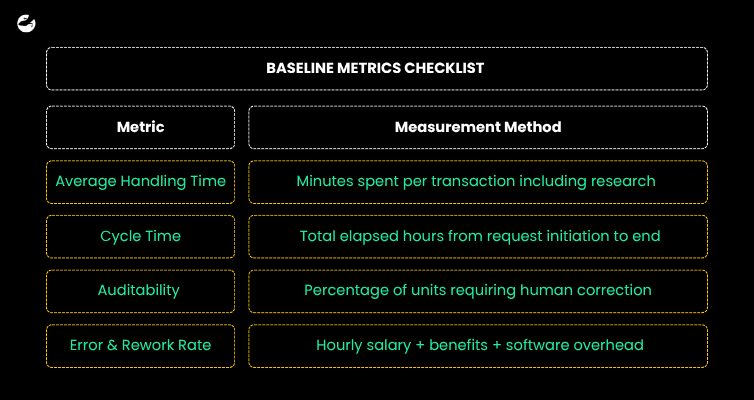
We advise our partners to measure four core data points over a 30-day window: total volume, average handling time, cycle time, and error rates. Multiply the total hours spent on the process by the fully loaded hourly cost of your staff to uncover the true expense of current operations.
Do not forget to account for hidden operational costs such as downstream rework, compliance errors, and missed SLA penalties. Tracking these initial parameters establishes a reliable baseline that proves performance gains once your custom software goes live.
How Can You Validate Workflow Logic Before Writing Any Code?
You do not need a custom AI architecture to test whether an automated workflow will work. We encourage teams to perform low-cost, low-fidelity prototyping using existing tools or manual prompt sandboxes to test business logic first through rapid prototyping.
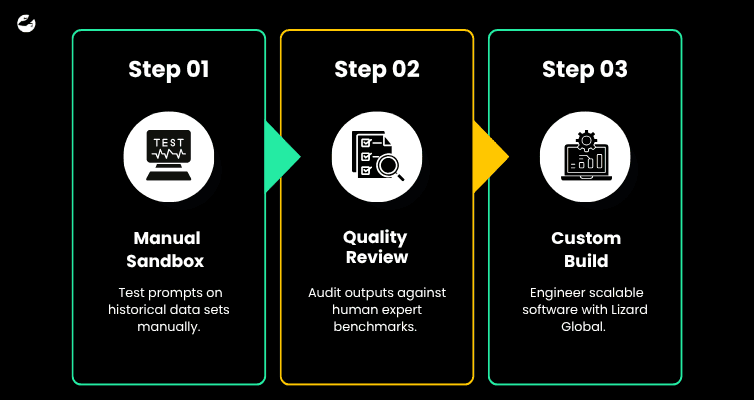
Gather a sample batch of historical inputs, such as complex customer queries, invoice documents, or reporting data. Run these inputs manually through standard models while carefully documenting prompt structures, edge-case failures, and necessary human corrections.
If manual testing shows a high error rate or requires constant human intervention, refining your internal data and process logic is essential before proceeding. Prototyping costs virtually nothing, yet it prevents your organization from building software around flawed workflow assumptions.
How Does Lizard Global Turn Verified Workflows Into Scalable Custom Software?
Once you identify and validate your highest-ROI operational pathway, transition from manual testing to a robust engineering plan. At Lizard Global, we specialize in bridging the gap between early process discovery and full-scale custom software development. We design digital solutions that integrate smoothly into your enterprise architecture, turning validated logic into reliable applications.
Our team brings deep technical expertise in custom software development, mobile app creation, web application architectures, and user-centric UI/UX design. We do not just build isolated algorithms; we craft seamless user interfaces and secure backend API connections that empower your workforce. By combining agile development practices with strict data privacy protocols, we ensure your newly automated workflows scale effectively without creating technical debt or operational security risks.
Our experience across sectors is demonstrated through custom platforms like AvantHealth Cognify in healthcare, Heineken Drinkies in direct-to-consumer delivery, and Narrates AI in smart text processing.
When you work with us, we help you translate initial efficiency gains into long-term competitive advantages. From intuitive admin dashboards to complex cross-platform software systems, we build scalable infrastructure tailored precisely to your strategic business goals.
Ready to Turn Your High-ROI AI Vision Into Custom Software?
Identifying the right workflow is the hardest step, but building a production-ready application requires the right technology partner. We help ambitious enterprises design, build, and deploy custom software solutions that convert operational bottlenecks into measurable revenue drivers.
Contact Lizard Global
today to consult with our digital product experts and start building your custom application!
FAQs
How do enterprises measure baseline ROI for custom software integrations?
What is the biggest mistake companies make when automating internal workflows?
How do we choose between off-the-shelf software and custom app development?
How fast can an enterprise expect positive returns from workflow automation?
How does Lizard Global ensure user adoption for new enterprise applications?
What data security measures are required when building automated enterprise workflows?
Why should we prototype software workflows before full-scale engineering?
similar reads

Case Studies & Interviews
Lereng Tanah: Developing a Direct Booking Platform Malaysian Boutique Villa
29 January 2026

Case Studies & Interviews
Tactlink: How a Malaysian Entrepreneur Turned Networking Chaos into a Digital Community
22 January 2026

Software Development
Who Are the Top Software Development Vendors in Amsterdam for 2026?
26 August 2026
Stuck between a great idea and the right team to build it?Let's talk.
We work with corporate innovation teams and ambitious scale-ups across the Netherlands, Singapore, and Australia, and wherever great software needs to be built. Drop us a message and we'll get back to you within one business day.


Markus Monnikendam
Global Commercial Director
hello@lizard.global