We've Rebuilt How We Build Software. Here's What That Means for You

29 May 2026
by Guido van Beek, CTO & Co-founder
Editor: Nadiy, Senior Content Writer
29 May 2026
by Guido van Beek, CTO & Co-founder
Editor: Nadiy, Senior Content Writer
We've Rebuilt How We Build Software. Here's What That Means for You
Table of contents
Contact us
We will get back to you in the next 48 hours.
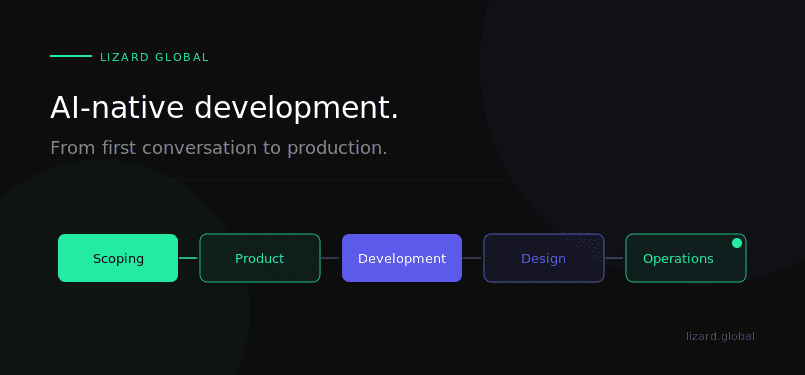
Lizard Global uses a connected system of AI agents across scoping, product, development, design, and operations. Here's how it works and what it means for the companies we build with.
key takeaways
There's a version of AI-assisted development that looks impressive in demos and falls apart in production. You've probably seen it: a team that swapped half their engineers for a ChatGPT subscription, shipped fast for three months, and is now quietly untangling the mess.
That's not what we're doing.
We've spent the last year rebuilding our development process around AI, not as a shortcut, but as a genuine force multiplier. The result is a system where our people move faster, make better decisions earlier in the process, and produce work that's actually maintainable at scale. For the companies we work with, that translates directly into faster time-to-market, lower cost of iteration, and less of the technical debt that tends to haunt growth-stage companies right when they need to move quickly.
What follows is a closer look at how we actually do this. If you're curious about AI in development at a high level, the first few sections cover that. If you want to understand the mechanics (how we've structured AI to work across the full lifecycle of a product) read on.
One AI tool is a shortcut. A system of AI agents is a different thing entirely.
Most teams using AI in development are doing one of two things: asking an AI chatbot to generate code, or using an AI coding assistant inside their editor. Both are useful. Neither is a system.
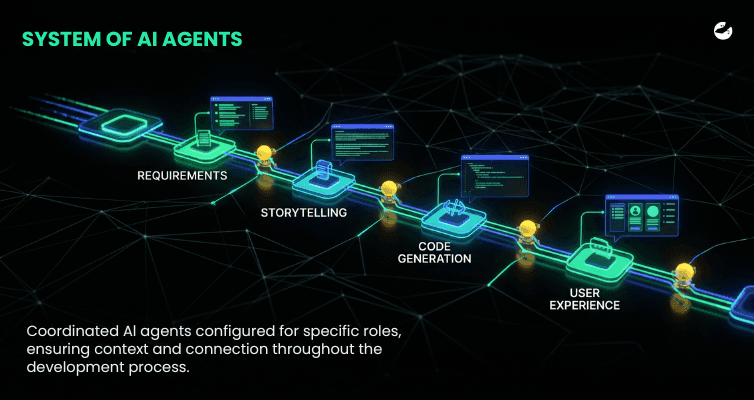
The difference matters because software development isn't a single task. It's a sequence of interdependent tasks performed by people with different roles, different contexts, and different definitions of done. A sales conversation shapes a brief. The brief shapes a set of requirements. Requirements shape stories. Stories shape code. Code shapes what your users actually experience. At every handoff in that chain, information gets lost, assumptions get baked in, and quality gets negotiated away.
What we've built is a set of specialised AI agents that sit at each stage of that chain. Not one AI doing everything, but a coordinated system where each agent is deeply configured for its specific role, with the right context, the right constraints, and the right connection to what came before and what comes next. Think of it less like hiring one very fast intern and more like adding an always-on specialist to every function in your product team.
Here's how that works in practice.
Stage one: Scoping that doesn't lie to you
The most expensive problems in software projects aren't discovered during development. They're discovered at the demo, or after launch, when it turns out the product doesn't actually solve the problem it was built to solve. The cause is almost always the same: assumptions that went unexamined at the start.
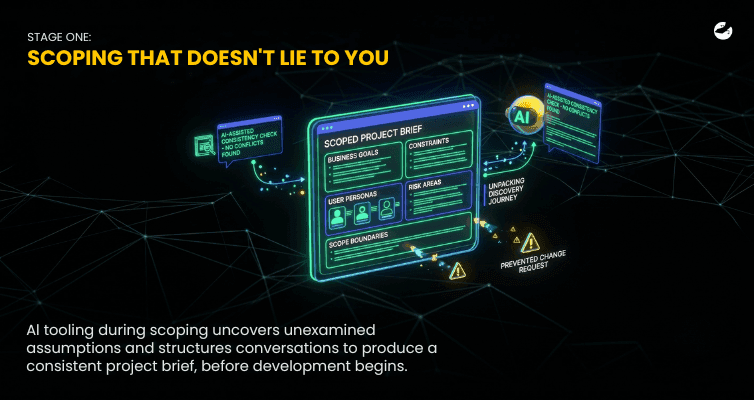
We use AI tooling in the sales and scoping process to address this before a single line of code is written. When we're working through a new engagement, an AI agent helps structure the conversation by building out a project context from the discussion: the business goal, the constraints, the user personas, the risk areas, the scope boundaries. It doesn't replace the conversation. It makes the conversation produce something useful, much like what we run during our dedicated discovery workshops to unpack complex user journeys.
What comes out of that process is a structured project brief that's already been stress-tested for internal consistency. Scope items that would have conflicted three months in get flagged now. Assumptions that would have turned into change requests get surfaced while they're still cheap to resolve. The brief becomes the foundation for everything that follows, and because it was built with AI assistance, it's structured in a way the next stage of AI tooling can actually use.
Stage two: From brief to buildable
The gap between a product brief and a set of developer-ready stories is where a lot of projects quietly go wrong. Product owners know the business logic; developers need technical specificity. Translating between those two worlds, under time pressure, tends to produce stories that are either too vague to build from or so rigidly defined that they don't survive contact with reality.
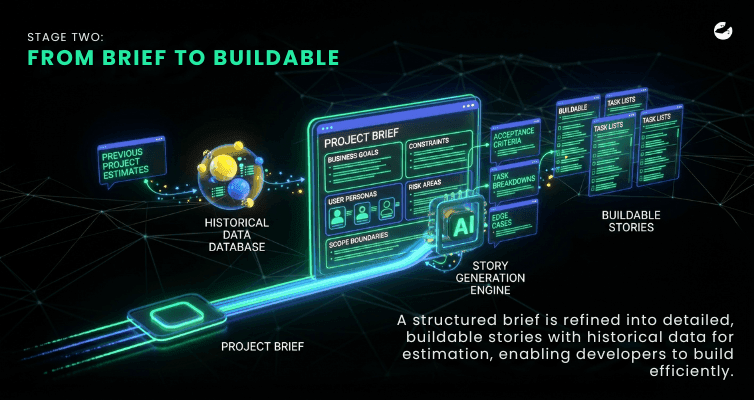
Our product AI agent takes the structured brief from the scoping phase and works with the product owner to generate stories, acceptance criteria, and task breakdowns that are genuinely ready to build. It asks the questions a good senior developer would ask before starting work: What does success look like? What are the edge cases? What dependencies exist? What can be descoped without affecting the core?
Sprint planning, estimation, and prioritisation also benefit from this. The agent draws on historical data from previous projects to help calibrate estimates, something most teams lack the discipline to do manually, and something that makes a real difference to delivery predictability over time. By the time work enters a sprint, it's been reviewed, scoped, and structured by a combination of human expertise and AI rigour. The result is that developers spend less time asking clarifying questions and more time building.
Stage three: Development with context
When developers do write code, they're not working with a generic AI assistant that knows nothing about the product. They're working with an AI agent that has access to the full project context: the architecture decisions, the story being built, the acceptance criteria, the codebase it fits into, the standards the team has agreed to follow.
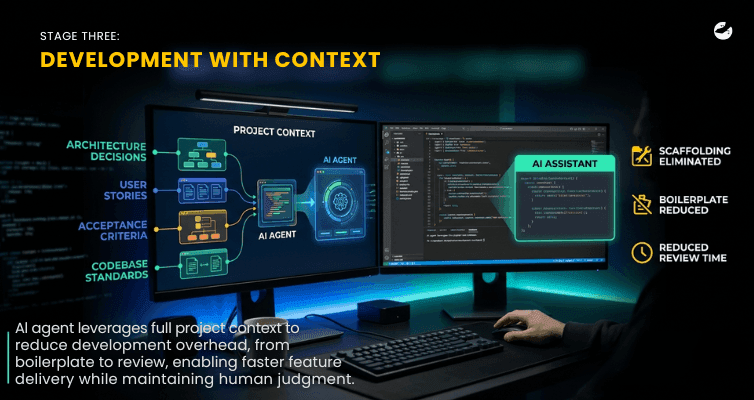
This changes the quality of the output significantly. The agent doesn't just generate code. It generates code that fits. It knows what patterns are already in use. It knows what the product owner asked for. It knows what a senior reviewer is likely to push back on. And because the developer is reviewing and directing that output at every step, the judgment layer stays firmly human.
In practice, this means features that used to take three days can move in one. Not because quality is being traded away, but because the overhead (the searching, the scaffolding, the boilerplate, the back-and-forth between intent and implementation) is handled by the agent. The developer's time goes to architecture, edge cases, and the decisions that actually require experience. We leveraged this balance when building advanced custom ecosystems like Parexus’ Sentry, ensuring high efficiency without losing human oversight.
There's also a review step built into the loop. Before code is marked ready, the AI agent runs a structured review against the original story and the codebase standards, flagging issues the way a good code reviewer would, before it ever reaches a human reviewer. What reaches the review stage is cleaner. What ships are better?
Stage four: Design and development in the same room
One of the most persistent inefficiencies in product development is the handoff between design and engineering. It's not a people problem. Designers and developers generally want the same thing. It's a tooling problem. The design lives in one tool. The code lives in another. Keeping them aligned requires manual effort at every step, and they drift.
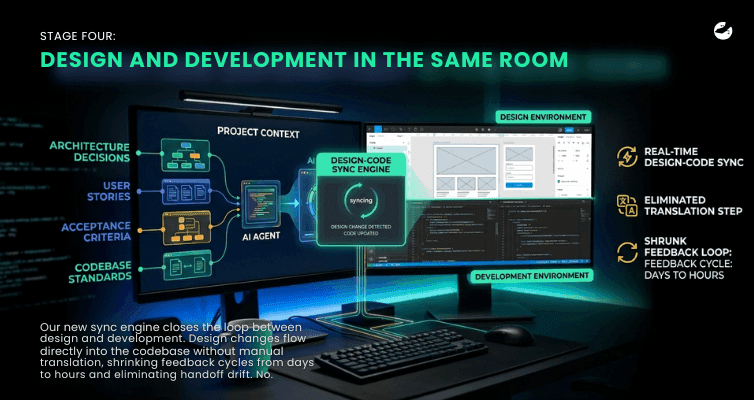
We're closing that loop with tooling that connects the design environment directly to the development environment. When a designer makes a change, that change can flow into the codebase without a translation step. When a developer needs to understand a design decision, the context is available without filing a ticket and waiting. The feedback cycle between what was designed and what was built shrinks from days to hours. This seamless interplay is central to our comprehensive UI design and UX design services, ensuring visual aesthetics mirror functional mechanics perfectly.
The bigger benefit is consistency. Products that go through this loop look and behave the way they were designed to, because the gap where interpretation usually lives has been removed.
Stage five: Operations that don't sleep
Most compliance and operational monitoring is reactive. Something goes wrong; someone investigates; a process gets patched. For companies operating under regulatory frameworks like financial services, healthcare, or any business handling sensitive data, this approach is increasingly inadequate. The standards are tightening, the scrutiny is increasing, and "we didn't know" is no longer a credible answer.
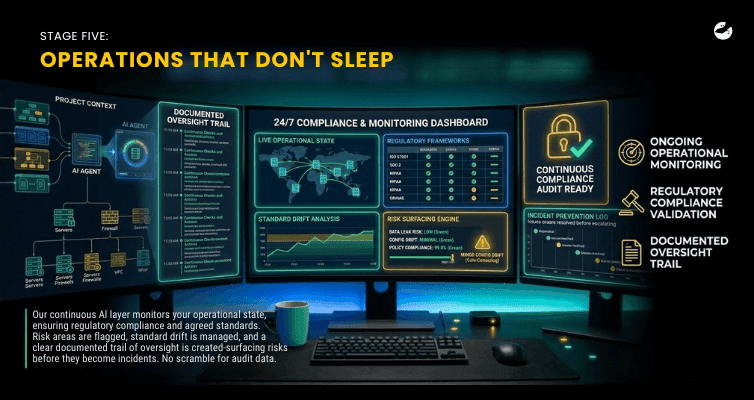
We've built an AI layer that monitors the operational state of the products we build on an ongoing basis, checking against compliance requirements, flagging drift from agreed standards, surfacing risks before they become incidents. It doesn't replace an audit. It means that by the time an audit happens, there's a documented trail of continuous oversight rather than a scramble to reconstruct what happened.
This level of powerful engineering forms the backbone of our security and ISO compliance framework. It is the same mindset we brought to specialized platforms like Aposto and ChatLicense, where user trust, data protection, and operational safety are foundational requirements rather than final checklist items.
For clients in regulated industries, this is no longer a nice-to-have. It's the difference between being audit-ready and being audit-exposed.
How it all connects
What makes this a system rather than a collection of tools is the thread that runs through all of it. The brief from the scoping phase informs the stories in the product phase. The stories inform what the development agent builds and reviews. The design decisions inform what the developer sees in the editor. The operational agent monitors what all of it produces in the field.
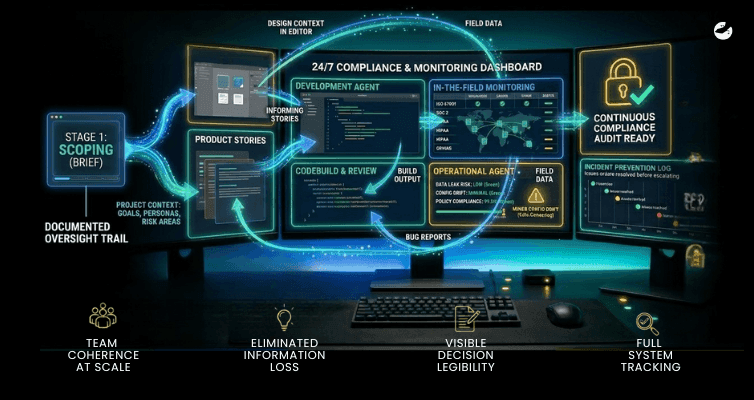
Information that would normally be lost at each handoff is preserved and carried forward. Decisions made early in the process stay legible at every later stage. The left hand knows what the right hand is doing, not because people remembered to communicate it, but because the system tracks it.
This is the key difference between using AI and having an AI-enabled process. A single AI tool makes individuals faster. A connected system makes the whole team more coherent, and coherence, at scale, is where the real gains are.
What this means if you're building something
If you're leading product at a scale-up or running an innovation function inside a larger organisation, the questions you're probably asking are: how do we ship faster without sacrificing quality, and how do we manage cost as the scope grows?
The honest answer is that AI doesn't solve those problems on its own. Most teams that adopt AI tools see a burst of early productivity followed by a plateau, or worse, a quality problem that takes months to surface. The tools are widely available. The system around them is not.
What we've built is that system: a way of working where AI is embedded at every stage of the process, with human expertise at every decision point. It's not a feature we offer. It's how we work.
The result, for the companies we partner with, is development that's measurably faster, more predictable, and easier to maintain as it scales. Fewer surprises late in the project. Better alignment between what was asked for and what gets built. And a team that can move at the pace that funded growth-stage companies actually need.
Stop chasing AI shortcuts. Build with a system that scales.
Most teams use AI to write code faster, only to spend months untangling the technical debt later. At Lizard Global, we’ve rebuilt the entire product lifecycle around a synchronized system of AI agents—meaning you get faster time-to-market, predictable delivery, and enterprise-grade maintainability without sacrificing human oversight.
If you're curious what this could look like for your product, we're happy to walk through it.
👉 Book a Free Scoping Session with Lizard Global
Let’s stress-test your product ideas and map out a build that’s engineered for scale.
Lizard Global uses a connected system of AI agents across scoping, product, development, design, and operations. Here's how it works and what it means for the companies we build with.
There's a version of AI-assisted development that looks impressive in demos and falls apart in production. You've probably seen it: a team that swapped half their engineers for a ChatGPT subscription, shipped fast for three months, and is now quietly untangling the mess.
That's not what we're doing.
We've spent the last year rebuilding our development process around AI, not as a shortcut, but as a genuine force multiplier. The result is a system where our people move faster, make better decisions earlier in the process, and produce work that's actually maintainable at scale. For the companies we work with, that translates directly into faster time-to-market, lower cost of iteration, and less of the technical debt that tends to haunt growth-stage companies right when they need to move quickly.
What follows is a closer look at how we actually do this. If you're curious about AI in development at a high level, the first few sections cover that. If you want to understand the mechanics (how we've structured AI to work across the full lifecycle of a product) read on.
One AI tool is a shortcut. A system of AI agents is a different thing entirely.
Most teams using AI in development are doing one of two things: asking an AI chatbot to generate code, or using an AI coding assistant inside their editor. Both are useful. Neither is a system.
The difference matters because software development isn't a single task. It's a sequence of interdependent tasks performed by people with different roles, different contexts, and different definitions of done. A sales conversation shapes a brief. The brief shapes a set of requirements. Requirements shape stories. Stories shape code. Code shapes what your users actually experience. At every handoff in that chain, information gets lost, assumptions get baked in, and quality gets negotiated away.
What we've built is a set of specialised AI agents that sit at each stage of that chain. Not one AI doing everything, but a coordinated system where each agent is deeply configured for its specific role, with the right context, the right constraints, and the right connection to what came before and what comes next. Think of it less like hiring one very fast intern and more like adding an always-on specialist to every function in your product team.
Here's how that works in practice.
Stage one: Scoping that doesn't lie to you
The most expensive problems in software projects aren't discovered during development. They're discovered at the demo, or after launch, when it turns out the product doesn't actually solve the problem it was built to solve. The cause is almost always the same: assumptions that went unexamined at the start.
We use AI tooling in the sales and scoping process to address this before a single line of code is written. When we're working through a new engagement, an AI agent helps structure the conversation by building out a project context from the discussion: the business goal, the constraints, the user personas, the risk areas, the scope boundaries. It doesn't replace the conversation. It makes the conversation produce something useful, much like what we run during our dedicated discovery workshops to unpack complex user journeys.
What comes out of that process is a structured project brief that's already been stress-tested for internal consistency. Scope items that would have conflicted three months in get flagged now. Assumptions that would have turned into change requests get surfaced while they're still cheap to resolve. The brief becomes the foundation for everything that follows, and because it was built with AI assistance, it's structured in a way the next stage of AI tooling can actually use.
Stage two: From brief to buildable
The gap between a product brief and a set of developer-ready stories is where a lot of projects quietly go wrong. Product owners know the business logic; developers need technical specificity. Translating between those two worlds, under time pressure, tends to produce stories that are either too vague to build from or so rigidly defined that they don't survive contact with reality.
Our product AI agent takes the structured brief from the scoping phase and works with the product owner to generate stories, acceptance criteria, and task breakdowns that are genuinely ready to build. It asks the questions a good senior developer would ask before starting work: What does success look like? What are the edge cases? What dependencies exist? What can be descoped without affecting the core?
Sprint planning, estimation, and prioritisation also benefit from this. The agent draws on historical data from previous projects to help calibrate estimates, something most teams lack the discipline to do manually, and something that makes a real difference to delivery predictability over time. By the time work enters a sprint, it's been reviewed, scoped, and structured by a combination of human expertise and AI rigour. The result is that developers spend less time asking clarifying questions and more time building.
Stage three: Development with context
When developers do write code, they're not working with a generic AI assistant that knows nothing about the product. They're working with an AI agent that has access to the full project context: the architecture decisions, the story being built, the acceptance criteria, the codebase it fits into, the standards the team has agreed to follow.
This changes the quality of the output significantly. The agent doesn't just generate code. It generates code that fits. It knows what patterns are already in use. It knows what the product owner asked for. It knows what a senior reviewer is likely to push back on. And because the developer is reviewing and directing that output at every step, the judgment layer stays firmly human.
In practice, this means features that used to take three days can move in one. Not because quality is being traded away, but because the overhead (the searching, the scaffolding, the boilerplate, the back-and-forth between intent and implementation) is handled by the agent. The developer's time goes to architecture, edge cases, and the decisions that actually require experience. We leveraged this balance when building advanced custom ecosystems like Parexus’ Sentry, ensuring high efficiency without losing human oversight.
There's also a review step built into the loop. Before code is marked ready, the AI agent runs a structured review against the original story and the codebase standards, flagging issues the way a good code reviewer would, before it ever reaches a human reviewer. What reaches the review stage is cleaner. What ships are better?
Stage four: Design and development in the same room
One of the most persistent inefficiencies in product development is the handoff between design and engineering. It's not a people problem. Designers and developers generally want the same thing. It's a tooling problem. The design lives in one tool. The code lives in another. Keeping them aligned requires manual effort at every step, and they drift.
We're closing that loop with tooling that connects the design environment directly to the development environment. When a designer makes a change, that change can flow into the codebase without a translation step. When a developer needs to understand a design decision, the context is available without filing a ticket and waiting. The feedback cycle between what was designed and what was built shrinks from days to hours. This seamless interplay is central to our comprehensive UI design and UX design services, ensuring visual aesthetics mirror functional mechanics perfectly.
The bigger benefit is consistency. Products that go through this loop look and behave the way they were designed to, because the gap where interpretation usually lives has been removed.
Stage five: Operations that don't sleep
Most compliance and operational monitoring is reactive. Something goes wrong; someone investigates; a process gets patched. For companies operating under regulatory frameworks like financial services, healthcare, or any business handling sensitive data, this approach is increasingly inadequate. The standards are tightening, the scrutiny is increasing, and "we didn't know" is no longer a credible answer.
We've built an AI layer that monitors the operational state of the products we build on an ongoing basis, checking against compliance requirements, flagging drift from agreed standards, surfacing risks before they become incidents. It doesn't replace an audit. It means that by the time an audit happens, there's a documented trail of continuous oversight rather than a scramble to reconstruct what happened.
This level of powerful engineering forms the backbone of our security and ISO compliance framework. It is the same mindset we brought to specialized platforms like Aposto and ChatLicense, where user trust, data protection, and operational safety are foundational requirements rather than final checklist items.
For clients in regulated industries, this is no longer a nice-to-have. It's the difference between being audit-ready and being audit-exposed.
How it all connects
What makes this a system rather than a collection of tools is the thread that runs through all of it. The brief from the scoping phase informs the stories in the product phase. The stories inform what the development agent builds and reviews. The design decisions inform what the developer sees in the editor. The operational agent monitors what all of it produces in the field.
Information that would normally be lost at each handoff is preserved and carried forward. Decisions made early in the process stay legible at every later stage. The left hand knows what the right hand is doing, not because people remembered to communicate it, but because the system tracks it.
This is the key difference between using AI and having an AI-enabled process. A single AI tool makes individuals faster. A connected system makes the whole team more coherent, and coherence, at scale, is where the real gains are.
What this means if you're building something
If you're leading product at a scale-up or running an innovation function inside a larger organisation, the questions you're probably asking are: how do we ship faster without sacrificing quality, and how do we manage cost as the scope grows?
The honest answer is that AI doesn't solve those problems on its own. Most teams that adopt AI tools see a burst of early productivity followed by a plateau, or worse, a quality problem that takes months to surface. The tools are widely available. The system around them is not.
What we've built is that system: a way of working where AI is embedded at every stage of the process, with human expertise at every decision point. It's not a feature we offer. It's how we work.
The result, for the companies we partner with, is development that's measurably faster, more predictable, and easier to maintain as it scales. Fewer surprises late in the project. Better alignment between what was asked for and what gets built. And a team that can move at the pace that funded growth-stage companies actually need.
Stop chasing AI shortcuts. Build with a system that scales.
Most teams use AI to write code faster, only to spend months untangling the technical debt later. At Lizard Global, we’ve rebuilt the entire product lifecycle around a synchronized system of AI agents—meaning you get faster time-to-market, predictable delivery, and enterprise-grade maintainability without sacrificing human oversight.
If you're curious what this could look like for your product, we're happy to walk through it.
👉 Book a Free Scoping Session with Lizard Global
Let’s stress-test your product ideas and map out a build that’s engineered for scale.
FAQs
What's the difference between this and just using GitHub Copilot or ChatGPT?
Does working this way mean you use fewer developers?
How do you make sure the AI-generated code is actually good?
Is this approach suitable for regulated industries?
How do you handle security and intellectual property when AI is involved in the build?
What kind of companies benefit most from working this way?
How long does it take to get started on a new project?
similar reads

Case Studies & Interviews
Client Review: Building A Custom Engagement App For MRT Corp
20 August 2026

Case Studies & Interviews
Lereng Tanah: Developing a Direct Booking Platform Malaysian Boutique Villa
29 January 2026

Case Studies & Interviews
Tactlink: How a Malaysian Entrepreneur Turned Networking Chaos into a Digital Community
22 January 2026
Stuck between a great idea and the right team to build it?Let's talk.
We work with corporate innovation teams and ambitious scale-ups across the Netherlands, Singapore, and Australia, and wherever great software needs to be built. Drop us a message and we'll get back to you within one business day.


Markus Monnikendam
Global Commercial Director
hello@lizard.global