Why Low-Cost Development Fails at Scale: Technical Debt, Rewrites & Lost Momentum
20 Mar 2026
by Team Lizard Global
Editor: Nadiy, Senior Content Writer
20 Mar 2026
by Team Lizard Global
Editor: Nadiy, Senior Content Writer
Why Low-Cost Development Fails at Scale: Technical Debt, Rewrites & Lost Momentum
Table of contents
Contact us
We will get back to you in the next 48 hours.

Choosing the lowest-cost development option may reduce upfront spend, but it often increases long-term risk. As businesses scale, hidden compromises in architecture, UX, security, and integrations surface. Performance degrades. Teams slow down. Rewrites become inevitable. This blog explores why low-cost development fails at scale and how technical debt, rushed architecture, and fragmented execution quietly erode momentum. We examine real-world examples from Lizard Global’s portfolio and outline how partnering with a strategic custom software development company ensures sustainable growth. If you are an enterprise or scale-up preparing for regional or global expansion, this guide will help you avoid costly rebuilds and position your product for performance, scalability, and long-term business value.
key takeaways
The digital landscape is littered with the remains of ambitious projects that prioritized low initial costs over long-term viability. For many founders and enterprise leaders, the allure of "affordable" development is strong, promising a quick entry into the market without the heavy upfront investment.
However, this path often leads to a "growth ceiling"—a point where the technical foundations of a product can no longer support its success. Building for scale is not a luxury; it is a fundamental requirement for any business that intends to survive past its first thousand users. When software is treated as a commodity rather than a strategic asset, the hidden costs of technical debt, fragmented user experiences, and integration barriers eventually outweigh the initial savings. At Lizard Global, we believe that the most expensive way to build software is to build it twice.
This guide explores why choosing a strategic partner over a low-cost vendor is the definitive factor in whether your digital product thrives or collapses under the weight of its own growth.
1. The Real Cost of “Affordable” Software Development
At first glance, low-cost development seems practical. Founders want speed. Enterprises want budget control. Procurement teams compare quotes and select the most affordable option. On paper, the decision looks efficient. However, cost and value are not the same thing.
When businesses choose development vendors based primarily on price, they often sacrifice architectural quality, scalability planning, documentation, and long-term maintainability. Initially, the product works. But once user growth accelerates or feature complexity increases, weaknesses surface.
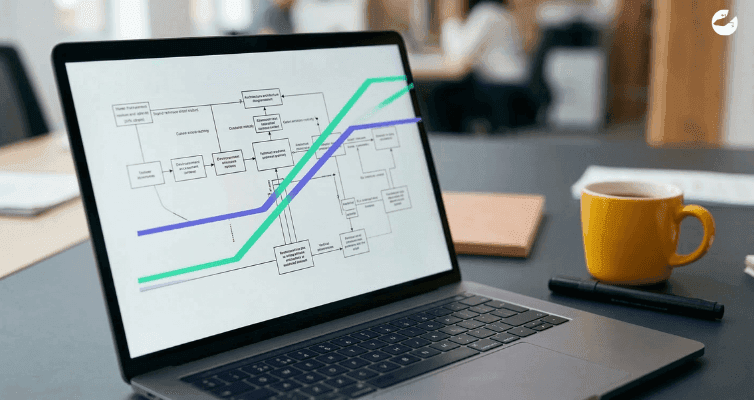
Performance slows. Bugs multiply. New features become harder to implement. In contrast, a strategic custom software development company designs systems for scale from day one.
Architecture decisions consider future integrations, analytics, user growth, and evolving business models. Instead of optimizing for launch alone, they optimize for longevity. The difference becomes painfully clear during growth phases.
2. Technical Debt: The Silent Growth Killer
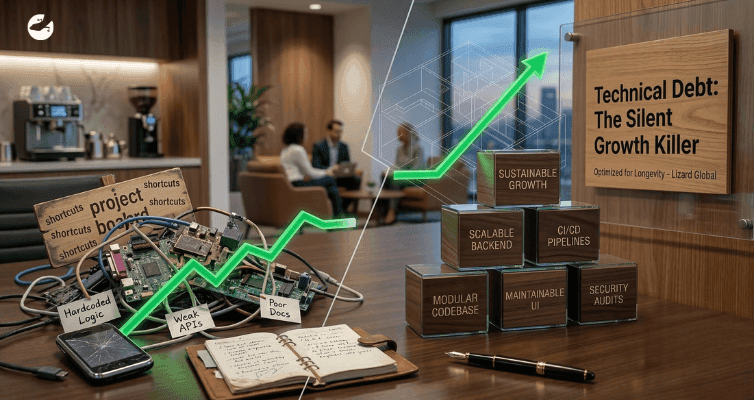
Technical debt is not just messy code. It is the accumulation of shortcuts taken to ship faster or cheaper. These shortcuts may include:
- Hardcoded logic instead of modular architecture
- Poor documentation
- No automated testing
- Inconsistent UI components
- Weak API structures
- Lack of security audits
Initially, none of these appear catastrophic. But as your product scales, every shortcut compounds. For example, in several transformation cases published on Lizard Global’s portfolio, businesses approached Lizard after rapid early growth exposed structural limitations. Their MVP worked. Their marketing worked. But the backend architecture could not support higher user loads or regional expansion.
Take the case of Heineken Drinkies, where migrating to a more robust, data-driven architecture was essential to support their global e-commerce ambitions. Instead of building new features, internal teams spent months fixing foundational issues. That is the true cost of technical debt: lost time, lost innovation, and lost market momentum.
A reliable digital transformation partner prevents this by balancing speed with sustainable engineering practices. They build scalable backend structures, CI/CD pipelines, modular codebases, and maintainable UI systems from the start.
3. Rewrites: When Scaling Becomes Rebuilding
Here is an uncomfortable truth: many “cheap” applications are eventually rewritten. Rewrites are expensive. They require:
- Rebuilding infrastructure
- Migrating databases
- Re-testing entire systems
- Re-educating users
- Freezing innovation during transition
Moreover, rewrites damage morale. Teams feel like they are starting over. This is especially common in mobile products built by underqualified teams. A business might hire a low-cost mobile app development agency to create an MVP.
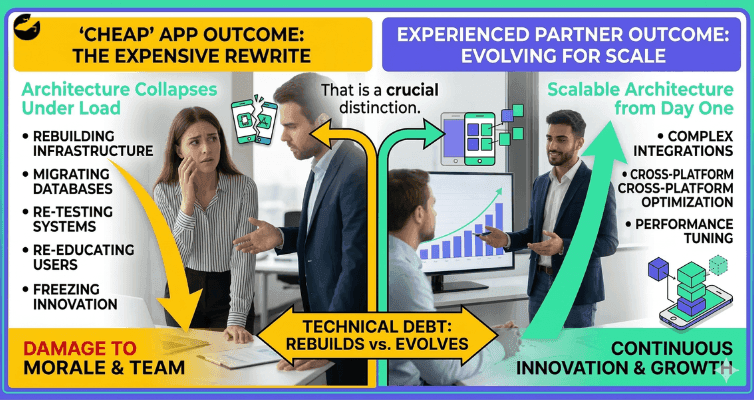
It works for early users. But when the product needs complex integrations, cross-platform optimization, or performance tuning for large audiences, the architecture collapses. At that point, businesses often turn to experienced partners offering professional iOS app development, Android app development, or even strategic hybrid app development with proper scalability frameworks.
The rewrite becomes inevitable. However, when a full-stack digital solutions agency designs the system correctly from the beginning—as seen with Travereel, which utilized user insights to redefine social travel planning—scalability does not require rebuilding. It requires evolving. That is a crucial distinction.
4. Poor UX at Scale: When Users Outgrow the Interface
Low-cost development frequently overlooks strategic UI/UX design services. Designers may copy templates. User research is skipped. Accessibility is ignored. Performance design is not tested under real load conditions. At small scale, friction is tolerable. Early adopters forgive awkward navigation. But at enterprise scale, UX inefficiencies become revenue blockers.
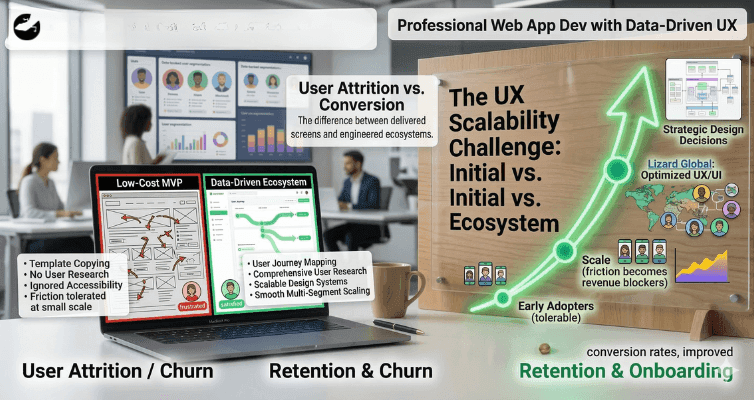
For instance, companies featured in Lizard Global’s blog insights often highlight how optimized UX/UI product design directly improved conversion rates, reduced churn, and supported international growth. Strategic design decisions, backed by data, allowed platforms like Bitewatch to set new standards in nutritional transparency through intuitive interfaces.
Low-cost vendors rarely provide comprehensive user journey mapping or scalable design systems. They deliver screens. Not ecosystems. In contrast, professional web app development services combined with data-driven UX ensure:
- Faster onboarding
- Higher retention
- Better analytics insights
- Scalable design systems
5. Integration Chaos: The Hidden Enterprise Risk
As companies grow, they integrate more tools:
- CRMs
- Payment gateways
- Analytics platforms
- ERP systems
- Marketing automation
- Regional compliance frameworks
Low-cost builds often lack integration foresight. APIs are brittle. Data models are inconsistent. Security standards are minimal. When enterprises later require CRM integration services or advanced analytics pipelines, integration becomes fragile and costly. Instead of seamless expansion, teams face system conflicts.
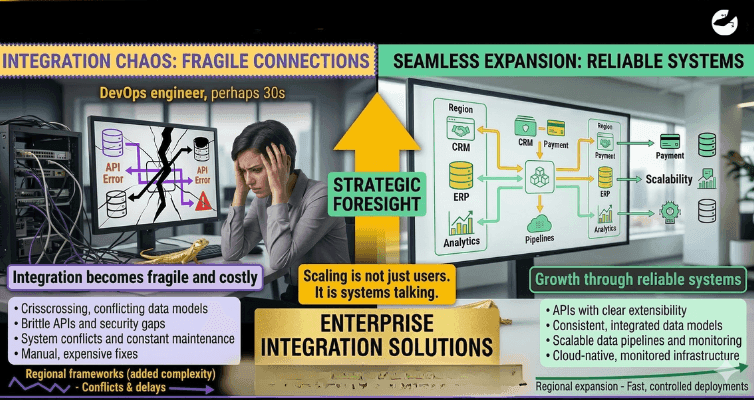
A strategic digital consultancy services provider anticipates integration needs early. They design APIs with extensibility. They consider multi-region deployments. They implement scalable data pipelines and enable growth analytics consulting frameworks, similar to how Iggi turned data into actionable business cases for property management. That difference determines whether expansion feels seamless or chaotic. Scaling is not just about users. It is about systems talking to each other reliably.
6. Lost Momentum: The Most Expensive Consequence
Technical debt and rewrites cost money. But lost momentum costs opportunity. When engineering teams spend months refactoring unstable architecture, competitors launch new features. Markets evolve. Customer expectations rise. Momentum is fragile. Enterprises that invest early in a robust development strategy often move faster long-term.
Why? Because their foundations support experimentation. They can test new features quickly. They can scale infrastructure horizontally. They can expand regionally without rebuilding. A mature web app development services provider designs for adaptability.
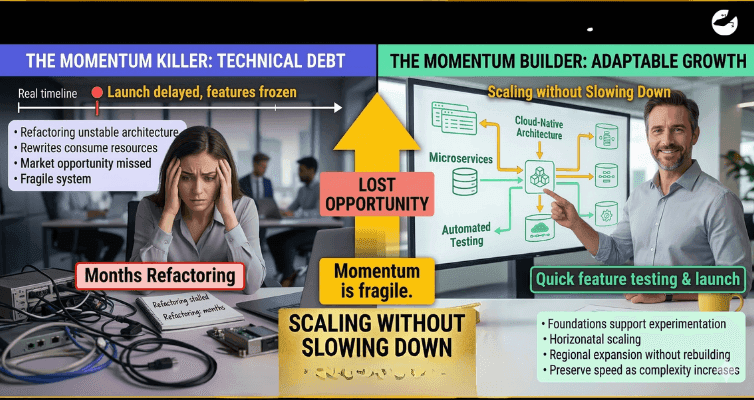
Cloud-native architecture. Automated testing. Microservices. Performance monitoring. These elements preserve speed as complexity increases, a strategy showcased by the digital transformation of Elfi in the Dutch rental market. Businesses that work with a seasoned custom software development company experience something powerful: scaling without slowing down.
7. Security & Compliance: Where Cheap Becomes Dangerous
Low-cost vendors frequently deprioritize security frameworks and compliance audits. For small projects, this may seem harmless. However, once you operate in multiple regions, collect sensitive user data, or integrate enterprise systems, security becomes non-negotiable. Data breaches destroy trust. Compliance violations trigger fines. Investors hesitate. A strategic digital transformation partner embeds security into development pipelines. They implement encrypted data handling, access control structures, infrastructure best practices, and compliance alignment.
This was a critical component in the development of ChatLicense, ensuring internet safety and data protection for younger users. This is particularly important in progressive web app development and cross-platform systems that serve large audiences. Security is not an add-on. It is architecture.
8. Strategic Development as a Competitive Advantage
Now, let us reframe the conversation. The question is not “How cheaply can we build this?” The question is “How sustainably can we scale this?” High-growth organizations treat technology as a strategic asset. They partner with a full-stack digital solutions agency that provides engineering, design, analytics, and strategic digital marketing strategy services alignment.
In several case examples across Lizard Global’s works, such as Strivers Hub, businesses evolved from MVP-stage products to scalable digital ecosystems. Instead of rewriting, they iterated. Instead of patching, they optimized. That consistency created measurable advantages:
- Faster feature cycles
- Better investor confidence
- Improved operational efficiency
- Sustainable regional expansion
- Technology built right becomes a growth engine.
Ready to Build for Scale Instead of Rebuilding Later?
If your organization is planning to scale, expand internationally, or modernize legacy systems, do not let low-cost shortcuts derail your growth. Partner with a proven custom software development company that understands architecture, UX, integration, and long-term digital strategy.

Lizard Global combines engineering excellence, strategic design, and enterprise-focused digital consultancy services to help ambitious companies scale without losing momentum.
Let’s build technology that grows with you. 👉 Contact us today and turn your software into a competitive advantage.
Choosing the lowest-cost development option may reduce upfront spend, but it often increases long-term risk. As businesses scale, hidden compromises in architecture, UX, security, and integrations surface. Performance degrades. Teams slow down. Rewrites become inevitable. This blog explores why low-cost development fails at scale and how technical debt, rushed architecture, and fragmented execution quietly erode momentum. We examine real-world examples from Lizard Global’s portfolio and outline how partnering with a strategic custom software development company ensures sustainable growth. If you are an enterprise or scale-up preparing for regional or global expansion, this guide will help you avoid costly rebuilds and position your product for performance, scalability, and long-term business value.
The digital landscape is littered with the remains of ambitious projects that prioritized low initial costs over long-term viability. For many founders and enterprise leaders, the allure of "affordable" development is strong, promising a quick entry into the market without the heavy upfront investment.
However, this path often leads to a "growth ceiling"—a point where the technical foundations of a product can no longer support its success. Building for scale is not a luxury; it is a fundamental requirement for any business that intends to survive past its first thousand users. When software is treated as a commodity rather than a strategic asset, the hidden costs of technical debt, fragmented user experiences, and integration barriers eventually outweigh the initial savings. At Lizard Global, we believe that the most expensive way to build software is to build it twice.
This guide explores why choosing a strategic partner over a low-cost vendor is the definitive factor in whether your digital product thrives or collapses under the weight of its own growth.
1. The Real Cost of “Affordable” Software Development
At first glance, low-cost development seems practical. Founders want speed. Enterprises want budget control. Procurement teams compare quotes and select the most affordable option. On paper, the decision looks efficient. However, cost and value are not the same thing.
When businesses choose development vendors based primarily on price, they often sacrifice architectural quality, scalability planning, documentation, and long-term maintainability. Initially, the product works. But once user growth accelerates or feature complexity increases, weaknesses surface.
Performance slows. Bugs multiply. New features become harder to implement. In contrast, a strategic custom software development company designs systems for scale from day one.
Architecture decisions consider future integrations, analytics, user growth, and evolving business models. Instead of optimizing for launch alone, they optimize for longevity. The difference becomes painfully clear during growth phases.
2. Technical Debt: The Silent Growth Killer
Technical debt is not just messy code. It is the accumulation of shortcuts taken to ship faster or cheaper. These shortcuts may include:
- Hardcoded logic instead of modular architecture
- Poor documentation
- No automated testing
- Inconsistent UI components
- Weak API structures
- Lack of security audits
Initially, none of these appear catastrophic. But as your product scales, every shortcut compounds. For example, in several transformation cases published on Lizard Global’s portfolio, businesses approached Lizard after rapid early growth exposed structural limitations. Their MVP worked. Their marketing worked. But the backend architecture could not support higher user loads or regional expansion.
Take the case of Heineken Drinkies, where migrating to a more robust, data-driven architecture was essential to support their global e-commerce ambitions. Instead of building new features, internal teams spent months fixing foundational issues. That is the true cost of technical debt: lost time, lost innovation, and lost market momentum.
A reliable digital transformation partner prevents this by balancing speed with sustainable engineering practices. They build scalable backend structures, CI/CD pipelines, modular codebases, and maintainable UI systems from the start.
3. Rewrites: When Scaling Becomes Rebuilding
Here is an uncomfortable truth: many “cheap” applications are eventually rewritten. Rewrites are expensive. They require:
- Rebuilding infrastructure
- Migrating databases
- Re-testing entire systems
- Re-educating users
- Freezing innovation during transition
Moreover, rewrites damage morale. Teams feel like they are starting over. This is especially common in mobile products built by underqualified teams. A business might hire a low-cost mobile app development agency to create an MVP.
It works for early users. But when the product needs complex integrations, cross-platform optimization, or performance tuning for large audiences, the architecture collapses. At that point, businesses often turn to experienced partners offering professional iOS app development, Android app development, or even strategic hybrid app development with proper scalability frameworks.
The rewrite becomes inevitable. However, when a full-stack digital solutions agency designs the system correctly from the beginning—as seen with Travereel, which utilized user insights to redefine social travel planning—scalability does not require rebuilding. It requires evolving. That is a crucial distinction.
4. Poor UX at Scale: When Users Outgrow the Interface
Low-cost development frequently overlooks strategic UI/UX design services. Designers may copy templates. User research is skipped. Accessibility is ignored. Performance design is not tested under real load conditions. At small scale, friction is tolerable. Early adopters forgive awkward navigation. But at enterprise scale, UX inefficiencies become revenue blockers.
For instance, companies featured in Lizard Global’s blog insights often highlight how optimized UX/UI product design directly improved conversion rates, reduced churn, and supported international growth. Strategic design decisions, backed by data, allowed platforms like Bitewatch to set new standards in nutritional transparency through intuitive interfaces.
Low-cost vendors rarely provide comprehensive user journey mapping or scalable design systems. They deliver screens. Not ecosystems. In contrast, professional web app development services combined with data-driven UX ensure:
- Faster onboarding
- Higher retention
- Better analytics insights
- Scalable design systems
5. Integration Chaos: The Hidden Enterprise Risk
As companies grow, they integrate more tools:
- CRMs
- Payment gateways
- Analytics platforms
- ERP systems
- Marketing automation
- Regional compliance frameworks
Low-cost builds often lack integration foresight. APIs are brittle. Data models are inconsistent. Security standards are minimal. When enterprises later require CRM integration services or advanced analytics pipelines, integration becomes fragile and costly. Instead of seamless expansion, teams face system conflicts.
A strategic digital consultancy services provider anticipates integration needs early. They design APIs with extensibility. They consider multi-region deployments. They implement scalable data pipelines and enable growth analytics consulting frameworks, similar to how Iggi turned data into actionable business cases for property management. That difference determines whether expansion feels seamless or chaotic. Scaling is not just about users. It is about systems talking to each other reliably.
6. Lost Momentum: The Most Expensive Consequence
Technical debt and rewrites cost money. But lost momentum costs opportunity. When engineering teams spend months refactoring unstable architecture, competitors launch new features. Markets evolve. Customer expectations rise. Momentum is fragile. Enterprises that invest early in a robust development strategy often move faster long-term.
Why? Because their foundations support experimentation. They can test new features quickly. They can scale infrastructure horizontally. They can expand regionally without rebuilding. A mature web app development services provider designs for adaptability.
Cloud-native architecture. Automated testing. Microservices. Performance monitoring. These elements preserve speed as complexity increases, a strategy showcased by the digital transformation of Elfi in the Dutch rental market. Businesses that work with a seasoned custom software development company experience something powerful: scaling without slowing down.
7. Security & Compliance: Where Cheap Becomes Dangerous
Low-cost vendors frequently deprioritize security frameworks and compliance audits. For small projects, this may seem harmless. However, once you operate in multiple regions, collect sensitive user data, or integrate enterprise systems, security becomes non-negotiable. Data breaches destroy trust. Compliance violations trigger fines. Investors hesitate. A strategic digital transformation partner embeds security into development pipelines. They implement encrypted data handling, access control structures, infrastructure best practices, and compliance alignment.
This was a critical component in the development of ChatLicense, ensuring internet safety and data protection for younger users. This is particularly important in progressive web app development and cross-platform systems that serve large audiences. Security is not an add-on. It is architecture.
8. Strategic Development as a Competitive Advantage
Now, let us reframe the conversation. The question is not “How cheaply can we build this?” The question is “How sustainably can we scale this?” High-growth organizations treat technology as a strategic asset. They partner with a full-stack digital solutions agency that provides engineering, design, analytics, and strategic digital marketing strategy services alignment.
In several case examples across Lizard Global’s works, such as Strivers Hub, businesses evolved from MVP-stage products to scalable digital ecosystems. Instead of rewriting, they iterated. Instead of patching, they optimized. That consistency created measurable advantages:
- Faster feature cycles
- Better investor confidence
- Improved operational efficiency
- Sustainable regional expansion
- Technology built right becomes a growth engine.
Ready to Build for Scale Instead of Rebuilding Later?
If your organization is planning to scale, expand internationally, or modernize legacy systems, do not let low-cost shortcuts derail your growth. Partner with a proven custom software development company that understands architecture, UX, integration, and long-term digital strategy.
Lizard Global combines engineering excellence, strategic design, and enterprise-focused digital consultancy services to help ambitious companies scale without losing momentum.
Let’s build technology that grows with you. 👉 Contact us today and turn your software into a competitive advantage.
FAQs

When should enterprises avoid low-cost development vendors?
How does technical debt impact long-term ROI?
What role does UI/UX play in scalable software products?
Why do many startups eventually rebuild their apps?
How does a digital transformation partner reduce scaling risks?
What should enterprises look for in a custom software development company?
Is progressive web app development suitable for enterprise growth?
similar reads

Case Studies & Interviews
Lereng Tanah: Developing a Direct Booking Platform Malaysian Boutique Villa
29 January 2026

Case Studies & Interviews
Tactlink: How a Malaysian Entrepreneur Turned Networking Chaos into a Digital Community
22 January 2026

Software Development
Best Practices for Developing Secure and Scalable eCommerce Platforms
10 June 2025
Stuck between a great idea and the right team to build it?Let's talk.
We work with corporate innovation teams and ambitious scale-ups across the Netherlands, Singapore, and Australia, and wherever great software needs to be built. Drop us a message and we'll get back to you within one business day.


Markus Monnikendam
Global Commercial Director
hello@lizard.global