Enterprise AI Implementation Services That Deliver Measurable Business Impact
05 May 2026
by Team Lizard Global
Editor: Nadiy, Senior Content Writer
05 May 2026
by Team Lizard Global
Editor: Nadiy, Senior Content Writer
Enterprise AI Implementation Services That Deliver Measurable Business Impact
Table of contents
Contact us
We will get back to you in the next 48 hours.

Enterprise AI is no longer an experimental initiative reserved for innovation labs. Businesses are now investing in AI implementation services that create measurable operational impact, improve decision-making, automate workflows, and unlock scalable growth. From Agentic AI for Enterprise to Autonomous AI Agents and Enterprise AI Orchestration, organizations are shifting toward intelligent systems that can reason, execute, and adapt in real time. This blog explores how enterprise AI implementation services deliver tangible ROI, what separates successful AI transformation from failed experimentation, and why companies need experienced digital transformation partners capable of combining strategy, engineering, UI/UX design services, and scalable software development into one integrated ecosystem.
key takeaways
For years, enterprises treated artificial intelligence as a future-facing innovation initiative. Teams experimented with chatbots, predictive analytics, and automation pilots, but many of these projects failed to move beyond proof-of-concept stages. Today, that landscape has changed dramatically. Businesses now expect AI investments to produce measurable operational improvements, cost efficiencies, and revenue growth.
As a result, organizations are increasingly searching for enterprise AI implementation services that go beyond technical deployment. They want strategic partners capable of integrating AI into real business operations while ensuring scalability, governance, usability, and long-term adaptability. This is where modern digital transformation partners create significant value.
At the same time, the rise of Agentic AI for Enterprise is redefining what intelligent systems can accomplish. Unlike traditional automation tools that rely on rigid rule-based processes, Agentic Workflows allow AI systems to reason, make decisions, coordinate tasks, and adapt dynamically to changing business conditions. These capabilities are creating entirely new operational models across industries.
However, implementing enterprise AI successfully requires more than selecting a model or integrating an API. Organizations need enterprise-grade infrastructure, thoughtful UX/UI product design, governance frameworks, full-stack engineering expertise, and scalable orchestration systems. Without these elements, even promising AI initiatives can struggle to generate real business impact.
Want to find out how much it costs to build your dream app or web app?


What Modern Enterprise AI Implementation Actually Includes
Many organizations still misunderstand what enterprise AI implementation services involve. AI transformation is not simply about adding a chatbot to a website or automating a single workflow. Instead, it requires designing an interconnected digital ecosystem where intelligent systems support business operations at scale.
Modern AI implementation typically combines multiple layers of expertise. This includes AI strategy consulting, data architecture, cloud infrastructure, Enterprise AI Orchestration, custom software development, API integrations, UI/UX design services, mobile experiences, governance frameworks, and analytics infrastructure. Each layer must work together seamlessly.
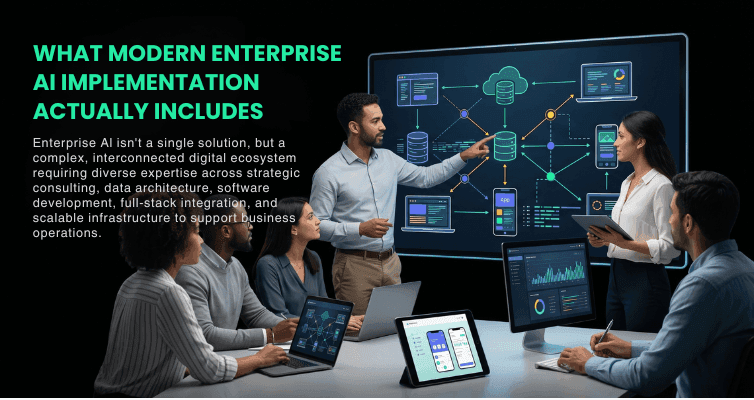
This is why enterprises increasingly prefer working with a full-stack digital solutions agency instead of managing fragmented vendors. A unified implementation approach accelerates deployment while reducing operational complexity and integration risks.
Additionally, AI implementation often extends far beyond desktop systems. Businesses now require AI-powered mobile applications, intelligent web platforms, and integrated digital products that support customers and employees across multiple touchpoints. This creates growing demand for services such as:
- Mobile app development agency support
- Web app development services
- iOS app development
- Android app development
- Hybrid app development
- Progressive web app development
- CRM integration services
- Growth analytics consulting
When these systems are designed cohesively, enterprises can create scalable AI ecosystems that support operational efficiency, customer engagement, and strategic decision-making simultaneously.
The Rise of Agentic AI for Enterprise Operations
One of the most significant developments in enterprise AI is the emergence of Autonomous AI Agents and Agentic Workflows. These systems move beyond simple automation by enabling AI to independently coordinate tasks, make contextual decisions, and execute multi-step processes.
For example, traditional automation might trigger a workflow after receiving a customer inquiry. In contrast, an Autonomous AI Agent can interpret intent, gather contextual information, access multiple business systems, generate responses, escalate when necessary, and continuously optimize outcomes based on previous interactions. This shift is fundamentally changing enterprise operations.
Agentic AI for Enterprise enables organizations to automate increasingly complex business functions while maintaining adaptability and intelligence. These systems can support customer service operations, internal knowledge management, sales enablement, compliance monitoring, operational planning, and supply chain coordination.
However, enterprises must implement these systems carefully. Agentic AI introduces new operational and governance considerations that require thoughtful orchestration and oversight. This is why Enterprise AI Orchestration has become such a critical capability.
Orchestration ensures that AI agents operate within defined business rules, compliance frameworks, and workflow boundaries. It also enables multiple AI systems to collaborate effectively while maintaining visibility and accountability across the organization.
Businesses that implement Agentic Workflows strategically can achieve substantial benefits, including:
- Faster operational execution
- Reduced manual workload
- Improved customer response times
- Better decision consistency
- Scalable digital labor support
- Enhanced organizational agility
For example, Heineken Drinkies demonstrates how data-driven digital ecosystems can improve engagement and operational efficiency at scale. Similarly, Travereel shows how user behavior insights can be transformed into intelligent platform experiences.
As enterprises continue adopting AI Digital Labor strategies, the ability to coordinate and govern intelligent systems will become a major competitive differentiator.
Why Governance and Human Oversight Matter in Enterprise AI
While AI creates enormous operational opportunities, enterprises cannot prioritize automation without considering governance, compliance, and risk management. This becomes especially important when deploying Autonomous AI Agents capable of making semi-independent decisions.
Responsible enterprise AI implementation requires robust AI Guardrails, monitoring systems, and Human-in-the-Loop (HITL) frameworks. These mechanisms ensure that AI outputs remain aligned with organizational standards, compliance requirements, and ethical expectations.
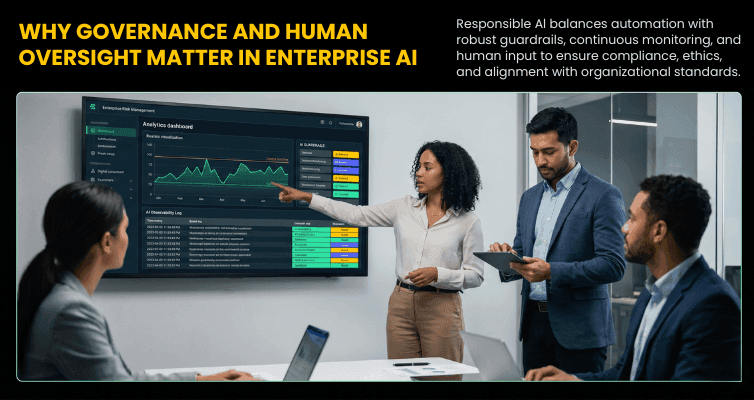
For example, enterprises operating in healthcare, finance, logistics, or enterprise SaaS environments often require detailed auditability. In these cases, AI Observability & Audit Logs become essential components of AI architecture. Additionally, businesses increasingly need Agentic Governance & Compliance frameworks that define how AI agents interact with sensitive systems and business-critical operations.
A strong real-world example is ContractChain, which demonstrates how secure digital workflows require strong governance and traceability across systems. Similarly, Chatlicense highlights the importance of responsible AI usage in sensitive digital environments.
Experienced digital consultancy services providers understand how to balance innovation with operational reliability. They help enterprises design AI ecosystems that remain scalable, secure, and compliant without limiting business agility.
Why UX, Product Design, and Human Experience Still Matter
One of the biggest mistakes enterprises make during AI implementation is focusing entirely on technical capability while neglecting user experience. However, AI systems only generate value when employees and customers can interact with them effectively.
This is why UX/UI product design plays such a critical role in enterprise AI transformation. Strong UI/UX design services ensure that AI capabilities remain accessible, understandable, and useful across the organization.
A strong example is Bitewatch, which demonstrates how design and data can combine to improve transparency and user engagement.
Another example is My New Behavior, which shows how behavioral design and product experience can drive meaningful user adoption and long-term engagement.
At the same time, AI implementation should support broader digital transformation goals. Organizations that integrate AI into scalable product ecosystems create stronger competitive advantages than businesses deploying isolated AI features.
Companies like Lizard Global stand out in this area because they combine strategy, design, software engineering, AI implementation, and product development into a unified transformation process.
Building Enterprise AI Systems That Scale Long-Term
Successful AI implementation is not about launching quickly. It is about building systems capable of scaling sustainably over time.
Scalable enterprise AI requires strong architectural foundations, including cloud-native infrastructure, modular system design, API interoperability, secure data pipelines, analytics frameworks, and orchestration capabilities.
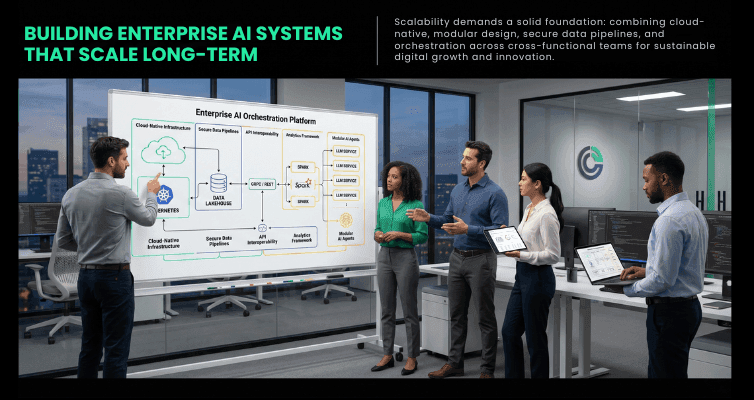
For example, Afflink demonstrates scalable platform architecture supporting growth-driven ecosystems. Similarly, Saleduck highlights how data-driven personalization and scalable systems drive long-term digital growth.
Long-term AI scalability also depends on cross-functional collaboration. Strategy teams, engineers, designers, operations leaders, and business stakeholders must align around shared objectives.
Organizations that approach AI as a long-term operational capability rather than a standalone project are far more likely to achieve sustainable competitive advantages.
The Strategic Advantage of Working With an Experienced AI Partner
As enterprise AI ecosystems become more sophisticated, implementation complexity increases significantly. Businesses no longer need isolated developers or disconnected vendors. They need strategic implementation partners capable of delivering end-to-end digital transformation. An experienced full-stack digital solutions agency brings together multiple disciplines under one operational framework, including AI strategy, custom software development, UX/UI design, cloud infrastructure, and orchestration systems. A strong example of large-scale ecosystem delivery is Globiz, which demonstrates how integrated platforms can be successfully delivered across complex operational environments.
The Future of Enterprise AI Will Be Operational, Autonomous, and Human-Centered
Enterprise AI is entering a new phase. Businesses are moving beyond isolated tools toward interconnected intelligent ecosystems powered by Agentic Workflows, Autonomous AI Agents, and Enterprise AI Orchestration.
In the coming years, AI will increasingly function as operational infrastructure rather than standalone software. Organizations will rely on AI Digital Labor to support decision-making, workflow execution, customer engagement, and business optimization across departments.
However, the enterprises that succeed will not necessarily be the ones adopting AI the fastest. Instead, success will belong to organizations that implement AI strategically, responsibly, and with long-term scalability in mind.
Let’s Turn AI Into Measurable Business Growth
Enterprise AI success requires more than experimentation. It requires the right strategy, scalable architecture, intelligent orchestration, and a partner capable of aligning AI innovation with real business outcomes.
Whether you are exploring Agentic AI for Enterprise, implementing Autonomous AI Agents, modernizing internal workflows, or building AI-powered digital products, Lizard Global can help you design and scale solutions that create measurable operational impact.

👉 Let’s build something impactful together. Get in touch with Lizard Global to start your digital transformation journey today.
Enterprise AI is no longer an experimental initiative reserved for innovation labs. Businesses are now investing in AI implementation services that create measurable operational impact, improve decision-making, automate workflows, and unlock scalable growth. From Agentic AI for Enterprise to Autonomous AI Agents and Enterprise AI Orchestration, organizations are shifting toward intelligent systems that can reason, execute, and adapt in real time. This blog explores how enterprise AI implementation services deliver tangible ROI, what separates successful AI transformation from failed experimentation, and why companies need experienced digital transformation partners capable of combining strategy, engineering, UI/UX design services, and scalable software development into one integrated ecosystem.
For years, enterprises treated artificial intelligence as a future-facing innovation initiative. Teams experimented with chatbots, predictive analytics, and automation pilots, but many of these projects failed to move beyond proof-of-concept stages. Today, that landscape has changed dramatically. Businesses now expect AI investments to produce measurable operational improvements, cost efficiencies, and revenue growth.
As a result, organizations are increasingly searching for enterprise AI implementation services that go beyond technical deployment. They want strategic partners capable of integrating AI into real business operations while ensuring scalability, governance, usability, and long-term adaptability. This is where modern digital transformation partners create significant value.
At the same time, the rise of Agentic AI for Enterprise is redefining what intelligent systems can accomplish. Unlike traditional automation tools that rely on rigid rule-based processes, Agentic Workflows allow AI systems to reason, make decisions, coordinate tasks, and adapt dynamically to changing business conditions. These capabilities are creating entirely new operational models across industries.
However, implementing enterprise AI successfully requires more than selecting a model or integrating an API. Organizations need enterprise-grade infrastructure, thoughtful UX/UI product design, governance frameworks, full-stack engineering expertise, and scalable orchestration systems. Without these elements, even promising AI initiatives can struggle to generate real business impact.
Want to find out how much it costs to build your dream app or web app?
What Modern Enterprise AI Implementation Actually Includes
Many organizations still misunderstand what enterprise AI implementation services involve. AI transformation is not simply about adding a chatbot to a website or automating a single workflow. Instead, it requires designing an interconnected digital ecosystem where intelligent systems support business operations at scale.
Modern AI implementation typically combines multiple layers of expertise. This includes AI strategy consulting, data architecture, cloud infrastructure, Enterprise AI Orchestration, custom software development, API integrations, UI/UX design services, mobile experiences, governance frameworks, and analytics infrastructure. Each layer must work together seamlessly.
This is why enterprises increasingly prefer working with a full-stack digital solutions agency instead of managing fragmented vendors. A unified implementation approach accelerates deployment while reducing operational complexity and integration risks.
Additionally, AI implementation often extends far beyond desktop systems. Businesses now require AI-powered mobile applications, intelligent web platforms, and integrated digital products that support customers and employees across multiple touchpoints. This creates growing demand for services such as:
- Mobile app development agency support
- Web app development services
- iOS app development
- Android app development
- Hybrid app development
- Progressive web app development
- CRM integration services
- Growth analytics consulting
When these systems are designed cohesively, enterprises can create scalable AI ecosystems that support operational efficiency, customer engagement, and strategic decision-making simultaneously.
The Rise of Agentic AI for Enterprise Operations
One of the most significant developments in enterprise AI is the emergence of Autonomous AI Agents and Agentic Workflows. These systems move beyond simple automation by enabling AI to independently coordinate tasks, make contextual decisions, and execute multi-step processes.
For example, traditional automation might trigger a workflow after receiving a customer inquiry. In contrast, an Autonomous AI Agent can interpret intent, gather contextual information, access multiple business systems, generate responses, escalate when necessary, and continuously optimize outcomes based on previous interactions. This shift is fundamentally changing enterprise operations.
Agentic AI for Enterprise enables organizations to automate increasingly complex business functions while maintaining adaptability and intelligence. These systems can support customer service operations, internal knowledge management, sales enablement, compliance monitoring, operational planning, and supply chain coordination.
However, enterprises must implement these systems carefully. Agentic AI introduces new operational and governance considerations that require thoughtful orchestration and oversight. This is why Enterprise AI Orchestration has become such a critical capability.
Orchestration ensures that AI agents operate within defined business rules, compliance frameworks, and workflow boundaries. It also enables multiple AI systems to collaborate effectively while maintaining visibility and accountability across the organization.
Businesses that implement Agentic Workflows strategically can achieve substantial benefits, including:
- Faster operational execution
- Reduced manual workload
- Improved customer response times
- Better decision consistency
- Scalable digital labor support
- Enhanced organizational agility
For example, Heineken Drinkies demonstrates how data-driven digital ecosystems can improve engagement and operational efficiency at scale. Similarly, Travereel shows how user behavior insights can be transformed into intelligent platform experiences.
As enterprises continue adopting AI Digital Labor strategies, the ability to coordinate and govern intelligent systems will become a major competitive differentiator.
Why Governance and Human Oversight Matter in Enterprise AI
While AI creates enormous operational opportunities, enterprises cannot prioritize automation without considering governance, compliance, and risk management. This becomes especially important when deploying Autonomous AI Agents capable of making semi-independent decisions.
Responsible enterprise AI implementation requires robust AI Guardrails, monitoring systems, and Human-in-the-Loop (HITL) frameworks. These mechanisms ensure that AI outputs remain aligned with organizational standards, compliance requirements, and ethical expectations.
For example, enterprises operating in healthcare, finance, logistics, or enterprise SaaS environments often require detailed auditability. In these cases, AI Observability & Audit Logs become essential components of AI architecture. Additionally, businesses increasingly need Agentic Governance & Compliance frameworks that define how AI agents interact with sensitive systems and business-critical operations.
A strong real-world example is ContractChain, which demonstrates how secure digital workflows require strong governance and traceability across systems. Similarly, Chatlicense highlights the importance of responsible AI usage in sensitive digital environments.
Experienced digital consultancy services providers understand how to balance innovation with operational reliability. They help enterprises design AI ecosystems that remain scalable, secure, and compliant without limiting business agility.
Why UX, Product Design, and Human Experience Still Matter
One of the biggest mistakes enterprises make during AI implementation is focusing entirely on technical capability while neglecting user experience. However, AI systems only generate value when employees and customers can interact with them effectively.
This is why UX/UI product design plays such a critical role in enterprise AI transformation. Strong UI/UX design services ensure that AI capabilities remain accessible, understandable, and useful across the organization.
A strong example is Bitewatch, which demonstrates how design and data can combine to improve transparency and user engagement.
Another example is My New Behavior, which shows how behavioral design and product experience can drive meaningful user adoption and long-term engagement.
At the same time, AI implementation should support broader digital transformation goals. Organizations that integrate AI into scalable product ecosystems create stronger competitive advantages than businesses deploying isolated AI features.
Companies like Lizard Global stand out in this area because they combine strategy, design, software engineering, AI implementation, and product development into a unified transformation process.
Building Enterprise AI Systems That Scale Long-Term
Successful AI implementation is not about launching quickly. It is about building systems capable of scaling sustainably over time.
Scalable enterprise AI requires strong architectural foundations, including cloud-native infrastructure, modular system design, API interoperability, secure data pipelines, analytics frameworks, and orchestration capabilities.
For example, Afflink demonstrates scalable platform architecture supporting growth-driven ecosystems. Similarly, Saleduck highlights how data-driven personalization and scalable systems drive long-term digital growth.
Long-term AI scalability also depends on cross-functional collaboration. Strategy teams, engineers, designers, operations leaders, and business stakeholders must align around shared objectives.
Organizations that approach AI as a long-term operational capability rather than a standalone project are far more likely to achieve sustainable competitive advantages.
The Strategic Advantage of Working With an Experienced AI Partner
As enterprise AI ecosystems become more sophisticated, implementation complexity increases significantly. Businesses no longer need isolated developers or disconnected vendors. They need strategic implementation partners capable of delivering end-to-end digital transformation. An experienced full-stack digital solutions agency brings together multiple disciplines under one operational framework, including AI strategy, custom software development, UX/UI design, cloud infrastructure, and orchestration systems. A strong example of large-scale ecosystem delivery is Globiz, which demonstrates how integrated platforms can be successfully delivered across complex operational environments.
The Future of Enterprise AI Will Be Operational, Autonomous, and Human-Centered
Enterprise AI is entering a new phase. Businesses are moving beyond isolated tools toward interconnected intelligent ecosystems powered by Agentic Workflows, Autonomous AI Agents, and Enterprise AI Orchestration.
In the coming years, AI will increasingly function as operational infrastructure rather than standalone software. Organizations will rely on AI Digital Labor to support decision-making, workflow execution, customer engagement, and business optimization across departments.
However, the enterprises that succeed will not necessarily be the ones adopting AI the fastest. Instead, success will belong to organizations that implement AI strategically, responsibly, and with long-term scalability in mind.
Let’s Turn AI Into Measurable Business Growth
Enterprise AI success requires more than experimentation. It requires the right strategy, scalable architecture, intelligent orchestration, and a partner capable of aligning AI innovation with real business outcomes.
Whether you are exploring Agentic AI for Enterprise, implementing Autonomous AI Agents, modernizing internal workflows, or building AI-powered digital products, Lizard Global can help you design and scale solutions that create measurable operational impact.
👉 Let’s build something impactful together. Get in touch with Lizard Global to start your digital transformation journey today.
FAQs

What are enterprise AI implementation services?
How does Agentic AI differ from traditional AI automation?
Why is Enterprise AI Orchestration important?
What industries benefit most from Autonomous AI Agents?
What role does Human-in-the-Loop (HITL) play in enterprise AI?
How do AI Guardrails improve enterprise AI reliability?
Why should enterprises work with a full-stack digital transformation partner for AI implementation?
similar reads

Case Studies & Interviews
Travereel: How a Digital Travel Experience Platform Demonstrates the Power of Strategic AI Product Development
7 May 2026

AI & Machine Learning
Enterprise Digital Transformation Services Powered by AI Integration
15 June 2026

Company Culture & Milestones
Lizard Global Thrilled to be Named Among Top Healthcare Software Development Companies in 2024 by Techreviewer.co
22 August 2024
Stuck between a great idea and the right team to build it?Let's talk.
We work with corporate innovation teams and ambitious scale-ups across the Netherlands, Singapore, and Australia, and wherever great software needs to be built. Drop us a message and we'll get back to you within one business day.


Markus Monnikendam
Global Commercial Director
hello@lizard.global