Retrieval-Augmented Generation (RAG): An Executive Guide to AI Accuracy

07 Aug 2026
by Nadiy, Senior Content Writer
07 Aug 2026
by Nadiy, Senior Content Writer
Retrieval-Augmented Generation (RAG): An Executive Guide to AI Accuracy
Table of contents
Contact us
We will get back to you in the next 48 hours.

Artificial Intelligence offers massive potential for the enterprise, but traditional Generative AI models struggle with accuracy, often presenting false information as fact. For C-suite leaders and non-technical executives, this unpredictability poses a significant risk to operational efficiency, compliance, and brand reputation. Retrieval-Augmented Generation (RAG) solves this fundamental flaw by anchoring AI models directly to your company's proprietary databases and internal document repositories. Instead of relying solely on static training data, RAG retrieves precise real-time information before generating responses, virtually eliminating hallucinations. In this article, we explain how RAG architecture works, why it transforms business decision-making, and how custom software development enables seamless enterprise integration to unlock secure, dependable AI capabilities.
key takeaways
Retrieval-Augmented Generation (RAG) is an enterprise AI architecture that combines standard large language models (LLMs) with real-time access to your organization's proprietary database. Standard AI models rely entirely on information gathered during their initial training phase, which means they often guess or fabricate answers when asked about internal company information.
RAG fixes this fundamental flaw by retrieving exact facts from your internal documents first and instructing the AI to generate responses using only those retrieved facts. By anchoring the generative model directly to verified company documents, RAG eliminates AI hallucinations, ensures strict data privacy, and turns unpredictable language models into dependable engines for enterprise business intelligence.
Why Do Traditional Generative AI Models Suffer From Hallucinations?
Traditional generative models operate as massive pattern recognition engines rather than factual lookup tools. When your teams interact with a standard large language model, the software calculates statistical probabilities to predict the next logical word in a sentence. The model does not check facts, verify source accuracy, or cross-reference internal company rules. When the system encounters a gap in its knowledge base, it fills that void with plausible sounding statements. In the software industry, we refer to these confident errors as hallucinations. For executives managing operational risk, relying on an ungrounded model creates massive compliance and financial hazards.
We often compare standard language models to exceptionally smart interns who possess a photographic memory of public internet text up to a certain date, but zero familiarity with your private company policies. If you ask that intern to write a report on your proprietary pricing structure, the intern will draft a polished document using general industry assumptions instead of your real numbers. The draft looks convincing, yet the underlying figures are entirely made up. Unassisted LLMs function in this exact manner, making them inherently risky for mission-critical enterprise workflows where precision remains non-negotiable.
How Does RAG Architecture Anchor AI Outputs to Real Enterprise Data?
Retrieval-Augmented Generation solves the reliability problem by adding a dynamic search mechanism directly in front of the generative language model. Before the AI writes a single word, the system converts your incoming prompt into a secure query, searches your connected internal databases, and fetches the most relevant document snippets. The architecture then passes these retrieved facts along with your original question to the language model. We essentially tell the model to analyze the provided source material and summarize the exact answer. The generative model shifts from guessing from memory to open-book processing.
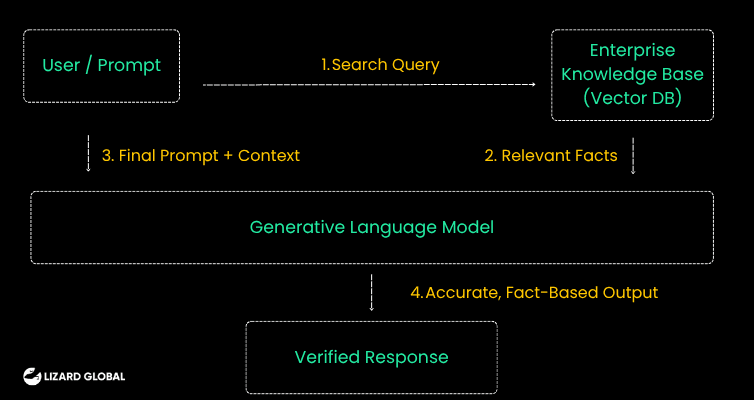
At Lizard Global, we engineer custom software solutions that integrate this multi-step process seamlessly into your existing technical ecosystem. Our team structures your unstructured files, such as PDFs, spreadsheets, and internal wikis, into optimized mathematical formats called vector embeddings. When an employee asks a question, our custom retrieval layer pulls precise source text in milliseconds. By building secure technical pipelines between your database and the AI model, we ensure that every generated answer traces directly back to your company records.
Why Do Hallucinations Stop Mattering in Enterprise RAG Implementations?
Hallucinations stop mattering because RAG shifts the AI's role from raw information retrieval to pure language synthesis. When we restrict the language model to process only the verified documents provided during the search phase, we remove its need to memorize or extrapolate facts. If the exact answer does not exist within your internal records, the system explicitly states that the information is unavailable rather than fabricating a response. This simple architectural boundary converts an unpredictable creative tool into a deterministic, enterprise-grade asset.
This structural change completely alters how C-suite leaders evaluate operational risk. You no longer need to worry about AI tools providing inaccurate policy advice to staff or hallucinating false terms in contract reviews. Every generated output includes precise digital citations pointing directly to the original source files within your database. Your management team can instantly audit and verify the reasoning behind every automated response, ensuring complete transparency across all internal departments.
How Does Custom RAG Integration Protect Proprietary Business Knowledge?
Data security represents a primary concern for executive leadership when evaluating new artificial intelligence initiatives. Publicly available AI platforms often retain user inputs to train future iterations of their base models, inadvertently exposing corporate intellectual property. RAG architecture mitigates this threat by keeping your proprietary information completely isolated within your private cloud environment or local database infrastructure. The external language model only processes temporary, encrypted contextual snippets required to complete the immediate task.
We design robust custom digital architectures that keep your core business assets fully protected while leveraging cutting-edge machine learning tools. Through careful API management and custom enterprise integration, we ensure your confidential financial records, client records, and technical specs remain strictly within your security perimeter. Our engineering team builds explicit access controls into the retrieval layer, meaning the system only retrieves documents that the individual user possesses permission to view. This approach aligns with our dedicated security and ISO compliance protocols to ensure complete data integrity.
What Commercial Value Does RAG Deliver to Your Organization?
Deploying a custom Retrieval-Augmented Generation framework yields immediate productivity gains across every department in your business. Your team members waste countless hours searching through scattered drives, legacy software systems, and complex policy manuals to locate specific information. RAG condenses these complex internal searches into instant, accurate answers that cite original source files. By streamlining internal knowledge distribution, your executive team accelerates decision-making timelines and eliminates structural operational bottlenecks.
Beyond internal efficiency, RAG drastically reduces the long-term technical costs associated with advanced AI adoption. Fine-tuning a custom language model from scratch requires hundreds of thousands of dollars in computational infrastructure, specialized talent, and continuous maintenance. RAG achieves superior accuracy at a fraction of the cost by pairing flexible, off-the-shelf language models with your existing, updating database. You gain a scalable, intelligent digital assistant that updates automatically whenever your team edits an internal document. Discover more about our approach in our guide to custom software development as a strategic advantage or read our breakdown on AI integration strategies.
Transform Your Enterprise Data into Actionable Intelligence
Navigating the complex landscape of enterprise artificial intelligence requires a technical partner who understands scalable architecture, robust data security, and real business outcomes. At Lizard Global, we specialize in building custom software, cross-platform applications, and advanced digital solutions through rigorous discovery workshops and digital strategy consultancy that turn complex technical challenges into competitive advantages. Explore our full range of completed case studies on our Works page to see how we help global businesses innovate across the AI industry space and beyond.

Whether you need to integrate Retrieval-Augmented Generation into your legacy systems or develop a custom digital product from scratch, our team provides end-to-end expertise every step of the way. Contact us today to schedule a strategic consultation and discover how we can elevate your organization's digital capabilities.
Artificial Intelligence offers massive potential for the enterprise, but traditional Generative AI models struggle with accuracy, often presenting false information as fact. For C-suite leaders and non-technical executives, this unpredictability poses a significant risk to operational efficiency, compliance, and brand reputation. Retrieval-Augmented Generation (RAG) solves this fundamental flaw by anchoring AI models directly to your company's proprietary databases and internal document repositories. Instead of relying solely on static training data, RAG retrieves precise real-time information before generating responses, virtually eliminating hallucinations. In this article, we explain how RAG architecture works, why it transforms business decision-making, and how custom software development enables seamless enterprise integration to unlock secure, dependable AI capabilities.
Retrieval-Augmented Generation (RAG) is an enterprise AI architecture that combines standard large language models (LLMs) with real-time access to your organization's proprietary database. Standard AI models rely entirely on information gathered during their initial training phase, which means they often guess or fabricate answers when asked about internal company information.
RAG fixes this fundamental flaw by retrieving exact facts from your internal documents first and instructing the AI to generate responses using only those retrieved facts. By anchoring the generative model directly to verified company documents, RAG eliminates AI hallucinations, ensures strict data privacy, and turns unpredictable language models into dependable engines for enterprise business intelligence.
Why Do Traditional Generative AI Models Suffer From Hallucinations?
Traditional generative models operate as massive pattern recognition engines rather than factual lookup tools. When your teams interact with a standard large language model, the software calculates statistical probabilities to predict the next logical word in a sentence. The model does not check facts, verify source accuracy, or cross-reference internal company rules. When the system encounters a gap in its knowledge base, it fills that void with plausible sounding statements. In the software industry, we refer to these confident errors as hallucinations. For executives managing operational risk, relying on an ungrounded model creates massive compliance and financial hazards.
We often compare standard language models to exceptionally smart interns who possess a photographic memory of public internet text up to a certain date, but zero familiarity with your private company policies. If you ask that intern to write a report on your proprietary pricing structure, the intern will draft a polished document using general industry assumptions instead of your real numbers. The draft looks convincing, yet the underlying figures are entirely made up. Unassisted LLMs function in this exact manner, making them inherently risky for mission-critical enterprise workflows where precision remains non-negotiable.
How Does RAG Architecture Anchor AI Outputs to Real Enterprise Data?
Retrieval-Augmented Generation solves the reliability problem by adding a dynamic search mechanism directly in front of the generative language model. Before the AI writes a single word, the system converts your incoming prompt into a secure query, searches your connected internal databases, and fetches the most relevant document snippets. The architecture then passes these retrieved facts along with your original question to the language model. We essentially tell the model to analyze the provided source material and summarize the exact answer. The generative model shifts from guessing from memory to open-book processing.
At Lizard Global, we engineer custom software solutions that integrate this multi-step process seamlessly into your existing technical ecosystem. Our team structures your unstructured files, such as PDFs, spreadsheets, and internal wikis, into optimized mathematical formats called vector embeddings. When an employee asks a question, our custom retrieval layer pulls precise source text in milliseconds. By building secure technical pipelines between your database and the AI model, we ensure that every generated answer traces directly back to your company records.
Why Do Hallucinations Stop Mattering in Enterprise RAG Implementations?
Hallucinations stop mattering because RAG shifts the AI's role from raw information retrieval to pure language synthesis. When we restrict the language model to process only the verified documents provided during the search phase, we remove its need to memorize or extrapolate facts. If the exact answer does not exist within your internal records, the system explicitly states that the information is unavailable rather than fabricating a response. This simple architectural boundary converts an unpredictable creative tool into a deterministic, enterprise-grade asset.
This structural change completely alters how C-suite leaders evaluate operational risk. You no longer need to worry about AI tools providing inaccurate policy advice to staff or hallucinating false terms in contract reviews. Every generated output includes precise digital citations pointing directly to the original source files within your database. Your management team can instantly audit and verify the reasoning behind every automated response, ensuring complete transparency across all internal departments.
How Does Custom RAG Integration Protect Proprietary Business Knowledge?
Data security represents a primary concern for executive leadership when evaluating new artificial intelligence initiatives. Publicly available AI platforms often retain user inputs to train future iterations of their base models, inadvertently exposing corporate intellectual property. RAG architecture mitigates this threat by keeping your proprietary information completely isolated within your private cloud environment or local database infrastructure. The external language model only processes temporary, encrypted contextual snippets required to complete the immediate task.
We design robust custom digital architectures that keep your core business assets fully protected while leveraging cutting-edge machine learning tools. Through careful API management and custom enterprise integration, we ensure your confidential financial records, client records, and technical specs remain strictly within your security perimeter. Our engineering team builds explicit access controls into the retrieval layer, meaning the system only retrieves documents that the individual user possesses permission to view. This approach aligns with our dedicated security and ISO compliance protocols to ensure complete data integrity.
What Commercial Value Does RAG Deliver to Your Organization?
Deploying a custom Retrieval-Augmented Generation framework yields immediate productivity gains across every department in your business. Your team members waste countless hours searching through scattered drives, legacy software systems, and complex policy manuals to locate specific information. RAG condenses these complex internal searches into instant, accurate answers that cite original source files. By streamlining internal knowledge distribution, your executive team accelerates decision-making timelines and eliminates structural operational bottlenecks.
Beyond internal efficiency, RAG drastically reduces the long-term technical costs associated with advanced AI adoption. Fine-tuning a custom language model from scratch requires hundreds of thousands of dollars in computational infrastructure, specialized talent, and continuous maintenance. RAG achieves superior accuracy at a fraction of the cost by pairing flexible, off-the-shelf language models with your existing, updating database. You gain a scalable, intelligent digital assistant that updates automatically whenever your team edits an internal document. Discover more about our approach in our guide to custom software development as a strategic advantage or read our breakdown on AI integration strategies.
Transform Your Enterprise Data into Actionable Intelligence
Navigating the complex landscape of enterprise artificial intelligence requires a technical partner who understands scalable architecture, robust data security, and real business outcomes. At Lizard Global, we specialize in building custom software, cross-platform applications, and advanced digital solutions through rigorous discovery workshops and digital strategy consultancy that turn complex technical challenges into competitive advantages. Explore our full range of completed case studies on our Works page to see how we help global businesses innovate across the AI industry space and beyond.
Whether you need to integrate Retrieval-Augmented Generation into your legacy systems or develop a custom digital product from scratch, our team provides end-to-end expertise every step of the way. Contact us today to schedule a strategic consultation and discover how we can elevate your organization's digital capabilities.
FAQs
What is the difference between RAG and standard LLM fine-tuning?
Will integrating RAG require us to rebuild our current database infrastructure?
How does RAG maintain strict role-based access control for corporate information?
How quickly can an enterprise deploy a working custom RAG prototype?
Does RAG completely eliminate the possibility of incorrect AI outputs?
Can RAG process complex visual data like charts, tables, and PDF diagrams?
Why should we build a custom RAG solution instead of buying an off-the-shelf tool?
similar reads

AI & Machine Learning
Enterprise RAG Architecture: How To Securely Connect LLMs To Your Legacy CRM
4 September 2026

AI & Machine Learning
Retrieval-Augmented Generation (RAG): An Executive Guide to AI Accuracy
5 August 2026

AI & Machine Learning
How RAG Stops AI Hallucinations in Enterprise Systems
7 August 2026
Stuck between a great idea and the right team to build it?Let's talk.
We work with corporate innovation teams and ambitious scale-ups across the Netherlands, Singapore, and Australia, and wherever great software needs to be built. Drop us a message and we'll get back to you within one business day.


Markus Monnikendam
Global Commercial Director
hello@lizard.global