
Enterprise RAG Architecture: How To Securely Connect LLMs To Your Legacy CRM

04 Sep 2026
by Guido van Beek, CTO & Co-founder
Editor, Nadiy, Senior Content Writer
04 Sep 2026
by Guido van Beek, CTO & Co-founder
Editor, Nadiy, Senior Content Writer
Enterprise RAG Architecture: How To Securely Connect LLMs To Your Legacy CRM
Table of contents
What RAG Is Actually For
Why Your CRM's Live Data Does Not Belong In A Vector Index
A Real Example: What This Looks Like Split Correctly
Where "Legacy" Makes This Harder, And Where The Real Risk Shows Up
What "Secure" Should Actually Mean Here
The Other Fear, And The Other Guarantee
Ready to Turn Your Vision Into Custom Software?
Contact us
We will get back to you in the next 48 hours.
Integrating LLMs with legacy CRM systems requires a clear separation of data types rather than treating the entire database as a retrieval problem. While vector search is ideal for unstructured text such as call notes and support tickets, relying on vector indices for live, structured CRM fields introduces data staleness, inaccurate snapshots, and significant security risks. Exporting full database records into external vector stores bypasses native access controls and creates vulnerable copies of sensitive customer data. Instead, enterprise architectures must combine live, narrow API connectors for deterministic record lookups with selective semantic retrieval for unstructured content. By maintaining data in its original system of record and enforcing zero-retention vendor agreements or strategic self-hosting, organizations can safely leverage generative AI without compromising data integrity or corporate security.
key takeaways
The real architecture decision in an enterprise RAG project is not which embedding model to use or which vector database to run. It is scope: deciding, deliberately, which parts of your data belong in a retrieval layer at all, and which parts should never go near one. Get that decision right and the rest is implementation detail. Get it wrong, and no amount of tuning fixes what is actually a design problem, not a performance one.
A legacy CRM is a good system to make this concrete, because it usually contains both kinds of data side by side. The structured core, contact fields, deal stage, account status, is a relational database with a UI layer on top, and it does not need RAG at all. But most CRMs also carry a second layer alongside those fields: free text. Deal notes, call summaries, support tickets, case history written in someone's own words, at different times, in different tones. That layer does not have an exact key you can query by, and it is the actual, legitimate reason RAG shows up anywhere near a CRM. Treat the whole CRM as one retrieval problem, structured fields and free text together, and the architecture ends up wrong in two separate, expensive ways.
What RAG Is Actually For
Retrieval-augmented generation means giving a model a search step before it answers: pull the most relevant chunks of content from a document store, based on meaning rather than exact keywords, and hand those chunks to the model as context. It earns its keep on content where the right answer is worded differently every time someone asks: policy documents, SOPs, the free-text layer described above, internal wikis. Nobody phrases the same question the same way twice, and a keyword search misses the version that does not use your exact words. Semantic retrieval solves that specific problem, and only that problem.
That is the whole case for RAG. It is a good answer to "find the passage that's probably relevant." It is not a good answer to "what is this customer's account balance right now," and the structured half of a CRM is entirely made of questions that look like the second one.
Why Your CRM's Live Data Does Not Belong In A Vector Index
The instinct, once RAG is in your vocabulary, is to point it at everything, including the CRM. This is where the data integrity problem starts.
A vector index is a snapshot. Records get embedded, stored, and searched against that stored version, not the live one. Every re-index has a lag behind it, however small, and a semantic search returns the closest match, not the correct one.
For a policy document, "closest match" is a fine outcome, the meaning is usually stable and the wording is what varies. For a CRM record, "closest match" is the wrong guarantee entirely. You do not want the model's best semantic guess at a customer's case status or contract value. You want the actual current value, retrieved at the moment it's needed, or you want the system to say plainly that it does not have one.
This is the part that gets missed in a lot of "connect your LLM to your CRM" pitches: structured data with an exact key, a customer ID, a phone number, a case number, does not need semantic search. It needs a direct, live lookup. RAG and structured retrieval are solving different problems, and treating a CRM record like a document to be semantically searched is how a system ends up confidently wrong about something a simple database query would have gotten right every time.
A Real Example: What This Looks Like Split Correctly
We run exactly this split in a call centre workflow we built for a long-term client. Two very different kinds of information feed the same agent, and they are retrieved in two very different ways.
Standard operating procedures are genuinely RAG territory. Call scenarios never arrive worded the same way twice, the right SOP has to be found by what the situation actually means, not by matching a fixed phrase, and the underlying documents change slowly enough that a periodically refreshed index is an acceptable trade-off. That is retrieval doing what it is good at.
The caller's account record and case history are the opposite case entirely. The moment a call connects, the system looks the caller up by phone number and pulls their current record directly from the CRM, live, every time. Nothing about that record is pre-indexed or embedded anywhere. It is a structured, deterministic lookup against the system of record, not a semantic search against a copy of it. If the account was updated ten minutes ago, the agent sees the update. There is no snapshot to be behind.
Put those next to each other and the pattern is the actual answer to "how do you connect an LLM to a legacy CRM": you mostly don't, in the RAG sense. You give the agent a narrow, scoped, live connector into the CRM for exact lookups, and you reserve retrieval for the unstructured material sitting around it.
Where "Legacy" Makes This Harder, And Where The Real Risk Shows Up
Modern CRMs generally have clean, well-documented APIs, so a live, scoped lookup is straightforward to build. Legacy systems are where this gets genuinely difficult, and where the shortcut of "just export everything into a vector store" becomes tempting, because building a proper live connector against a twenty-year-old on-prem system with no real API is real engineering work, and bulk-exporting a database dump into an index is comparatively easy.
That shortcut is exactly the wrong one, for two separate reasons. The data integrity problem is the one already covered: the export goes stale the moment it is taken, and every day after that, the agent is working from an increasingly outdated picture. The second problem is security, and it is the more serious one: an export sitting in a vector store is a full copy of your CRM's data, outside the access controls, audit logging, and permission model of the system it came from. You have not connected an LLM to your CRM. You have duplicated your CRM into a new, usually less protected, place.
The right answer, even against a genuinely legacy system, is to build the narrow interface: a connector that can perform the specific lookups an agent actually needs, live, against the real system, respecting whatever access controls that system already enforces. It is more work up front. It does not create a second copy of your customer data that someone now has to secure, retain, and eventually delete on its own separate schedule.
What "Secure" Should Actually Mean Here
A few concrete things follow from taking this seriously, for CRM connections specifically:
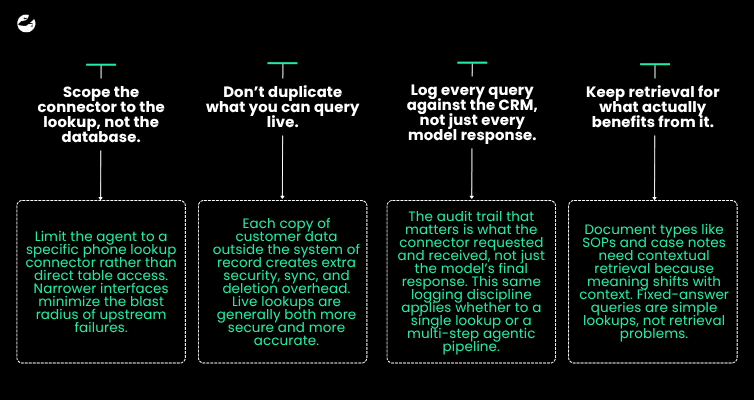
Scope the connector to the lookup, not the database. An agent that needs a caller's record by phone number should have a connector that does exactly that, not general query access to the underlying tables. The narrower the interface, the smaller the blast radius if something goes wrong upstream of it.
Don't duplicate what you can query live. Every copy of customer data outside the system of record is something new to secure, keep current, and eventually delete. If a live lookup is possible, it is usually the more secure option, not just the more accurate one.
Log every query against the CRM, not just every model response. The audit trail that matters here is what the connector actually asked for and what it got back, not just what the model said afterward. This is the same logging discipline we've written about applying to agentic workflows generally, and it applies just as directly to a single lookup as it does to a multi-step pipeline.
Keep retrieval for what actually benefits from it. SOPs, policy documents, case notes, anything where meaning varies more than the underlying facts do. If a query has an exact key and one correct current answer, that is a lookup, not a retrieval problem, no matter how the request gets phrased when it comes into your roadmap.
The honest version of "securely connect an LLM to your legacy CRM" is mostly about resisting the version of the project that sounds easier: don't embed the database, build the connector.
The Other Fear, And The Other Guarantee
Everything above is about architecture: what gets retrieved, how, and whether a copy of your data exists somewhere it should not. There is a separate fear underneath a lot of these conversations that architecture alone does not answer, and it is worth naming plainly instead of talking around it: the worry that the model itself learns from what you send it. That it does not just answer the question and forget, but absorbs the customer record somewhere, the way a person would remember something you told them. It is the same instinct behind being careful what you share with Facebook: a privacy policy is a promise, and people have learned, reasonably, to want more than a promise.
The comparison is worth being precise about, not just sympathetic to. A social platform's business model is built on using what you give it. A serious enterprise LLM vendor's is not; you are the customer paying for usage, not the product being monetized, and that difference shows up in the contract, not just the marketing. Reputable providers explicitly exclude business and API data from training, and enterprise agreements can include a hard zero-retention option on top of that. That is a real guarantee, backed by a real incentive structure, and it deserves to be taken seriously rather than dismissed as "just a policy."
But it is still a policy, and a CTO is entitled to want something stronger than a promise, however well-incentivised. That is what private or self-hosted deployment actually buys you: not a better contract, but no third party in the loop at all. The data never leaves infrastructure you control, on-premise or in your own cloud, and there is nothing left to train on because there is no outside vendor there to do it. This is not exotic engineering. A capable GPU, or even something as modest as a well-specced machine sitting in your own network, running an open model, is a realistic setup, not a moonshot.
What it is not, is automatically the safer choice. It is a different allocation of liability, and the trade tends to run the opposite direction from how it is usually pitched. A reputable vendor carries the security resourcing and the legal exposure if their infrastructure is breached; that liability is written into the agreement you are paying for. Bring the model fully in-house, and that exposure moves to you: your infrastructure, your patching, your team's ability to secure something a specialist vendor was built to secure at scale. Self-hosting does not remove risk so much as relocate it, from a vendor whose entire business depends on getting this right, to whoever runs your servers.
We have not built a private or self-hosted deployment for a client. Not because it is technically difficult, it genuinely is not, but because for most of the businesses we work with, the cost of building and maintaining it is disproportionate to a risk that a well-contracted vendor has already addressed. That will not be true for every client, and for genuinely regulated data with a real mandate behind it, it is a legitimate option worth the investment. The point is that it should be a deliberate decision, made after weighing what it actually buys against what it actually costs, not a reflexive upgrade purchased to settle a fear that a good contract would have settled already.
So, in short:
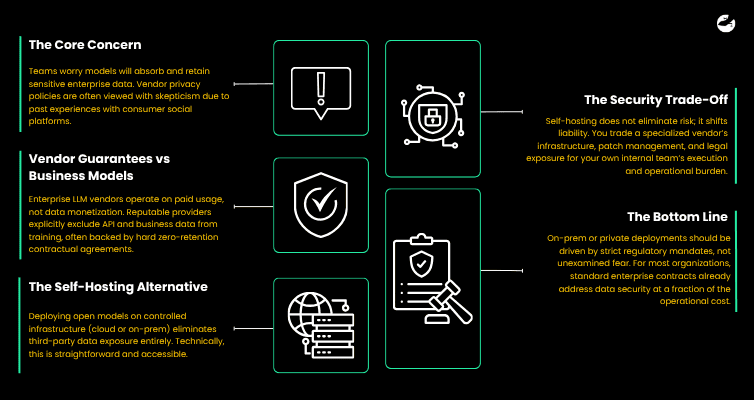
- The Core Concern: Teams worry models will absorb and retain sensitive enterprise data. Vendor privacy policies are often viewed with skepticism due to past experiences with consumer social platforms.
- Vendor Guarantees vs. Business Models: Enterprise LLM vendors operate on paid usage, not data monetization. Reputable providers explicitly exclude API and business data from training, often backed by hard zero-retention contractual agreements.
- The Self-Hosting Alternative: Deploying open models on controlled infrastructure (cloud or on-prem) eliminates third-party data exposure entirely. Technically, this is straightforward and accessible.
- The Security Trade-Off: Self-hosting does not eliminate risk; it shifts liability. You trade a specialized vendor's infrastructure, patch management, and legal exposure for your own internal team's execution and operational burden.
- The Bottom Line: On-prem or private deployments should be driven by strict regulatory mandates, not unexamined fear. For most organizations, standard enterprise contracts already address data security at a fraction of the operational cost.
Ready to Turn Your Vision Into Custom Software?
Connecting LLMs to legacy enterprise systems doesn't have to mean compromising data security or dealing with stale records. If you are looking to architect a secure, live-lookup integration for your legacy CRM, contact our engineering team today to schedule an architecture review.

similar reads

Case Studies & Interviews
Lereng Tanah: Developing a Direct Booking Platform Malaysian Boutique Villa
29 January 2026

Case Studies & Interviews
Tactlink: How a Malaysian Entrepreneur Turned Networking Chaos into a Digital Community
22 January 2026

Software Development
Who Are the Top Software Development Vendors in Amsterdam for 2026?
26 August 2026