
Agile Meets Analytics: Turning Data into Actionable Sprints

11 Dec 2025
by Nadiy, Senior Content Writer
Contributor - Titi Hartinah, Product Growth Analyst
11 Dec 2025
by Nadiy, Senior Content Writer
Contributor - Titi Hartinah, Product Growth Analyst
Agile Meets Analytics: Turning Data into Actionable Sprints
Table of contents
Contact us
We will get back to you in the next 48 hours.
Agile Meets Analytics Turning Data into Actionable Sprints
Agile teams ship fast, but without analytics they often ship in the dark. This blog breaks down how integrating real data into agile workflows helps teams prioritize the right work, set meaningful sprint goals, and build products that deliver measurable impact.
key takeaways
Agile teams move fast, but speed alone doesn’t guarantee impact. The difference between releasing features and releasing the right features often comes down to one thing: how effectively you use data. When agile methodology meets analytics, teams stop guessing and start sprinting with intention—prioritizing what actually moves the needle.
This fourth installment in the Growth Analytics series breaks down how integrating analytics into agile workflows transforms decision-making, strengthens team collaboration, and helps organisations build products that deliver measurable value.
Be sure to check out the previous three installments in the Growth Analytics series:
The Problem with Traditional Agile
Traditional agile frameworks promise rapid delivery and iterative improvement—but in practice, many teams find themselves moving quickly without clear direction. Sprints become cycles of activity rather than cycles of value.
When teams lack access to reliable data, they’re forced to make decisions based on assumptions, instincts, or the loudest stakeholder in the room. This creates two major issues:
Poor Prioritisation Backlogs grow, assumptions multiply, and teams spend energy on tasks that feel urgent rather than what is truly important. The lack of visibility into what users actually do—versus what we think they do—creates blind spots.
Guesswork Over Clarity When decisions are based on opinions, outputs improve but outcomes plateau. Teams ship features without understanding whether they delivered value, improved conversion, or enhanced user satisfaction.
These gaps limit the effectiveness of agile. Instead of empowering teams to iterate intelligently, the process becomes a continuous loop of work with limited proof of progress.
This is where analytics becomes essential. By shifting from assumption-driven decisions to data-backed insights, teams can transform their sprints into strategic, outcome-driven cycles. This sets the stage for the next critical evolution: Data-Informed Sprints.
The Power of Data-Informed Sprints
Agile only becomes truly effective when teams sprint with intention. Data-informed sprints bring clarity, structure, and alignment to the agile process by grounding decisions in measurable insights rather than opinions.
When analytics is incorporated into sprint planning, teams gain a deeper understanding of user behaviour, product performance, and the actual impact of features. Instead of planning work based on projection, they plan based on proof. This shift elevates every stage of the sprint cycle.
How Analytics Shapes Sprints
- Sprint Goals: Instead of vague objectives, teams use real numbers—such as drop-off rates, engagement patterns, or conversion funnels—to decide what needs improvement.
- Backlog Prioritisation:Data highlights which features are underperforming, which customer segments are struggling, and where optimisation will have the biggest impact.
- Retrospectives: Instead of discussing only what happened, teams discuss why it happened. Analytics brings evidence to conversations and creates shared understanding.
- Example: If a feature shows high engagement but low conversion, the next sprint may focus on improving the user journey rather than building new features.
Data-informed sprints shift the mindset from “What should we work on next?” to “What will create the most value next?” This approach leads naturally into understanding which metrics matter most.
Key Metrics That Drive Agile Decision-Making
Metrics are the backbone of modern agile decision-making. Without them, teams might deliver frequently but fail to deliver meaningfully. The right metrics ensure every sprint is tied to outcomes rather than just outputs.
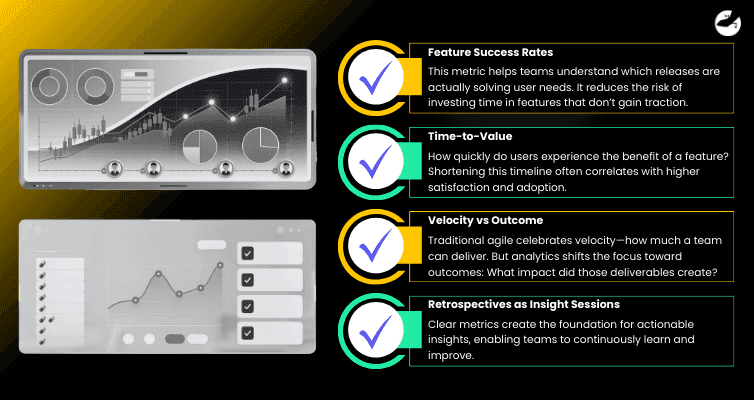
- Feature Success Rates
This metric helps teams understand which releases are actually solving user needs. It reduces the risk of investing time in features that don’t gain traction.
- Time-to-Value How quickly do users experience the benefit of a feature? Shortening this timeline often correlates with higher satisfaction and adoption.
- Velocity vs Outcome Traditional agile celebrates velocity—how much a team can deliver. But analytics shifts the focus toward outcomes: What impact did those deliverables create?
- Retrospectives as Insight Sessions Clear metrics create the foundation for actionable insights, enabling teams to continuously learn and improve. The next step is making sure this learning doesn’t happen in isolation but becomes part of a continuous cycle.
Building the Agile–Analytics Feedback Loop
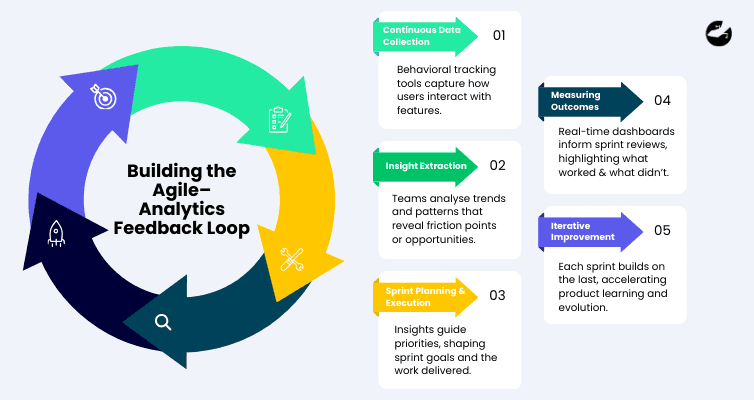
For analytics to be effective in agile, it must be integrated into the workflow—not treated as a separate function. The agile–analytics feedback loop ensures teams continuously collect insights, apply them, measure outcomes, and refine the product with each sprint.
How the Feedback Loop Works
- Continuous Data Collection: Behavioral tracking tools capture how users interact with features.
- Insight Extraction: Teams analyse trends and patterns that reveal friction points or opportunities.
- Sprint Planning & Execution: Insights guide priorities, shaping sprint goals and the work delivered.
- Measuring Outcomes: Real-time dashboards inform sprint reviews, highlighting what worked and what didn’t.
- Iterative Improvement: Each sprint builds on the last, accelerating product learning and evolution.
When analytics becomes an embedded part of the agile process, teams shift from reactive work to proactive optimisation. This level of integration also requires the right mindset and collaboration across teams.
Want to find out how much it costs to build your dream app or web app?


Team Culture and Collaboration
Agile and analytics can only succeed when the team culture supports transparency, learning, and shared ownership. Data should not be isolated with analysts—the entire team needs a level of data literacy to understand what the numbers mean and how they influence decisions.
Why Culture Matters
- Encourages Data Literacy This doesn’t mean everyone must become an analyst. It means creating a culture where data is accessible, easy to digest, and part of everyday conversation. Teams make better decisions when they understand the story behind the numbers.
- Cross-Functional Alignment Improves Outcomes When product owners, designers, engineers, and data specialists work from the same insights, problem-solving becomes sharper. Alignment reduces rework, accelerates delivery, and ensures every sprint contributes to real business outcomes.
- Teams Make Smarter Decisions Faster With clear access to data, teams reduce rework, avoid misaligned priorities, and accelerate value creation.
By strengthening collaboration and building a culture that values data, organisations fully unlock the potential of analytics-enhanced agile. This cultural readiness is what enables the final step—turning insights into consistent, meaningful product evolution.
Why Agile + Analytics Matters and How Lizard Global Can Help
We at Lizard Global have long believed that great products are built at the intersection of intelligence and execution. Our agile delivery model, fine-tuned over the course of 12 years, integrates behavioural data at every stage—from discovery to launch to continuous optimisation.
We’ve learnt that when organisations combine agile processes with analytics, they gain clarity, direction, and the ability to move with purpose. Instead of sprinting for the sake of speed, teams sprint toward outcomes that matter—higher engagement, better retention, stronger conversions, and happier users.
What This Looks Like in Practice
- Data-driven discovery workshops to define real user needs
- Analytics-rich product roadmaps that prioritize impact
- Sprint cycles informed by engagement data and customer behaviour
- Dashboards and measurement frameworks used in sprint reviews and retrospectives
- Cross-functional collaboration across strategy, design, engineering, and analytics

This blend of agile methodology and data intelligence helps clients reduce risk, speed up learning, and build software that delivers measurable value—not just features. Lizard Global is always ready to support businesses through this transformation by embedding analytics into every stage of agile development. From shaping product strategy to guiding sprint decisions and scaling successful features, we help teams build digital solutions rooted in data and designed for long-term impact.
If you're ready to turn data into actionable sprints and build products that grow intelligently, Lizard Global is here to help.
Join 2000+ subscribers
Stay in the loop with everything you need to know
FAQs

What is the relationship between agile and analytics?
Why is data important in agile development?
How can analytics improve sprint planning?
What metrics should agile teams track?
How does analytics help in sprint retrospectives?
What tools support analytics in agile workflows?
How do you build an agile–analytics feedback loop?
How does data literacy affect agile success?
How do cross-functional teams use analytics in agile?
How does Lizard Global use analytics in agile projects?
similar reads

Case Studies & Interviews
Lereng Tanah: Developing a Direct Booking Platform Malaysian Boutique Villa
29 January 2026

Case Studies & Interviews
Tactlink: How a Malaysian Entrepreneur Turned Networking Chaos into a Digital Community
22 January 2026

Software Development
Who Are the Top Software Development Vendors in Amsterdam for 2026?
26 August 2026
Stuck between a great idea and the right team to build it?Let's talk.
We work with corporate innovation teams and ambitious scale-ups across the Netherlands, Singapore, and Australia, and wherever great software needs to be built. Drop us a message and we'll get back to you within one business day.


Markus Monnikendam
Global Commercial Director
hello@lizard.global