Beyond the API Wrapper: Designing Customized Cognitive Layers Mapped to Proprietary Business Logic

10 Aug 2026
by Nadiy, Senior Content Writer
10 Aug 2026
by Nadiy, Senior Content Writer
Beyond the API Wrapper: Designing Customized Cognitive Layers Mapped to Proprietary Business Logic
Table of contents
Contact us
We will get back to you in the next 48 hours.

Many enterprise organizations initially experiment with Generative AI by building quick API wrappers around public large language models. However, basic wrappers fail when scaled because they lack context, data security, and alignment with complex internal workflows. In this comprehensive guide, we explore how designing custom cognitive layers solves these structural limitations. A cognitive layer serves as intelligent middleware, mapping foundation models directly to your enterprise databases, compliance rules, and operational logic. By integrating custom orchestration, retrieval systems, and domain guardrails, we empower organizations to transform generic AI models into predictable, high-performing enterprise assets that drive measurable efficiency and long-term competitive advantage.
key takeaways
Building a basic API wrapper around a commercial large language model allows teams to prototype quickly, but it fails to address enterprise needs. Basic wrappers merely pass text prompts to external servers and return raw responses. They cannot understand complex operational workflows, enforce strict regulatory rules, or process private transactional data securely.
To achieve true digital transformation, organizations must build custom cognitive layers that sit directly between foundational AI models and proprietary business infrastructure. A cognitive layer functions as intelligent middleware. It ingests enterprise data, enforces domain-specific logic, manages real-time context, and routes queries dynamically. Consequently, this architectural approach transforms unpredictable artificial intelligence into a reliable engine designed specifically for your core business goals.
We regularly observe companies reaching the limits of simple API integrations. When enterprises attempt to deploy generic wrappers to handle customer support, automated underwriting, or supply chain logistics, they encounter costly hallucinations and fragmented data flows. By engineering customized cognitive architectures, we enable businesses to bridge the gap between flexible AI capabilities and strict operational requirements.
Why Are Basic AI API Wrappers Failing Modern Enterprise Requirements?
Basic API wrappers provide an initial glimpse into artificial intelligence, yet they quickly crumble under real-world operational demands. Simple wrappers send user inputs directly to a third-party model and return the generated text without validating the underlying context. Because foundation models operate on generalized training datasets, they possess zero innate understanding of your internal policies, historical customer records, or pricing structures. Furthermore, direct API wrappers expose organizations to significant data privacy risks and unpredictable API costs, making them unsuitable for long-term production environments.
In addition, basic wrappers cannot enforce deterministic business rules. Enterprise operations demand precise, predictable outcomes where compliance, security, and accuracy are paramount. When an AI system operates without intermediate governance, it routinely generates hallucinatory facts or offers promises that contradict company guidelines. Therefore, relying on surface-level integrations creates significant reputational and financial exposure for growing enterprises.
What Is a Custom Cognitive Layer and How Does Its Architecture Work?
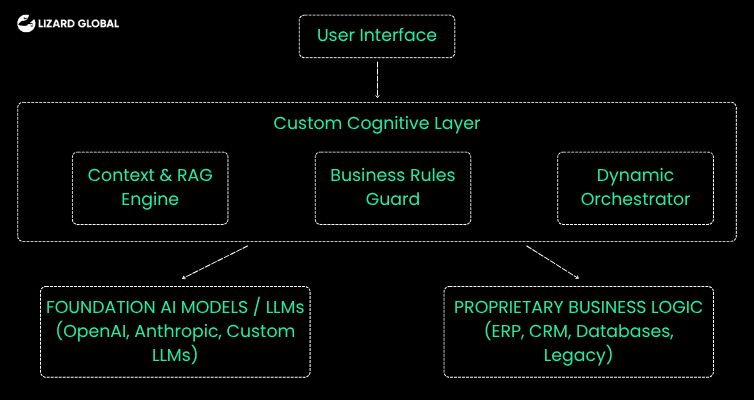
A custom cognitive layer acts as an intelligent abstraction layer placed between user touchpoints and underlying machine learning infrastructure. Instead of letting a third-party model dictate the output directly, the cognitive layer orchestrates every request through a structured sequence of data fetching, policy checking, and contextual enrichment. First, it analyzes incoming queries to identify intent and permission levels. Next, it queries internal enterprise systems to pull relevant real-time data before formulating a comprehensive prompt structure.
Moreover, this architecture integrates advanced state management and multi-agent coordination. By breaking complex tasks into smaller sub-tasks, the cognitive layer assigns distinct specialized agents to validate calculations, verify database entries, and construct formatted responses. As a result, your software platform delivers answers that reflect live operational truth rather than probabilistic guesses.
How Do You Map Proprietary Business Logic to Foundation AI Models?
Mapping proprietary business logic requires structuring your domain expertise into structured programmatic guardrails and data retrieval mechanisms. We start by mapping out your internal knowledge graphs, decision trees, and compliance rules. Through hybrid Retrieval-Augmented Generation (RAG) pipelines, the cognitive layer fetches exact document snippets, customer profiles, and product parameters from secure internal vector databases. Thus, the foundation model receives rich, hyper-specific context alongside every user prompt.
Furthermore, we program explicit semantic validators into the middleware to verify model outputs before they reach the end user. If a foundation model attempts to generate a response that violates a company rule, the cognitive middleware intercepts the message, corrects the error, or routes the query to a human operator. This continuous feedback loop guarantees that the AI acts in strict alignment with your brand standards and operational criteria.
What Real-World Impact Does Custom AI Architecture Deliver for Enterprises?
Custom cognitive layers unlock substantial performance gains across complex software ecosystems, including fintech, healthtech, and enterprise logistics platforms. For instance, in modern financial platforms, a custom cognitive middleware can analyze structured transaction data alongside unstructured market news, applying regulatory risk formulas automatically. In supply chain environments, the layer connects predictive AI models directly to legacy ERP databases, optimizing inventory reorders without human error.
Real-world applications of this tailored technical approach are visible across diverse enterprise implementations:
- In healthcare, solutions like AvantHealth Cognify demonstrate how structured architectures safely process specialized data to prevent cognitive decline.
- In AI-driven document and content workflows, platforms like Narrates AI illustrate how custom middleware transforms raw generation into structured narrative outputs.
- For corporate governance and operations, automated intelligence systems like CompEasy AI highlight how proprietary business rules simplify complex compliance checks.
Additionally, building custom middleware preserves the value of your core digital assets. Because the cognitive layer remains modular, your engineering team can swap out underlying foundation models as newer, cheaper, or faster models emerge in the market. Consequently, your proprietary business logic remains secure and independent, protecting your company against vendor lock-in while maintaining continuous technical agility.
How Can Organizations Engineer and Scale Cognitive Middleware Successfully?
Engineering a scalable cognitive layer requires an agile, user-centric software development methodology. Developers must treat cognitive architecture as a core software component rather than a simple script. This involves designing clean RESTful and GraphQL APIs, establishing robust unit testing frameworks for prompt pipelines, and monitoring system latencies continuously. Additionally, strict data encryption protocols must safeguard sensitive operational data throughout every transaction phase.
At Lizard Global, we specialize in helping industry leaders design, build, and scale custom digital solutions tailored to complex business models. As a full-stack digital product studio, we combine deep expertise in cloud architecture, custom software development, UI/UX design, and artificial intelligence integration. We work alongside your stakeholders to translate nuanced enterprise workflows into resilient cognitive systems, ensuring your technology investments yield long-term measurable value.
Transforming Enterprise Intelligence Into Sustainable Value
Transitioning from basic API wrappers to custom cognitive layers marks the defining shift between experimental AI projects and production-grade enterprise software. By embedding your proprietary business logic into a dedicated middleware layer, you regain full control over data security, compliance, and user experience. As AI technology continues to evolve rapidly, owning a flexible, modular cognitive architecture ensures your business stays resilient, agile, and ahead of the competition.

Are you ready to unlock the full potential of your enterprise data with custom AI software architecture? Contact us at Lizard Global today, and let our expert digital product studio design a tailored cognitive layer built for your exact business goals.
Many enterprise organizations initially experiment with Generative AI by building quick API wrappers around public large language models. However, basic wrappers fail when scaled because they lack context, data security, and alignment with complex internal workflows. In this comprehensive guide, we explore how designing custom cognitive layers solves these structural limitations. A cognitive layer serves as intelligent middleware, mapping foundation models directly to your enterprise databases, compliance rules, and operational logic. By integrating custom orchestration, retrieval systems, and domain guardrails, we empower organizations to transform generic AI models into predictable, high-performing enterprise assets that drive measurable efficiency and long-term competitive advantage.
Building a basic API wrapper around a commercial large language model allows teams to prototype quickly, but it fails to address enterprise needs. Basic wrappers merely pass text prompts to external servers and return raw responses. They cannot understand complex operational workflows, enforce strict regulatory rules, or process private transactional data securely.
To achieve true digital transformation, organizations must build custom cognitive layers that sit directly between foundational AI models and proprietary business infrastructure. A cognitive layer functions as intelligent middleware. It ingests enterprise data, enforces domain-specific logic, manages real-time context, and routes queries dynamically. Consequently, this architectural approach transforms unpredictable artificial intelligence into a reliable engine designed specifically for your core business goals.
We regularly observe companies reaching the limits of simple API integrations. When enterprises attempt to deploy generic wrappers to handle customer support, automated underwriting, or supply chain logistics, they encounter costly hallucinations and fragmented data flows. By engineering customized cognitive architectures, we enable businesses to bridge the gap between flexible AI capabilities and strict operational requirements.
Why Are Basic AI API Wrappers Failing Modern Enterprise Requirements?
Basic API wrappers provide an initial glimpse into artificial intelligence, yet they quickly crumble under real-world operational demands. Simple wrappers send user inputs directly to a third-party model and return the generated text without validating the underlying context. Because foundation models operate on generalized training datasets, they possess zero innate understanding of your internal policies, historical customer records, or pricing structures. Furthermore, direct API wrappers expose organizations to significant data privacy risks and unpredictable API costs, making them unsuitable for long-term production environments.
In addition, basic wrappers cannot enforce deterministic business rules. Enterprise operations demand precise, predictable outcomes where compliance, security, and accuracy are paramount. When an AI system operates without intermediate governance, it routinely generates hallucinatory facts or offers promises that contradict company guidelines. Therefore, relying on surface-level integrations creates significant reputational and financial exposure for growing enterprises.
What Is a Custom Cognitive Layer and How Does Its Architecture Work?
A custom cognitive layer acts as an intelligent abstraction layer placed between user touchpoints and underlying machine learning infrastructure. Instead of letting a third-party model dictate the output directly, the cognitive layer orchestrates every request through a structured sequence of data fetching, policy checking, and contextual enrichment. First, it analyzes incoming queries to identify intent and permission levels. Next, it queries internal enterprise systems to pull relevant real-time data before formulating a comprehensive prompt structure.
Moreover, this architecture integrates advanced state management and multi-agent coordination. By breaking complex tasks into smaller sub-tasks, the cognitive layer assigns distinct specialized agents to validate calculations, verify database entries, and construct formatted responses. As a result, your software platform delivers answers that reflect live operational truth rather than probabilistic guesses.
How Do You Map Proprietary Business Logic to Foundation AI Models?
Mapping proprietary business logic requires structuring your domain expertise into structured programmatic guardrails and data retrieval mechanisms. We start by mapping out your internal knowledge graphs, decision trees, and compliance rules. Through hybrid Retrieval-Augmented Generation (RAG) pipelines, the cognitive layer fetches exact document snippets, customer profiles, and product parameters from secure internal vector databases. Thus, the foundation model receives rich, hyper-specific context alongside every user prompt.
Furthermore, we program explicit semantic validators into the middleware to verify model outputs before they reach the end user. If a foundation model attempts to generate a response that violates a company rule, the cognitive middleware intercepts the message, corrects the error, or routes the query to a human operator. This continuous feedback loop guarantees that the AI acts in strict alignment with your brand standards and operational criteria.
What Real-World Impact Does Custom AI Architecture Deliver for Enterprises?
Custom cognitive layers unlock substantial performance gains across complex software ecosystems, including fintech, healthtech, and enterprise logistics platforms. For instance, in modern financial platforms, a custom cognitive middleware can analyze structured transaction data alongside unstructured market news, applying regulatory risk formulas automatically. In supply chain environments, the layer connects predictive AI models directly to legacy ERP databases, optimizing inventory reorders without human error.
Real-world applications of this tailored technical approach are visible across diverse enterprise implementations:
- In healthcare, solutions like AvantHealth Cognify demonstrate how structured architectures safely process specialized data to prevent cognitive decline.
- In AI-driven document and content workflows, platforms like Narrates AI illustrate how custom middleware transforms raw generation into structured narrative outputs.
- For corporate governance and operations, automated intelligence systems like CompEasy AI highlight how proprietary business rules simplify complex compliance checks.
Additionally, building custom middleware preserves the value of your core digital assets. Because the cognitive layer remains modular, your engineering team can swap out underlying foundation models as newer, cheaper, or faster models emerge in the market. Consequently, your proprietary business logic remains secure and independent, protecting your company against vendor lock-in while maintaining continuous technical agility.
How Can Organizations Engineer and Scale Cognitive Middleware Successfully?
Engineering a scalable cognitive layer requires an agile, user-centric software development methodology. Developers must treat cognitive architecture as a core software component rather than a simple script. This involves designing clean RESTful and GraphQL APIs, establishing robust unit testing frameworks for prompt pipelines, and monitoring system latencies continuously. Additionally, strict data encryption protocols must safeguard sensitive operational data throughout every transaction phase.
At Lizard Global, we specialize in helping industry leaders design, build, and scale custom digital solutions tailored to complex business models. As a full-stack digital product studio, we combine deep expertise in cloud architecture, custom software development, UI/UX design, and artificial intelligence integration. We work alongside your stakeholders to translate nuanced enterprise workflows into resilient cognitive systems, ensuring your technology investments yield long-term measurable value.
Transforming Enterprise Intelligence Into Sustainable Value
Transitioning from basic API wrappers to custom cognitive layers marks the defining shift between experimental AI projects and production-grade enterprise software. By embedding your proprietary business logic into a dedicated middleware layer, you regain full control over data security, compliance, and user experience. As AI technology continues to evolve rapidly, owning a flexible, modular cognitive architecture ensures your business stays resilient, agile, and ahead of the competition.
Are you ready to unlock the full potential of your enterprise data with custom AI software architecture? Contact us at Lizard Global today, and let our expert digital product studio design a tailored cognitive layer built for your exact business goals.
FAQs

What is the difference between an API wrapper and a custom cognitive layer?
How does a cognitive layer protect our proprietary business data?
Can a custom cognitive layer integrate with our legacy enterprise software?
How do cognitive layers prevent AI model hallucinations in production?
Will building a cognitive layer tie our platform to one AI vendor?
How long does it take to develop a custom cognitive layer?
Why should we partner with Lizard Global to build our AI solution?
Stuck between a great idea and the right team to build it?Let's talk.
We work with corporate innovation teams and ambitious scale-ups across the Netherlands, Singapore, and Australia, and wherever great software needs to be built. Drop us a message and we'll get back to you within one business day.


Markus Monnikendam
Global Commercial Director
hello@lizard.global