How to Build a Scalable FoodTech Marketplace: Lessons from Optimizing FoodToo

24 Aug 2026
by Nadiy, Senior Content Writer
Contributor, Khaldoon Alwan, Head of Project Management,
24 Aug 2026
by Nadiy, Senior Content Writer
Contributor, Khaldoon Alwan, Head of Project Management,
How to Build a Scalable FoodTech Marketplace: Lessons from Optimizing FoodToo
Table of contents
What Triggers the Need for Platform Modernization in FoodTech?
How Do You Streamline UX and Fix Core Merchant Workflows?
Why Is Localized Payment Gateway Integration Crucial for Conversion?
What Does the Metrics Say About Real-World FoodTech Impact?
How Should You Structure Your Long-Term Product Roadmap?
Partner with Lizard Global for End-to-End Product Excellence
Contact us
We will get back to you in the next 48 hours.
In this blog post, we explore how modern FoodTech platforms and two-sided marketplaces solve real-world sustainability challenges while driving business efficiency. Highlighting our technical partnership with PostCap Pte. Ltd. on the FoodToo app, we share actionable strategies for resolving operational bottlenecks, upgrading legacy codebases, and optimizing digital infrastructure. Readers will learn the importance of friction-free order management, localized payment integrations, and modular application architectures designed for long-term scalability.
key takeaways
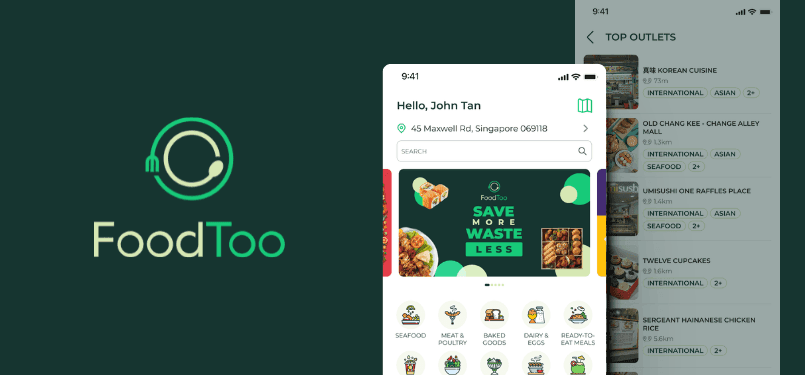
Every single day, restaurants, bakeries, and supermarkets produce high-quality, delicious food that goes unsold simply because demand fluctuates. At the same time, budget-conscious consumers search for affordable dining options nearby. Connecting these two sides efficiently requires more than just a basic mobile app; it demands a robust, real-time two-sided marketplace engineered for speed, reliability, and growth.
When PostCap Pte. Ltd. approached us at Lizard Global to work on FoodToo, their Singapore-based surplus food marketplace app, we saw an exciting opportunity to apply our deep experience in software development, UI/UX design, and platform modernization. We took over the development of FoodToo from a previous technical vendor to audit, fix, and elevate the entire platform, similar to how we engineered scaled digital experiences for brands like Heineken Drinkies.
In this blog, we break down how to overcome technical debt, refine user experience, and structure a sustainable FoodTech product for enterprise growth.
What Triggers the Need for Platform Modernization in FoodTech?
Building a minimum viable product (MVP) gets a startup into the market quickly, but rapid launch often comes with technical debt. For marketplace platforms operating in high-frequency industries like food service, legacy code bottlenecks can quickly stifle operations. Merchants struggle with manual workarounds, while end-users face friction during checkout, ultimately harming user retention.
When we took over the FoodToo codebase, we identified several critical friction points left behind by the previous vendor. The order management flow suffered from structural UX friction, and the recurring listing feature was broken—forcing merchants to re-enter daily surplus stock manually. As your technical partner, we systematically address these operational pain points through comprehensive platform audits, ensuring that legacy issues do not hold back business scale.
How Do You Streamline UX and Fix Core Merchant Workflows?
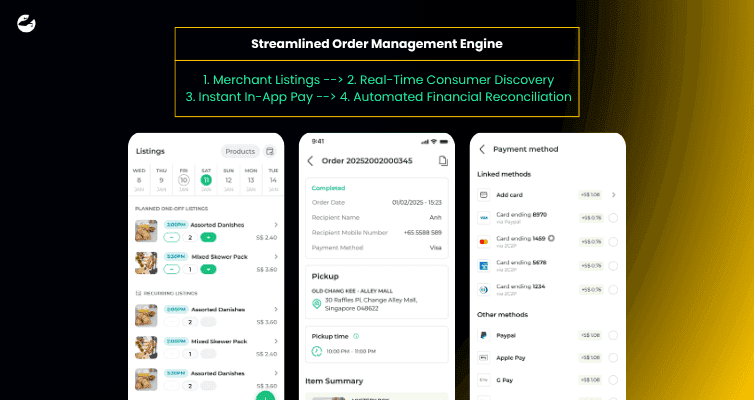
A two-sided marketplace succeeds only when operating it is effortless for suppliers. If store managers find updating inventory cumbersome during busy closing hours, listings drop, and the marketplace loses supply. We restructured the core workflows inside FoodToo to remove friction for both local merchants and consumers.
We completely overhauled the order management flow to create a smooth, intuitive UX. Additionally, we rebuilt the recurring listings architecture properly. By automating daily surplus inventory creation, we eliminated manual workload for merchant staff, allowing them to list excess stock in real time with minimal effort.
At Lizard Global, our product discovery workshops and specialized UX/UI design processes ensure that software fits perfectly into real-world operational environments, much like our user-first design approach for Travereel and Chatlicense.
Why Is Localized Payment Gateway Integration Crucial for Conversion?
Payment preferences vary wildly across regions. A payment method that works well in one country may see negligible traction in another. FoodToo initially relied on PayPal, which resulted in minimal adoption among Singaporean shoppers who preferred localized digital wallets.
To eliminate checkout drop-off, we prioritized migrating the payment infrastructure to 2c2p, a leading regional payment gateway.
This upgrade allowed us to integrate localized options directly into the app, including:
- PayNow (top priority for Singapore consumers)
- GrabPay
- Apple Pay
- Alipay and WeChat Pay
By replacing legacy channels with regional payment options, we removed a major barrier at checkout, directly driving higher order completion rates.
What Does the Metrics Say About Real-World FoodTech Impact?
Technical stability directly influences business outcomes and social impact. In regions like Singapore, food waste accounts for approximately 12% of total generated waste, making digital rescue platforms a key part of sustainability initiatives. Optimizing platform functionality gives non-technical founders and product teams the foundation needed to achieve clear, measurable results.
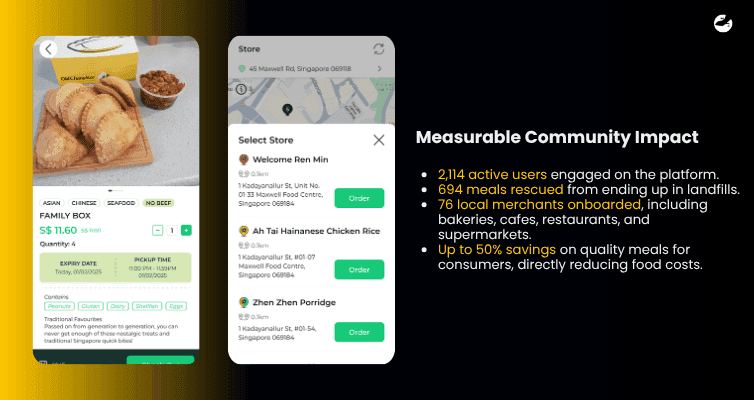
Through our work stabilizing and improving the platform, FoodToo has driven measurable community impact:
- 2,114 active users engaged on the platform.
- 694 meals rescued from ending up in landfills.
- 76 local merchants onboarded, including bakeries, cafes, restaurants, and supermarkets.
- Up to 50% savings on quality meals for consumers, directly reducing food costs.
These numbers demonstrate how addressing backend vulnerabilities and UX friction translates into real-world platform adoption and operational success.
How Should You Structure Your Long-Term Product Roadmap?
Scaling a software platform requires shifting from a single, monolithic application to a modular ecosystem. As a product matures, combining merchant tools, consumer storefronts, and internal administrative dashboards into one application limits scalability and complicates role management.
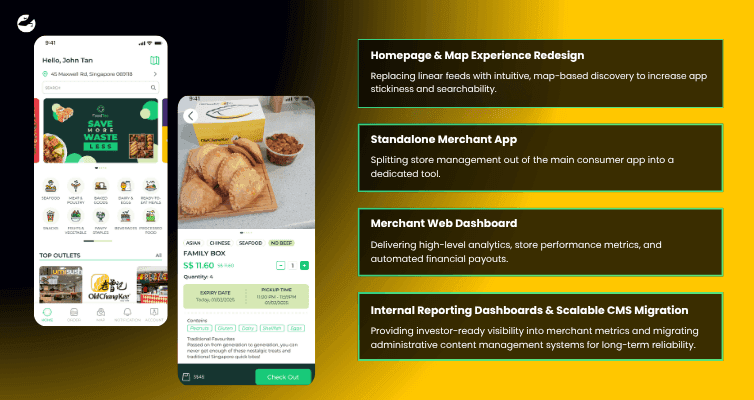
Our strategic roadmap for FoodToo focuses on unbundling and expanding architecture to support growth:
- Homepage & Map Experience Redesign: Replacing linear feeds with intuitive, map-based discovery to increase app stickiness and searchability.
- Standalone Merchant App: Splitting store management out of the main consumer app into a dedicated tool with role-based access for store owners, managers, and clerks.
- Merchant Web Dashboard: Delivering high-level analytics, store performance metrics, and automated financial payouts for enterprise multi-outlet brands.
- Internal Reporting Dashboards & Scalable CMS Migration: Providing investor-ready visibility into merchant metrics and migrating administrative content management systems for long-term reliability.
At Lizard Global, we bring full-stack software development expertise across frontend, backend, web, and mobile, serving as an extension of your product team to build scalable digital solutions, whether for consumer apps or complex enterprise platforms like Elfi / Iggi.
Partner with Lizard Global for End-to-End Product Excellence
Are you looking to scale an existing platform, modernize legacy software, or build a complex two-sided marketplace from scratch? At Lizard Global, we act as your dedicated digital partner. From deep technical audits and custom UX design to high-performance backend development and cloud scaling, we deliver modern software solutions tailored to your business goals.

Ready to elevate your digital product? 👉 Contact Lizard Global today to discuss your development roadmap!
FAQs

How does Lizard Global handle taking over existing codebases from previous software vendors?
Why should platforms replace global payment gateways with localized payment providers?
What are the benefits of decoupling merchant features into a standalone mobile app?
How do custom admin dashboards improve enterprise reporting and investor relations?
Why is a map-based UI critical for local marketplace applications?
What services does Lizard Global provide for mobile app modernizations?
How do scalable CMS migrations support long-term business growth?
similar reads

Case Studies & Interviews
Lereng Tanah: Developing a Direct Booking Platform Malaysian Boutique Villa
29 January 2026

Case Studies & Interviews
Tactlink: How a Malaysian Entrepreneur Turned Networking Chaos into a Digital Community
22 January 2026

Software Development
Who Are the Top Software Development Vendors in Amsterdam for 2026?
26 August 2026
Stuck between a great idea and the right team to build it?Let's talk.
We work with corporate innovation teams and ambitious scale-ups across the Netherlands, Singapore, and Australia, and wherever great software needs to be built. Drop us a message and we'll get back to you within one business day.


Markus Monnikendam
Global Commercial Director
hello@lizard.global