
How Far Can Vibe Coding Really Scale? The Multi-Million Line Codebase Bottleneck

26 Oct 2026
by Nadiy, Senior Content Writer
26 Oct 2026
by Nadiy, Senior Content Writer
How Far Can Vibe Coding Really Scale? The Multi-Million Line Codebase Bottleneck
Table of contents
Why Natural Language Prompting Hits a Wall in Enterprise Architecture
How Hidden Technical Debt Compounds Across Massive Codebases
Why Deterministic Debugging Remains Irreplaceable at Scale
How Security Vulnerabilities Multiply in Automated Code Generation
How Engineering Teams Bridge the Gap Between Speed and Stability
Ready to Scale Your Digital Product Securely?
Contact us
We will get back to you in the next 48 hours.
This comprehensive blog post examines the phenomenon of vibe coding, evaluating its true limits when applied to multi-million line codebases, legacy enterprise integration, and systemic software architecture. We explore why natural language prompts break down at scale, how technical debt accumulates without rigorous human oversight, and how engineering teams bridge the gap between rapid AI prototyping and secure, production-grade enterprise software development.
key takeaways
Vibe coding enables developers to build complex software features through natural language instructions, but scaling this approach to a multi-million line codebase exposes critical architectural bottlenecks.
When we rely solely on conversational prompts to generate large volumes of code, we often overlook the deep structural integrity, deterministic debugging, and rigorous security standards required by modern enterprises. Although artificial intelligence transforms how we prototype and iterate, enterprise software engineering demands a level of precision that probabilistic text generation cannot always sustain.
Therefore, we must examine where vibe coding thrives, where it breaks down, and how engineering teams maintain control over massive codebases.
Why Natural Language Prompting Hits a Wall in Enterprise Architecture
Natural language interfaces excel at abstracting boilerplate setup and generating standalone components quickly. However, as codebases expand into millions of lines, the contextual scope exceeds the working memory and deterministic reasoning of standard language models. We see that complex enterprise systems rely on intricate web dependencies, asynchronous event loops, and strict state management that resist high-level summarization.
When developers prompt an AI to modify deeply nested legacy systems, the generated output frequently introduces subtle regression bugs because the underlying model lacks a holistic mental model of the entire repository.
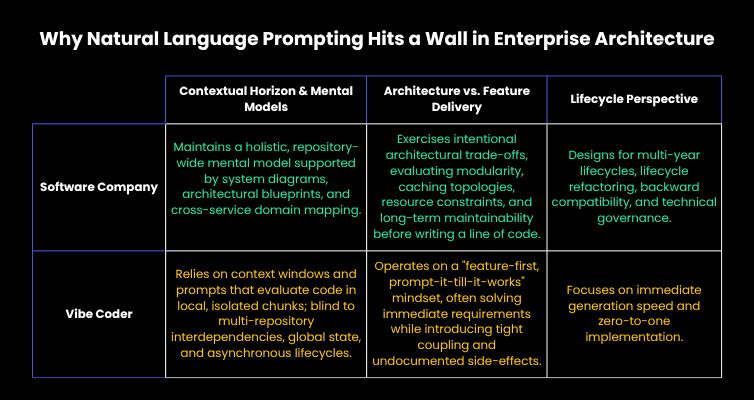
Furthermore, software architecture requires intentional trade-offs regarding performance, modularity, and resource consumption. Conversational prompts encourage a feature-first mindset that prioritizes immediate functionality over long-term maintainability.
Consequently, teams that depend entirely on vibe coding without rigorous architectural governance soon find themselves drowning in tightly coupled, undocumented logic. We realize that writing code is only a fraction of software engineering; maintaining, refactoring, and securing that code across multi-year lifecycles remains an entirely human discipline.
How Hidden Technical Debt Compounds Across Massive Codebases
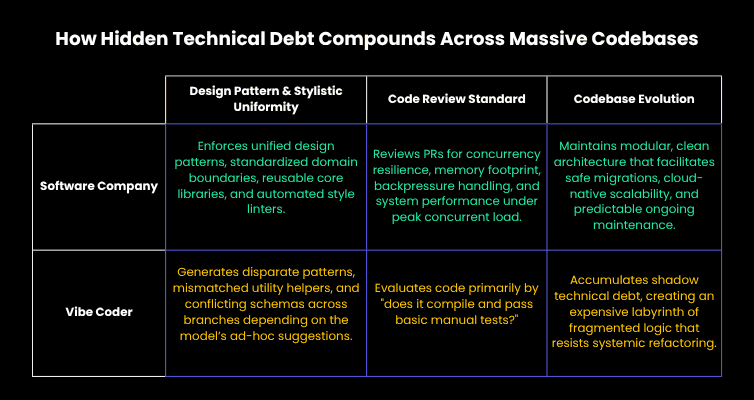
Technical debt accumulates exponentially when automated tools generate code without unified design patterns or strict coding standards. When multiple developers use conversational coding assistants across different branches, the repository begins to fragment stylistically and architecturally.
We observe that AI models often solve local problems with disparate approaches, leading to redundant utilities, conflicting data schemas, and fractured error-handling mechanisms. This stylistic inconsistency transforms a codebase into a labyrinth of fragmented logic that becomes increasingly expensive to audit and refactor.
At Lizard Global, we frequently partner with enterprises migrating from legacy infrastructures to modern, scalable cloud environments. Our experience building robust web and mobile applications demonstrates that clean architecture and modular design are non-negotiable for long-term survival.
When our engineering teams review AI-generated pull requests, we look beyond syntax correctness to evaluate how components interact under high concurrent load. Without this rigorous oversight, hidden technical debt quietly erodes system performance, eventually triggering catastrophic failures during peak operational traffic.
Why Deterministic Debugging Remains Irreplaceable at Scale
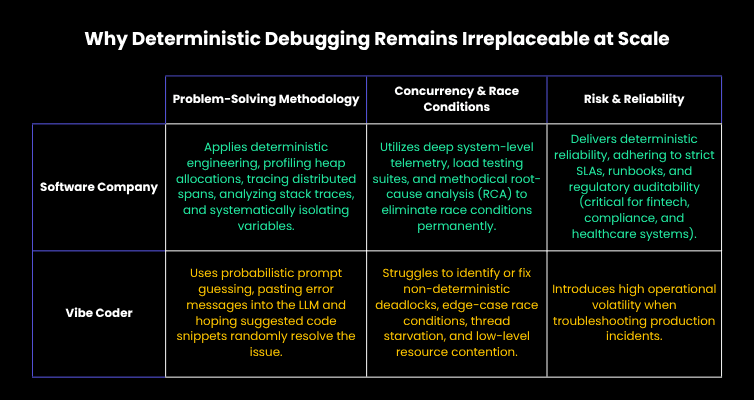
Debugging a multi-million line codebase requires deterministic tracing, precise root-cause analysis, and deep profiling of memory allocations. Because large language models operate on probabilistic token prediction, they struggle to reason about non-deterministic concurrency issues, race conditions, and obscure hardware-level bottlenecks.
When an enterprise application crashes in production, engineers cannot simply prompt the system to fix the error and hope for the best. They need exact stack traces, systematic logging, and methodical isolation of variables to resolve the underlying flaw permanently.
We understand that relying on probabilistic generation for mission-critical debugging introduces unacceptable operational risk. Modern digital ecosystems demand predictable reliability, especially in highly regulated sectors like fintech, healthcare, and logistics.
For instance, when engineering complex platforms like Aposto for digital compliance management or high-precision healthcare applications like Cognify, precise execution and stability are paramount.
While AI tools accelerate log analysis and suggest initial hypotheses, human engineers must validate every fix against stringent compliance and security benchmarks. We bridge this gap by combining automated efficiency with disciplined software craftsmanship, ensuring our clients achieve both speed and stability.
How Security Vulnerabilities Multiply in Automated Code Generation
Security is arguably the most vulnerable frontier when scaling vibe coding across enterprise applications. Large language models are trained on vast public datasets that often include deprecated libraries, insecure authentication patterns, and known vulnerability CVEs.
When developers prompt an AI to construct data pipelines or user authentication flows, the model may inadvertently introduce injection vulnerabilities or improper access controls. Because these generated snippets often look polished and syntactically correct, overworked review teams frequently miss subtle security flaws during code inspections.
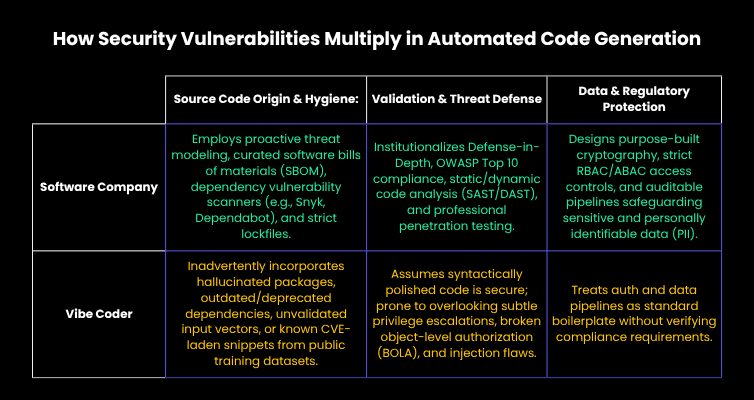
Enterprise-grade security requires proactive threat modeling, penetration testing, and adherence to secure coding frameworks like OWASP Top Ten. At Lizard Global, our security-first development lifecycle integrates rigorous vulnerability scanning and manual code reviews into every sprint.
We ensure that every digital product we build withstands sophisticated cyber threats, as demonstrated in our work delivering enterprise-grade, secure digital platforms like ContractChain. Vibe coding can draft the initial interface or API endpoint, but safeguarding sensitive user data requires the vigilance of seasoned cybersecurity professionals.
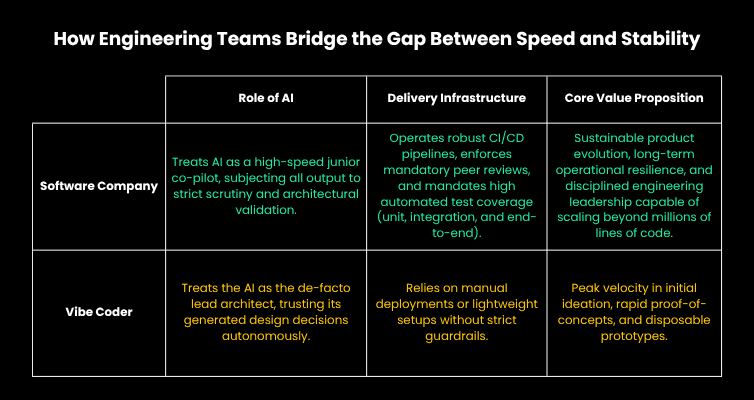
How Engineering Teams Bridge the Gap Between Speed and Stability
Balancing the velocity of generative AI with the stability of enterprise architecture requires a hybrid operational model. We advocate for treating AI assistants as powerful junior co-pilots rather than autonomous lead architects.
By establishing strict continuous integration pipelines, automated test coverage thresholds, and mandatory human code reviews, organizations can capture the productivity benefits of vibe coding while mitigating its systemic risks. This disciplined approach ensures that speed never compromises structural integrity.
Our work across diverse industries proves that sustainable digital transformation hinges on blending cutting-edge tooling with expert human guidance. Whether we are engineering bespoke mobile applications, scaling interactive consumer platforms like Drinkies, or architecting scalable cloud platforms like Skoon, our focus remains on delivering resilient, future-proof solutions.
Vibe coding is a remarkable catalyst for initial ideation and rapid prototyping, but mastering the multi-million line codebase bottleneck ultimately depends on disciplined engineering leadership.
Ready to Scale Your Digital Product Securely?
Navigating the complexities of modern software architecture requires more than fast code generation. Partner with Lizard Global to transform your vision into secure, scalable, and enterprise-grade digital solutions.

Contact our expert team
today to discuss your next project.
FAQs

Can vibe coding completely replace traditional software engineering for large enterprise applications?
What are the primary risks of using AI-generated code in multi-million line codebases?
How do enterprise engineering teams maintain security while using conversational coding tools?
Does Lizard Global use AI tools in its custom software development lifecycle?
How does technical debt accumulate differently in AI-assisted development compared to legacy coding?
Why do probabilistic language models struggle with debugging large-scale production environments?
What is the best strategy for balancing development speed with codebase scalability?
similar reads

Case Studies & Interviews
Lereng Tanah: Developing a Direct Booking Platform Malaysian Boutique Villa
29 January 2026

Software Development
How Far Can Vibe Coding Really Scale? The Multi-Million Line Codebase Bottleneck
22 October 2026

Case Studies & Interviews
Tactlink: How a Malaysian Entrepreneur Turned Networking Chaos into a Digital Community
22 January 2026
Stuck between a great idea and the right team to build it?Let's talk.
We work with corporate innovation teams and ambitious scale-ups across the Netherlands, Singapore, and Australia, and wherever great software needs to be built. Drop us a message and we'll get back to you within one business day.


Markus Monnikendam
Global Commercial Director
hello@lizard.global