Connecting AI Agents to Your Real-World Business Systems
29 Jun 2026
by Team Lizard Global
Editor: Nadiy, Senior Content Writer
29 Jun 2026
by Team Lizard Global
Editor: Nadiy, Senior Content Writer
Connecting AI Agents to Your Real-World Business Systems
Table of contents
Overcoming the Integration Divide: Bridging Modern Models with Legacy Software Infrastructure
Enterprise AI Orchestration: Managing Complex Multitasking Digital Workers
Balancing Deterministic vs. Agentic AI: Building Stable and Predictable Workflows
Security, Compliance, and Control: Implementing AI Guardrails and Audit Logs
Transforming Real-World Enterprises: Practical Case Studies and Core Competencies
Ready to Revolutionize Your Enterprise Operations?
Contact us
We will get back to you in the next 48 hours.
In the current corporate landscape, traditional automation no longer suffices to sustain a competitive edge. Forward-thinking enterprises are rapidly shifting toward autonomous ecosystems where advanced AI solutions act as dynamic digital workers. This comprehensive blog post explores the critical framework of connecting autonomous AI agents directly to your legacy databases, CRM software, and real-world business systems. We examine the functional divide between deterministic programming and adaptive, intelligent orchestration while addressing critical corporate security demands through robust AI guardrails and human-in-the-loop validation frameworks. By reviewing real-world business challenges and system integration strategies, this guide outlines how partnering with a full-stack digital solutions agency turns complex data environments into highly optimized, automated operational pipelines.
key takeaways
For many years, corporate automation relied almost exclusively on rigid, rule-based software structures. Standard programs executed tasks using predictable logic paths, managing straightforward formulas but failing completely when encountering unexpected data variations or complex corporate scenarios. This rigid limitation meant that human workers still had to spend hours manually copying files, verifying details, and connecting disconnected applications. Fortunately, a massive technological paradigm shift is unfolding across the corporate landscape today. Modern enterprises are moving away from passive, static applications and actively embracing the incredible capabilities of Agentic AI for Enterprise. This sophisticated technology moves beyond simple prompt responses, introducing active digital workers that can independently analyze problems, evaluate choices, and execute multi-step operations across your entire business ecosystem.
Want to find out how much it costs to build your dream app or web app?


When you transition to this modern architecture, you introduce Autonomous AI Agents capable of managing complete, open-ended operational goals rather than just single, isolated actions. Instead of waiting patiently for a human to manually trigger every phase of a corporate workflow, these cognitive systems continuously monitor your data environment and make real-world decisions based on changing business factors. They process complex documents, handle unstructured customer complaints, and systematically update legacy records without needing constant human intervention. To successfully launch these advanced digital workers, organizations require the technical support of a reliable custom software development company. Working with an expert digital transformation partner allows you to successfully upgrade your legacy operations, turning fragmented daily procedures into smooth, continuous, and highly scalable automated pipelines.
Overcoming the Integration Divide: Bridging Modern Models with Legacy Software Infrastructure
Deploying an intelligent language model inside a corporate environment represents only a minor step toward achieving complete operational automation. If an advanced model remains isolated from your underlying databases, custom applications, and customer platforms, it functions merely as an expensive corporate chatbot. The real strategic value emerges when you intentionally build secure bridges between these cognitive models and your central operational software systems. Establishing this deep connection allows your specialized Agentic Workflows to actively fetch live records, update customer profiles, modify inventory logs, and trigger real-world logistics processes. However, linking advanced cognitive architecture with decades-old legacy enterprise software requires meticulous planning, clean API engineering, and highly secure database design.
During this integration journey, organizations frequently face the difficult challenge of handling highly fragmented data environments and rigid software infrastructure. This is precisely why enterprises require the technical support of a full-stack digital solutions agency to build clean, reliable middleware layers. Experienced engineering teams specialize in creating tailored API connections, implementing robust webhooks, and crafting flexible data translation layers that allow modern cognitive models to communicate smoothly with older backend software. Whether your business relies heavily on standard cloud systems or complex, on-premise databases, custom web app development services guarantee that your automated agents retrieve precise information in real time. Overcoming this integration divide eliminates manual data silos, allowing your cognitive tools to act as fully functional, system-aware digital workers.
Enterprise AI Orchestration: Managing Complex Multitasking Digital Workers
Managing a single automated tool is relatively straightforward, but coordinating a large team of diverse, independent digital workers across an enterprise requires sophisticated operational control. This complex requirement is exactly why forward-thinking organizations invest heavily in Enterprise AI Orchestration frameworks. Rather than allowing isolated scripts to run independently without centralized oversight, a unified orchestration engine acts as a corporate command center. This central engine smoothly manages data paths, balances intense computing workloads, and carefully structures handoffs between different specialized digital systems. For example, a specialized customer-facing agent can independently gather an online request and immediately route the technical data to a backend logistics agent to update inventory tracking.
To bring this level of operational coordination to life, organizations frequently require the deep technical expertise of a dedicated mobile app development agency and web engineering team. Building cross-platform operational dashboards gives corporate executives complete visibility into how these independent digital systems collaborate in real time. Whether your internal business groups require a native mobile app development agency to build secure management tools or need advanced progressive web app development to support distributed remote teams, clean interface design remains vital. A full-stack digital solutions agency ensures that your front-end dashboards integrate beautifully with complex backend orchestration systems. This powerful combination allows your leadership team to comfortably monitor complex automated workflows across your entire global enterprise.
Balancing Deterministic vs. Agentic AI: Building Stable and Predictable Workflows
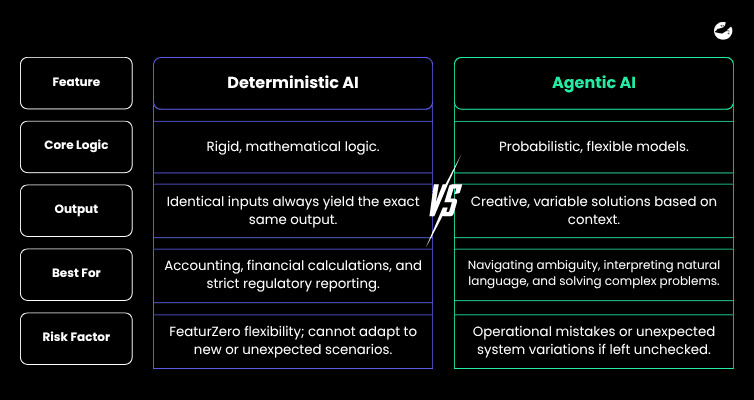
When designing an automated enterprise ecosystem, software architects must carefully balance two distinct technical concepts: Deterministic vs. Agentic AI. Deterministic systems operate on rigid, mathematical logic where identical inputs always yield the exact same output. This absolute predictability is essential for core business tasks like accounting, financial calculations, and strict regulatory reporting where error margins must remain at zero. On the other hand, agentic systems use probabilistic models to navigate ambiguous scenarios, interpret natural human language, and find creative solutions to complex problems. Relying entirely on agentic flexibility without structural limits, however, introduces unacceptable risks of operational mistakes or unexpected system variations within an enterprise environment.
The ideal solution lies in blending these two approaches by placing flexible cognitive models inside structured, deterministic software code. In this hybrid layout, the deterministic software code acts as a reliable running track, while the agentic model provides the intellectual agility to navigate changing situations along the way. Achieving this perfect technical balance requires deep digital consultancy services and a thorough understanding of advanced UI/UX product design. By carefully mapping out every step of your user journey, developers ensure that human workers interact naturally with these hybrid automated workflows. Striking this balance protects your core enterprise data stability while unlocking the incredible speed and adaptability of modern autonomous operations.
Security, Compliance, and Control: Implementing AI Guardrails and Audit Logs
Allowing autonomous digital workers to interact directly with real-world business systems requires the absolute highest levels of data security and operational compliance. Without strict boundaries, an autonomous system could accidentally overwrite critical database fields, misinterpret sensitive vendor agreements, or expose confidential client details. To prevent these dangerous errors, organizations must implement comprehensive AI Guardrails directly into their software architecture. These software guardrails act as strict digital walls, preventing autonomous systems from executing unapproved actions, accessing restricted data folders, or sending unverified communications to external clients.
Beyond boundaries, true operational compliance relies heavily on complete transparency, achieved through advanced AI Observability & Audit Logs. Every single choice, data lookup, and system modification made by an autonomous agent must be immutably recorded in a secure, searchable log file. This detailed tracking allows corporate compliance teams to easily audit the system's logic and verify exactly why a specific action occurred. Additionally, implementing an explicit Human-in-the-Loop (HITL) framework ensures that high-risk choices such as approving major financial transactions or updating legal agreements—always pause for final human verification. By introducing rigorous Agentic Governance & Compliance frameworks, full-stack developers protect sensitive corporate assets while empowering the organization to scale its automated labor securely.
Transforming Real-World Enterprises: Practical Case Studies and Core Competencies
The theoretical benefits of autonomous digital systems are compelling, but their true value shines through practical application across complex industries. The adoption of intelligence layers extends directly into lifestyle, media, and digital commerce industries, proving that custom agentic systems can fundamentally rethink complex consumer and creative operations:
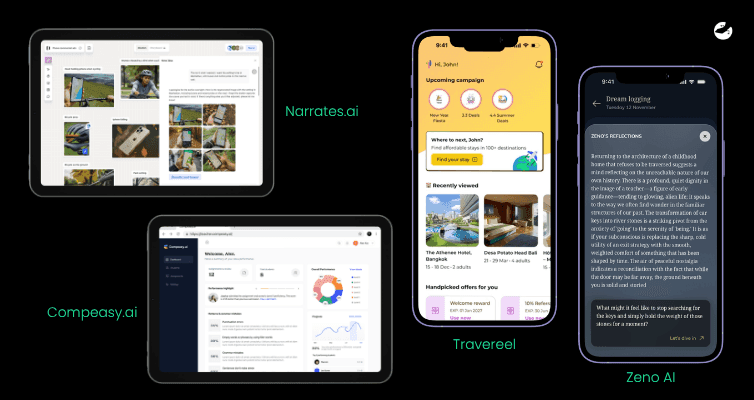
- Travereel: In the tourism and travel space, Travereel introduces an all-in-one next-generation mobile platform that redefines vacation planning. By combining AI-powered itinerary coordination (powered by their conversational assistant, Vicky) with social video sharing, hotel bookings, real-time group collaboration, and automated expense tracking, the platform eliminates fragmented planning steps and creates highly engaging, monetizable user journeys.
- Zeno AI: Addressing specialized personal wellness needs, Zeno AI functions as an intelligent, secure mental health companion platform. Through structured engineering workshops and a robust proof-of-concept, it deploys custom cognitive architectures to deliver conversational guidance, reflective journaling frameworks, and automated emotional pattern tracking to support long-term emotional resilience.
- Narrates.ai: Within media and marketing ecosystems, Narrates.ai builds a powerful bridge across the video pre-production communication divide. The platform utilizes advanced generative frameworks to instantly transform text-based creative prompts into rich visual storyboards and narrative outlines, streamlining agency workflows and keeping corporate brand goals perfectly aligned with creative outputs.
- Compeasy.ai: Revolutionizing digital trade and commercial sourcing, Compeasy.ai acts as a visual-first global product intelligence platform for e-commerce entrepreneurs. By blending image recognition pipelines with large language models, it allows sourcing professionals to upload photos or screenshots and immediately receive automated, real-time calculations regarding global procurement costs, profit margins, competitor price matching, and regional market demand.
Ready to Revolutionize Your Enterprise Operations?
Do not let fragmented legacy systems and manual data silos slow down your corporate growth. The future of business efficiency belongs to organizations that successfully connect autonomous digital solutions with their core operational platforms. As an international full-stack digital solutions agency, Lizard Global combines world-class European product strategy with exceptional software engineering to build secure, scalable agentic workflows tailored precisely to your strategic goals.
👉Contact our digital consultancy services team today to schedule an enterprise automation workshop and take your first step toward true digital transformation!
FAQs

What is Agentic AI for Enterprise and how does it differ from traditional business automation?
How does a custom software development company ensure autonomous agents do not corrupt live databases?
Why is a Human-in-the-Loop (HITL) framework necessary for enterprise AI orchestration?
Can your mobile app development agency connect autonomous digital workflows to iOS and Android applications?
What role do AI Observability & Audit Logs play in corporate governance and regulatory compliance?
How do CRM integration services enhance the capabilities of autonomous business agents?
Why should an enterprise choose a digital transformation partner like Lizard Global for AI integration?
similar reads

Case Studies & Interviews
Travereel: How a Digital Travel Experience Platform Demonstrates the Power of Strategic AI Product Development
7 May 2026

AI & Machine Learning
Enterprise Digital Transformation Services Powered by AI Integration
15 June 2026

AI & Machine Learning
The Hidden Data-Readiness Work That Decides Whether Your AI Integration Succeeds
7 September 2026
Stuck between a great idea and the right team to build it?Let's talk.
We work with corporate innovation teams and ambitious scale-ups across the Netherlands, Singapore, and Australia, and wherever great software needs to be built. Drop us a message and we'll get back to you within one business day.


Markus Monnikendam
Global Commercial Director
hello@lizard.global