
The Hidden Data-Readiness Work That Decides Whether Your AI Integration Succeeds

07 Sep 2026
by Nadiy, Senior Content Writer
07 Sep 2026
by Nadiy, Senior Content Writer
The Hidden Data-Readiness Work That Decides Whether Your AI Integration Succeeds
Table of contents
How Do Data Silos and Incomplete Records Sabotage Enterprise AI?
What Does Building an AI-Ready Unified Data Architecture Require?
Why Is Context Engineering More Critical Than Prompt Engineering?
How Does Strict Data Governance Prevent AI Security Risks and Technical Debt?
Why Should Enterprises Choose Full-Stack Development Experts Like Lizard Global for AI Integration?
Transform Your Enterprise Data Foundation with Lizard Global Today
Contact us
We will get back to you in the next 48 hours.
Most enterprise AI projects do not fail because of weak algorithms or bad prompts; they fail because the underlying data is unorganized, inaccessible, or incomplete. Industry benchmarks reveal that up to 80% of enterprise AI initiatives get abandoned or fail to deliver a measurable return on investment due to poor data readiness. To build generative AI tools, predictive platforms, or automated workflows that deliver real value, organizations must clean, structure, and govern their data foundations first. At Lizard Global, we have guided clients through complex digital transformations by prioritizing robust data pipelines and seamless system architecture. In this guide, we reveal the five non-negotiable data-readiness phases every enterprise must execute before scaling artificial intelligence, sharing insights from our hands-on engineering experience across logistics, fintech, and digital health.
key takeaways
To deploy an AI integration that actually works, we must fix the underlying data pipelines before writing complex algorithms or building UI components. Most enterprises jump straight to model selection and prompt engineering, only to see their AI projects stall or fail because their internal data is fragmented, locked in legacy software, or filled with missing fields.
At Lizard Global, we have seen firsthand that successful enterprise AI deployment relies on structured data engineering, context optimization, and secure API integrations. Industry research consistently shows that up to 80% of AI project failures stem from poor data quality rather than bad model architecture. In fact, Gartner predicts that through 2026, organizations will abandon 60% of AI initiatives that lack proper AI-ready data. If we want our machine learning models and generative AI agents to return accurate insights, we must execute the unglamorous data preparation work first.
How Do Data Silos and Incomplete Records Sabotage Enterprise AI?
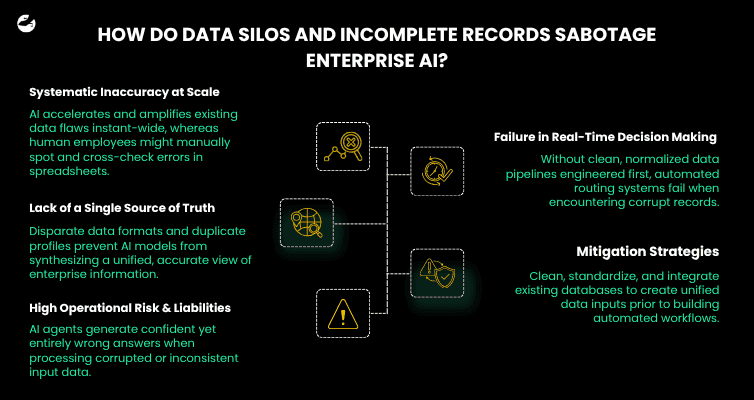
When we connect AI models to uncleaned enterprise systems, missing records and disparate formats turn promising automation pilots into operational liabilities. If fifteen percent of our customer profile records lack historical transactional details, any AI agent relying on that data to personalize customer outreach will fail fifteen percent of the time. Enterprise data usually lives across isolated platforms like Salesforce, SAP, custom internal databases, and third-party APIs. When these systems speak different languages or store duplicate profiles, the AI model cannot establish a single source of truth.
The primary danger here is that artificial intelligence amplifies existing data flaws at scale. If human employees manually cross-check spreadsheets to catch data errors, an automated AI agent will process those same errors instantly, producing confident yet completely inaccurate answers. We prevent this by establishing automated data validation gates and cleaning existing databases before deploying inference models.
When working with clients in the transport and logistics sector such as our work with DEXTR to streamline real-time dispatching and ride options, we face massive amounts of real-time tracking data and operational records. Before building seamless tracking tools and smart dispatch features, clean data pipelines must be engineered to normalize location inputs, transaction status codes, and driver logs across the operational ecosystem. By standardizing these data inputs first, automated systems can route operations and update statuses accurately without failing due to corrupt records.
What Does Building an AI-Ready Unified Data Architecture Require?
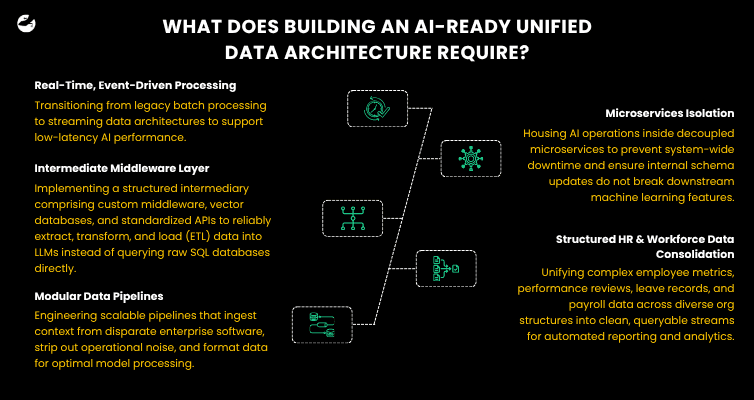
Creating an AI-ready environment requires moving away from static batch processing toward real-time, event-driven data architectures. We cannot simply dump raw SQL databases into a Large Language Model and expect reliable performance. Instead, we must build an intermediate layer of custom middleware, vector databases, and standardized APIs that extract, transform, and load clean data into the AI processing environment.
This architectural foundation relies on modular data pipelines that extract context from disparate enterprise software, strip out noise, and format the data so the model can process it efficiently. By isolating your AI operations within structured microservices, we prevent system-wide downtime and ensure that schema updates in one internal application do not break downstream machine learning features.
We applied this exact architectural approach when engineering workforce solutions like Talent Portal and employee matching systems like GetHired. Modern HR management platforms need to consolidate complex employee metrics, performance reviews, leave tracking, and payroll data across diverse organization structures. Designing robust backend data pipelines that structure raw HR metrics into clean, queryable data streams allows platforms to generate accurate analytics and automated reporting seamlessly, giving managers actionable insights without data discrepancies.
Why Is Context Engineering More Critical Than Prompt Engineering?
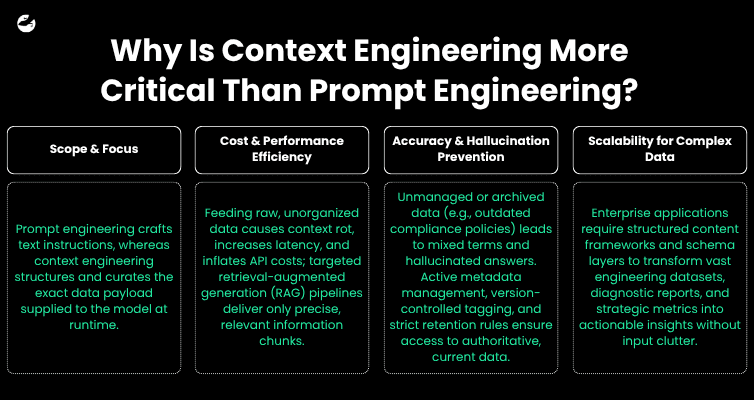
While prompt engineering focuses on drafting better instructions for an AI chatbot, context engineering structures the exact, relevant payload of data fed to the model at runtime. Providing an AI model with too much raw, unorganized information leads to context rot, high latency, and increased API costs. We must build retrieval-augmented generation (RAG) pipelines that fetch only the most precise, up-to-date chunks of information relevant to the user's specific request.
Context engineering also means setting up active metadata management to prevent outdated documents from corrupting your output. If an AI retrieval system pulls an archived compliance policy from three years ago alongside the current policy, it will mix terms and hallucinate incorrect answers. We implement version-controlled metadata tagging and clear retention rules so the model always accesses current, authoritative data.
During our work with complex analytics tools, such as developing the AI-powered inspection platform Parexus, context accuracy was essential. Handling vast amounts of complex engineering data, diagnostic reports, and strategic metrics requires structured content frameworks and intuitive data-handling workflows. By organizing raw research into well-defined schema layers, complex data sets become instantly accessible and digestible for corporate decision-makers, eliminating the confusion caused by cluttered or outdated inputs.
How Does Strict Data Governance Prevent AI Security Risks and Technical Debt?
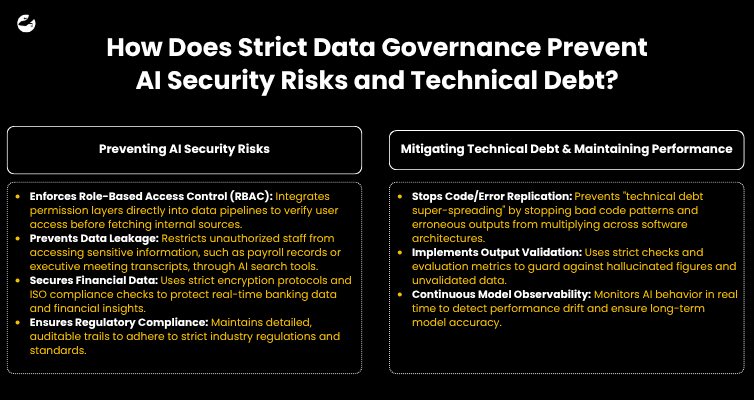
Integrating AI tools into enterprise workflows introduces distinct security vulnerabilities, including data leakage, unauthorized access to sensitive records, and regulatory non-compliance. Without role-based access control built directly into your data pipeline, an AI search tool might accidentally reveal sensitive payroll records or executive meeting transcripts to unauthorized staff. We build granular governance layers that verify user permissions before fetching any internal data sources.
Furthermore, ungoverned AI integrations create technical debt super-spreading, where bad code patterns or erroneous outputs get automatically replicated across your software architecture. We stop this debt from accumulating by implementing evaluation metrics, model observability tools, and strict output validation checks.
These guardrails monitor model behavior continuously to detect performance drift, guard against hallucinated figures, and maintain auditable trails for regulatory compliance.
We prioritized these stringent security and governance standards when building platforms in the FinTech space like ViroPay and real-time transaction apps like GWAP. Handling real-time financial data and sensitive banking information leaves zero room for security slip-ups or unvalidated data handling. We engineer strict encryption protocols, ISO compliance checks, and precise access permission layers to safeguard user data. This ensures that automated financial insights remain accurate, secure, and compliant with financial industry regulations.
Why Should Enterprises Choose Full-Stack Development Experts Like Lizard Global for AI Integration?
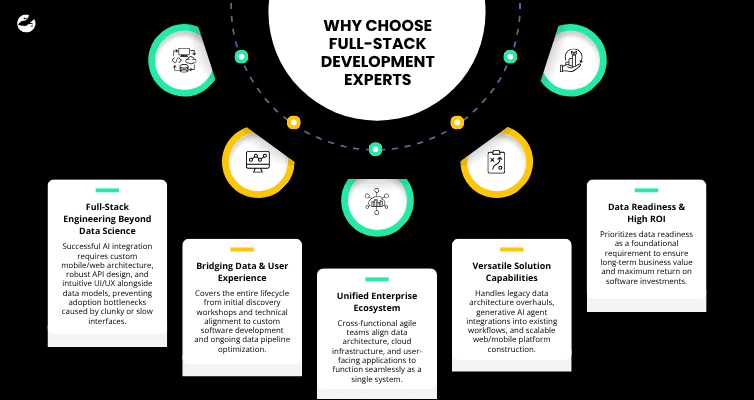
Successful AI deployment is never just a data science project; it is a full-stack engineering challenge that requires custom mobile and web architecture, seamless API design, and intuitive UI/UX workflows. If your AI backend generates intelligent predictions, but your front-end interface is clunky or slow, your internal teams or end customers will refuse to adopt the technology.
At Lizard Global, we bridge the gap between complex data preparation and user experience design. We work with enterprises from initial discovery workshops and technical alignment through to custom software development and ongoing data pipeline optimization. Our cross-functional agile teams ensure that your underlying data architecture, cloud infrastructure, and user-facing applications function together as a single enterprise ecosystem.
Whether you need to overhaul legacy data architectures, integrate generative AI agents into existing workflows, or construct scalable web and mobile platforms, our software development experts bring proven technical mastery to every project. We treat data readiness as an essential foundation, ensuring your software investments deliver long-term business value and high return on investment.
Transform Your Enterprise Data Foundation with Lizard Global Today
Building an AI integration that scales requires moving past surface-level demos and focusing on the core software infrastructure that powers intelligent enterprise systems. If your organization is ready to clean its data pipelines, integrate scalable AI capabilities, and launch high-performing custom applications, Lizard Global is your end-to-end technical partner.

We collaborate with forward-thinking enterprises to design, engineer, and deploy digital products that solve complex business challenges. Contact Lizard Global today to consult with our software architects and start building your AI-ready data foundation.
FAQs

What is AI-ready data for enterprise applications?
Why do most enterprise AI integration projects fail?
How long does a data readiness assessment take?
What is the difference between prompt engineering and context engineering?
How does Lizard Global help enterprises prepare data for AI integration?
How do we prevent AI models from leaking sensitive enterprise data?
Can we integrate AI capabilities into our existing legacy software systems?
similar reads

Case Studies & Interviews
Lereng Tanah: Developing a Direct Booking Platform Malaysian Boutique Villa
29 January 2026

Case Studies & Interviews
Tactlink: How a Malaysian Entrepreneur Turned Networking Chaos into a Digital Community
22 January 2026

Software Development
Who Are the Top Software Development Vendors in Amsterdam for 2026?
26 August 2026
Stuck between a great idea and the right team to build it?Let's talk.
We work with corporate innovation teams and ambitious scale-ups across the Netherlands, Singapore, and Australia, and wherever great software needs to be built. Drop us a message and we'll get back to you within one business day.


Markus Monnikendam
Global Commercial Director
hello@lizard.global