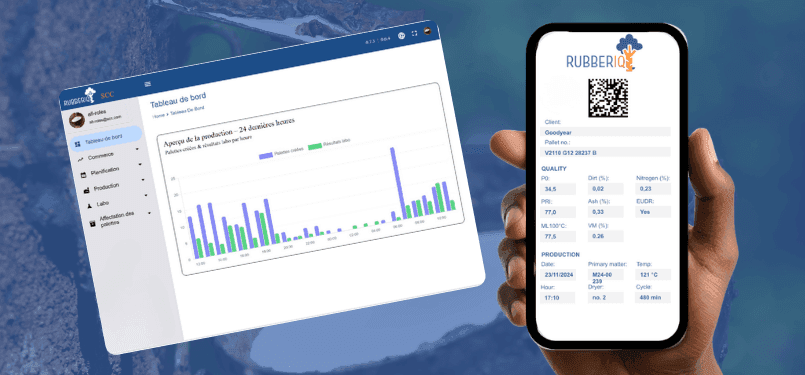
How Digital Twin Technology Transforms Traceability in Rubber Manufacturing

21 Oct 2026
by Nadiy, Senior Content Writer
Contributor, Jeremy Raes, CEO & Co-Founder
21 Oct 2026
by Nadiy, Senior Content Writer
Contributor, Jeremy Raes, CEO & Co-Founder
How Digital Twin Technology Transforms Traceability in Rubber Manufacturing
Table of contents
Why Is Paperless Digital Traceability Essential for Modern Rubber Plants?
How Does a Digital Twin Passport Work on the Factory Floor?
What Role Does Integrated Laboratory Software Play in Process Optimization?
How Do Automated Compliance Engine Features Match Pallets to Global Buyer Contracts?
What Concrete Results Show the Impact of RubberIQ in Enterprise Processing Facilities?
How Does Digital Twin Architecture Secure Enterprise Supply Chain Transparency?
Transform Your Industrial Operations With Lizard Global
Contact us
We will get back to you in the next 48 hours.
Natural rubber processing facilities face increasing regulatory pressure and stringent client specifications from global tire manufacturers like Michelin and Goodyear. Legacy paper-based record-keeping introduces high transcription error rates, audit risks, and operational bottlenecks. This article explores how modernizing rubber manufacturing with digital twin traceability transforms raw factory floor data into actionable intelligence. By integrating real-time telemetry, automated laboratory information management (LIMS), and intelligent buyer contract matching, processing plants achieve zero human data entry errors, end-to-end EUDR compliance, and instantaneous Certificate of Analysis (COA) generation.
key takeaways
Natural rubber processing plants operate under high-volume pressure, converting field latex and cup lump into standardized industrial rubber bales. As global buyers such as Goodyear and Michelin demand increasingly rigorous quality and origin verification standards, natural rubber processors face severe data management challenges. Historically, critical plant parameters and laboratory quality metrics were logged by hand on physical paper journals. We solve complex operational bottlenecks by replacing these outdated manual paper logs with custom digital platform ecosystems.
Today, regulatory frameworks like the European Union Deforestation Regulation (EUDR) require complete digital supply chain visibility alongside automated Process Capability (Cpk) validation. We turn physical factory output into a fully connected digital ecosystem. Through custom digital twin architectures, we bridge the gap between factory floor production and high-level enterprise resource planning.
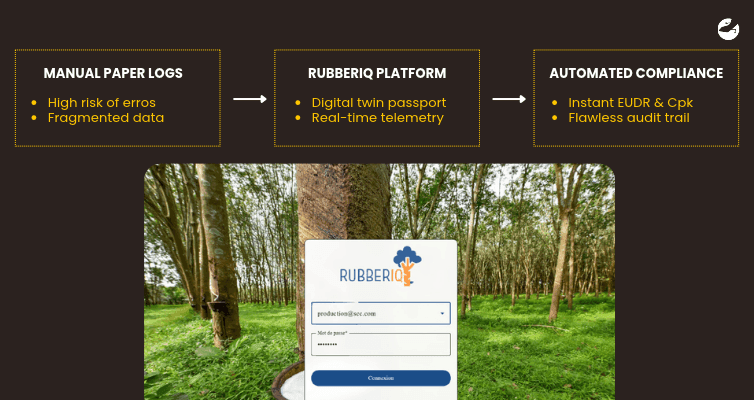
How do digital twin systems modernize legacy rubber factories? We digitize operations from initial raw material processing to final pallet storage by linking physical goods to cloud data platforms. Our technology tracks dryer temperatures, acid dosing, and laboratory quality tests in real time. As a result, factory managers monitor production continuously while ensuring total compliance for global enterprise clients.
At Lizard Global, we leverage deep cross-industry software expertise to architect robust digital platforms that streamline complex operational workflows across international industrial environments.
Why Is Paperless Digital Traceability Essential for Modern Rubber Plants?
We observe that legacy paper logs create significant risks for industrial processing plants. Factory technicians frequently write crucial laboratory data on paper logbooks, leading to transcription errors, fragmented data sets, and lost historical records. Global buyers now demand automated statistical process control (SPC) and strict EUDR origin verification before accepting international shipments. Manual tracking cannot support these fast-paced, high-volume data requirements, leaving plants vulnerable to costly non-conformity disputes and rejected deliveries.
We address this gap by establishing digital twin platforms that digitize every stage of factory operations. When operators create a physical rubber pallet, our software assigns a unique digital passport to that item instantly. This paperless workflow connects direct laboratory metrics to individual pallet serial numbers. Consequently, processing facilities reduce data errors, lower administrative overhead, and protect themselves against non-conformity claims.
Furthermore, transitioning from manual paper registers to cloud-native platforms allows remote executive teams to maintain full oversight over decentralized processing facilities. Rather than waiting for end-of-month manual reports, managers evaluate daily yield figures, track laboratory testing queues, and confirm regulatory compliance status in real time. Digital traceability transforms quality assurance from a slow administrative bottleneck into a responsive competitive advantage.
How Does a Digital Twin Passport Work on the Factory Floor?
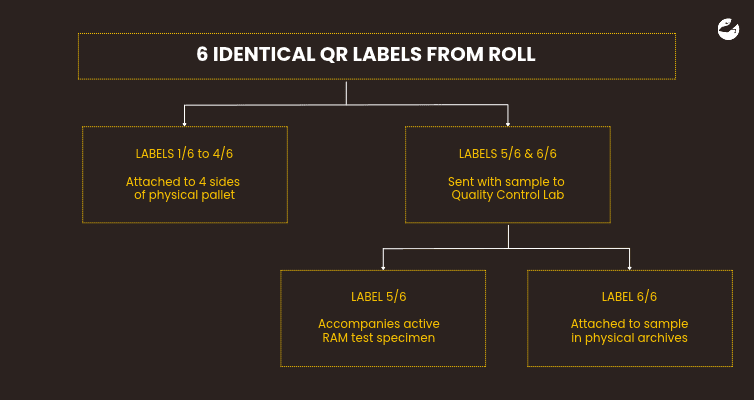
We design intuitive digital workflows that streamline physical factory tasks rather than slowing down production speed. The digital twin lifecycle begins directly on the shop floor during pallet compression. When operators load the third layer of rubber bales into a pallet container, the system assigns a unique SCC pallet ID. Operators then utilize a multi-label QR code protocol to connect physical assets to the software platform.
Operators detach a strip of six identical QR labels from a pre-printed roll. Labels one through four attach directly to the four outer sides of the physical pallet container. Labels five and six attach to physical samples sent directly to the quality control laboratory. Using mobile devices or industrial computers, operators enter the manual SCC ID, scan the QR code, and assign the active dryer unit.
To guarantee absolute process integrity, production operators record actual observed shop floor telemetry rather than assumed machine controller settings. These hourly logged parameters ensure complete context for every batch:
- Dryer Parameters: Dryer ID, Burner 1 Temperature (°C), Burner 2 Temperature (°C), and total Cycle Duration (minutes).
- Acid Dosage: Acid Mixture Type (such as Oxalic 67% / Phosphoric 33%), Spray Time (seconds), and Acid Concentration (g/L).
By recording these live variables in ProductionIQ, we ensure that every physical unit possesses an accurate digital record in the cloud platform. Transitioning from paper logs to digital inputs gives management instant visibility into hourly dryer performance and chemical dosing consistency.
What Role Does Integrated Laboratory Software Play in Process Optimization?
We integrate specialized Laboratory Information Management Systems (LIMS) directly into the core production architecture through modules like LabIQ. When physical samples reach the quality testing station, label five stays with the active test specimen, while label six attaches to the physical archival reference sample in SampleIQ. Technicians perform seven mandatory standard Rubber Analytical Method (RAM) procedures and input results directly into the system using either the SCC Pallet ID or the QR code.
The software systematically tracks seven core laboratory parameters essential for international trade:
- RAM R102: Initial Plasticity (P0)
- 2.RAM R103: Plasticity Retention Index (PRI)
- 3.RAM R104: Mooney Viscosity ($ML_{100^\circ\text{C}}$)
- 4.RAM R105: Impurities Content / Dirt (%)
- 5.RAM R106: Volatile Matter Content (VM %)
- 6.RAM R107: Ash Content (%)
- 7.RAM R108: Nitrogen Content (%)
We automate data ingestion to ensure test results attach directly to the correct pallet digital twin. Instead of searching through physical binder archives, quality assurance managers inspect live dashboards that plot batch results in real time. The platform continuously tracks process capability indices like Cpk, ensuring early detection of quality drifts. This direct connection between lab data and batch IDs eliminates human transcription errors entirely.
How Do Automated Compliance Engine Features Match Pallets to Global Buyer Contracts?
We develop intelligent software engines that handle complex client contract matching automatically. Major international tire manufacturers require strict, custom material specifications for every delivered order. Sorting through hundreds of production pallets manually to find compliant batches costs enterprise managers valuable hours and introduces substantial human error risks.
We solve this issue by programming automated contract eligibility modules into the digital twin platform. The system analyzes every laboratory metric against target buyer criteria automatically.
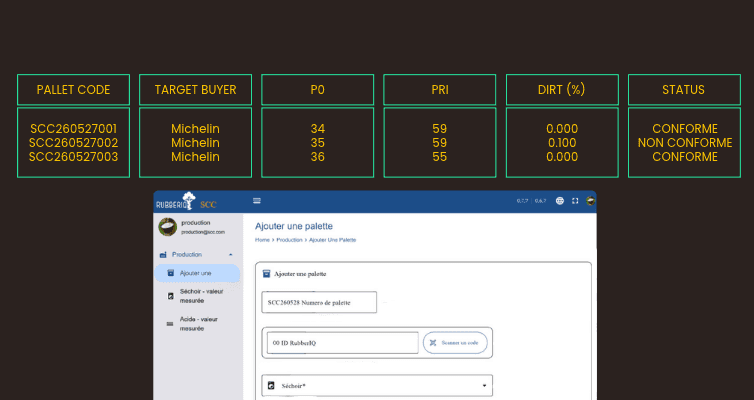
Our software instantly flags pallets as compliant or non-compliant for specific client contracts. Authorized lab managers generate customer-ready Certificates of Analysis (COA) with a single click, dramatically accelerating inventory dispatch and sales turnover. At Lizard Global, our experience constructing user-centric digital products enables us to design complex algorithmic rule engines with clean, accessible management interfaces that simplify day-to-day decision making.
What Concrete Results Show the Impact of RubberIQ in Enterprise Processing Facilities?
We demonstrate real-world success through the deployment of RubberIQ across active industrial rubber processing plants. In partnership with leading agricultural management group Socfin, the RubberIQ suite was implemented to digitize primary rubber processing facilities in West Africa, including operational sites in Côte d'Ivoire such as CCP and SOGB. Before our intervention, facility technicians logged dryer temperatures and lab results using handwritten paper forms.
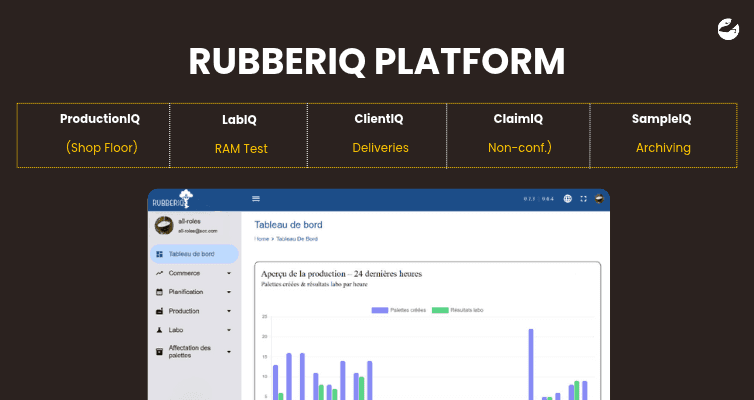
We deployed RubberIQ as a unified digital twin platform, integrating modular tools like ProductionIQ, LabIQ, ClientIQ, ClaimIQ, and SampleIQ. The platform successfully replaced manual paper registers across active plant sites without causing operational downtime.
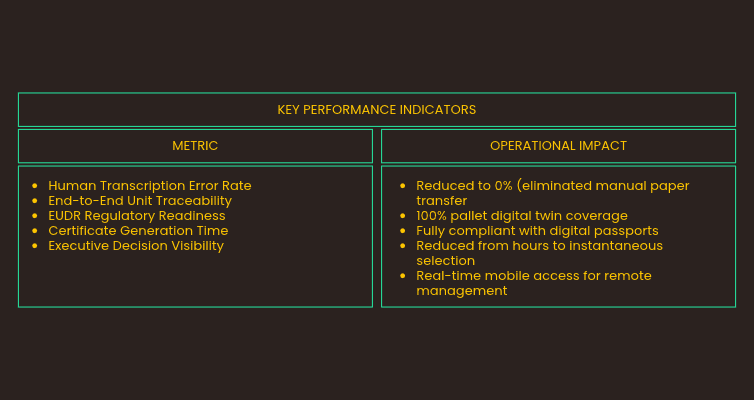
Plant managers now monitor real-time hourly output on centralized dashboards while maintaining full EUDR compliance logs. Operators effortlessly scan QR passports to track pallets from initial slab cutting to final container shipping, ensuring zero lost data entries. Similar to our work designing scalable enterprise platforms across fintech, logistics, and healthcare sectors, Lizard Global prioritizes robust system architecture that seamlessly handles complex operational workflows under demanding physical conditions.
How Does Digital Twin Architecture Secure Enterprise Supply Chain Transparency?
We build enterprise software solutions that give high-level executives complete oversight over remote operational facilities. Headquarter executives log into centralized dashboards to track live output, monitor non-conformities, and audit EUDR origin certifications instantly. This level of operational transparency enhances corporate reputation among global buyers and minimizes regulatory compliance risks.
We future-proof manufacturing facilities by establishing a single source of truth for all operational metrics. Our cloud platform interfaces seamlessly with existing plant ERP tools and weighbridge systems. By maintaining comprehensive historical logs for every manufactured pallet, companies mitigate dispute claims, optimize factory throughput, and secure long-term commercial contracts.
Transform Your Industrial Operations With Lizard Global
We at Lizard Global build tailored, enterprise-grade software platforms that solve real-world industrial challenges. Whether you need to digitize manual factory workflows, deploy IoT tracking platforms, or ensure strict international regulatory compliance like EUDR, our team delivers custom, end-to-end software solutions tailored to your unique supply chain requirements.

Contact Lizard Global
today to schedule an expert consultancy session and accelerate your manufacturing digital transformation.
FAQs

How does digital twin technology eliminate transcription errors in rubber processing?
How does digital twin traceability ensure compliance with European Union Deforestation Regulation (EUDR) standards?
Can RubberIQ be deployed in rubber processing plants without operational downtime?
What core laboratory parameters are tracked in the LabIQ module?
How does automated contract eligibility matching accelerate shipment dispatch?
How does digital twin architecture integrate with existing factory ERP and weighbridge systems?
Why choose Lizard Global as a digital transformation partner for industrial manufacturing?

Stuck between a great idea and the right team to build it?Let's talk.
We work with corporate innovation teams and ambitious scale-ups across the Netherlands, Singapore, and Australia, and wherever great software needs to be built. Drop us a message and we'll get back to you within one business day.


Markus Monnikendam
Global Commercial Director
hello@lizard.global