E-Commerce
International Growth
+ 2 more ...
Choosing the Right E-commerce Architecture for International Growth

19 Mar 2026
by Team Lizard Global
Editor: Nadiy, Senior Content Writer
19 Mar 2026
by Team Lizard Global
Editor: Nadiy, Senior Content Writer
E-Commerce
International Growth
Mobile App Development
Custom Software Development
Choosing the Right E-commerce Architecture for International Growth
Table of contents
Contact us
We will get back to you in the next 48 hours.

International growth demands more than translated product pages and multi-currency checkout. It requires a scalable, secure, and flexible e-commerce architecture that supports localization, performance, compliance, omnichannel experiences, and rapid innovation. In this guide, we explore how enterprises and scale-ups can choose between monolithic, headless, and composable commerce models while aligning technology with long-term global strategy. We explain when to invest in custom development, how to integrate CRM and growth analytics, and why UI/UX design plays a crucial role in cross-border success. With insights drawn from real-world implementations and digital transformation experience across industries, this article provides a practical framework for decision-makers preparing to scale internationally.
key takeaways
In an era where geographic boundaries are becoming secondary to digital accessibility, the leap from a local business to an international powerhouse depends on more than just a great product. For modern enterprises, the secret to sustainable expansion lies in the technical foundation of their online presence. As a leading software development company in the Netherlands and beyond, we have seen firsthand how a rigid system can stifle even the most ambitious growth plans.
True international success requires a shift in perspective: viewing your platform not just as a shop, but as a flexible ecosystem. Whether you are exploring custom e-commerce solutions to reach new markets or looking to optimize your existing user experience, your architectural choices today will define your conversion rates tomorrow. By integrating design thinking with scalable technology, businesses can create seamless, cross-border journeys that resonate with users from Amsterdam to Kuala Lumpur.
In this blog, we dive deep into how the right e-commerce architecture serves as the ultimate strategic lever for global scaling.
1. Why E-commerce Architecture Determines International Success
When companies expand internationally, they often focus on marketing, logistics, and partnerships first. However, the real constraint usually sits beneath the surface. Your e-commerce architecture determines how quickly you can launch in new regions, localize experiences, integrate payment systems, and handle peak traffic across time zones.

In other words, architecture is not an IT afterthought. It is a strategic growth lever. If your system struggles with multi-language content, localized pricing, regional tax rules, or third-party integrations, your expansion will slow down. Moreover, performance issues in new markets can directly impact conversion rates. International customers expect fast loading times, intuitive navigation, and seamless checkout, regardless of location.
As a digital transformation partner working with scale-ups and enterprises, we often see businesses outgrow their initial platforms. What worked for a domestic market does not automatically scale globally. Therefore, choosing the right architecture early, or refactoring at the right moment, becomes critical for sustainable international growth.
2. Monolithic vs Headless vs Composable Commerce: What Should Enterprises Choose?
The first architectural decision revolves around structure.
Monolithic Architecture
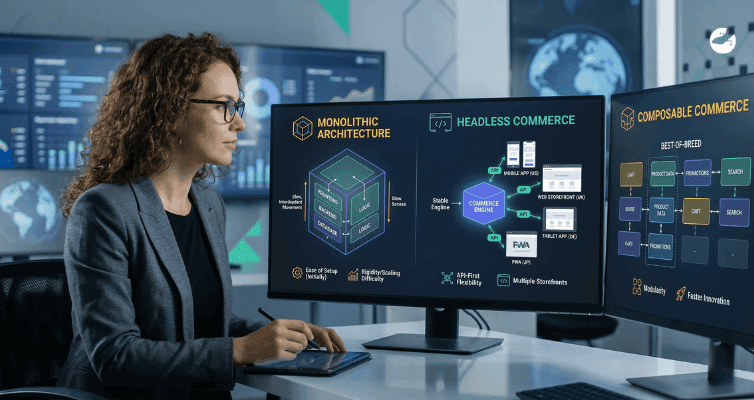
Traditional monolithic e-commerce platforms bundle frontend, backend, database, and business logic into a single system. While this approach is easier to set up initially, it often becomes rigid over time. Customizations can be complex, and scaling specific components independently is difficult. For companies expanding internationally, monolithic systems may limit flexibility in localization and omnichannel expansion.
Headless Commerce
Headless commerce separates the frontend from the backend via APIs. This structure allows teams to build custom user interfaces while maintaining a stable commerce engine underneath. This model works particularly well for enterprises requiring:
- Multiple storefronts across regions
- Mobile app integration
- Progressive web app development
- Personalization at scale
A mobile app development agency with strong web development capabilities can build region-specific frontends while keeping the backend centralized. This allows faster international launches without rebuilding core commerce logic.
Composable Commerce
Composable commerce takes flexibility even further. Instead of relying on a single platform, you assemble best-of-breed services for payments, search, CMS, CRM, analytics, and fulfillment. Although composable architecture requires higher upfront investment, it enables long-term scalability and innovation.
As a full-stack digital solutions agency, we frequently guide organizations through digital consultancy services to determine which architecture aligns with their growth roadmap, technical maturity, and budget constraints.
3. Localization, Performance, and Compliance: Designing for Global Markets
Expanding internationally is not just about currency conversion. It requires deep architectural support for localization and regulatory compliance.
First, consider content localization. Your system must manage multi-language product catalogs and localized UX flows. Second, performance matters. A headless setup combined with CDN strategies improves performance, which is vital for iOS and Android app development.

Third, compliance cannot be ignored. Data protection regulations (like GDPR or PDPA) differ across regions. A custom software development company ensures security is integrated into the foundation.
In several international projects showcased in our works, scalability and compliance were addressed early:
- Travereel: Redefining social travel planning through user insights.
- Saleduck: Revolutionizing online shopping with AI in the e-commerce space.
- Heineken Drinkies: Using data to boost retention and conversion in the F&B industry.
4. Omnichannel Strategy: Web, Mobile, and Beyond
International growth rarely happens through a single channel. Therefore, your e-commerce architecture must support omnichannel experiences.
Integrating cross-platform app development ensures that customers can access optimized experiences. Through integrated UI/UX design services, businesses can unify brand experiences across platforms. This is evident in our work with Hitachi Air Partners Rewards, where we revolutionized loyalty programs through seamless digital integration.

Moreover, CRM integration allows you to personalize experiences across channels, gaining a 360-degree view of your international customers.
5. UI/UX Design for Cross-Border Conversion Optimization
Even the most scalable architecture will fail without strong UX. Cultural differences influence purchasing behavior; therefore, UI/UX design must adapt to local expectations.

By leveraging growth analytics, businesses can monitor conversion rates by region. Our blog insights on digital strategy consistently highlight the importance of aligning design with technical architecture. For instance, the Bitewatch case study shows how nutritional transparency and a clean interface can become a new standard for user engagement.
6. Integration Strategy: CRM, ERP, Payments, and Growth Analytics
International scaling increases system complexity. Your e-commerce architecture must integrate seamlessly with:
- CRM systems
- Payment gateways
- Growth analytics platforms

Successful integration requires strategic oversight. This is where digital workshops like our Digital Transformation workshop play a critical role. We focus on building secure API layers that allow modular expansion, as seen in the Afflink platform, which centralizes affiliate discounts.
7. Build vs Buy: When to Invest in Custom E-commerce Development
Not every company needs fully custom architecture from day one. However, international growth often exposes the limitations of off-the-shelf solutions.
If your platform restricts API access or limits localization, it may be time to consider custom software development. The decision should be strategic, weighing ROI and scalability. As seen with IGGI, custom data-driven property management solutions can transform a market when off-the-shelf tools fall short.
Ready to Scale Internationally?
International growth is not just about entering new markets. It is about building infrastructure that supports sustained expansion, innovation, and operational resilience.

If you are evaluating your current e-commerce architecture, use our cost estimator to plan your next move. As a digital transformation partner, we help enterprises design future-ready commerce ecosystems - Contact us today!
International growth demands more than translated product pages and multi-currency checkout. It requires a scalable, secure, and flexible e-commerce architecture that supports localization, performance, compliance, omnichannel experiences, and rapid innovation. In this guide, we explore how enterprises and scale-ups can choose between monolithic, headless, and composable commerce models while aligning technology with long-term global strategy. We explain when to invest in custom development, how to integrate CRM and growth analytics, and why UI/UX design plays a crucial role in cross-border success. With insights drawn from real-world implementations and digital transformation experience across industries, this article provides a practical framework for decision-makers preparing to scale internationally.
In an era where geographic boundaries are becoming secondary to digital accessibility, the leap from a local business to an international powerhouse depends on more than just a great product. For modern enterprises, the secret to sustainable expansion lies in the technical foundation of their online presence. As a leading software development company in the Netherlands and beyond, we have seen firsthand how a rigid system can stifle even the most ambitious growth plans.
True international success requires a shift in perspective: viewing your platform not just as a shop, but as a flexible ecosystem. Whether you are exploring custom e-commerce solutions to reach new markets or looking to optimize your existing user experience, your architectural choices today will define your conversion rates tomorrow. By integrating design thinking with scalable technology, businesses can create seamless, cross-border journeys that resonate with users from Amsterdam to Kuala Lumpur.
In this blog, we dive deep into how the right e-commerce architecture serves as the ultimate strategic lever for global scaling.
1. Why E-commerce Architecture Determines International Success
When companies expand internationally, they often focus on marketing, logistics, and partnerships first. However, the real constraint usually sits beneath the surface. Your e-commerce architecture determines how quickly you can launch in new regions, localize experiences, integrate payment systems, and handle peak traffic across time zones.
In other words, architecture is not an IT afterthought. It is a strategic growth lever. If your system struggles with multi-language content, localized pricing, regional tax rules, or third-party integrations, your expansion will slow down. Moreover, performance issues in new markets can directly impact conversion rates. International customers expect fast loading times, intuitive navigation, and seamless checkout, regardless of location.
As a digital transformation partner working with scale-ups and enterprises, we often see businesses outgrow their initial platforms. What worked for a domestic market does not automatically scale globally. Therefore, choosing the right architecture early, or refactoring at the right moment, becomes critical for sustainable international growth.
2. Monolithic vs Headless vs Composable Commerce: What Should Enterprises Choose?
The first architectural decision revolves around structure.
Monolithic Architecture
Traditional monolithic e-commerce platforms bundle frontend, backend, database, and business logic into a single system. While this approach is easier to set up initially, it often becomes rigid over time. Customizations can be complex, and scaling specific components independently is difficult. For companies expanding internationally, monolithic systems may limit flexibility in localization and omnichannel expansion.
Headless Commerce
Headless commerce separates the frontend from the backend via APIs. This structure allows teams to build custom user interfaces while maintaining a stable commerce engine underneath. This model works particularly well for enterprises requiring:
- Multiple storefronts across regions
- Mobile app integration
- Progressive web app development
- Personalization at scale
A mobile app development agency with strong web development capabilities can build region-specific frontends while keeping the backend centralized. This allows faster international launches without rebuilding core commerce logic.
Composable Commerce
Composable commerce takes flexibility even further. Instead of relying on a single platform, you assemble best-of-breed services for payments, search, CMS, CRM, analytics, and fulfillment. Although composable architecture requires higher upfront investment, it enables long-term scalability and innovation.
As a full-stack digital solutions agency, we frequently guide organizations through digital consultancy services to determine which architecture aligns with their growth roadmap, technical maturity, and budget constraints.
3. Localization, Performance, and Compliance: Designing for Global Markets
Expanding internationally is not just about currency conversion. It requires deep architectural support for localization and regulatory compliance.
First, consider content localization. Your system must manage multi-language product catalogs and localized UX flows. Second, performance matters. A headless setup combined with CDN strategies improves performance, which is vital for iOS and Android app development.
Third, compliance cannot be ignored. Data protection regulations (like GDPR or PDPA) differ across regions. A custom software development company ensures security is integrated into the foundation.
In several international projects showcased in our works, scalability and compliance were addressed early:
- Travereel: Redefining social travel planning through user insights.
- Saleduck: Revolutionizing online shopping with AI in the e-commerce space.
- Heineken Drinkies: Using data to boost retention and conversion in the F&B industry.
4. Omnichannel Strategy: Web, Mobile, and Beyond
International growth rarely happens through a single channel. Therefore, your e-commerce architecture must support omnichannel experiences.
Integrating cross-platform app development ensures that customers can access optimized experiences. Through integrated UI/UX design services, businesses can unify brand experiences across platforms. This is evident in our work with Hitachi Air Partners Rewards, where we revolutionized loyalty programs through seamless digital integration.
Moreover, CRM integration allows you to personalize experiences across channels, gaining a 360-degree view of your international customers.
5. UI/UX Design for Cross-Border Conversion Optimization
Even the most scalable architecture will fail without strong UX. Cultural differences influence purchasing behavior; therefore, UI/UX design must adapt to local expectations.
By leveraging growth analytics, businesses can monitor conversion rates by region. Our blog insights on digital strategy consistently highlight the importance of aligning design with technical architecture. For instance, the Bitewatch case study shows how nutritional transparency and a clean interface can become a new standard for user engagement.
6. Integration Strategy: CRM, ERP, Payments, and Growth Analytics
International scaling increases system complexity. Your e-commerce architecture must integrate seamlessly with:
- CRM systems
- Payment gateways
- Growth analytics platforms
Successful integration requires strategic oversight. This is where digital workshops like our Digital Transformation workshop play a critical role. We focus on building secure API layers that allow modular expansion, as seen in the Afflink platform, which centralizes affiliate discounts.
7. Build vs Buy: When to Invest in Custom E-commerce Development
Not every company needs fully custom architecture from day one. However, international growth often exposes the limitations of off-the-shelf solutions.
If your platform restricts API access or limits localization, it may be time to consider custom software development. The decision should be strategic, weighing ROI and scalability. As seen with IGGI, custom data-driven property management solutions can transform a market when off-the-shelf tools fall short.
Ready to Scale Internationally?
International growth is not just about entering new markets. It is about building infrastructure that supports sustained expansion, innovation, and operational resilience.
If you are evaluating your current e-commerce architecture, use our cost estimator to plan your next move. As a digital transformation partner, we help enterprises design future-ready commerce ecosystems - Contact us today!
FAQs

What e-commerce architecture is best for international enterprise expansion?
When should an enterprise move from monolithic to headless commerce?
How does CRM integration improve international e-commerce growth?
Is custom e-commerce development necessary for global brands?
How important is UX design in cross-border e-commerce?
Can mobile apps support international e-commerce architecture?
What role does digital consultancy play in e-commerce architecture decisions?
similar reads