Scalability
Software Architecture
+ 2 more ...
Speed vs Stability: Mobile Architecture Trade-Offs at Scale

19 Mar 2026
by Team Lizard Global
Editor: Nadiy, Senior Content Writer
19 Mar 2026
by Team Lizard Global
Editor: Nadiy, Senior Content Writer
Scalability
Software Architecture
Mobile App Development
Custom Software Development
Speed vs Stability: Mobile Architecture Trade-Offs at Scale
Table of contents
Contact us
We will get back to you in the next 48 hours.

When scaling a digital product, speed alone is not enough. Enterprises must balance rapid feature delivery with architectural stability to ensure performance, security, and long-term scalability. In this blog, we explore the strategic trade-offs between velocity and resilience in mobile architecture. We break down native vs hybrid frameworks, modular design, DevOps automation, performance engineering, and UX alignment. Drawing insights from real-world projects and enterprise implementations, we examine how leading organizations approach mobile scalability without compromising stability. Whether you are modernizing legacy systems or launching new digital platforms, this guide offers practical insights into making architecture decisions that support sustainable growth.
key takeaways
Mobile architecture decisions define whether your digital product thrives under growth or collapses under its own success. At first, speed feels like the obvious priority. Markets move fast. Competitors iterate quickly. Stakeholders expect rapid delivery. However, stability determines whether that momentum is sustainable.
As a custom software development company and mobile app development agency working with scale-ups and enterprises, we have repeatedly seen one pattern: organizations that optimize purely for speed eventually pay for it in technical debt. Meanwhile, teams that over-engineer for stability risk missing the market entirely.
So how do you strike the right balance? Let’s explore the strategic, technical, and operational trade-offs that define mobile architecture at scale.
1. The Core Dilemma: Rapid Releases vs Long-Term Scalability
Every enterprise digital initiative begins with urgency. You want to validate product-market fit, capture users, and iterate quickly. Naturally, lightweight architectures and rapid development frameworks appear attractive. However, speed-focused decisions often introduce coupling, scalability bottlenecks, and performance constraints.
For example, choosing a hybrid stack for fast rollout can reduce time-to-market. Yet if traffic grows exponentially, performance tuning may require structural refactoring. On the other hand, fully native architecture with deep modularity provides long-term resilience but demands higher upfront investment.

In many enterprise engagements, including projects featured in our works, the key has been architectural foresight. We help organizations avoid “rewrite moments” by aligning MVP decisions with enterprise scalability roadmaps from day one. That balance defines mature digital transformation.
2. Native, Hybrid, or Progressive Web Apps: Strategic Architecture Choices
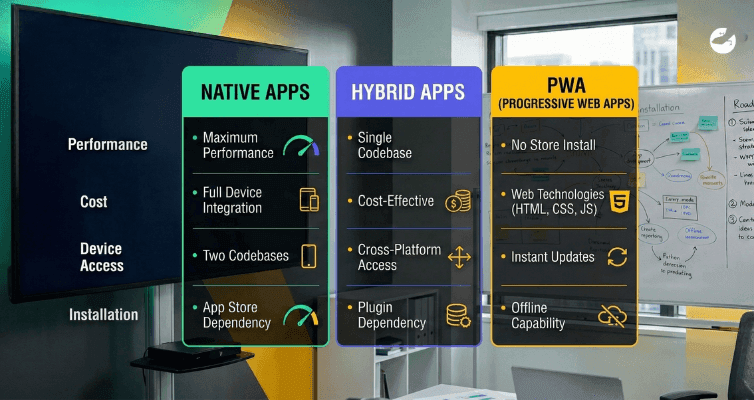
Architecture frameworks directly impact speed and stability.
Native Architecture
With iOS or Android development, teams gain maximum performance, platform-specific optimization, and hardware integration. Native apps handle heavy data processing and high-traffic usage more reliably. However, maintaining two separate codebases increases development time and costs.
Hybrid Architecture
Hybrid frameworks accelerate releases by sharing code across platforms. For startups, this is often ideal. For enterprises, cross-platform app development must be evaluated against performance expectations, offline functionality, and long-term extensibility.
Progressive Web Apps (PWA)
Progressive web app developmentprovides cross-platform access through browsers while reducing app store dependency. However, PWAs may not fully leverage device-level features required in complex enterprise ecosystems.
As a full-stack digital solutions agency, we often recommend architecture based on growth projections rather than immediate cost. In high-growth environments, short-term convenience must not compromise future performance engineering.
3. Modular Architecture: Designing for Change Without Breaking Stability
Speed becomes dangerous when architecture lacks modularity. Monolithic mobile apps scale poorly because even minor updates risk destabilizing the system. In contrast, modular architecture isolates features, enabling independent deployment cycles.
For enterprises, this means faster feature releases without jeopardizing system integrity. Modularization supports:
- Feature toggling
- Independent APIs
- Seamless CRM integration
- Easier refactoring

This approach is particularly powerful when aligned with backend microservices and web development. Instead of viewing mobile as a standalone channel, modern organizations treat it as part of a broader digital ecosystem.
In our digital workshops, we often conduct architectural audits to evaluate dependency maps. This process ensures that scaling one module does not create cascading failures elsewhere. Stability, therefore, becomes a product of intentional design rather than defensive firefighting.
4. DevOps, CI/CD, and Automation: Scaling Without Sacrificing Quality
You cannot achieve both speed and stability without operational discipline. DevOps maturity bridges that gap. CI/CD pipelines allow teams to release faster while maintaining code quality. Automated software testing reduces human error. Infrastructure-as-code standardizes environments. Performance monitoring detects instability before users experience it.

However, speed-driven teams sometimes treat DevOps as an afterthought. That approach introduces risk. Enterprise mobile architecture requires automated regression testing and security vulnerability scans. When implemented correctly, CI/CD enables rapid iteration without sacrificing stability.
5. Performance Engineering and User Experience at Scale
Architecture is invisible until performance degrades. Slow load times, battery drain, crashes, and lag directly affect user retention. Therefore, design services must align with backend architecture decisions. High-resolution animations and real-time dashboards require performance-conscious engineering.

In several enterprise mobile platforms highlighted in our blog, we observed that performance optimization often determines competitive advantage. Not merely design aesthetics. UI/UX design must therefore collaborate closely with engineering.
6. Technical Debt: The Hidden Cost of Prioritizing Speed
Every shortcut introduces debt. Early-stage mobile apps often bypass architecture documentation or scalability planning. This accelerates initial releases. However, as traffic scales, refactoring becomes expensive and disruptive.

We have worked with organizations where legacy mobile architecture blocked innovation. Instead of launching new features, teams spent resources fixing core instability. As a custom software development company, our approach focuses on “progressive hardening,” reinforcing architecture incrementally to prevent exponential technical debt.
7. Data, Analytics, and Growth Considerations
Architecture choices influence not only performance but also growth intelligence. Growth analytics require stable event tracking, reliable data pipelines, and scalable backend systems. If mobile architecture cannot handle real-time data synchronization, insights become fragmented.

Mobile products are no longer isolated apps. They are central nodes within enterprise ecosystems. As a full-stack digital solutions agency, we design architecture with data continuity in mind. Speed matters. However, lean analytics scalability matters more.
8. Governance, Security, and Enterprise Risk Management
At scale, architecture becomes a governance issue. Security vulnerabilities multiply under rapid iteration cycles. Enterprises must implement robust application security within their pipelines.

Key considerations include:
- Encryption protocols
- Secure authentication flows
- Role-based access control
- API security hardening
When organizations treat architecture strategically, mobile becomes a competitive asset rather than an operational liability.
Ready to Scale Without Compromise?
If your organization is evaluating mobile architecture decisions, now is the time to align speed with long-term stability. As a trusted mobile app development agency and digital transformation partner, we help enterprises design resilient, scalable mobile ecosystems.

Let’s architect your growth responsibly. Check out our cost estimator to start planning your project, or book a strategic consultation today to build mobile platforms that scale with confidence.
When scaling a digital product, speed alone is not enough. Enterprises must balance rapid feature delivery with architectural stability to ensure performance, security, and long-term scalability. In this blog, we explore the strategic trade-offs between velocity and resilience in mobile architecture. We break down native vs hybrid frameworks, modular design, DevOps automation, performance engineering, and UX alignment. Drawing insights from real-world projects and enterprise implementations, we examine how leading organizations approach mobile scalability without compromising stability. Whether you are modernizing legacy systems or launching new digital platforms, this guide offers practical insights into making architecture decisions that support sustainable growth.
Mobile architecture decisions define whether your digital product thrives under growth or collapses under its own success. At first, speed feels like the obvious priority. Markets move fast. Competitors iterate quickly. Stakeholders expect rapid delivery. However, stability determines whether that momentum is sustainable.
As a custom software development company and mobile app development agency working with scale-ups and enterprises, we have repeatedly seen one pattern: organizations that optimize purely for speed eventually pay for it in technical debt. Meanwhile, teams that over-engineer for stability risk missing the market entirely.
So how do you strike the right balance? Let’s explore the strategic, technical, and operational trade-offs that define mobile architecture at scale.
1. The Core Dilemma: Rapid Releases vs Long-Term Scalability
Every enterprise digital initiative begins with urgency. You want to validate product-market fit, capture users, and iterate quickly. Naturally, lightweight architectures and rapid development frameworks appear attractive. However, speed-focused decisions often introduce coupling, scalability bottlenecks, and performance constraints.
For example, choosing a hybrid stack for fast rollout can reduce time-to-market. Yet if traffic grows exponentially, performance tuning may require structural refactoring. On the other hand, fully native architecture with deep modularity provides long-term resilience but demands higher upfront investment.
In many enterprise engagements, including projects featured in our works, the key has been architectural foresight. We help organizations avoid “rewrite moments” by aligning MVP decisions with enterprise scalability roadmaps from day one. That balance defines mature digital transformation.
2. Native, Hybrid, or Progressive Web Apps: Strategic Architecture Choices
Architecture frameworks directly impact speed and stability.
Native Architecture
With iOS or Android development, teams gain maximum performance, platform-specific optimization, and hardware integration. Native apps handle heavy data processing and high-traffic usage more reliably. However, maintaining two separate codebases increases development time and costs.
Hybrid Architecture
Hybrid frameworks accelerate releases by sharing code across platforms. For startups, this is often ideal. For enterprises, cross-platform app development must be evaluated against performance expectations, offline functionality, and long-term extensibility.
Progressive Web Apps (PWA)
Progressive web app developmentprovides cross-platform access through browsers while reducing app store dependency. However, PWAs may not fully leverage device-level features required in complex enterprise ecosystems.
As a full-stack digital solutions agency, we often recommend architecture based on growth projections rather than immediate cost. In high-growth environments, short-term convenience must not compromise future performance engineering.
3. Modular Architecture: Designing for Change Without Breaking Stability
Speed becomes dangerous when architecture lacks modularity. Monolithic mobile apps scale poorly because even minor updates risk destabilizing the system. In contrast, modular architecture isolates features, enabling independent deployment cycles.
For enterprises, this means faster feature releases without jeopardizing system integrity. Modularization supports:
- Feature toggling
- Independent APIs
- Seamless CRM integration
- Easier refactoring
This approach is particularly powerful when aligned with backend microservices and web development. Instead of viewing mobile as a standalone channel, modern organizations treat it as part of a broader digital ecosystem.
In our digital workshops, we often conduct architectural audits to evaluate dependency maps. This process ensures that scaling one module does not create cascading failures elsewhere. Stability, therefore, becomes a product of intentional design rather than defensive firefighting.
4. DevOps, CI/CD, and Automation: Scaling Without Sacrificing Quality
You cannot achieve both speed and stability without operational discipline. DevOps maturity bridges that gap. CI/CD pipelines allow teams to release faster while maintaining code quality. Automated software testing reduces human error. Infrastructure-as-code standardizes environments. Performance monitoring detects instability before users experience it.
However, speed-driven teams sometimes treat DevOps as an afterthought. That approach introduces risk. Enterprise mobile architecture requires automated regression testing and security vulnerability scans. When implemented correctly, CI/CD enables rapid iteration without sacrificing stability.
5. Performance Engineering and User Experience at Scale
Architecture is invisible until performance degrades. Slow load times, battery drain, crashes, and lag directly affect user retention. Therefore, design services must align with backend architecture decisions. High-resolution animations and real-time dashboards require performance-conscious engineering.
In several enterprise mobile platforms highlighted in our blog, we observed that performance optimization often determines competitive advantage. Not merely design aesthetics. UI/UX design must therefore collaborate closely with engineering.
6. Technical Debt: The Hidden Cost of Prioritizing Speed
Every shortcut introduces debt. Early-stage mobile apps often bypass architecture documentation or scalability planning. This accelerates initial releases. However, as traffic scales, refactoring becomes expensive and disruptive.
We have worked with organizations where legacy mobile architecture blocked innovation. Instead of launching new features, teams spent resources fixing core instability. As a custom software development company, our approach focuses on “progressive hardening,” reinforcing architecture incrementally to prevent exponential technical debt.
7. Data, Analytics, and Growth Considerations
Architecture choices influence not only performance but also growth intelligence. Growth analytics require stable event tracking, reliable data pipelines, and scalable backend systems. If mobile architecture cannot handle real-time data synchronization, insights become fragmented.
Mobile products are no longer isolated apps. They are central nodes within enterprise ecosystems. As a full-stack digital solutions agency, we design architecture with data continuity in mind. Speed matters. However, lean analytics scalability matters more.
8. Governance, Security, and Enterprise Risk Management
At scale, architecture becomes a governance issue. Security vulnerabilities multiply under rapid iteration cycles. Enterprises must implement robust application security within their pipelines.
Key considerations include:
- Encryption protocols
- Secure authentication flows
- Role-based access control
- API security hardening
When organizations treat architecture strategically, mobile becomes a competitive asset rather than an operational liability.
Ready to Scale Without Compromise?
If your organization is evaluating mobile architecture decisions, now is the time to align speed with long-term stability. As a trusted mobile app development agency and digital transformation partner, we help enterprises design resilient, scalable mobile ecosystems.
Let’s architect your growth responsibly. Check out our cost estimator to start planning your project, or book a strategic consultation today to build mobile platforms that scale with confidence.
FAQs

How do enterprises balance speed and stability in mobile architecture?
When should an enterprise choose native over hybrid development?
What role does DevOps play in mobile scalability?
How does mobile architecture affect digital transformation initiatives?
Can hybrid apps handle enterprise-level traffic?
How does UI/UX impact architectural decisions?
What is the biggest architectural mistake enterprises make?
similar reads