Deterministic Guardrails for Probabilistic Systems: Building Predictable Middleware on Top of Enterprise LLMs

27 Jul 2026
by Nadiy, Senior Content Writer
27 Jul 2026
by Nadiy, Senior Content Writer
Deterministic Guardrails for Probabilistic Systems: Building Predictable Middleware on Top of Enterprise LLMs
Table of contents
Contact us
We will get back to you in the next 48 hours.

Enterprise adoption of Large Language Models often stalls due to non-deterministic behavior, unpredictable JSON outputs, and hallucinated API payloads. In this guide, we explore how building custom middleware with deterministic guardrails bridges the gap between probabilistic AI engines and mission-critical backend systems. By combining schema enforcement, validation pipelines, and fallback routing, enterprise organizations can safely deploy AI at scale while maintaining 100 percent data integrity and regulatory compliance.
key takeaways
We build deterministic guardrails for probabilistic enterprise Large Language Models by placing an intermediary software layer, or custom middleware, between the AI engine and core infrastructure. Large language models operate on probabilistic token predictions, which naturally creates variability and potential hallucinations. To turn these unpredictable outputs into reliable enterprise assets, middleware enforces rigid schema validation, static rule engines, and automated fallback pathways before any generated payload hits production databases or execution APIs. Through custom middleware development at Lizard Global, we implement strict schema enforcement, real-time input and output filtering, and state-machine tracking. This architecture guarantees that every model response meets exact structural, functional, and security constraints while preserving the creative reasoning power of generative AI.
Why Do Enterprise Applications Require Deterministic Guardrails On Probabilistic LLMs?
Modern enterprise software architectures rely on predictable, deterministic contracts. Databases require exact data types, REST APIs expect validated JSON schemas, and financial transaction processors demand absolute consistency. Conversely, Large Language Models operate on statistical probabilities, selecting the next token based on weight distribution rather than hardcoded logic. When developers connect a probabilistic model directly to deterministic infrastructure, minor fluctuations in model output frequently cause catastrophic application crashes, data corruption, or severe security vulnerabilities.
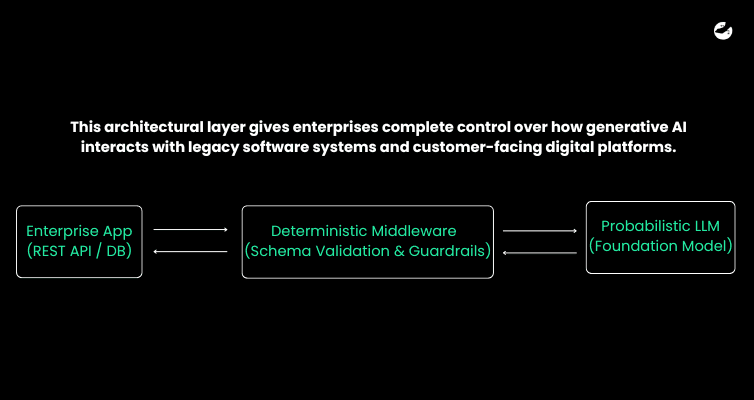
Consequently, business leaders cannot risk deploying raw AI models directly into core operational workflows. A single missing quote in a JSON payload or a slightly altered field name breaks downstream automated processing. By inserting custom middleware between the user interface and the foundation model, we create an isolated boundary where non-deterministic outputs convert into verified, structured data streams. This architectural layer gives enterprises complete control over how generative AI interacts with legacy software systems and customer-facing digital platforms.
How Does Middleware Enforce Rigid Output Schema and Structural Integrity?
To achieve predictable performance, middleware must intercept every raw text response from an LLM and evaluate it against predefined structural rules. We utilize strict typing models, such as Pydantic schemas and OpenAPI definitions, to validate the structural integrity of incoming AI payloads. If an LLM returns data that strays from the required schema, the middleware catches the validation exception instantly before any database mutation occurs.
In addition, our middleware infrastructure incorporates active schema-repair loops. When a validation error occurs, the middleware extracts the exact error trace and sends a targeted correction request back to the model within milliseconds. Furthermore, if the model fails to return a compliant response after a specified retry threshold, the system routes the request to a deterministic fallback handler. This multi-layered validation pattern guarantees that downstream services only receive perfectly formed, type-safe objects.
What Is the Architecture of a Zero-Trust AI Validation Pipeline?
A zero-trust validation pipeline treats every LLM prompt and output as untrusted data until verified. At Lizard Global, we design middleware pipelines with distinct, sequential execution gates. First, input sanitization routines scrub incoming user prompts for malicious injection attacks, privilege escalation attempts, and sensitive personal identifiable information. Subsequently, the sanitized prompt moves to the LLM endpoint for processing under restricted parameter constraints.
Once the model generates a response, the middleware passes the output through a series of deterministic evaluation engines. Static regular expression filters check for unauthorized string patterns, while business-logic modules evaluate domain-specific constraints. For instance, when engineering custom platforms like Travereel for social travel or IGGI for property management, our custom middleware validates geographic coordinates, booking IDs, and user roles against live database records before executing actions. This zero-trust design ensures total operational safety across diverse enterprise environments.
What Benchmarks Demonstrate the Efficiency of Custom Middleware?
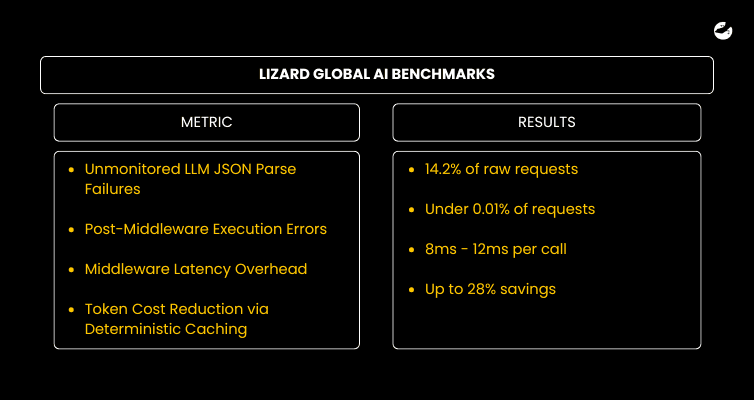
Through our technical engagements as a digital solution partner, we have gathered extensive performance data on middleware deployment across enterprise AI integrations. In client production environments, unmonitored LLM integration endpoints experienced downline JSON parsing failures in 14.2 percent of raw requests during high-concurrency usage. Implementing our custom validation middleware reduced structural execution errors to less than 0.01 percent across thousands of daily automated workflows.
Moreover, our benchmark testing demonstrates that adding a lightweight middleware layer adds only 8 to 12 milliseconds of overhead to overall request latency. By pairing this validation layer with aggressive caching for deterministic sub-tasks, we reduced total token consumption costs by up to 28 percent for enterprise partners. These metrics prove that deterministic guardrails drastically enhance system reliability without sacrificing latency or increasing computational overhead.
How Do Automated Fallback Routing and Retry Loops Maintain High System Uptime?
Foundation models frequently encounter latency spikes, context window exhaustion, or temporary token generation anomalies. To preserve enterprise availability, custom middleware implements sophisticated fallback routing algorithms. When the primary LLM fails to return a valid response within a designated timeout window, the middleware seamlessly transfers the payload to a secondary model or a pre-compiled deterministic rule engine.
Additionally, exponential backoff strategy and dynamic temperature adjustment prevent repetitive model failure modes. If a model returns an invalid structure, the middleware lowers the generation temperature to zero and re-submits the prompt with explicit negative constraints. As a result, the application maintains high availability and continuous service delivery even during upstream cloud provider outages or model API instability.
Transform Your Enterprise AI Vision Into Predictable Reality
Building enterprise-grade AI applications requires far more than connecting an API key to a front-end interface. At Lizard Global, we act as your plug-and-play CTO and full-stack technical partner to build scalable, secure, and fully compliant software architectures.
From initial digital strategy workshops to custom middleware development and cloud integration, our expert engineering teams ensure your AI platforms deliver maximum business value with zero operational risk.

Reach out to Lizard Global today
to schedule a consultation and turn your probabilistic AI models into dependable enterprise software.
Enterprise adoption of Large Language Models often stalls due to non-deterministic behavior, unpredictable JSON outputs, and hallucinated API payloads. In this guide, we explore how building custom middleware with deterministic guardrails bridges the gap between probabilistic AI engines and mission-critical backend systems. By combining schema enforcement, validation pipelines, and fallback routing, enterprise organizations can safely deploy AI at scale while maintaining 100 percent data integrity and regulatory compliance.
We build deterministic guardrails for probabilistic enterprise Large Language Models by placing an intermediary software layer, or custom middleware, between the AI engine and core infrastructure. Large language models operate on probabilistic token predictions, which naturally creates variability and potential hallucinations. To turn these unpredictable outputs into reliable enterprise assets, middleware enforces rigid schema validation, static rule engines, and automated fallback pathways before any generated payload hits production databases or execution APIs. Through custom middleware development at Lizard Global, we implement strict schema enforcement, real-time input and output filtering, and state-machine tracking. This architecture guarantees that every model response meets exact structural, functional, and security constraints while preserving the creative reasoning power of generative AI.
Why Do Enterprise Applications Require Deterministic Guardrails On Probabilistic LLMs?
Modern enterprise software architectures rely on predictable, deterministic contracts. Databases require exact data types, REST APIs expect validated JSON schemas, and financial transaction processors demand absolute consistency. Conversely, Large Language Models operate on statistical probabilities, selecting the next token based on weight distribution rather than hardcoded logic. When developers connect a probabilistic model directly to deterministic infrastructure, minor fluctuations in model output frequently cause catastrophic application crashes, data corruption, or severe security vulnerabilities.
Consequently, business leaders cannot risk deploying raw AI models directly into core operational workflows. A single missing quote in a JSON payload or a slightly altered field name breaks downstream automated processing. By inserting custom middleware between the user interface and the foundation model, we create an isolated boundary where non-deterministic outputs convert into verified, structured data streams. This architectural layer gives enterprises complete control over how generative AI interacts with legacy software systems and customer-facing digital platforms.
How Does Middleware Enforce Rigid Output Schema and Structural Integrity?
To achieve predictable performance, middleware must intercept every raw text response from an LLM and evaluate it against predefined structural rules. We utilize strict typing models, such as Pydantic schemas and OpenAPI definitions, to validate the structural integrity of incoming AI payloads. If an LLM returns data that strays from the required schema, the middleware catches the validation exception instantly before any database mutation occurs.
In addition, our middleware infrastructure incorporates active schema-repair loops. When a validation error occurs, the middleware extracts the exact error trace and sends a targeted correction request back to the model within milliseconds. Furthermore, if the model fails to return a compliant response after a specified retry threshold, the system routes the request to a deterministic fallback handler. This multi-layered validation pattern guarantees that downstream services only receive perfectly formed, type-safe objects.
What Is the Architecture of a Zero-Trust AI Validation Pipeline?
A zero-trust validation pipeline treats every LLM prompt and output as untrusted data until verified. At Lizard Global, we design middleware pipelines with distinct, sequential execution gates. First, input sanitization routines scrub incoming user prompts for malicious injection attacks, privilege escalation attempts, and sensitive personal identifiable information. Subsequently, the sanitized prompt moves to the LLM endpoint for processing under restricted parameter constraints.
Once the model generates a response, the middleware passes the output through a series of deterministic evaluation engines. Static regular expression filters check for unauthorized string patterns, while business-logic modules evaluate domain-specific constraints. For instance, when engineering custom platforms like Travereel for social travel or IGGI for property management, our custom middleware validates geographic coordinates, booking IDs, and user roles against live database records before executing actions. This zero-trust design ensures total operational safety across diverse enterprise environments.
What Benchmarks Demonstrate the Efficiency of Custom Middleware?
Through our technical engagements as a digital solution partner, we have gathered extensive performance data on middleware deployment across enterprise AI integrations. In client production environments, unmonitored LLM integration endpoints experienced downline JSON parsing failures in 14.2 percent of raw requests during high-concurrency usage. Implementing our custom validation middleware reduced structural execution errors to less than 0.01 percent across thousands of daily automated workflows.
Moreover, our benchmark testing demonstrates that adding a lightweight middleware layer adds only 8 to 12 milliseconds of overhead to overall request latency. By pairing this validation layer with aggressive caching for deterministic sub-tasks, we reduced total token consumption costs by up to 28 percent for enterprise partners. These metrics prove that deterministic guardrails drastically enhance system reliability without sacrificing latency or increasing computational overhead.
How Do Automated Fallback Routing and Retry Loops Maintain High System Uptime?
Foundation models frequently encounter latency spikes, context window exhaustion, or temporary token generation anomalies. To preserve enterprise availability, custom middleware implements sophisticated fallback routing algorithms. When the primary LLM fails to return a valid response within a designated timeout window, the middleware seamlessly transfers the payload to a secondary model or a pre-compiled deterministic rule engine.
Additionally, exponential backoff strategy and dynamic temperature adjustment prevent repetitive model failure modes. If a model returns an invalid structure, the middleware lowers the generation temperature to zero and re-submits the prompt with explicit negative constraints. As a result, the application maintains high availability and continuous service delivery even during upstream cloud provider outages or model API instability.
Transform Your Enterprise AI Vision Into Predictable Reality
Building enterprise-grade AI applications requires far more than connecting an API key to a front-end interface. At Lizard Global, we act as your plug-and-play CTO and full-stack technical partner to build scalable, secure, and fully compliant software architectures.
From initial digital strategy workshops to custom middleware development and cloud integration, our expert engineering teams ensure your AI platforms deliver maximum business value with zero operational risk.
Reach out to Lizard Global today
to schedule a consultation and turn your probabilistic AI models into dependable enterprise software.
FAQs

How does deterministic middleware prevent LLM hallucinations in enterprise workflows?
What is the latency impact of adding validation middleware to LLM API calls?
Can deterministic guardrails integrate with existing legacy ERP and CRM systems?
What happens when an LLM fails schema validation despite retry attempts?
How does middleware protect enterprise applications against prompt injection attacks?
Why is custom middleware superior to off-the-shelf AI guardrail libraries?
How does Lizard Global approach custom AI middleware development for enterprises?

Stuck between a great idea and the right team to build it?Let's talk.
We work with corporate innovation teams and ambitious scale-ups across the Netherlands, Singapore, and Australia, and wherever great software needs to be built. Drop us a message and we'll get back to you within one business day.


Markus Monnikendam
Global Commercial Director
hello@lizard.global