What User Validation Test and Two Years of Funnel Data Taught Us About Travereel

29 Jul 2026
by Titi Hartinah, AI Data Innovation & Strategist
Editor, Nadiy, Senior Content Writer
29 Jul 2026
by Titi Hartinah, AI Data Innovation & Strategist
Editor, Nadiy, Senior Content Writer
What User Validation Test and Two Years of Funnel Data Taught Us About Travereel
Table of contents
Contact us
We will get back to you in the next 48 hours.
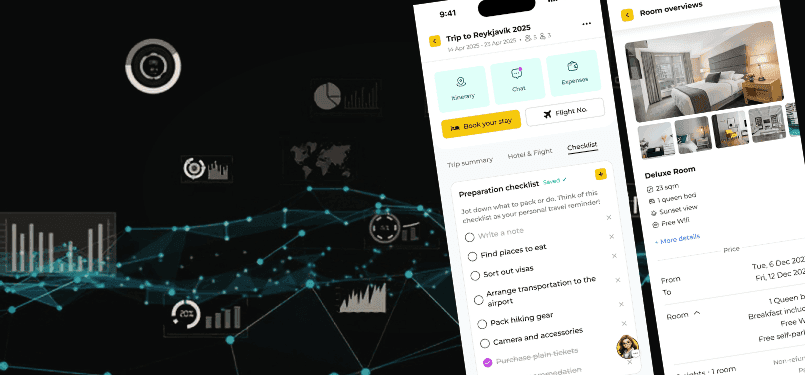
This case study examines how Travereel transformed from a struggling hotel booking app into a high-engagement itinerary planning platform by analyzing two years of user funnel data. When booking conversions stalled at 20–30%, behavioral analytics revealed that ~80% of users abandoned the booking flow but completed the trip-generation funnel. Rather than forcing an unviable model, product partner Lizard Global pivoted the experience toward interactive planning, collaborative tools, and "Vicky AI"—a guided trip assistant. Instead of using open-ended AI chatboxes that drive up LLM API costs, Lizard Global applied a UX-driven approach: using intuitive UI elements like swipe mechanics to pre-structure user intent before querying the model. This strategy maximized feature completion, optimized inference costs, and provided a proven, scalable blueprint for integrating AI across travel, fintech, healthtech, and logistics enterprise applications.
key takeaways
When we published Travereel's first case study, the story was about validation, a hybrid social-and-booking travel app, built lean, beating category benchmarks on retention and engagement. All true.
But a benchmark you clear in year one isn't a moat, and the most useful thing a product can do is keep telling you when your original plan is wrong.
Same App, Same Users: They Abandon the Booking Flow and Finish the Planning One
When Travereel launched in Q4 2023, it was a hotel booking app, the same lane as Agoda and Trip.com. For a year we ran it on lean analytics and watched the numbers stay stubbornly flat: booking and engagement both sat around 20–30%, against a 60% target. Not a leak to patch. A thesis that just wasn't earning attention.
So, at the start of 2025 we ran a pivot workshop and asked a different question; "what are users actually here to do?"
The product was already answering us. The contrast that decided it, and is still true in our live data today; same app, same period.
- Booking funnel: ~80% drop off before reaching payment. Most never click through to a hotel option, let alone book. Engagement is shallow.
- Trip-generation funnel: ~80% of sessions that enter complete it end-to-end, low drop-off per step, 15–25 minute sessions.
Same app. Same users. Same months. One funnel they abandon, one they finish. We didn't guess which job Travereel was good at. The behavioral data said so, every month.
And the win isn't "we added features". It's how we built the entry. We made the trip setup a discovery experience, not an administrative one. Users set goals Tinder-style, swipe right or left on suggestions before committing, then generate an itinerary manually or with Vicky AI.
The collaborative layer (group chat, shared expenses, POI-scanning from video) keeps it social rather than form-filling. That design choice produces 80% feature engagement. People don't abandon a flow that feels like discovering their trip.
![[Header] Integrating AI Agents into Mobile Apps Lessons from Travereel.png](/_next/image?url=https%3A%2F%2Fres.cloudinary.com%2Flizardwebsite%2Fimage%2Fupload%2Fv1783582572%2Flizard_website2025%2FHeader_Integrating_AI_Agents_into_Mobile_Apps_Lessons_from_Travereel_6358d56e3f.png&w=3840&q=75&dpl=dpl_6vhYPGCiXL4L4UxNdwfVdWPSVz6N)
How We Build AI Into A Travel App And Keep It Running
There's a pattern we see constantly in products racing to add "an AI feature": an open-ended chatbox gets dropped into the app, users are invited to type anything, and the prompt goes straight to a frontier model. It demos well. But it quietly couples the cost base to users' typing habits, every unbounded conversation becomes a variable cost nobody governs, and it often produces worse output, because the model is guessing what the user actually wanted.
Lizard Global built Travereel's AI, Vicky, on the opposite principle, and it's the principle they carry into every AI build regardless of industry: the product's UX should do the reasoning the model shouldn't have to.
By the time a Travereel user reaches Vicky, the swipe-based goal-setting has already shaped intent, the feel of the trip, the type, the rough budget, into a structured brief. So Vicky isn't answering "plan me a trip" from a blank slate; it's completing a tightly scoped request where the interface has already resolved most of the ambiguity.
That's a deliberate architectural choice, and it pays off twice:
- A well-scoped request is leaner for the model to handle, and
- It produces a better itinerary, because the AI works from real constraints instead of inferring them.
And here's the part that isn't about travel. That method; let domain-specific UX pre-structure the problem so the model does less guessing and less work, isn't a travel trick. It's how Lizard Global approaches AI integration in any context: the swipe flow happens to be the right interface for trip planning, but the underlying discipline (shape intent in the UI, constrain what the model has to handle, design for sustainable inference from day one) transfers to fintech, logistics, healthtech, or anywhere an AI feature has to live in production rather than in a demo.
Travereel is the travel-industry proof of a method that's industry-agnostic by design.
![[Key Features Image] Travereel (2).png](/_next/image?url=https%3A%2F%2Fres.cloudinary.com%2Flizardwebsite%2Fimage%2Fupload%2Fv1774511305%2Flizard_website2025%2FKey_Features_Image_Travereel_2_aaf40b0809.png&w=3840&q=75&dpl=dpl_6vhYPGCiXL4L4UxNdwfVdWPSVz6N)
How We Think Along With Our Clients About The Cost of Go-Live With AI Integrated Features
We're not going to put a token figure in a public post, but the philosophy is the point, and it's what we'd put in front of anyone weighing an AI build. Engagement and cost-discipline are usually framed as a trade-off, and we don't think they have to be. When the interface carries its share of the reasoning, you get a feature users stay inside and an inference footprint that doesn't balloon the moment adoption grows.
The goal was never a clever demo. It's an AI feature the client can actually run in production, sustainably, as the user base scales, which is the only version of "go-live with AI" that means anything.
We're at 300–400 monthly active users. The 80% completion is real and directional, but it's 80% of a deliberately small, early base , strong evidence of product-market fit on the planning thesis, not yet a forecast of scale.
We say that plainly because the discipline that drove the pivot is the same one that makes us label our own sample honestly. The same caveat applies to the AI: the method is proven to work here, in travel , proving it carries the cost-efficiency promise at 10x the users, and demonstrating the same approach across other industries, is the work ahead, not a result we're declaring today.
What it does justify? Reallocating build investment toward the funnel that's already winning , itinerary planning, the AI layer, the collaborative features; rather than pouring it into a booking flow the data keeps telling us users don't want from us yet.
![[Impact Image] Travereel.png](/_next/image?url=https%3A%2F%2Fres.cloudinary.com%2Flizardwebsite%2Fimage%2Fupload%2Fv1774511320%2Flizard_website2025%2FImpact_Image_Travereel_a5dc43eb1d.png&w=3840&q=75&dpl=dpl_6vhYPGCiXL4L4UxNdwfVdWPSVz6N)
What's Next: Making The Front Door Match The Product
The data has settled the what; the open question is the first impression. The homepage still carries booking-app DNA , and if 80% of our value is planning, the homepage should say so in the first few seconds, surfacing the swipe-to-plan entry, Vicky, and the collaborative layer early instead of burying them.
That's the next piece of work: redesign the homepage to represent the pivot, then validate it properly. We're not claiming a result here , we're mid-research, and the next round is moderated testing, precisely because the questions have sharpened and we want to watch users reason out loud, not just click. We'll publish what we find, asterisks included.
In A Nutshell (TL;DR)
Two years, two funnels, one discipline. Travereel didn't pivot because someone had a better idea in a meeting. It pivoted because the behavioral data made the original thesis indefensible and pointed somewhere better.
The AI didn't ship because AI is fashionable, it shipped in a form the client could afford to keep running, because the UX was engineered to carry its share of the load. And the homepage redesign isn't launching on a hunch, as it's going into user moderated testing first.
That's the whole method, and it's the thing worth taking away whether or not you ever build a travel app: let real user behavior overrule your assumptions, design your AI so engagement and cost aren't at war.
Is your AI integration driving up cloud costs while users abandon your primary funnel?
If you're building a product, in travel or any industry, and your AI roadmap assumes engagement and cost-control are opposing forces, or your analytics are still organized around the funnel you hoped users would use: that's the conversation Lizard Global starts every build from.
Design the UX so your AI does less guessing, your users do more, and your inference bill does the work it's supposed to.

👉 [Schedule an Enterprise Architecture Strategy Session with Lizard Global]
This case study examines how Travereel transformed from a struggling hotel booking app into a high-engagement itinerary planning platform by analyzing two years of user funnel data. When booking conversions stalled at 20–30%, behavioral analytics revealed that ~80% of users abandoned the booking flow but completed the trip-generation funnel. Rather than forcing an unviable model, product partner Lizard Global pivoted the experience toward interactive planning, collaborative tools, and "Vicky AI"—a guided trip assistant. Instead of using open-ended AI chatboxes that drive up LLM API costs, Lizard Global applied a UX-driven approach: using intuitive UI elements like swipe mechanics to pre-structure user intent before querying the model. This strategy maximized feature completion, optimized inference costs, and provided a proven, scalable blueprint for integrating AI across travel, fintech, healthtech, and logistics enterprise applications.
When we published Travereel's first case study, the story was about validation, a hybrid social-and-booking travel app, built lean, beating category benchmarks on retention and engagement. All true.
But a benchmark you clear in year one isn't a moat, and the most useful thing a product can do is keep telling you when your original plan is wrong.
Same App, Same Users: They Abandon the Booking Flow and Finish the Planning One
When Travereel launched in Q4 2023, it was a hotel booking app, the same lane as Agoda and Trip.com. For a year we ran it on lean analytics and watched the numbers stay stubbornly flat: booking and engagement both sat around 20–30%, against a 60% target. Not a leak to patch. A thesis that just wasn't earning attention.
So, at the start of 2025 we ran a pivot workshop and asked a different question; "what are users actually here to do?"
The product was already answering us. The contrast that decided it, and is still true in our live data today; same app, same period.
- Booking funnel: ~80% drop off before reaching payment. Most never click through to a hotel option, let alone book. Engagement is shallow.
- Trip-generation funnel: ~80% of sessions that enter complete it end-to-end, low drop-off per step, 15–25 minute sessions.
Same app. Same users. Same months. One funnel they abandon, one they finish. We didn't guess which job Travereel was good at. The behavioral data said so, every month.
And the win isn't "we added features". It's how we built the entry. We made the trip setup a discovery experience, not an administrative one. Users set goals Tinder-style, swipe right or left on suggestions before committing, then generate an itinerary manually or with Vicky AI.
The collaborative layer (group chat, shared expenses, POI-scanning from video) keeps it social rather than form-filling. That design choice produces 80% feature engagement. People don't abandon a flow that feels like discovering their trip.
How We Build AI Into A Travel App And Keep It Running
There's a pattern we see constantly in products racing to add "an AI feature": an open-ended chatbox gets dropped into the app, users are invited to type anything, and the prompt goes straight to a frontier model. It demos well. But it quietly couples the cost base to users' typing habits, every unbounded conversation becomes a variable cost nobody governs, and it often produces worse output, because the model is guessing what the user actually wanted.
Lizard Global built Travereel's AI, Vicky, on the opposite principle, and it's the principle they carry into every AI build regardless of industry: the product's UX should do the reasoning the model shouldn't have to.
By the time a Travereel user reaches Vicky, the swipe-based goal-setting has already shaped intent, the feel of the trip, the type, the rough budget, into a structured brief. So Vicky isn't answering "plan me a trip" from a blank slate; it's completing a tightly scoped request where the interface has already resolved most of the ambiguity.
That's a deliberate architectural choice, and it pays off twice:
- A well-scoped request is leaner for the model to handle, and
- It produces a better itinerary, because the AI works from real constraints instead of inferring them.
And here's the part that isn't about travel. That method; let domain-specific UX pre-structure the problem so the model does less guessing and less work, isn't a travel trick. It's how Lizard Global approaches AI integration in any context: the swipe flow happens to be the right interface for trip planning, but the underlying discipline (shape intent in the UI, constrain what the model has to handle, design for sustainable inference from day one) transfers to fintech, logistics, healthtech, or anywhere an AI feature has to live in production rather than in a demo.
Travereel is the travel-industry proof of a method that's industry-agnostic by design.
How We Think Along With Our Clients About The Cost of Go-Live With AI Integrated Features
We're not going to put a token figure in a public post, but the philosophy is the point, and it's what we'd put in front of anyone weighing an AI build. Engagement and cost-discipline are usually framed as a trade-off, and we don't think they have to be. When the interface carries its share of the reasoning, you get a feature users stay inside and an inference footprint that doesn't balloon the moment adoption grows.
The goal was never a clever demo. It's an AI feature the client can actually run in production, sustainably, as the user base scales, which is the only version of "go-live with AI" that means anything.
We're at 300–400 monthly active users. The 80% completion is real and directional, but it's 80% of a deliberately small, early base , strong evidence of product-market fit on the planning thesis, not yet a forecast of scale.
We say that plainly because the discipline that drove the pivot is the same one that makes us label our own sample honestly. The same caveat applies to the AI: the method is proven to work here, in travel , proving it carries the cost-efficiency promise at 10x the users, and demonstrating the same approach across other industries, is the work ahead, not a result we're declaring today.
What it does justify? Reallocating build investment toward the funnel that's already winning , itinerary planning, the AI layer, the collaborative features; rather than pouring it into a booking flow the data keeps telling us users don't want from us yet.
What's Next: Making The Front Door Match The Product
The data has settled the what; the open question is the first impression. The homepage still carries booking-app DNA , and if 80% of our value is planning, the homepage should say so in the first few seconds, surfacing the swipe-to-plan entry, Vicky, and the collaborative layer early instead of burying them.
That's the next piece of work: redesign the homepage to represent the pivot, then validate it properly. We're not claiming a result here , we're mid-research, and the next round is moderated testing, precisely because the questions have sharpened and we want to watch users reason out loud, not just click. We'll publish what we find, asterisks included.
In A Nutshell (TL;DR)
Two years, two funnels, one discipline. Travereel didn't pivot because someone had a better idea in a meeting. It pivoted because the behavioral data made the original thesis indefensible and pointed somewhere better.
The AI didn't ship because AI is fashionable, it shipped in a form the client could afford to keep running, because the UX was engineered to carry its share of the load. And the homepage redesign isn't launching on a hunch, as it's going into user moderated testing first.
That's the whole method, and it's the thing worth taking away whether or not you ever build a travel app: let real user behavior overrule your assumptions, design your AI so engagement and cost aren't at war.
Is your AI integration driving up cloud costs while users abandon your primary funnel?
If you're building a product, in travel or any industry, and your AI roadmap assumes engagement and cost-control are opposing forces, or your analytics are still organized around the funnel you hoped users would use: that's the conversation Lizard Global starts every build from.
Design the UX so your AI does less guessing, your users do more, and your inference bill does the work it's supposed to.
👉 [Schedule an Enterprise Architecture Strategy Session with Lizard Global]
FAQs

How do you reduce AI inference and LLM API costs in mobile applications?
Why do travel apps pivot from booking models to itinerary planning?
What is the best way to integrate AI into enterprise mobile products?
How does UX design directly impact AI backend operational costs?
What metrics indicate it is time to pivot a digital product funnel?
How can enterprise software teams validate AI feature scalability before full launch?
What is Lizard Global’s software development methodology for custom AI applications?
similar reads

AI & Machine Learning
The Hidden Data-Readiness Work That Decides Whether Your AI Integration Succeeds
7 September 2026

Lean Analytics
Designing Roadmaps Around User Behavior: The Data-Driven Playbook
23 December 2025

Lean Analytics
Travereel Case Study: How User Insights Are Redefining Social Travel Planning
2 September 2025
Stuck between a great idea and the right team to build it?Let's talk.
We work with corporate innovation teams and ambitious scale-ups across the Netherlands, Singapore, and Australia, and wherever great software needs to be built. Drop us a message and we'll get back to you within one business day.


Markus Monnikendam
Global Commercial Director
hello@lizard.global