Why 95% Of AI Pilots Never Reach Production & The 5 Integration Gaps That Kill Them

20 Jul 2026
by Nadiy, Senior Content Writer
20 Jul 2026
by Nadiy, Senior Content Writer
Why 95% Of AI Pilots Never Reach Production & The 5 Integration Gaps That Kill Them
Table of contents
Contact us
We will get back to you in the next 48 hours.

Despite massive investments in artificial intelligence, an estimated 85% to 95% of enterprise AI pilots never make it into live production. While initial proof-of-concepts (POCs) often impress stakeholders during demos, they frequently stall when confronted with the complex realities of enterprise infrastructure, legacy systems, dirty production data, and unaligned business workflows. This article breaks down why the AI "pilot trap" happens and examines the five specific integration gaps that quietly kill enterprise initiatives: the data readiness gap, the workflow friction gap, the legacy orchestration gap, the governance and security gap, and the operational ownership gap. Learn actionable strategies to bridge these technical and organizational hurdles, design production-ready AI architectures, and transform your experimental pilots into scalable, ROI-driven enterprise assets.
key takeaways
Despite surging investments in artificial intelligence, an uncomfortable truth persists across executive suites: up to 85% of enterprise AI projects fail to reach production. We see organizations excel at launching flashy proofs-of-concept (POCs) that generate initial excitement. However, when executive leaders attempt to scale these tools across core operations, momentum grinds to a sudden halt. The reality is that isolated generative AI sandboxes operating under ideal conditions simply cannot survive the harsh realities of enterprise software ecosystems.
Moving an intelligent tool from a controlled prototype to a mission-critical platform demands far more than tweaking prompt templates. Consequently, it requires closing complex architectural gaps across data pipelines, core software engineering, governance, and user experience.
As a full-stack digital solutions agency and trusted digital transformation partner, we at Lizard Global frequently work with enterprise clients who find their AI initiatives stranded in production limbo. Bridging this gap requires recognizing that AI is not a standalone feature—it is an architectural layer that must sit seamlessly within your wider enterprise landscape.
Below, we dissect the five core integration gaps that systematically destroy enterprise AI initiatives and outline the exact strategies required to scale your digital assets successfully.
The Data Readiness Gap: Moving Beyond Curated Sandbox Datasets
Most AI pilots succeed in development because engineers feed them meticulously cleaned, static datasets. In these sandbox environments, null values are stripped out, edge cases are manually handled, and data formatting remains perfectly uniform. Unfortunately, live enterprise data environments are chaotic. Real-world enterprise ecosystems present incomplete records, legacy schema inconsistencies, and unannounced API updates that immediately degrade model accuracy and trigger cascading failures.
When enterprise AI applications process real-time inputs, small anomalies severely compromise outputs. This discrepancy between clean testing data and chaotic live data creates the first major barrier to deployment. Without proper infrastructure, models succumb to data drift, hallucination, and high latency, forcing engineering teams to continually fix broken connections instead of delivering business value.
To overcome the data readiness gap, organizations must transition from static data dumps to resilient, real-time data orchestration pipelines. As a custom software development company specializing in scalable cloud architectures, we approach data readiness through full-stack modernization. We systematically structure data ingestion layers with automated schema validation, dynamic data normalization, and fallback mechanisms.
For example, when building complex enterprise platforms like Transvision (DEXTR) for taxi dispatch routing or vanbreda (WAPA) for maritime insurance risk tracking, real-time data integrity was non-negotiable. By architecting robust API connectors, event-driven data streaming, and continuous data validation layers, we ensure that underlying systems feed clean, reliable inputs to downstream automated decision engines—preventing live data failures before they reach end users.
The Workflow Friction Gap: Why Isolated AI Tools Suffer Low Adoption
Even if an enterprise builds a technically superior AI model, it will fail if it disrupts employee workflows. A primary reason pilot programs stall is context switching. When users are required to leave their primary operational hub, whether a custom web portal, a mobile application, or a legacy CRM, to log into a separate AI interface, adoption plummets. Employees inevitably revert to familiar manual methods, rendering expensive technology investments useless.
Intelligent capabilities should adapt to how teams naturally operate, rather than forcing teams to adapt to new software interfaces. Delivering value requires integrating insights directly into daily touchpoints, such as automated notifications, real-time field suggestions, or single-click task approvals. If a recommendation takes five extra steps to review and apply, users will ignore it.
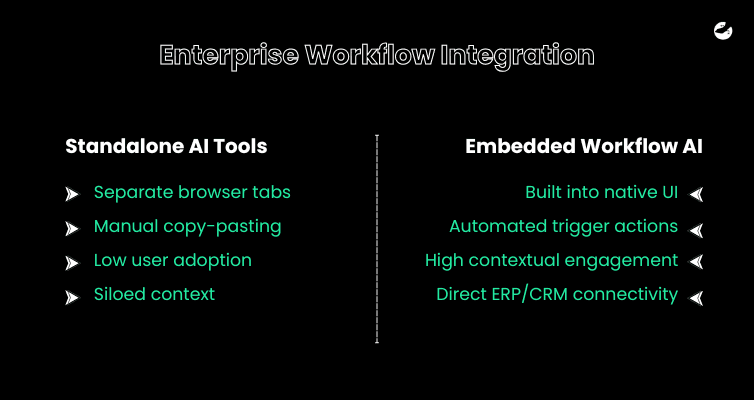
Closing this gap demands exceptional UI/UX design services and specialized UX/UI product design. At Lizard Global, our digital consultancy services center on human-centered design principles that map out existing user journeys before writing code. By integrating smart features into custom web app development services, mobile app development agency frameworks, and CRM integration services, we embed predictive insights directly within primary screens.
Consider our work with Heineken (Drinkies), where we optimized complex ordering and logistics management. By embedding data-driven recommendations, streamlined inventory workflows, and intelligent order tracking directly into native mobile app interfaces and web consoles, operational teams interacted with smart features effortlessly without context switching. Similarly, in our travel-tech app Travereel, we embedded Autonomous AI Agents and interactive AI-LLM itinerary planning straight into the core video-sharing and hotel booking interface. Users curate travel itineraries dynamically within the social feed, completely removing user friction.
This focus on human-centered software design is a hallmark of Lizard Global’s approach. When developing specialized, multi-platform applications—such as the human-centric platform designed for SK-Pharmacy—Lizard Global prioritized intuitive navigation and seamless workflow alignment so healthcare professionals could interact with complex data effortlessly. By leveraging strategic digital consultancy services, enterprise leaders can map exact user journeys and build mobile app development agency solutions or web app development services that embed intelligent automation directly into frontline operational workflows.
The Legacy Orchestration Gap: Moving to Enterprise AI Orchestration
Traditional enterprise software relies heavily on deterministic rules: if an event occurs, execute a predetermined function. While deterministic systems provide predictability, they struggle with unstructured inputs, dynamic edge cases, and multi-step decision trees. Conversely, early generative AI implementations were purely conversational, answering queries in isolation without performing backend operations. The modern enterprise requires bridging Deterministic vs. Agentic AI, transitioning from basic script automation to full Enterprise AI Orchestration.
When enterprise projects scale beyond simple chatbots, basic prompt chaining breaks down. A true operational deployment requires Agentic AI for Enterprise, where multi-agent systems independently analyze tasks, query databases, trigger API calls, handle errors, and execute cross-departmental operations. Building this degree of autonomous capability without proper middleware creates fragile dependencies, unhandled API timeouts, and broken logic paths that disrupt enterprise operations.
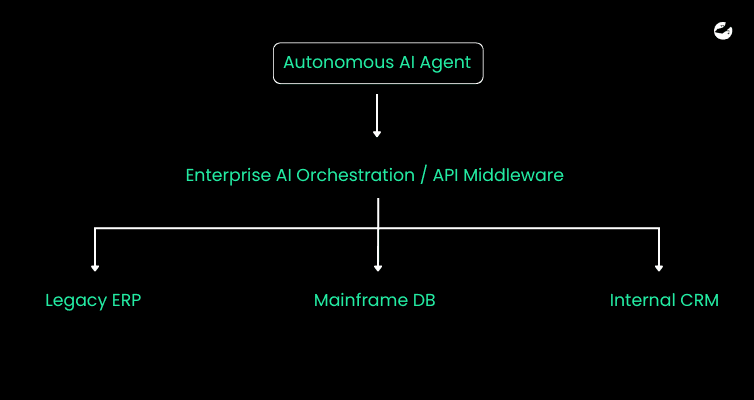
Overcoming this obstacle requires building robust Agentic Workflows backed by scalable microservices. As a full-stack digital solutions agency, we engineer secure API gateways and event-driven architectures that orchestrate complex AI logic alongside legacy IT systems.
For MRT OnTrack, an enterprise intranet and workforce tracking solution, managing complex workforce data across diverse field environments required rigorous systems integration. By creating dependable backend microservices, we demonstrated how legacy enterprise systems can orchestrate high-volume data streams securely. Applying these orchestration principles to AI environments enables Autonomous AI Agents to safely execute complex business logic, query backend databases, and communicate across disparate software suites without breaking underlying architecture.
The Governance and Security Gap: Balancing Risk and Innovation
Enterprise leaders rightfully worry about compliance, data leaks, and reputation damage. A major reason corporate legal and security teams halt AI deployments is the lack of strict enterprise governance. Out-of-the-box model APIs often lack built-in boundaries to prevent hallucinations, secure sensitive personal identifiable information (PII), or restrict system access based on user authorization roles.
Deploying intelligent systems into production without governance creates severe vulnerability. To pass strict compliance reviews in regulated industries like finance, healthcare, and real estate, organizations must establish robust Agentic Governance & Compliance protocols.
Building enterprise-ready AI solutions demands integrating explicit AI Guardrails and Human-in-the-Loop (HITL) controls directly into core application workflows. This guarantees that high-stakes autonomous actions require explicit human authorization before execution. Furthermore, systems must include comprehensive AI Observability & Audit Logs that record every prompt, backend decision path, and external call for complete operational traceability.
At Lizard Global, we embed compliance and security into every layer of our custom software projects. Whether developing secure iOS app development platforms, Android app development solutions, or hybrid app development engines, we enforce strict zero-trust security architectures. For real estate management platforms like Elfi & Iggi, where processing sensitive tenant documents and financial transactions required absolute privacy, we built robust data governance frameworks. Applying this expertise to enterprise AI projects ensures models operate safely within predefined parameter boundaries, satisfying corporate risk parameters.
The Operational Ownership Gap: Transitioning from Innovation to Maintenance
The final gap that dooms enterprise AI pilots occurs after initial deployment: the operational ownership void. Traditional software development often operates on a "build and hand off" cycle. However, AI solutions are dynamic, evolving assets that require continuous monitoring, model retraining, and proactive infrastructure support.
When an R&D team builds a pilot project without a strategy for ongoing operational maintenance, the system inevitably degrades over time. Standard IT help desks are rarely equipped to identify subtle model drift, manage shifting token costs, or adjust prompt logic when third-party APIs update. Without clear operational ownership, performance drops, costs spike, and business leadership loses confidence in the initiative.
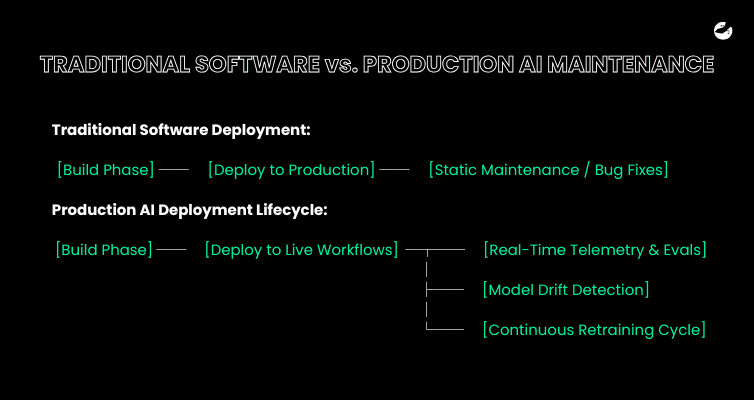
To ensure long-term ROI, enterprises must shift from treating AI as a temporary experiment to treating it as a core digital asset that requires structured product management and continuous support. Partnering with an experienced custom software development company ensures your team has dedicated technical support, clear SLAs, and active observability dashboards.
We work as an ongoing digital transformation partner and go-to-market technology consultancy. Through our dedicated growth analytics consulting, product management, and ongoing software maintenance services, we ensure digital assets remain high-performing, cost-optimized, and secure over their entire lifecycle. We help clients monitor token usage, optimize latency across progressive web app development frameworks, and refine model performance based on real-world usage data.
Transforming AI Pilots into Scalable Enterprise Assets
Scaling artificial intelligence across an enterprise isn't solved by picking the latest LLM framework. Success requires systematic software engineering, thoughtful user experience design, and robust system integration. By bridging the five integration gaps, Data Readiness, Workflow Friction, Legacy Orchestration, Governance, and Operational Ownership, organizations can reliably convert promising sandbox experiments into mission-critical platforms.
Moving from pilot to production requires a delivery partner who understands both cutting-edge AI concepts and classical enterprise application architecture. From full-stack web and mobile engineering to complex CRM integrations and growth analytics, building a resilient digital ecosystem requires an end-to-end approach.
Accelerate Your AI Deployment with Lizard Global
Is your AI initiative stalled in the sandbox phase? At Lizard Global, we act as your cross-functional CTO and digital engineering team. We help cross-industry leaders transform complex concepts into secure, user-friendly, enterprise-grade software products.

Schedule a Strategic AI Discovery Session
with Lizard Global Today to audit your integration architecture, eliminate workflow bottlenecks, and confidently launch your enterprise software solutions into production.
Despite massive investments in artificial intelligence, an estimated 85% to 95% of enterprise AI pilots never make it into live production. While initial proof-of-concepts (POCs) often impress stakeholders during demos, they frequently stall when confronted with the complex realities of enterprise infrastructure, legacy systems, dirty production data, and unaligned business workflows. This article breaks down why the AI "pilot trap" happens and examines the five specific integration gaps that quietly kill enterprise initiatives: the data readiness gap, the workflow friction gap, the legacy orchestration gap, the governance and security gap, and the operational ownership gap. Learn actionable strategies to bridge these technical and organizational hurdles, design production-ready AI architectures, and transform your experimental pilots into scalable, ROI-driven enterprise assets.
Despite surging investments in artificial intelligence, an uncomfortable truth persists across executive suites: up to 85% of enterprise AI projects fail to reach production. We see organizations excel at launching flashy proofs-of-concept (POCs) that generate initial excitement. However, when executive leaders attempt to scale these tools across core operations, momentum grinds to a sudden halt. The reality is that isolated generative AI sandboxes operating under ideal conditions simply cannot survive the harsh realities of enterprise software ecosystems.
Moving an intelligent tool from a controlled prototype to a mission-critical platform demands far more than tweaking prompt templates. Consequently, it requires closing complex architectural gaps across data pipelines, core software engineering, governance, and user experience.
As a full-stack digital solutions agency and trusted digital transformation partner, we at Lizard Global frequently work with enterprise clients who find their AI initiatives stranded in production limbo. Bridging this gap requires recognizing that AI is not a standalone feature—it is an architectural layer that must sit seamlessly within your wider enterprise landscape.
Below, we dissect the five core integration gaps that systematically destroy enterprise AI initiatives and outline the exact strategies required to scale your digital assets successfully.
The Data Readiness Gap: Moving Beyond Curated Sandbox Datasets
Most AI pilots succeed in development because engineers feed them meticulously cleaned, static datasets. In these sandbox environments, null values are stripped out, edge cases are manually handled, and data formatting remains perfectly uniform. Unfortunately, live enterprise data environments are chaotic. Real-world enterprise ecosystems present incomplete records, legacy schema inconsistencies, and unannounced API updates that immediately degrade model accuracy and trigger cascading failures.
When enterprise AI applications process real-time inputs, small anomalies severely compromise outputs. This discrepancy between clean testing data and chaotic live data creates the first major barrier to deployment. Without proper infrastructure, models succumb to data drift, hallucination, and high latency, forcing engineering teams to continually fix broken connections instead of delivering business value.
To overcome the data readiness gap, organizations must transition from static data dumps to resilient, real-time data orchestration pipelines. As a custom software development company specializing in scalable cloud architectures, we approach data readiness through full-stack modernization. We systematically structure data ingestion layers with automated schema validation, dynamic data normalization, and fallback mechanisms.
For example, when building complex enterprise platforms like Transvision (DEXTR) for taxi dispatch routing or vanbreda (WAPA) for maritime insurance risk tracking, real-time data integrity was non-negotiable. By architecting robust API connectors, event-driven data streaming, and continuous data validation layers, we ensure that underlying systems feed clean, reliable inputs to downstream automated decision engines—preventing live data failures before they reach end users.
The Workflow Friction Gap: Why Isolated AI Tools Suffer Low Adoption
Even if an enterprise builds a technically superior AI model, it will fail if it disrupts employee workflows. A primary reason pilot programs stall is context switching. When users are required to leave their primary operational hub, whether a custom web portal, a mobile application, or a legacy CRM, to log into a separate AI interface, adoption plummets. Employees inevitably revert to familiar manual methods, rendering expensive technology investments useless.
Intelligent capabilities should adapt to how teams naturally operate, rather than forcing teams to adapt to new software interfaces. Delivering value requires integrating insights directly into daily touchpoints, such as automated notifications, real-time field suggestions, or single-click task approvals. If a recommendation takes five extra steps to review and apply, users will ignore it.
Closing this gap demands exceptional UI/UX design services and specialized UX/UI product design. At Lizard Global, our digital consultancy services center on human-centered design principles that map out existing user journeys before writing code. By integrating smart features into custom web app development services, mobile app development agency frameworks, and CRM integration services, we embed predictive insights directly within primary screens.
Consider our work with Heineken (Drinkies), where we optimized complex ordering and logistics management. By embedding data-driven recommendations, streamlined inventory workflows, and intelligent order tracking directly into native mobile app interfaces and web consoles, operational teams interacted with smart features effortlessly without context switching. Similarly, in our travel-tech app Travereel, we embedded Autonomous AI Agents and interactive AI-LLM itinerary planning straight into the core video-sharing and hotel booking interface. Users curate travel itineraries dynamically within the social feed, completely removing user friction.
This focus on human-centered software design is a hallmark of Lizard Global’s approach. When developing specialized, multi-platform applications—such as the human-centric platform designed for SK-Pharmacy—Lizard Global prioritized intuitive navigation and seamless workflow alignment so healthcare professionals could interact with complex data effortlessly. By leveraging strategic digital consultancy services, enterprise leaders can map exact user journeys and build mobile app development agency solutions or web app development services that embed intelligent automation directly into frontline operational workflows.
The Legacy Orchestration Gap: Moving to Enterprise AI Orchestration
Traditional enterprise software relies heavily on deterministic rules: if an event occurs, execute a predetermined function. While deterministic systems provide predictability, they struggle with unstructured inputs, dynamic edge cases, and multi-step decision trees. Conversely, early generative AI implementations were purely conversational, answering queries in isolation without performing backend operations. The modern enterprise requires bridging Deterministic vs. Agentic AI, transitioning from basic script automation to full Enterprise AI Orchestration.
When enterprise projects scale beyond simple chatbots, basic prompt chaining breaks down. A true operational deployment requires Agentic AI for Enterprise, where multi-agent systems independently analyze tasks, query databases, trigger API calls, handle errors, and execute cross-departmental operations. Building this degree of autonomous capability without proper middleware creates fragile dependencies, unhandled API timeouts, and broken logic paths that disrupt enterprise operations.
Overcoming this obstacle requires building robust Agentic Workflows backed by scalable microservices. As a full-stack digital solutions agency, we engineer secure API gateways and event-driven architectures that orchestrate complex AI logic alongside legacy IT systems.
For MRT OnTrack, an enterprise intranet and workforce tracking solution, managing complex workforce data across diverse field environments required rigorous systems integration. By creating dependable backend microservices, we demonstrated how legacy enterprise systems can orchestrate high-volume data streams securely. Applying these orchestration principles to AI environments enables Autonomous AI Agents to safely execute complex business logic, query backend databases, and communicate across disparate software suites without breaking underlying architecture.
The Governance and Security Gap: Balancing Risk and Innovation
Enterprise leaders rightfully worry about compliance, data leaks, and reputation damage. A major reason corporate legal and security teams halt AI deployments is the lack of strict enterprise governance. Out-of-the-box model APIs often lack built-in boundaries to prevent hallucinations, secure sensitive personal identifiable information (PII), or restrict system access based on user authorization roles.
Deploying intelligent systems into production without governance creates severe vulnerability. To pass strict compliance reviews in regulated industries like finance, healthcare, and real estate, organizations must establish robust Agentic Governance & Compliance protocols.
Building enterprise-ready AI solutions demands integrating explicit AI Guardrails and Human-in-the-Loop (HITL) controls directly into core application workflows. This guarantees that high-stakes autonomous actions require explicit human authorization before execution. Furthermore, systems must include comprehensive AI Observability & Audit Logs that record every prompt, backend decision path, and external call for complete operational traceability.
At Lizard Global, we embed compliance and security into every layer of our custom software projects. Whether developing secure iOS app development platforms, Android app development solutions, or hybrid app development engines, we enforce strict zero-trust security architectures. For real estate management platforms like Elfi & Iggi, where processing sensitive tenant documents and financial transactions required absolute privacy, we built robust data governance frameworks. Applying this expertise to enterprise AI projects ensures models operate safely within predefined parameter boundaries, satisfying corporate risk parameters.
The Operational Ownership Gap: Transitioning from Innovation to Maintenance
The final gap that dooms enterprise AI pilots occurs after initial deployment: the operational ownership void. Traditional software development often operates on a "build and hand off" cycle. However, AI solutions are dynamic, evolving assets that require continuous monitoring, model retraining, and proactive infrastructure support.
When an R&D team builds a pilot project without a strategy for ongoing operational maintenance, the system inevitably degrades over time. Standard IT help desks are rarely equipped to identify subtle model drift, manage shifting token costs, or adjust prompt logic when third-party APIs update. Without clear operational ownership, performance drops, costs spike, and business leadership loses confidence in the initiative.
To ensure long-term ROI, enterprises must shift from treating AI as a temporary experiment to treating it as a core digital asset that requires structured product management and continuous support. Partnering with an experienced custom software development company ensures your team has dedicated technical support, clear SLAs, and active observability dashboards.
We work as an ongoing digital transformation partner and go-to-market technology consultancy. Through our dedicated growth analytics consulting, product management, and ongoing software maintenance services, we ensure digital assets remain high-performing, cost-optimized, and secure over their entire lifecycle. We help clients monitor token usage, optimize latency across progressive web app development frameworks, and refine model performance based on real-world usage data.
Transforming AI Pilots into Scalable Enterprise Assets
Scaling artificial intelligence across an enterprise isn't solved by picking the latest LLM framework. Success requires systematic software engineering, thoughtful user experience design, and robust system integration. By bridging the five integration gaps, Data Readiness, Workflow Friction, Legacy Orchestration, Governance, and Operational Ownership, organizations can reliably convert promising sandbox experiments into mission-critical platforms.
Moving from pilot to production requires a delivery partner who understands both cutting-edge AI concepts and classical enterprise application architecture. From full-stack web and mobile engineering to complex CRM integrations and growth analytics, building a resilient digital ecosystem requires an end-to-end approach.
Accelerate Your AI Deployment with Lizard Global
Is your AI initiative stalled in the sandbox phase? At Lizard Global, we act as your cross-functional CTO and digital engineering team. We help cross-industry leaders transform complex concepts into secure, user-friendly, enterprise-grade software products.
Schedule a Strategic AI Discovery Session
with Lizard Global Today to audit your integration architecture, eliminate workflow bottlenecks, and confidently launch your enterprise software solutions into production.
FAQs

Why do most enterprise AI pilots fail to reach production?
What is the difference between an AI Proof of Concept (POC) and production AI?
How does Agentic AI differ from standard generative AI in enterprise settings?
How can custom software development bridge the AI integration gap?
What role does UI/UX design play in AI production success?
Why is data readiness the biggest hurdle for production-grade AI?
How does Lizard Global help enterprises scale AI beyond the pilot stage?
similar reads

Case Studies & Interviews
Travereel: How a Digital Travel Experience Platform Demonstrates the Power of Strategic AI Product Development
7 May 2026

AI & Machine Learning
Enterprise Digital Transformation Services Powered by AI Integration
15 June 2026

AI & Machine Learning
The Hidden Data-Readiness Work That Decides Whether Your AI Integration Succeeds
7 September 2026
Stuck between a great idea and the right team to build it?Let's talk.
We work with corporate innovation teams and ambitious scale-ups across the Netherlands, Singapore, and Australia, and wherever great software needs to be built. Drop us a message and we'll get back to you within one business day.


Markus Monnikendam
Global Commercial Director
hello@lizard.global