Modernize or Rebuild? Making Strategic Decisions Around Enterprise Technical Debt

03 Apr 2026
by Nadiy, Senior Content Writer
03 Apr 2026
by Nadiy, Senior Content Writer
Modernize or Rebuild? Making Strategic Decisions Around Enterprise Technical Debt
Table of contents
Contact us
We will get back to you in the next 48 hours.
Enterprises often face critical decisions when dealing with technical debt. Choosing between modernizing existing systems or rebuilding from scratch impacts costs, performance, and long-term growth. This blog explores strategic approaches, practical examples from Lizard Global’s portfolio, and how organizations can make informed decisions for scalable, future-proof solutions.
key takeaways
Every growing enterprise eventually runs into the same challenge: systems that once powered innovation begin to slow it down. What started as a quick solution evolves into layers of complexity, workarounds, and outdated technologies. As technical debt builds, teams face a critical question that directly impacts cost, performance, and future scalability: should you modernize what you have, or rebuild from the ground up?
The answer is rarely straightforward. Modernizing can extend the life of existing systems with less disruption, while rebuilding can unlock long-term agility and innovation. However, choosing the wrong path can lead to wasted investment, operational risks, and missed market opportunities. This is where a strategic approach, guided by experienced digital transformation partners like Lizard Global, becomes essential.
Understanding Technical Debt in Enterprise Systems
Technical debt in enterprise environments rarely appears overnight. More often, it is the result of years of fast releases, temporary workarounds, legacy integrations, and business decisions that favored speed over scalability. While those decisions may have made sense at the time, the cumulative effect often creates systems that are expensive to maintain, difficult to scale, and increasingly risky to evolve. As organizations grow, these hidden inefficiencies begin to impact product velocity, customer experience, compliance readiness, and even revenue opportunities.
Moreover, enterprise technical debt is not only a code problem. It often extends into infrastructure, outdated user interfaces, disconnected data layers, and manual workflows that no longer match how teams operate today. For example, a legacy customer portal may still function, but if it cannot support CRM integration services, advanced analytics, or secure API connectivity, it becomes a blocker to transformation. This is where a custom software development company and digital consultancy services partner can help assess whether the debt is isolated, systemic, or deeply tied to business-critical operations.
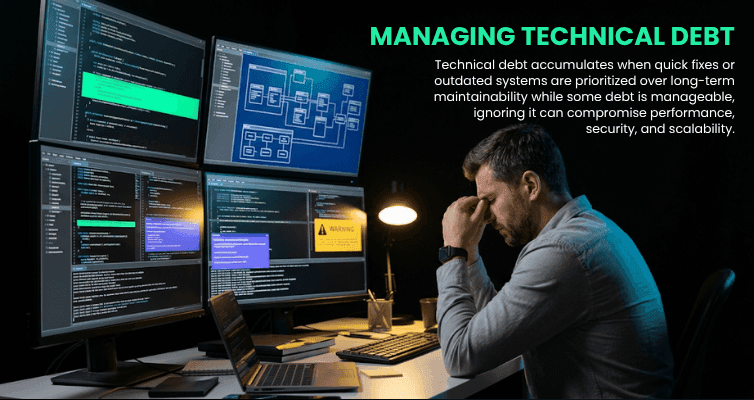
At Lizard Global, we often see this in organizations that have scaled rapidly through acquisitions, regional expansion, or product diversification. Systems that once served one market now need to support multiple business units, mobile ecosystems, and global user bases. Portfolio examples such as Travereel and Dextr demonstrate how legacy architecture can still contain valuable business logic worth preserving, especially when paired with modern web app development services and a clearer product roadmap.
The most important step is understanding that technical debt should be treated as a strategic business issue, not merely an engineering inconvenience. When addressed proactively, it creates opportunities for stronger governance, faster release cycles, and more sustainable innovation.
Signs You Should Modernize
Modernization is often the most strategic route when the existing system still provides business value but struggles to keep up with modern demands. If your core workflows remain stable, your data models are reliable, and your architecture can support modular upgrades, then modernization allows you to extend value without introducing the risks of a complete rebuild. This path is especially effective for enterprises that need operational continuity while improving performance, security, and user experience.
A common signal is when teams are slowed down by repetitive maintenance work instead of innovation. For instance, if every new feature requires excessive regression testing, complex deployment workarounds, or manual infrastructure fixes, your system is likely ready for modernization. Similarly, poor integration capabilities with newer services such as analytics dashboards, cloud platforms, or CRM integration services are strong indicators that the foundation needs selective upgrades.
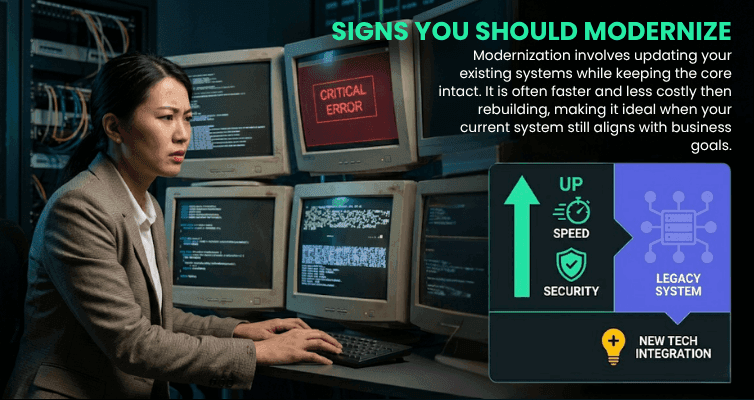
Another major trigger is the customer experience layer. In many enterprise systems, the backend may still be solid while the frontend experience feels outdated, inconsistent, or difficult to use across devices. This is where UI/UX design services and UX/UI product design become critical. Lizard Global’s experience as a mobile app development agency often helps clients modernize digital touchpoints first, improving adoption without disrupting the entire architecture.
For example, in solutions similar to Heineken Drinkies, modernization might involve redesigning ordering flows, improving mobile responsiveness, and introducing API-first service layers while preserving the transactional backbone. This balances speed, risk, and measurable business outcomes, making modernization an ideal path for many enterprise products.
When a Full Rebuild Makes Sense
A full rebuild becomes the better strategic choice when the cost of maintaining the existing system exceeds the value it creates. This typically happens when the codebase is tightly coupled, documentation is poor, dependencies are obsolete, or the platform can no longer support current business ambitions. In these cases, continuing to modernize may only delay a larger problem and increase long-term costs.
Rebuilds are particularly relevant when enterprises are preparing for major transformation initiatives such as launching a new digital product line, entering multiple markets, or consolidating fragmented platforms into one ecosystem. If the existing foundation cannot support hybrid app development, progressive web app development, or secure enterprise-grade integrations, rebuilding provides the clean architecture needed for sustainable growth.
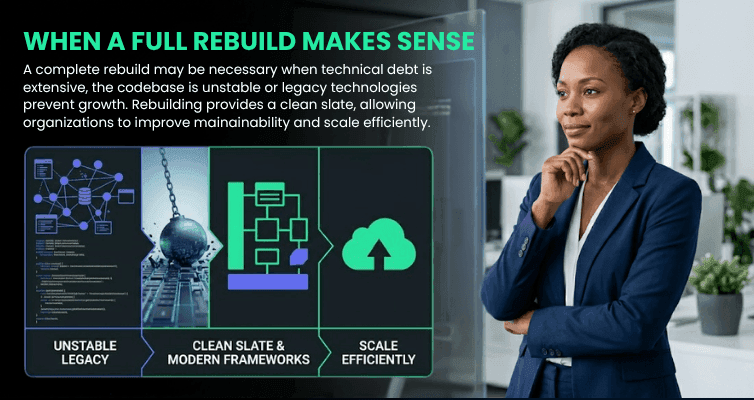
Additionally, compliance and security often push enterprises toward rebuilding. Older systems may lack proper access controls, auditability, or cloud-native resilience, making them unsuitable for industries with strict governance requirements like FinTech or Healthcare. A rebuild allows teams to redesign the architecture around modern DevSecOps practices, scalable infrastructure, and future-ready service orchestration.
Lizard Global’s work across scalable platforms like Skoon has shown that rebuilds often create the best long-term ROI when paired with strong discovery workshops and design validation. Rather than simply replacing old code, the process becomes an opportunity to rethink workflows, remove redundant features, and align the product with strategic growth goals.
Strategic Evaluation: Cost, Risk, and Business Alignment
The modernize-versus-rebuild decision should never be based on engineering preference alone. It must be evaluated through the lens of business impact, total cost of ownership, operational risk, and long-term strategic value. What appears cheaper in the short term may become significantly more expensive over a three- to five-year horizon if maintenance complexity continues to rise.
A practical way to assess this is by mapping systems against three dimensions: business criticality, technical flexibility, and future growth requirements. If a platform directly supports revenue generation, customer retention, or compliance workflows, the tolerance for instability is much lower. In such cases, phased modernization may reduce disruption, whereas a rebuild may be justified if the risk of failure from the current architecture is already too high.
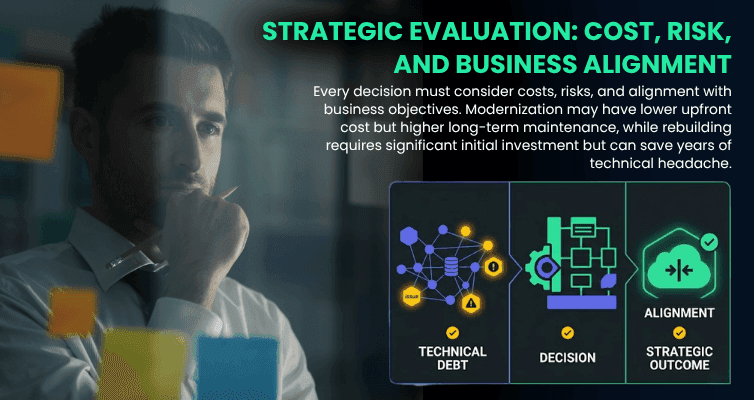
This is why Lizard Global frequently recommends structured digital consultancy services, product workshops, and stakeholder alignment sessions before technical decisions are made. As a digital transformation partner, the goal is to ensure that the chosen path supports measurable KPIs such as faster time-to-market, lower maintenance costs, improved NPS, or better conversion across digital journeys.
Importantly, strategic evaluation should also include talent and process maturity. If your team lacks the capacity to maintain outdated frameworks or onboard new developers efficiently, the hidden cost of technical debt grows faster than most leaders anticipate. Business alignment ensures the chosen investment supports not only the system, but also the people and processes behind it.
Leveraging UI/UX Design and Digital Transformation
Too often, enterprises frame technical debt as purely an infrastructure or engineering challenge. In reality, outdated interfaces, poor workflows, and fragmented user journeys are often the most visible symptoms of deeper technical debt. Even when backend systems are stable, poor usability can reduce employee productivity, frustrate customers, and slow digital adoption.
This is why UI/UX design services should be embedded into modernization and rebuild strategies from the start. Through usability testing, design systems, and validated prototypes, teams can identify friction points that may not be visible in code reviews alone. Sometimes the fastest path to measurable ROI is modernizing the experience layer while progressively transforming backend services behind it.
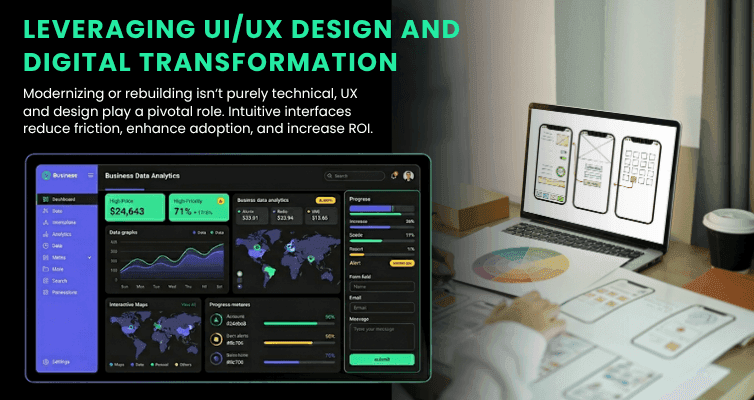
For enterprises, this approach also supports change management. Employees and customers are far more likely to adopt updated systems when interfaces feel intuitive, familiar, and purpose-built for their workflows. Lizard Global’s design service and workshop expertise help bridge the gap between technical architecture and real-world usability, ensuring that digital transformation delivers outcomes people actually use.
Projects like Flexpackerz demonstrate how redesigning workflows and interaction patterns can significantly improve operational efficiency. When paired with a strategic modernization roadmap, better UX becomes a force multiplier that amplifies the value of every engineering investment.
Integrating Modern Technologies
Whether you modernize or rebuild, the end goal should be to create a technology ecosystem that reduces future debt rather than recreating it. This requires integrating modern architectures, scalable frameworks, and flexible services that support continuous evolution. Enterprises should prioritize technologies that enable modularity, automation, and seamless interoperability across systems.
For many organizations, this includes adopting cloud-native services, API-first infrastructure, and cross-platform delivery models such as mobile app development for iOS and Android. These technologies make it easier to launch features faster, support multiple user touchpoints, and reduce duplicated engineering effort across teams.
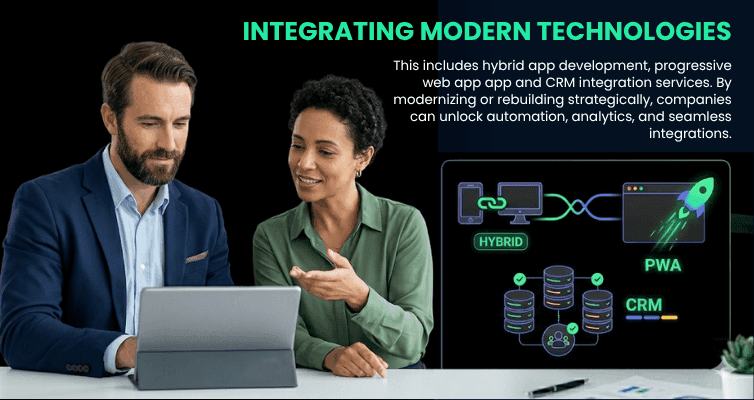
Additionally, integrating analytics and intelligence layers is increasingly important. With growth analytics consulting, enterprises can connect product usage data, customer behavior, and operational performance into one decision-making framework. This transforms modernization from a technical upgrade into a strategic growth lever.
As a full-stack digital solutions agency, Lizard Global helps enterprises design architectures that combine scalable backend systems, modern frontend frameworks, and user-centric product layers. The result is not just a cleaner system, but a digital foundation built to support long-term transformation, faster experimentation, and lower future technical debt.
Making the Enterprise Decision with Lizard Global
Choosing between modernizing or rebuilding requires careful analysis. Lizard Global combines enterprise experience with hands-on digital transformation expertise. From evaluating legacy systems to implementing full-scale rebuilds or modernization plans, our team ensures every decision maximizes efficiency, reduces risk, and aligns with business strategy.

By leveraging our expertise in web app development services, enterprises can achieve scalable, user-friendly, and secure digital solutions that support long-term growth.
Partner with Lizard Global to assess your technical debt, modernize effectively, or rebuild your infrastructure for sustainable growth. Contact us today to start your transformation journey.
Enterprises often face critical decisions when dealing with technical debt. Choosing between modernizing existing systems or rebuilding from scratch impacts costs, performance, and long-term growth. This blog explores strategic approaches, practical examples from Lizard Global’s portfolio, and how organizations can make informed decisions for scalable, future-proof solutions.
Every growing enterprise eventually runs into the same challenge: systems that once powered innovation begin to slow it down. What started as a quick solution evolves into layers of complexity, workarounds, and outdated technologies. As technical debt builds, teams face a critical question that directly impacts cost, performance, and future scalability: should you modernize what you have, or rebuild from the ground up?
The answer is rarely straightforward. Modernizing can extend the life of existing systems with less disruption, while rebuilding can unlock long-term agility and innovation. However, choosing the wrong path can lead to wasted investment, operational risks, and missed market opportunities. This is where a strategic approach, guided by experienced digital transformation partners like Lizard Global, becomes essential.
Understanding Technical Debt in Enterprise Systems
Technical debt in enterprise environments rarely appears overnight. More often, it is the result of years of fast releases, temporary workarounds, legacy integrations, and business decisions that favored speed over scalability. While those decisions may have made sense at the time, the cumulative effect often creates systems that are expensive to maintain, difficult to scale, and increasingly risky to evolve. As organizations grow, these hidden inefficiencies begin to impact product velocity, customer experience, compliance readiness, and even revenue opportunities.
Moreover, enterprise technical debt is not only a code problem. It often extends into infrastructure, outdated user interfaces, disconnected data layers, and manual workflows that no longer match how teams operate today. For example, a legacy customer portal may still function, but if it cannot support CRM integration services, advanced analytics, or secure API connectivity, it becomes a blocker to transformation. This is where a custom software development company and digital consultancy services partner can help assess whether the debt is isolated, systemic, or deeply tied to business-critical operations.
At Lizard Global, we often see this in organizations that have scaled rapidly through acquisitions, regional expansion, or product diversification. Systems that once served one market now need to support multiple business units, mobile ecosystems, and global user bases. Portfolio examples such as Travereel and Dextr demonstrate how legacy architecture can still contain valuable business logic worth preserving, especially when paired with modern web app development services and a clearer product roadmap.
The most important step is understanding that technical debt should be treated as a strategic business issue, not merely an engineering inconvenience. When addressed proactively, it creates opportunities for stronger governance, faster release cycles, and more sustainable innovation.
Signs You Should Modernize
Modernization is often the most strategic route when the existing system still provides business value but struggles to keep up with modern demands. If your core workflows remain stable, your data models are reliable, and your architecture can support modular upgrades, then modernization allows you to extend value without introducing the risks of a complete rebuild. This path is especially effective for enterprises that need operational continuity while improving performance, security, and user experience.
A common signal is when teams are slowed down by repetitive maintenance work instead of innovation. For instance, if every new feature requires excessive regression testing, complex deployment workarounds, or manual infrastructure fixes, your system is likely ready for modernization. Similarly, poor integration capabilities with newer services such as analytics dashboards, cloud platforms, or CRM integration services are strong indicators that the foundation needs selective upgrades.
Another major trigger is the customer experience layer. In many enterprise systems, the backend may still be solid while the frontend experience feels outdated, inconsistent, or difficult to use across devices. This is where UI/UX design services and UX/UI product design become critical. Lizard Global’s experience as a mobile app development agency often helps clients modernize digital touchpoints first, improving adoption without disrupting the entire architecture.
For example, in solutions similar to Heineken Drinkies, modernization might involve redesigning ordering flows, improving mobile responsiveness, and introducing API-first service layers while preserving the transactional backbone. This balances speed, risk, and measurable business outcomes, making modernization an ideal path for many enterprise products.
When a Full Rebuild Makes Sense
A full rebuild becomes the better strategic choice when the cost of maintaining the existing system exceeds the value it creates. This typically happens when the codebase is tightly coupled, documentation is poor, dependencies are obsolete, or the platform can no longer support current business ambitions. In these cases, continuing to modernize may only delay a larger problem and increase long-term costs.
Rebuilds are particularly relevant when enterprises are preparing for major transformation initiatives such as launching a new digital product line, entering multiple markets, or consolidating fragmented platforms into one ecosystem. If the existing foundation cannot support hybrid app development, progressive web app development, or secure enterprise-grade integrations, rebuilding provides the clean architecture needed for sustainable growth.
Additionally, compliance and security often push enterprises toward rebuilding. Older systems may lack proper access controls, auditability, or cloud-native resilience, making them unsuitable for industries with strict governance requirements like FinTech or Healthcare. A rebuild allows teams to redesign the architecture around modern DevSecOps practices, scalable infrastructure, and future-ready service orchestration.
Lizard Global’s work across scalable platforms like Skoon has shown that rebuilds often create the best long-term ROI when paired with strong discovery workshops and design validation. Rather than simply replacing old code, the process becomes an opportunity to rethink workflows, remove redundant features, and align the product with strategic growth goals.
Strategic Evaluation: Cost, Risk, and Business Alignment
The modernize-versus-rebuild decision should never be based on engineering preference alone. It must be evaluated through the lens of business impact, total cost of ownership, operational risk, and long-term strategic value. What appears cheaper in the short term may become significantly more expensive over a three- to five-year horizon if maintenance complexity continues to rise.
A practical way to assess this is by mapping systems against three dimensions: business criticality, technical flexibility, and future growth requirements. If a platform directly supports revenue generation, customer retention, or compliance workflows, the tolerance for instability is much lower. In such cases, phased modernization may reduce disruption, whereas a rebuild may be justified if the risk of failure from the current architecture is already too high.
This is why Lizard Global frequently recommends structured digital consultancy services, product workshops, and stakeholder alignment sessions before technical decisions are made. As a digital transformation partner, the goal is to ensure that the chosen path supports measurable KPIs such as faster time-to-market, lower maintenance costs, improved NPS, or better conversion across digital journeys.
Importantly, strategic evaluation should also include talent and process maturity. If your team lacks the capacity to maintain outdated frameworks or onboard new developers efficiently, the hidden cost of technical debt grows faster than most leaders anticipate. Business alignment ensures the chosen investment supports not only the system, but also the people and processes behind it.
Leveraging UI/UX Design and Digital Transformation
Too often, enterprises frame technical debt as purely an infrastructure or engineering challenge. In reality, outdated interfaces, poor workflows, and fragmented user journeys are often the most visible symptoms of deeper technical debt. Even when backend systems are stable, poor usability can reduce employee productivity, frustrate customers, and slow digital adoption.
This is why UI/UX design services should be embedded into modernization and rebuild strategies from the start. Through usability testing, design systems, and validated prototypes, teams can identify friction points that may not be visible in code reviews alone. Sometimes the fastest path to measurable ROI is modernizing the experience layer while progressively transforming backend services behind it.
For enterprises, this approach also supports change management. Employees and customers are far more likely to adopt updated systems when interfaces feel intuitive, familiar, and purpose-built for their workflows. Lizard Global’s design service and workshop expertise help bridge the gap between technical architecture and real-world usability, ensuring that digital transformation delivers outcomes people actually use.
Projects like Flexpackerz demonstrate how redesigning workflows and interaction patterns can significantly improve operational efficiency. When paired with a strategic modernization roadmap, better UX becomes a force multiplier that amplifies the value of every engineering investment.
Integrating Modern Technologies
Whether you modernize or rebuild, the end goal should be to create a technology ecosystem that reduces future debt rather than recreating it. This requires integrating modern architectures, scalable frameworks, and flexible services that support continuous evolution. Enterprises should prioritize technologies that enable modularity, automation, and seamless interoperability across systems.
For many organizations, this includes adopting cloud-native services, API-first infrastructure, and cross-platform delivery models such as mobile app development for iOS and Android. These technologies make it easier to launch features faster, support multiple user touchpoints, and reduce duplicated engineering effort across teams.
Additionally, integrating analytics and intelligence layers is increasingly important. With growth analytics consulting, enterprises can connect product usage data, customer behavior, and operational performance into one decision-making framework. This transforms modernization from a technical upgrade into a strategic growth lever.
As a full-stack digital solutions agency, Lizard Global helps enterprises design architectures that combine scalable backend systems, modern frontend frameworks, and user-centric product layers. The result is not just a cleaner system, but a digital foundation built to support long-term transformation, faster experimentation, and lower future technical debt.
Making the Enterprise Decision with Lizard Global
Choosing between modernizing or rebuilding requires careful analysis. Lizard Global combines enterprise experience with hands-on digital transformation expertise. From evaluating legacy systems to implementing full-scale rebuilds or modernization plans, our team ensures every decision maximizes efficiency, reduces risk, and aligns with business strategy.
By leveraging our expertise in web app development services, enterprises can achieve scalable, user-friendly, and secure digital solutions that support long-term growth.
Partner with Lizard Global to assess your technical debt, modernize effectively, or rebuild your infrastructure for sustainable growth. Contact us today to start your transformation journey.
FAQs
When should an enterprise modernize instead of rebuilding?
What are the risks of a full system rebuild?
How does UI/UX influence modernization decisions?
Can legacy systems integrate with modern technologies?
How does Lizard Global approach enterprise technical debt?
What is the typical timeline for modernization versus rebuild?
How do enterprises future-proof their systems after addressing technical debt?
similar reads

Case Studies & Interviews
Client Review: Building A Custom Engagement App For MRT Corp
20 August 2026

Case Studies & Interviews
Lereng Tanah: Developing a Direct Booking Platform Malaysian Boutique Villa
29 January 2026

Case Studies & Interviews
Tactlink: How a Malaysian Entrepreneur Turned Networking Chaos into a Digital Community
22 January 2026
Stuck between a great idea and the right team to build it?Let's talk.
We work with corporate innovation teams and ambitious scale-ups across the Netherlands, Singapore, and Australia, and wherever great software needs to be built. Drop us a message and we'll get back to you within one business day.


Markus Monnikendam
Global Commercial Director
hello@lizard.global