Compeasy.ai: How Custom AI Essay Scoring Platforms Scale Writing Excellence

14 Sep 2026
by Nadiy, Senior Content Writer
Contributor, Eric Coutet, Head Product Designer
14 Sep 2026
by Nadiy, Senior Content Writer
Contributor, Eric Coutet, Head Product Designer
Compeasy.ai: How Custom AI Essay Scoring Platforms Scale Writing Excellence
Table of contents
Contact us
We will get back to you in the next 48 hours.
Educational institutions and EdTech providers face a persistent operational bottleneck: manual essay evaluation. Teachers spend dozens of hours every week grading papers, creating delays in feedback that hinder student progress. Generic commercial Large Language Model (LLM) wrappers fail to resolve this because they lack domain-specific assessment standards, structured rubrics, and strict privacy safeguards required for primary and secondary education environments. This post explores how custom AI essay scoring platforms bridge the gap between automated assessment and personalized learning. We discuss the transition from traditional scoring methods to tuned, domain-specific AI engines, showing how modern EdTech solutions deliver structured, actionable writing advice. Readers will examine real-world application architectures, progress tracking dashboards for educators, and data-driven methods for scaling scalable writing evaluation across classrooms while maintaining accuracy, security, and student engagement.
key takeaways
Manual essay grading remains one of the most time-intensive operational bottlenecks in modern K-12 education. Educators spend anywhere from ten to fifteen hours weekly assessing written submissions, leading to slow turnaround times that hinder student improvement. When students wait days or weeks for written feedback, the contextual learning window closes, reducing their engagement with writing instruction.
Custom AI essay scoring platforms solve this challenge by delivering automated, consistent, and actionable writing evaluations in real time. At Lizard Global, we design and build full-stack digital products that bridge complex machine learning models with human-centered user experiences. By developing specialized AI assessment applications, we help EdTech providers and school networks automate administrative evaluation tasks, improve learning outcomes, and scale writing instruction across institutional classrooms.
The Hidden Cost of Manual Essay Grading in Modern Classrooms
Standard primary and secondary education workflows rely heavily on qualitative evaluation. However, traditional manual grading creates severe operational friction for teachers and students alike. Educators face compounding workloads, making it nearly impossible to deliver continuous, individualized feedback for classrooms containing dozens of students. This administrative overload leads to teacher fatigue and operational inconsistency across grade levels.
For students, delayed evaluation disrupts the learning loop. Generic scores, such as receiving a single letter grade or numerical percentage, offer zero guidance on structural improvement, syntax refinement, or thesis development. Without targeted feedback highlighting strengths and clear areas for growth, student writing skills plateau. Existing digital scoring software historically failed to solve this issue because basic tools only evaluated superficial mechanics, such as spelling or basic grammar, without evaluating context, tone, or structural clarity.
![[Impact Image] Compeasy (2).png](/_next/image?url=https%3A%2F%2Fres.cloudinary.com%2Flizardwebsite%2Fimage%2Fupload%2Fv1775651570%2Flizard_website2025%2FImpact_Image_Compeasy_2_f540e9a601.png&w=3840&q=75&dpl=dpl_6vhYPGCiXL4L4UxNdwfVdWPSVz6N)
Why Generic LLM Wrappers Fail Enterprise EdTech Requirements
Deploying off-the-shelf generative AI wrappers for student assessment creates significant risk for educational institutions. Standard API calls to public large language models often result in unpredictable output formats, inconsistent scoring rubrics, and potential model hallucinations. More critically, off-the-shelf implementations lack the strict data privacy infrastructure needed to safeguard minor student data under international educational standards.
Custom AI architectures solve these technical flaws by pairing fine-tuned scoring engines with structured application workflows. Rather than prompting a generic LLM for unstructured commentary, enterprise EdTech platforms utilize specialized scoring engines tuned specifically for K-12 English language criteria. This design choice ensures that every submission is parsed against predefined pedagogical rubrics, yielding reliable, consistent, and repeatable scores across entire school networks.
Our cross-functional software design teams at Lizard Global emphasize end-to-end product discovery, robust user interface architectures, and seamless API integrations for complex software ecosystems. Building purpose-built web and mobile applications allows us to construct clear separation layers between model processing, business logic, and presentation interfaces. This guarantees high system throughput, low latency response times, and maximum data protection for institutional deployments.
Engineered for Impact: The Compeasy.ai Case Study
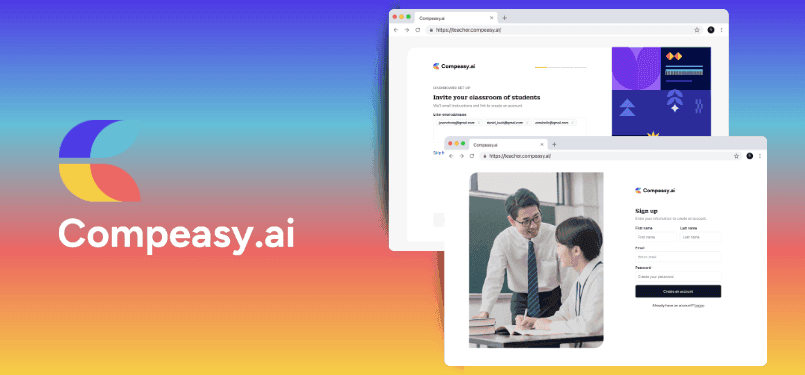
To understand the practical impact of specialized AI assessment tools, consider our work on Compeasy.ai. Compeasy.ai operates within the EdTech sector, serving schools, teachers, and primary and secondary students to elevate English writing proficiency at scale. The client approached Lizard Global to design and implement a web-based platform capable of managing high-volume essay submissions, automating scoring, and delivering granular feedback to guide student development.
![[Impact Image] Compeasy (3).png](/_next/image?url=https%3A%2F%2Fres.cloudinary.com%2Flizardwebsite%2Fimage%2Fupload%2Fv1775651571%2Flizard_website2025%2FImpact_Image_Compeasy_3_0f43b8c2b5.png&w=3840&q=75&dpl=dpl_6vhYPGCiXL4L4UxNdwfVdWPSVz6N)
Our team conducted digital strategy workshops and managed the end-to-end UX/UI design and system integration for both teacher and student interfaces. We mapped out streamlined submission flows, integrated an AI engine tuned for K-12 writing rubrics, and crafted clear analytical dashboards. The final delivery provided immediate, structured writing advice for students while giving educators clear visibility into class-wide performance metrics.
Validated Project Outcomes & Operational Impact
- 50% to 70% Reduction in Grading Workload: Automating the preliminary scoring process significantly decreased manual grading time for educators.
- Actionable Student Feedback: Essays were analyzed for structural composition, allowing students to instantly access personalized recommendations to refine their writing.
- Data-Driven Classroom Management: Comprehensive teacher dashboards enabled educators to identify class-wide writing weaknesses and adjust daily lesson plans accordingly.
![[Impact Image] Compeasy (4).png](/_next/image?url=https%3A%2F%2Fres.cloudinary.com%2Flizardwebsite%2Fimage%2Fupload%2Fv1775651569%2Flizard_website2025%2FImpact_Image_Compeasy_4_157e9f2cbe.png&w=3840&q=75&dpl=dpl_6vhYPGCiXL4L4UxNdwfVdWPSVz6N)
Key Technical Features of a Next-Generation AI Assessment Platform
An enterprise-ready AI writing platform requires a multi-faceted feature set designed around usability, data visibility, and scalar growth. A modern EdTech solution must offer intuitive user journeys for both young learners and administrative personnel.
Automated, Multi-Dimensional AI Scoring
The platform evaluates submissions using consistent, pre-calibrated parameters. It analyzes vocabulary diversity, sentence structure, logical flow, and argument coherence, providing an objective evaluation that eliminates personal bias.
Guided Improvement Recommendations
Rather than presenting raw percentage scores, the interface displays contextual writing advice. Specific text segments are highlighted with recommendations on how to strengthen transition phrases, correct syntax errors, and expand supporting arguments.
Centralized Progress Dashboards
Teachers access centralized analytics modules that display individual progress alongside aggregate classroom trends. These dashboards highlight recurring weak spots across a cohort, enabling targeted instructional interventions.
Designing Intuitive Interfaces for Dual User Cohorts
Creating software for educational environments presents unique UX/UI challenges. Platforms must simultaneously cater to student users who require intuitive, motivating digital experiences, and teacher users who require fast, data-dense administrative tools.
![[Impact Image] Compeasy.png](/_next/image?url=https%3A%2F%2Fres.cloudinary.com%2Flizardwebsite%2Fimage%2Fupload%2Fv1775651571%2Flizard_website2025%2FImpact_Image_Compeasy_76a5333e58.png&w=3840&q=75&dpl=dpl_6vhYPGCiXL4L4UxNdwfVdWPSVz6N)
At Lizard Global, we address dual-user requirements by running iterative prototyping and testing phases before writing production code. For student interfaces, we focus on clear typography, visual distraction reduction, and supportive messaging layouts that transform feedback into an encouraging learning journey. For teacher portals, we prioritize information density, quick-filtering controls, and one-click reporting functions that minimize administrative friction.
Our experience building complex mobile and web platforms across more than twenty industry verticals, including healthcare, fintech, and EdTech, informs our approach to design system architecture. We ensure that accessibility standards, device responsiveness, and intuitive navigation patterns are built directly into the codebase from day one.
Future-Proofing EdTech Infrastructure for Scalable Growth
As machine learning models evolve, educational technology platforms must adapt without requiring complete architectural overhauls. Modern software development strategies emphasize modular API integration, allowing underlying AI scoring engines to be swapped or upgraded as superior models emerge.
Future enhancements for AI writing environments include advanced predictive analytics that flag learning difficulties before standard testing windows occur. Furthermore, introducing gamification mechanics, such as skill progression paths, milestone badges, and real-time revision tracking, boosts student retention and self-directed practice. Expanding core scoring engines to accommodate multiple languages and specialized technical subjects opens up international markets and higher education opportunities.
Partnering with a full-stack digital product agency ensures that your software architecture accounts for future scale. By integrating scalable backend infrastructure, modern frontend frameworks, and continuous product analytics, EdTech companies can transition smoothly from localized pilot programs to widespread enterprise deployment.
Transform Your EdTech Vision Into Enterprise Reality
Building high-impact educational software requires a balance of deep technical capability, intuitive UX design, and robust platform architecture. At Lizard Global, we bring years of experience developing custom digital solutions, guiding projects from initial design thinking workshops through to global deployment. Whether you are looking to integrate specialized AI evaluation engines, redesign complex enterprise workflows, or scale a new EdTech product, our team delivers software designed for long-term growth.

Contact Lizard Global today
to schedule a consultation with our technology experts and turn your product roadmap into a market-leading reality!
Educational institutions and EdTech providers face a persistent operational bottleneck: manual essay evaluation. Teachers spend dozens of hours every week grading papers, creating delays in feedback that hinder student progress. Generic commercial Large Language Model (LLM) wrappers fail to resolve this because they lack domain-specific assessment standards, structured rubrics, and strict privacy safeguards required for primary and secondary education environments. This post explores how custom AI essay scoring platforms bridge the gap between automated assessment and personalized learning. We discuss the transition from traditional scoring methods to tuned, domain-specific AI engines, showing how modern EdTech solutions deliver structured, actionable writing advice. Readers will examine real-world application architectures, progress tracking dashboards for educators, and data-driven methods for scaling scalable writing evaluation across classrooms while maintaining accuracy, security, and student engagement.
Manual essay grading remains one of the most time-intensive operational bottlenecks in modern K-12 education. Educators spend anywhere from ten to fifteen hours weekly assessing written submissions, leading to slow turnaround times that hinder student improvement. When students wait days or weeks for written feedback, the contextual learning window closes, reducing their engagement with writing instruction.
Custom AI essay scoring platforms solve this challenge by delivering automated, consistent, and actionable writing evaluations in real time. At Lizard Global, we design and build full-stack digital products that bridge complex machine learning models with human-centered user experiences. By developing specialized AI assessment applications, we help EdTech providers and school networks automate administrative evaluation tasks, improve learning outcomes, and scale writing instruction across institutional classrooms.
The Hidden Cost of Manual Essay Grading in Modern Classrooms
Standard primary and secondary education workflows rely heavily on qualitative evaluation. However, traditional manual grading creates severe operational friction for teachers and students alike. Educators face compounding workloads, making it nearly impossible to deliver continuous, individualized feedback for classrooms containing dozens of students. This administrative overload leads to teacher fatigue and operational inconsistency across grade levels.
For students, delayed evaluation disrupts the learning loop. Generic scores, such as receiving a single letter grade or numerical percentage, offer zero guidance on structural improvement, syntax refinement, or thesis development. Without targeted feedback highlighting strengths and clear areas for growth, student writing skills plateau. Existing digital scoring software historically failed to solve this issue because basic tools only evaluated superficial mechanics, such as spelling or basic grammar, without evaluating context, tone, or structural clarity.
Why Generic LLM Wrappers Fail Enterprise EdTech Requirements
Deploying off-the-shelf generative AI wrappers for student assessment creates significant risk for educational institutions. Standard API calls to public large language models often result in unpredictable output formats, inconsistent scoring rubrics, and potential model hallucinations. More critically, off-the-shelf implementations lack the strict data privacy infrastructure needed to safeguard minor student data under international educational standards.
Custom AI architectures solve these technical flaws by pairing fine-tuned scoring engines with structured application workflows. Rather than prompting a generic LLM for unstructured commentary, enterprise EdTech platforms utilize specialized scoring engines tuned specifically for K-12 English language criteria. This design choice ensures that every submission is parsed against predefined pedagogical rubrics, yielding reliable, consistent, and repeatable scores across entire school networks.
Our cross-functional software design teams at Lizard Global emphasize end-to-end product discovery, robust user interface architectures, and seamless API integrations for complex software ecosystems. Building purpose-built web and mobile applications allows us to construct clear separation layers between model processing, business logic, and presentation interfaces. This guarantees high system throughput, low latency response times, and maximum data protection for institutional deployments.
Engineered for Impact: The Compeasy.ai Case Study
To understand the practical impact of specialized AI assessment tools, consider our work on Compeasy.ai. Compeasy.ai operates within the EdTech sector, serving schools, teachers, and primary and secondary students to elevate English writing proficiency at scale. The client approached Lizard Global to design and implement a web-based platform capable of managing high-volume essay submissions, automating scoring, and delivering granular feedback to guide student development.
Our team conducted digital strategy workshops and managed the end-to-end UX/UI design and system integration for both teacher and student interfaces. We mapped out streamlined submission flows, integrated an AI engine tuned for K-12 writing rubrics, and crafted clear analytical dashboards. The final delivery provided immediate, structured writing advice for students while giving educators clear visibility into class-wide performance metrics.
Validated Project Outcomes & Operational Impact
- 50% to 70% Reduction in Grading Workload: Automating the preliminary scoring process significantly decreased manual grading time for educators.
- Actionable Student Feedback: Essays were analyzed for structural composition, allowing students to instantly access personalized recommendations to refine their writing.
- Data-Driven Classroom Management: Comprehensive teacher dashboards enabled educators to identify class-wide writing weaknesses and adjust daily lesson plans accordingly.
Key Technical Features of a Next-Generation AI Assessment Platform
An enterprise-ready AI writing platform requires a multi-faceted feature set designed around usability, data visibility, and scalar growth. A modern EdTech solution must offer intuitive user journeys for both young learners and administrative personnel.
Automated, Multi-Dimensional AI Scoring
The platform evaluates submissions using consistent, pre-calibrated parameters. It analyzes vocabulary diversity, sentence structure, logical flow, and argument coherence, providing an objective evaluation that eliminates personal bias.
Guided Improvement Recommendations
Rather than presenting raw percentage scores, the interface displays contextual writing advice. Specific text segments are highlighted with recommendations on how to strengthen transition phrases, correct syntax errors, and expand supporting arguments.
Centralized Progress Dashboards
Teachers access centralized analytics modules that display individual progress alongside aggregate classroom trends. These dashboards highlight recurring weak spots across a cohort, enabling targeted instructional interventions.
Designing Intuitive Interfaces for Dual User Cohorts
Creating software for educational environments presents unique UX/UI challenges. Platforms must simultaneously cater to student users who require intuitive, motivating digital experiences, and teacher users who require fast, data-dense administrative tools.
At Lizard Global, we address dual-user requirements by running iterative prototyping and testing phases before writing production code. For student interfaces, we focus on clear typography, visual distraction reduction, and supportive messaging layouts that transform feedback into an encouraging learning journey. For teacher portals, we prioritize information density, quick-filtering controls, and one-click reporting functions that minimize administrative friction.
Our experience building complex mobile and web platforms across more than twenty industry verticals, including healthcare, fintech, and EdTech, informs our approach to design system architecture. We ensure that accessibility standards, device responsiveness, and intuitive navigation patterns are built directly into the codebase from day one.
Future-Proofing EdTech Infrastructure for Scalable Growth
As machine learning models evolve, educational technology platforms must adapt without requiring complete architectural overhauls. Modern software development strategies emphasize modular API integration, allowing underlying AI scoring engines to be swapped or upgraded as superior models emerge.
Future enhancements for AI writing environments include advanced predictive analytics that flag learning difficulties before standard testing windows occur. Furthermore, introducing gamification mechanics, such as skill progression paths, milestone badges, and real-time revision tracking, boosts student retention and self-directed practice. Expanding core scoring engines to accommodate multiple languages and specialized technical subjects opens up international markets and higher education opportunities.
Partnering with a full-stack digital product agency ensures that your software architecture accounts for future scale. By integrating scalable backend infrastructure, modern frontend frameworks, and continuous product analytics, EdTech companies can transition smoothly from localized pilot programs to widespread enterprise deployment.
Transform Your EdTech Vision Into Enterprise Reality
Building high-impact educational software requires a balance of deep technical capability, intuitive UX design, and robust platform architecture. At Lizard Global, we bring years of experience developing custom digital solutions, guiding projects from initial design thinking workshops through to global deployment. Whether you are looking to integrate specialized AI evaluation engines, redesign complex enterprise workflows, or scale a new EdTech product, our team delivers software designed for long-term growth.
Contact Lizard Global today
to schedule a consultation with our technology experts and turn your product roadmap into a market-leading reality!
FAQs

How does a custom AI essay scoring platform reduce teacher grading workloads?
Why are custom AI scoring platforms better than off-the-shelf LLM wrappers?
Can AI scoring engines accurately evaluate subjective K-12 English writing?
How do progress tracking dashboards benefit teachers and school administrators?
How do custom AI EdTech solutions protect student data privacy?
What involvement is required from an engineering partner to build an AI EdTech app?
What are the long-term expansion capabilities for AI-powered writing tools?
similar reads

Case Studies & Interviews
Lereng Tanah: Developing a Direct Booking Platform Malaysian Boutique Villa
29 January 2026

Case Studies & Interviews
Tactlink: How a Malaysian Entrepreneur Turned Networking Chaos into a Digital Community
22 January 2026

Software Development
Who Are the Top Software Development Vendors in Amsterdam for 2026?
26 August 2026
Stuck between a great idea and the right team to build it?Let's talk.
We work with corporate innovation teams and ambitious scale-ups across the Netherlands, Singapore, and Australia, and wherever great software needs to be built. Drop us a message and we'll get back to you within one business day.


Markus Monnikendam
Global Commercial Director
hello@lizard.global