Should You Build a Custom Loyalty Program Platform or Opt for Third-Party SaaS Integrations?

28 Oct 2026
by Nadiy, Senior Content Writer
28 Oct 2026
by Nadiy, Senior Content Writer
Should You Build a Custom Loyalty Program Platform or Opt for Third-Party SaaS Integrations?
Table of contents
How Do Initial Investment and Long-Term Operating Costs Compare Between Custom Platforms and SaaS Tools?
Why Does Data Ownership and Ecosystem Security Favor Custom Loyalty Architectures?
What Architectural Constraints Do Brands Face with Off-the-Shelf SaaS Integrations?
How Does Bespoke Engineering Power Hyper-Personalized and Gamified Loyalty Workflows?
When Should Enterprise Leaders Transition from Third-Party SaaS to Custom Platforms?
Drive Enterprise Growth with Custom Loyalty Solutions
Contact us
We will get back to you in the next 48 hours.
Retention strategies directly dictate long-term profitability, making the choice between custom loyalty software and off-the-shelf SaaS integrations a pivotal strategic decision. While third-party SaaS tools promise quick setup, they often impose scaling limits, inflexible user journeys, and recurring licensing fees. Conversely, custom loyalty platforms deliver tailored rewards engine logic, complete data ownership, and seamless integration with existing enterprise resource planning and point-of-sale systems. In this comprehensive comparison, we evaluate total cost of ownership, technical scalability, security compliance, and user engagement mechanics to help enterprise leaders select the right retention infrastructure for sustained revenue growth.
key takeaways
Choosing between a custom loyalty program platform and a third-party SaaS integration depends primarily on your operational complexity, long-term ROI goals, and data ownership requirements. Third-party SaaS integrations offer rapid deployment and lower upfront costs, making them suitable for standard e-commerce setups with straightforward reward structures.
However, off-the-shelf SaaS tools create severe bottlenecks as enterprise organizations scale, imposing recurring subscription fees, rigid API rate limits, and restricted data access. In contrast, custom loyalty program platforms require higher initial capital expenditure but deliver complete software ownership, tailored workflow integrations, and unlimited scalability without transaction-based licensing fees.
Businesses processing high transaction volumes or managing complex multi-tier reward logic achieve a lower total cost of ownership through bespoke software development within 18 to 24 months. We recommend third-party SaaS solutions for early-stage validation, while fast-growing enterprises should build custom platforms to maintain full control over their customer retention infrastructure.
How Do Initial Investment and Long-Term Operating Costs Compare Between Custom Platforms and SaaS Tools?
We consistently observe executive teams underestimating the long-term cumulative cost of off-the-shelf SaaS platforms. Third-party loyalty plugins lure brands with attractive monthly fees and minimal upfront setup charges. However, as your active user base expands and transaction volumes grow, these vendor platforms adjust pricing tiers aggressively. SaaS providers typically charge based on active loyalty members or total order processing volume. Consequently, high-growth brands face escalating operational expenses that scale alongside their success, eroding profit margins over time.
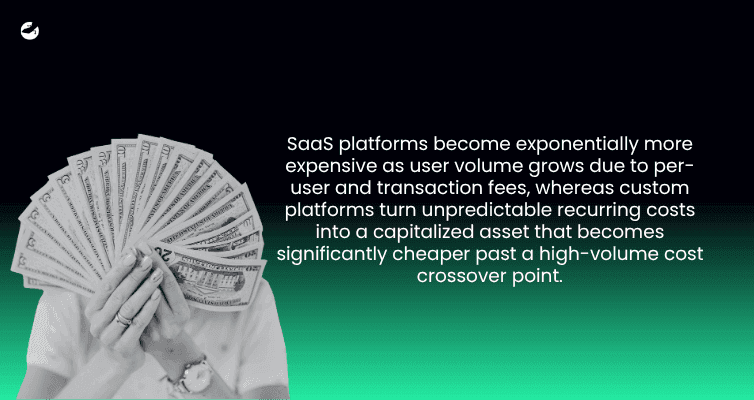
Building a custom loyalty program platform demands a higher initial capital expenditure during the discovery, design, and software development phases. Nevertheless, we construct custom architectures that shift your financials from unpredictable recurring operational expenses to predictable asset capitalization. You own the software IP outright once deployment finishes. Furthermore, you avoid paying monthly per-user tax fees or commission surcharges on earned rewards. High-volume retail and fintech organizations reach a cost crossover point where custom platform maintenance becomes significantly cheaper than ongoing SaaS tier subscriptions.
Why Does Data Ownership and Ecosystem Security Favor Custom Loyalty Architectures?
Customer retention relies entirely on rich behavioural data, purchase histories, and deeply personalized reward triggers. When you rely on third-party SaaS tools, you store valuable customer interaction data on external, multi-tenant databases. Third-party providers limit your raw data extraction capabilities, forcing you to rely on pre-built reporting dashboards or rate-limited export APIs. In contrast, we design custom enterprise solutions that store customer data directly within your secure, dedicated cloud infrastructure. You retain 100% ownership over your data schemas, enabling advanced real-time analytics and direct machine learning model integration.
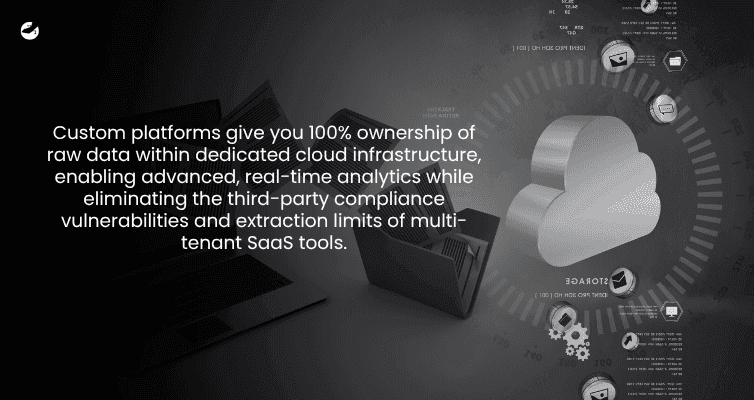
Security compliance presents another critical bottleneck for scaling organizations. Third-party integrations introduce external risk vectors into your digital ecosystem, making GDPR, CCPA, and PCI-DSS compliance harder to manage across multiple software vendors. We engineer bespoke software architectures with tailored end-to-end encryption, strict role-based access controls, and custom audit logging. By maintaining full control over your code base, your internal engineering and compliance teams eliminate dependency on external vendor patch schedules and security protocols.
What Architectural Constraints Do Brands Face with Off-the-Shelf SaaS Integrations?
Off-the-shelf SaaS plugins function on standardized, rigid frameworks designed for mass-market adoption. While this model works well for straightforward Shopify or WooCommerce stores, it fails complex omnichannel environments. SaaS vendors enforce strict API rate limits and pre-defined webhooks that restrict real-time data syncs between physical point-of-sale systems, custom mobile apps, and backend ERP engines. When enterprise workflows demand instant point redemption or complex multi-currency calculations, off-the-shelf connectors frequently introduce latency and broken user sessions.
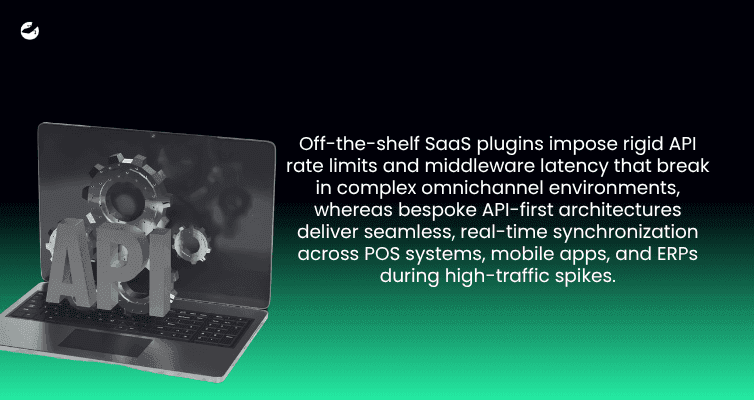
We address these architectural limitations by building purpose-built, API-first loyalty platforms that interface directly with existing tech stacks. Custom platforms eliminate unnecessary middleware layers, allowing instant communication across web portals, native iOS and Android applications, and hardware checkout terminals. We design resilient backend microservices that handle massive concurrent traffic spikes during promotional campaigns without performance degradation or system downtime.
How Does Bespoke Engineering Power Hyper-Personalized and Gamified Loyalty Workflows?
Modern consumers reject generic point-per-dollar reward schemes. Higher retention demands dynamic, gamified mechanics, tiered VIP statuses, dynamic pricing rules, and contextual partner rewards. Standard SaaS integrations offer minimal UI customization and basic template logic, forcing your brand experience to resemble dozens of competitors. Attempting to hack custom features into rigid SaaS logic results in fragile workaround scripts that break whenever the software vendor updates their core API.
We build fully custom loyalty software that empowers product managers to deploy highly complex engagement mechanics. We build custom rules engines that evaluate customer behaviour across online and offline touchpoints instantaneously. Through tailored cross-platform app development and intuitive digital human-centric design, we ensure your loyalty program feels like an organic extension of your brand identity rather than an embedded third-party widget.
When Should Enterprise Leaders Transition from Third-Party SaaS to Custom Platforms?
Transitioning from a SaaS loyalty integration to a proprietary custom platform becomes essential when third-party limitations actively impede your business growth. If your engineering team spends excessive hours managing platform workarounds, or if annual SaaS licensing fees approach the cost of dedicated software development, you have reached the transition threshold. Furthermore, expanding across international markets with localized compliance rules, multi-entity tax structures, and distinct regional reward partners necessitates complete system flexibility.
At Lizard Global, we guide global enterprises through this critical digital transformation journey. We analyze your existing data structures, audit current retention workflows, and architect scalable, future-proof loyalty platforms. Our full-stack engineering expertise across cloud infrastructure, custom web application development, and cross-platform mobile apps ensures seamless data migration with zero downtime. We empower your business to break free from vendor lock-in and build sustainable, high-ROI retention engines.
Drive Enterprise Growth with Custom Loyalty Solutions
Are you ready to stop paying escalating SaaS fees and take total ownership of your customer retention infrastructure? Partner with Lizard Global to engineer a high-performing, bespoke loyalty program platform tailored specifically to your enterprise operations.
Contact our digital transformation experts today
to schedule your technical consultation and unlock predictable, long-term growth.
FAQs

How long does it take to deploy a custom loyalty platform versus SaaS?
Which option provides a better total cost of ownership for enterprises?
Can custom loyalty platforms integrate with legacy ERP and POS systems?
What are the main data security risks with third-party SaaS loyalty tools?
How does custom loyalty software improve customer engagement rates?
Can we migrate our existing user points data from SaaS to a custom platform?
Why should scaling brands avoid rigid off-the-shelf loyalty templates?
similar reads

Case Studies & Interviews
Lereng Tanah: Developing a Direct Booking Platform Malaysian Boutique Villa
29 January 2026

Case Studies & Interviews
Tactlink: How a Malaysian Entrepreneur Turned Networking Chaos into a Digital Community
22 January 2026

Software Development
Should You Build a Custom Loyalty Program Platform or Opt for Third-Party SaaS Integrations?
27 October 2026
Stuck between a great idea and the right team to build it?Let's talk.
We work with corporate innovation teams and ambitious scale-ups across the Netherlands, Singapore, and Australia, and wherever great software needs to be built. Drop us a message and we'll get back to you within one business day.


Markus Monnikendam
Global Commercial Director
hello@lizard.global