Modernize or Rebuild? A Cost-and-Risk Decision Tree For legacy Enterprise B2B platforms

24 Jul 2026
by Nadiy, Senior Content Writer
24 Jul 2026
by Nadiy, Senior Content Writer
Modernize or Rebuild? A Cost-and-Risk Decision Tree For legacy Enterprise B2B platforms
Table of contents
Contact us
We will get back to you in the next 48 hours.
Legacy enterprise software often becomes a hidden bottleneck, slowing down innovation and draining IT budgets through rising technical debt. Technical leaders face a critical turning point when deciding whether to incrementally modernize their existing codebase or execute a full platform rebuild. This article provides a comprehensive cost and risk decision framework to help enterprise executives evaluate architectural complexity, security compliance, user experience friction, and total cost of ownership. We share proven strategies, practical decision trees, and real-world enterprise engineering insights to guide organizations toward the right path for long-term scalability and business agility.
key takeaways
Legacy enterprise platforms eventually reach a threshold where maintaining existing code costs more than replacing it. We regularly see engineering teams struggle with fragile monolithic backends, outdated user interfaces, and scaling limitations that slow down critical product rollouts. The core dilemma for enterprise leadership comes down to two options: do we incrementally modernize our architecture, or do we start fresh with a complete platform rebuild?
To answer this question, we must look beyond basic software features and evaluate total lifecycle costs, operational risks, and long-term strategic alignment. Making the wrong decision can result in years of wasted engineering resources or unexpected system outages. In this framework, we walk through the critical decision factors that help technical decision-makers choose the optimal path for their enterprise B2B platforms.
How Do You Quantify the True Total Cost of Ownership of a Legacy Platform?
Evaluating legacy systems requires looking past direct infrastructure hosting fees. We must calculate the hidden operational costs created by technical debt, such as slower developer onboarding, extended QA cycles, and frequent hotfixes. When core engineering teams spend most of their capacity patching legacy code rather than shipping revenue-generating features, the opportunity cost quickly outpaces the price of system upgrades.
Furthermore, legacy platform maintenance creates severe talent retention challenges. Developers prefer working with modern stacks, and finding specialized talent to maintain deprecated frameworks raises recruitment and salary expenses. We also see elevated security compliance risks as outdated libraries stop receiving critical security patches, exposing enterprise operations to data breaches and regulatory fines.
What Technical Risk Signals Indicate It Is Time for a Full Rebuild?
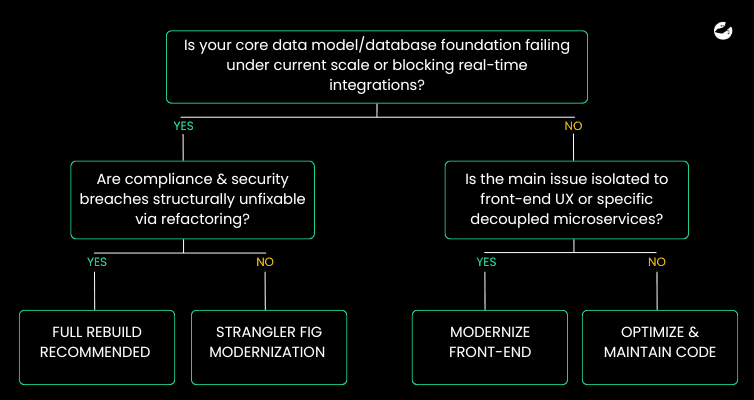
A full platform rebuild becomes necessary when architectural technical debt blocks business expansion. If your core system database structure cannot support multi-tenant scale, real-time data streaming, or automated cross-platform integrations, refactoring existing modules will yield diminishing returns. Trying to layer new microservices over a tightly coupled legacy monolith often creates severe latency issues and unpredictable system dependencies.
Another major risk signal appears when continuous integration and automated deployment pipelines become impossible to implement. When small feature updates trigger widespread system failures, or when deployment requires manual database scripts, the codebase has lost structural integrity. At Lizard Global, we help enterprise leadership assess these architectural bottlenecks to determine if a clean slate build offers a faster, safer return on investment than continuous patching. For instance, in our project with Skoon, we built a scalable clean-slate platform to support clean energy marketplace operations, while our work with Pipeline Pre-Commissioning (PPC) demonstrated how replacing outdated systems with custom engineering tools overcomes severe technical limitations.
How Can Incremental Modernization Mitigate Enterprise Business Disruption?
Choosing incremental modernization allows enterprises to transform their software while maintaining daily business continuity. Rather than taking on a high-risk "big bang" release, we recommend using architectural patterns like the Strangler Fig approach. This strategy involves gradually wrapping legacy capabilities with modern APIs and migrating individual services to cloud-native microservices over time.
By breaking modernization into phased milestones, organizations manage cash flow better and gather early user feedback. Business operations keep running smoothly on the proven core system while new modules undergo rigorous testing in parallel environments. This phased approach isolates technical failures and prevents enterprise-wide downtime during system upgrades. A great example of managing gradual platform modernization is Elfi (IGGI), where real estate management was digitally transformed through modular software architecture, or Hitachi Air Partners Rewards, where legacy installer incentive processes were smoothly transitioned into a modernized digital loyalty ecosystem.
Why Does UI/UX Redesign Serve as a Gateway to Backend Optimization?
Modernizing the user experience often delivers the fastest operational impact for enterprise platforms. Outdated user interfaces with overly complex navigation patterns increase training costs and slow down internal team productivity. Decoupling the front-end user experience from the legacy backend using modern API layers creates a flexible design architecture while buying engineering teams time to refactor deep database layers.
At Lizard Global, we combine human-centered UI design and UX design with scalable full-stack development. Updating user interface components and streamlining workflows allows enterprises to collect valuable usage analytics. We applied this exact approach with Heineken Drinkies, redesigning the user experience to streamline ordering workflows, as well as with ActNow, where intuitive UI design turned complex data into engaging user journeys. These behavioral insights highlight which legacy features get used most, giving product managers clear data on what to rebuild, optimize, or deprecate.
What Governance Frameworks Ensure Successful Enterprise Delivery?
Executing an enterprise software project requires clear governance and cross-functional alignment between business and engineering stakeholders. Without continuous oversight, modernization efforts can suffer from scope creep and rising budgets. We use agile sprint planning, automated testing suites, and clear KPI tracking to ensure development milestones match business objectives. Our collaborative framework is evident in projects like ContractChain, where secure architecture and rigorous governance delivered a trusted blockchain solution, and eBOL, where digitized maritime operations required strict cross-functional alignment and compliance.
Managing enterprise risk requires establishing strict data migration protocols and maintaining fail-safe rollback mechanisms. Cross-functional teams must track deployment velocity, system error rates, and end-user adoption metrics throughout the transformation lifecycle. This structured oversight guarantees that software modernization delivers measurable improvements in operational efficiency and lower platform ownership costs.
Ready to Modernize Your Enterprise Platform?
Navigating legacy software updates requires balancing technical strategy with practical business execution. At Lizard Global, we work as your digital innovation partner to turn legacy challenges into scalable software platforms. Whether you need to refactor existing architecture or build a modern cloud-native system, our team provides technical consultancy, UI/UX design, and full-stack engineering.
Contact Lizard Global
today to schedule a digital transformation consultation and start modernizing your enterprise B2B platform with confidence.
Legacy enterprise software often becomes a hidden bottleneck, slowing down innovation and draining IT budgets through rising technical debt. Technical leaders face a critical turning point when deciding whether to incrementally modernize their existing codebase or execute a full platform rebuild. This article provides a comprehensive cost and risk decision framework to help enterprise executives evaluate architectural complexity, security compliance, user experience friction, and total cost of ownership. We share proven strategies, practical decision trees, and real-world enterprise engineering insights to guide organizations toward the right path for long-term scalability and business agility.
Legacy enterprise platforms eventually reach a threshold where maintaining existing code costs more than replacing it. We regularly see engineering teams struggle with fragile monolithic backends, outdated user interfaces, and scaling limitations that slow down critical product rollouts. The core dilemma for enterprise leadership comes down to two options: do we incrementally modernize our architecture, or do we start fresh with a complete platform rebuild?
To answer this question, we must look beyond basic software features and evaluate total lifecycle costs, operational risks, and long-term strategic alignment. Making the wrong decision can result in years of wasted engineering resources or unexpected system outages. In this framework, we walk through the critical decision factors that help technical decision-makers choose the optimal path for their enterprise B2B platforms.
How Do You Quantify the True Total Cost of Ownership of a Legacy Platform?
Evaluating legacy systems requires looking past direct infrastructure hosting fees. We must calculate the hidden operational costs created by technical debt, such as slower developer onboarding, extended QA cycles, and frequent hotfixes. When core engineering teams spend most of their capacity patching legacy code rather than shipping revenue-generating features, the opportunity cost quickly outpaces the price of system upgrades.
Furthermore, legacy platform maintenance creates severe talent retention challenges. Developers prefer working with modern stacks, and finding specialized talent to maintain deprecated frameworks raises recruitment and salary expenses. We also see elevated security compliance risks as outdated libraries stop receiving critical security patches, exposing enterprise operations to data breaches and regulatory fines.
What Technical Risk Signals Indicate It Is Time for a Full Rebuild?
A full platform rebuild becomes necessary when architectural technical debt blocks business expansion. If your core system database structure cannot support multi-tenant scale, real-time data streaming, or automated cross-platform integrations, refactoring existing modules will yield diminishing returns. Trying to layer new microservices over a tightly coupled legacy monolith often creates severe latency issues and unpredictable system dependencies.
Another major risk signal appears when continuous integration and automated deployment pipelines become impossible to implement. When small feature updates trigger widespread system failures, or when deployment requires manual database scripts, the codebase has lost structural integrity. At Lizard Global, we help enterprise leadership assess these architectural bottlenecks to determine if a clean slate build offers a faster, safer return on investment than continuous patching. For instance, in our project with Skoon, we built a scalable clean-slate platform to support clean energy marketplace operations, while our work with Pipeline Pre-Commissioning (PPC) demonstrated how replacing outdated systems with custom engineering tools overcomes severe technical limitations.
How Can Incremental Modernization Mitigate Enterprise Business Disruption?
Choosing incremental modernization allows enterprises to transform their software while maintaining daily business continuity. Rather than taking on a high-risk "big bang" release, we recommend using architectural patterns like the Strangler Fig approach. This strategy involves gradually wrapping legacy capabilities with modern APIs and migrating individual services to cloud-native microservices over time.
By breaking modernization into phased milestones, organizations manage cash flow better and gather early user feedback. Business operations keep running smoothly on the proven core system while new modules undergo rigorous testing in parallel environments. This phased approach isolates technical failures and prevents enterprise-wide downtime during system upgrades. A great example of managing gradual platform modernization is Elfi (IGGI), where real estate management was digitally transformed through modular software architecture, or Hitachi Air Partners Rewards, where legacy installer incentive processes were smoothly transitioned into a modernized digital loyalty ecosystem.
Why Does UI/UX Redesign Serve as a Gateway to Backend Optimization?
Modernizing the user experience often delivers the fastest operational impact for enterprise platforms. Outdated user interfaces with overly complex navigation patterns increase training costs and slow down internal team productivity. Decoupling the front-end user experience from the legacy backend using modern API layers creates a flexible design architecture while buying engineering teams time to refactor deep database layers.
At Lizard Global, we combine human-centered UI design and UX design with scalable full-stack development. Updating user interface components and streamlining workflows allows enterprises to collect valuable usage analytics. We applied this exact approach with Heineken Drinkies, redesigning the user experience to streamline ordering workflows, as well as with ActNow, where intuitive UI design turned complex data into engaging user journeys. These behavioral insights highlight which legacy features get used most, giving product managers clear data on what to rebuild, optimize, or deprecate.
What Governance Frameworks Ensure Successful Enterprise Delivery?
Executing an enterprise software project requires clear governance and cross-functional alignment between business and engineering stakeholders. Without continuous oversight, modernization efforts can suffer from scope creep and rising budgets. We use agile sprint planning, automated testing suites, and clear KPI tracking to ensure development milestones match business objectives. Our collaborative framework is evident in projects like ContractChain, where secure architecture and rigorous governance delivered a trusted blockchain solution, and eBOL, where digitized maritime operations required strict cross-functional alignment and compliance.
Managing enterprise risk requires establishing strict data migration protocols and maintaining fail-safe rollback mechanisms. Cross-functional teams must track deployment velocity, system error rates, and end-user adoption metrics throughout the transformation lifecycle. This structured oversight guarantees that software modernization delivers measurable improvements in operational efficiency and lower platform ownership costs.
Ready to Modernize Your Enterprise Platform?
Navigating legacy software updates requires balancing technical strategy with practical business execution. At Lizard Global, we work as your digital innovation partner to turn legacy challenges into scalable software platforms. Whether you need to refactor existing architecture or build a modern cloud-native system, our team provides technical consultancy, UI/UX design, and full-stack engineering.
Contact Lizard Global
today to schedule a digital transformation consultation and start modernizing your enterprise B2B platform with confidence.
FAQs
What is the main difference between software modernization and a platform rebuild?
How do we decide between refactoring legacy code and building a custom platform?
What is the Strangler Fig pattern in enterprise platform modernization?
How long does a typical enterprise software rebuild take compared to modernization?
How can technical leaders justify modernization costs to executive decision-makers?
What security risks come with running outdated B2B legacy software?
How does Lizard Global help enterprises evaluate and execute platform upgrades?
similar reads

Case Studies & Interviews
Client Review: Building A Custom Engagement App For MRT Corp
20 August 2026

Case Studies & Interviews
How to Build a Scalable FoodTech Marketplace: Lessons from Optimizing FoodToo
25 August 2026

AI & Machine Learning
How to Identify Your Highest-ROI AI Workflow Before Spending a Cent
31 August 2026
Stuck between a great idea and the right team to build it?Let's talk.
We work with corporate innovation teams and ambitious scale-ups across the Netherlands, Singapore, and Australia, and wherever great software needs to be built. Drop us a message and we'll get back to you within one business day.


Markus Monnikendam
Global Commercial Director
hello@lizard.global