
How Much Does It Cost to Develop an App in Amsterdam, The Netherlands? (2026 Market Entry Blueprint)

02 Sep 2026
by Nadiy, Senior Content Writer
02 Sep 2026
by Nadiy, Senior Content Writer
How Much Does It Cost to Develop an App in Amsterdam, The Netherlands? (2026 Market Entry Blueprint)
Table of contents
What Are the Core Project Pricing Tiers in the Dutch Market?
What Does AI Integration Cost in Mobile and Web Apps?
How Do Local Dutch Factors Drive Development Rates?
How Does Regulatory Compliance Impact Software Budgets in Europe?
Why Is Tech Stack Selection Essential for Cost Control?
What First-Hand Data Benchmark Shows Real App Development Expenses?
How Does Lizard Global Maximize Software ROI in Amsterdam?
Contact us
We will get back to you in the next 48 hours.
Developing a custom app in Amsterdam requires balancing engineering quality, EU privacy mandates, and local market dynamics. In 2026, software development costs in the Randstad area span from €25,000 for a basic proof-of-concept to well over €150,000 for complex enterprise ecosystems. Main budget drivers include regional developer rates, strict GDPR requirements, system integration points, and advanced features like autonomous AI agents or real-time data streaming. Partnering with an end-to-end digital consultancy allows businesses to optimize capital efficiency through cross-platform frameworks, strategic UI/UX design, and cross-shore agile sprint models. This guide breaks down project pricing tiers, compliance mandates, AI integration costs, and practical cost-saving strategies to help digital decision-makers launch software products efficiently in the Dutch market.
key takeaways
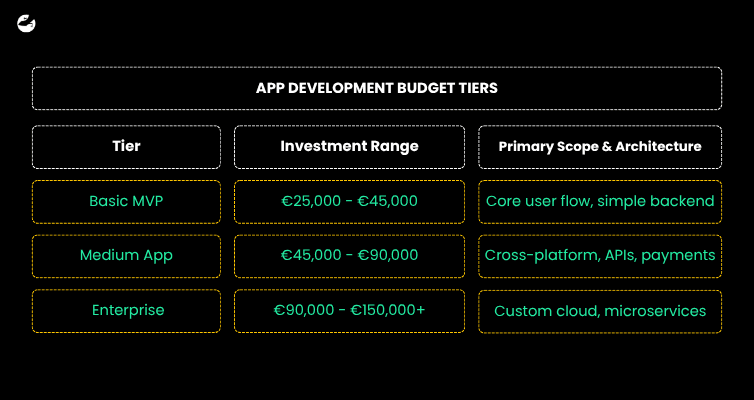
Building a mobile or web app in Amsterdam in 2026 generally costs between €25,000 and €150,000+ depending on your functional complexity, integration scale, regulatory needs, and AI requirements. A focused Minimum Viable Product (MVP) costs €25,000 to €45,000, a medium-complexity application ranges from €45,000 to €90,000, and an enterprise platform starts at €90,000.
These figures reflect hourly engineering rates across the Netherlands of €75 to €140 per hour, alongside strict European data compliance regulations. At Lizard Global, we bring over 14 years of hands-on digital engineering experience, helping startups, scale-ups, and global brands engineer scalable applications across more than 20 industries. In this blueprint, we break down every cost driver, regional requirement, and architectural decision that shapes your software investment in the Dutch market.
What Are the Core Project Pricing Tiers in the Dutch Market?
When we calculate development costs across the Dutch software landscape, we divide projects into three primary tiers. Each tier reflects total developer sprint hours, front-end customization, back-end architecture depth, and system integration points.
A Basic Minimum Viable Product focuses exclusively on solving one core problem for your target user segment. We keep the visual interface streamlined while ensuring the underlying codebase is modular and scalable. This tier allows founders and innovation leads to test market traction quickly without committing massive capital upfront.
Medium-complexity applications expand into multi-platform availability for iOS and Android, custom administrative panels, localized payment infrastructure, and robust user roles. At this level, we leverage cross-platform development tools to ensure fast execution across platforms while maintaining top-tier performance standards.
Enterprise platforms require extensive architectural planning, microservices architecture, complex database structures, and high-concurrency cloud environments. These systems support heavy user traffic and complex workflows, often connecting directly into legacy software ecosystems.
What Does AI Integration Cost in Mobile and Web Apps?
Integrating Artificial Intelligence into software platforms has shifted from a novelty to an operational necessity in 2026. Incorporating dedicated AI modules into a custom app in Amsterdam adds between €15,000 and €45,000 to your base development budget depending on model complexity, data pipelines, and real-time processing needs.
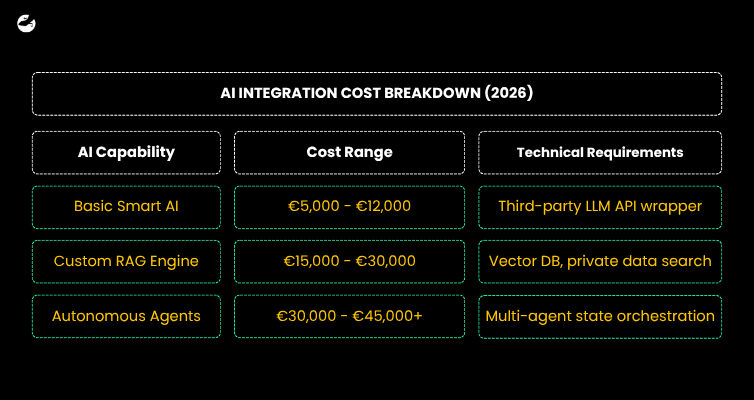
Simple AI enhancements like smart recommendations or basic conversational interfaces built via standard API wrappers start around €5,000 to €12,000. These features work well for light personalization, simple chat assistance, or content tagging without needing dedicated model training or custom vector infrastructure.
Enterprise-grade Retrieval-Augmented Generation (RAG) systems and autonomous agent workflows require a larger investment. Building private vector databases, fine-tuning retrieval pipelines to prevent hallucinations, and orchestrating multi-agent state machines typically cost between €15,000 and €45,000+. We demonstrated this cost-aware approach when we built Travereel, integrating AI trip recommendation engines to help travelers discover destinations seamlessly. Similarly, our work on Zeno AI involved engineering a privacy-first AI emotional self-exploration companion that balances deep real-time interaction with strict data security boundaries.
How Do Local Dutch Factors Drive Development Rates?
Developing software in the Randstad tech hub puts your product alongside major global digital hubs. However, local market factors in the Netherlands exert direct pressure on hourly engineering rates and operational overhead.
On-site Senior Full-Stack Engineers in Amsterdam command hourly rates between €90 and €140 per hour. High local demand for specialized talent, combined with regional office costs, means hiring an exclusively local Dutch dev agency quickly elevates total project estimates.
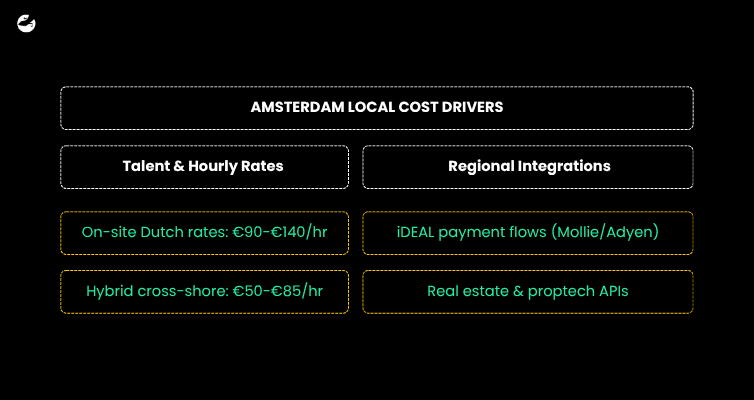
Targeting the Dutch consumer market also introduces specific third-party integration requirements. For instance, Dutch e-commerce apps must support iDEAL payment flows through gateways like Mollie or Adyen. In specialized verticals, software must interface with regional data networks. When we developed Elfi, an all-in-one digital real estate platform in the Netherlands, we engineered custom integration flows to handle property management, lease processing, and tenant communications smoothly.
How Does Regulatory Compliance Impact Software Budgets in Europe?
Building digital platforms for European users requires adherence to strict privacy and data security frameworks. Compliance cannot be retrofitted at the end of a project; we build privacy controls directly into the system architecture.
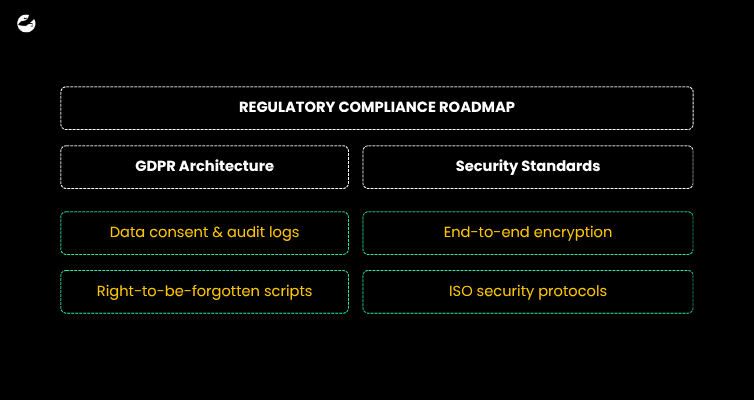
Implementing General Data Protection Regulation (GDPR) compliance adds roughly 10% to 15% to back-end engineering efforts. Developers must build explicit user consent management systems, data anonymization workflows, and automated right-to-be-forgotten database tasks. These mechanisms guarantee your app passes strict compliance audits without structural code rewrites later.
Enterprise platforms handling sensitive commercial or identity data require further security steps. Building end-to-end data encryption, audit trails, and preparation for ISO certifications increases initial sprint time. We encountered these exact requirements when developing WAPA, a maritime tracking app that processes real-time vessel data across international shipping corridors with strict audit logging.
Why Is Tech Stack Selection Essential for Cost Control?
Your technology stack choice determines both initial build costs and long-term platform maintenance overhead. Choosing modern cross-platform frameworks accelerates time-to-market while protecting capital reserves.
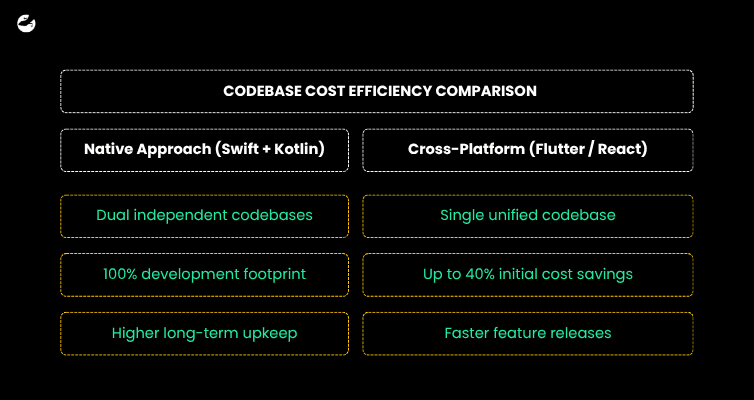
Building separate native applications in Swift for iOS and Kotlin for Android doubles your codebase size and increases engineering hours by up to 70%. We frequently recommend cross-platform engineering using Flutter or React Native for modern mobile products. This approach allows developers to share up to 90% of the codebase across platforms, cutting initial development expenses by up to 40% while delivering native performance.
Cloud infrastructure choices also protect your long-term operational budget. Selecting modular Node.js or Python microservices paired with serverless architectures keeps hosting expenses low during launch. When we built Heineken’s Drinkies platform, we engineered a scalable back-end architecture capable of handling heavy order volumes and expanding into dynamic features like loyalty rewards through Drinkies Star Bar.
What First-Hand Data Benchmark Shows Real App Development Expenses?
Drawing directly from Lizard Global's 14 years of commercial engineering, we analyze actual resource distribution across typical product builds. Our project metrics show how engineering budgets break down across core project phases:
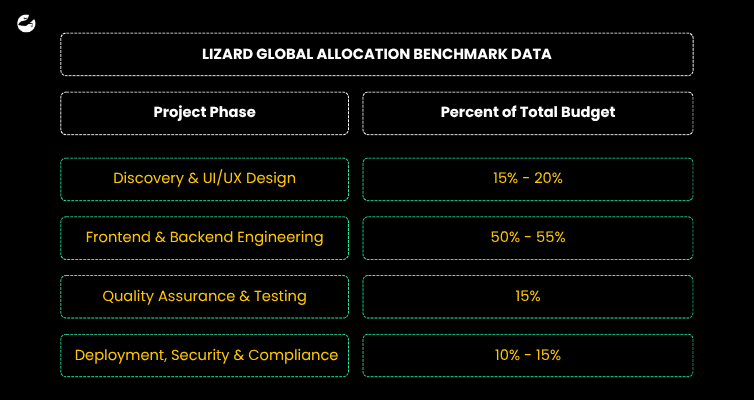
Our historical project data reveals that skipping structured UI/UX discovery phase workshops increases total development rework costs by up to 30% in later sprints. We saw the value of early strategic design during our work on Aposto, a sports event management app where streamlined event staff workflows were validated early via prototypes to prevent back-end changes mid-build.
Similarly, allocating 15% of your total budget to automated Quality Assurance (QA) prevents severe technical debt post-launch. When building Saleduck, a high-traffic affiliate platform operating across multiple global markets, continuous automated testing ensured high performance during extreme user traffic spikes.
How Does Lizard Global Maximize Software ROI in Amsterdam?
At Lizard Global, we combine local Dutch product strategy with cost-efficient cross-shore engineering excellence. Operating through our Dutch leadership alongside established global development hubs, we serve as your end-to-end technical partner and digital leadership team.
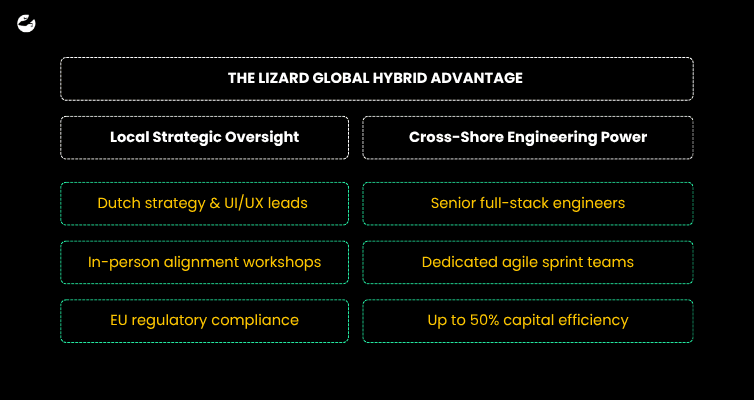
Our hybrid operational model pairs local strategy, design thinking, and product oversight with our dedicated engineering teams. This structure provides clear communication and local accountability while reducing total software development costs by up to 50% compared to traditional on-site Amsterdam agencies.
We follow disciplined agile frameworks that give you complete visibility into sprint velocity, deliverable milestones, and budget consumption. Whether we are engineering AI platforms like Travereel or building complex e-commerce platforms like Perpetual Memorial Park, our team builds future-proof software designed for real commercial growth.
Transform your software vision into a scalable, high-performing digital product with Lizard Global. Contact our expert team today to schedule a technical discovery session, receive a custom cost estimate, and launch your application efficiently in the Amsterdam market.
FAQs
What is the average cost to build a mobile app in Amsterdam in 2026?
How much does adding custom AI features increase an app budget?
How long does it take to develop a custom application from start to finish?
Should we choose native app development or cross-platform tools like Flutter?
How much should we budget for ongoing app maintenance after deployment?
How do GDPR requirements impact software development costs in the Netherlands?
How does Lizard Global optimize app development costs for European clients?
similar reads

Case Studies & Interviews
Lereng Tanah: Developing a Direct Booking Platform Malaysian Boutique Villa
29 January 2026

Case Studies & Interviews
Tactlink: How a Malaysian Entrepreneur Turned Networking Chaos into a Digital Community
22 January 2026

Software Development
Who Are the Top Software Development Vendors in Amsterdam for 2026?
26 August 2026
Stuck between a great idea and the right team to build it?Let's talk.
We work with corporate innovation teams and ambitious scale-ups across the Netherlands, Singapore, and Australia, and wherever great software needs to be built. Drop us a message and we'll get back to you within one business day.


Markus Monnikendam
Global Commercial Director
hello@lizard.global