Which Agencies Specialize in AI Integration in Amsterdam, Netherlands? A Commercial Vendor Audit

19 Aug 2026
by Nadiy, Senior Content WriterFood & Beverage
19 Aug 2026
by Nadiy, Senior Content WriterFood & Beverage
Which Agencies Specialize in AI Integration in Amsterdam, Netherlands? A Commercial Vendor Audit
Table of contents
Enterprise Consultancies
What Defines True Enterprise AI Integration Beyond API Wrappers?
How Do You Evaluate Technical Capabilities and Legacy Modernization in Amsterdam?
Why Is EU AI Act Compliance and Data Sovereignty Essential for Local Partners?
Key Buyer Checklist for Dutch AI Procurement
What Role Does Human-Centered UI/UX Play in Successful AI Adoption?
How Should Enterprise Decision-Makers Structure Their Vendor Selection Process?
Partner with Lizard Global to engineer your enterprise AI integration
Contact us
We will get back to you in the next 48 hours.
Selecting an AI integration partner in Amsterdam requires evaluating technical depth, regulatory compliance, and architectural alignment. This commercial vendor audit reviews the local agency landscape for enterprise engineering, legacy modernization, and scalable deployment. We analyze key criteria to help executive teams select an ideal technology partner.
key takeaways
Navigating the enterprise AI vendor ecosystem in Amsterdam requires cutting through market noise to identify software partners capable of delivering real business engineering. As European organizations face mounting pressure to modernize operations, integrate predictive intelligence, and comply with strict regulatory frameworks like the EU AI Act, choosing the right digital production partner is critical. Many agencies market artificial intelligence solutions, yet few possess the cross-disciplinary engineering required to connect intelligent models with complex legacy systems.
We conduct this commercial vendor audit to evaluate how technical decision-makers should assess AI integration agencies in Amsterdam. By examining core capabilities, system architecture approaches, regulatory standards, and software production methodologies, we outline the exact parameters needed to choose a partner that drives measurable ROI.
Enterprise Consultancies
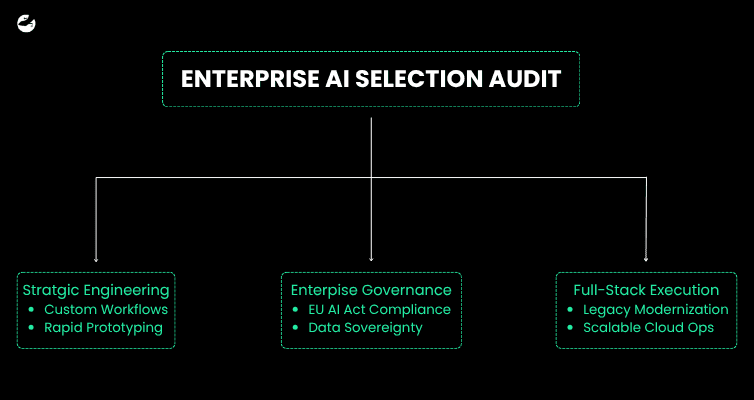
Before we get into how technical decision-makers should assess AI Integration agencies, let's take a look at ones that are best for multi-million euro transformations, EU AI Act compliance, and complex legacy IT architectures.
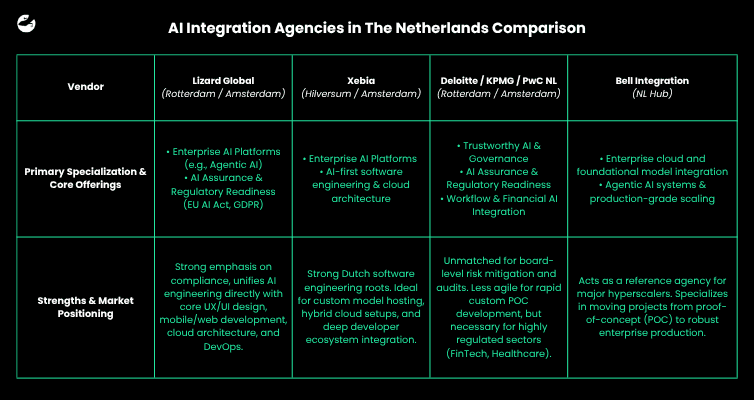
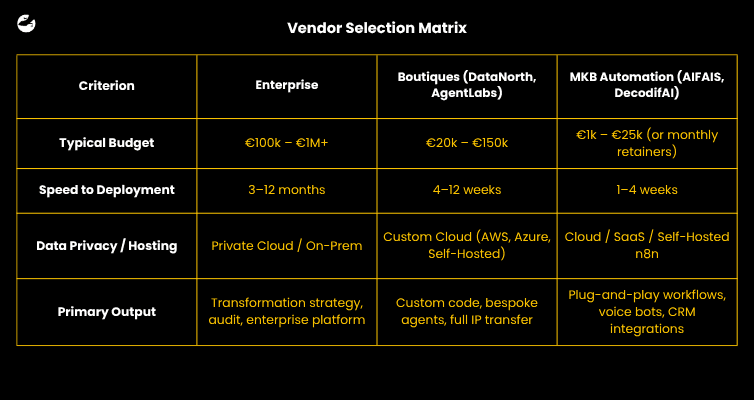
Below is an audit categorizing the top commercial vendors in the Dutch market based on technical specialty, target audience, typical pricing models, and compliance posture.
Lizard Global (Amsterdam/Rotterdam)
- Primary Specialization & Core Offerings: Enterprise AI Platforms (e.g., Agentic AI), AI Assurance & Regulatory Readiness (EU AI Act, GDPR)
- Strengths & Market Positioning: Strong emphasis on compliance, unifies AI engineering directly with core UX/UI design, mobile/web development, cloud architecture, and DevOps, preventing AI features from feeling disconnected from the primary user experience.
Xebia (Hilversum / Amsterdam)
- Primary Specialization & Core Offerings: Enterprise AI Platforms (e.g., Agentic OS), AI-first software engineering & cloud architecture
- Strengths & Market Positioning: Strong Dutch software engineering roots. Ideal for custom model hosting, hybrid cloud setups, and deep developer ecosystem integration.
Deloitte / KPMG / PwC NL (Rotterdam / Amsterdam)
- Primary Specialization & Core Offerings: Trustworthy AI & Governance, AI Assurance & Regulatory Readiness (EU AI Act, GDPR), Workflow & Financial AI Integration
- Strengths & Market Positioning: Unmatched for board-level risk mitigation and audits. Less agile for rapid custom POC development, but necessary for highly regulated sectors (FinTech, Healthcare).
Bell Integration (NL Hub)
- Primary Specialization & Core Offerings: Enterprise cloud and foundational model integration, Agentic AI systems & production-grade scaling
- Strengths & Market Positioning: Acts as a reference agency for major hyperscalers. Specializes in moving projects from proof-of-concept (POC) to robust enterprise production.
What Defines True Enterprise AI Integration Beyond API Wrappers?
Enterprise AI integration goes far beyond connecting a standard language model to a basic user interface via simple API calls. True integration demands deep custom engineering that binds intelligent algorithms directly to an enterprise’s internal databases, custom enterprise resource planning (ERP) platforms, and proprietary operational workflows. We view real AI capabilities as custom-built neural networks, retrieval-augmented generation (RAG) pipelines, and autonomous agent networks designed around specific business logic.
When software agencies merely wrap existing third-party APIs without addressing core architecture, enterprise clients suffer from severe latency, security vulnerabilities, and vendor lock-in. We recommend looking for engineering teams that design custom middleware, implement vector databases, and build scalable infrastructure to handle complex data transformation. This level of technical rigor ensures that your AI integration delivers reliable outcomes, preserves data privacy, and scales seamlessly alongside your core business operations.
At Lizard Global, we engineer end-to-end custom digital platforms that unify advanced data processing with resilient software design. Our engineers treat artificial intelligence as a foundational architecture layer, integrating intelligence into enterprise platforms so complex systems run reliably and securely.
How Do You Evaluate Technical Capabilities and Legacy Modernization in Amsterdam?
Modernizing enterprise software infrastructure in the Netherlands requires bridging the gap between legacy tech stacks and modern cloud-native architectures. Many established enterprises rely on monolithic systems built over decades, making direct AI integration challenging without thoughtful refactoring. We audit vendor technical capabilities by assessing their experience in microservices architecture, API gateway development, and legacy database refactoring.
A qualified integration partner must demonstrate deep expertise across both modern machine learning frameworks and traditional enterprise backends. They should evaluate whether your existing stack supports event-driven architecture, containerization, and secure cloud orchestration. Without this dual expertise, attempting to layer intelligent automation onto legacy databases often leads to system downtime, degraded performance, and brittle user experiences.
We have applied this exact balance of modern stack architecture and legacy integration across diverse global projects. For instance, when partnering with OV-Taxi, we helped modernize complex transit system interfaces by building streamlined, high-availability digital solutions. Similarly, our work with ELFI demonstrated how structured software engineering can transform dense, legacy operational workflows into clean, accessible digital environments. By approaching AI integration through this same structural lens, we ensure modern intelligence works in harmony with existing enterprise tools.
Why Is EU AI Act Compliance and Data Sovereignty Essential for Local Partners?
Operating within the European Union means AI adoption must adhere to strict regulatory structures, including the General Data Protection Regulation (GDPR) and the EU AI Act. Amsterdam has established itself as a major European tech hub, meaning local businesses face immediate scrutiny regarding data governance, algorithmic bias, and automated decision transparency. We advise executive teams to eliminate vendors that treat regulatory compliance as an afterthought.
A competent AI integration agency must implement robust data sovereignty protocols from day one of development. This includes offering local dynamic deployment options, such as private cloud infrastructure or on-premise model hosting, ensuring sensitive corporate data never leaves your controlled network. Furthermore, development teams must build clear audit logs, explainable output mechanisms, and strict access controls into the software's foundational architecture.
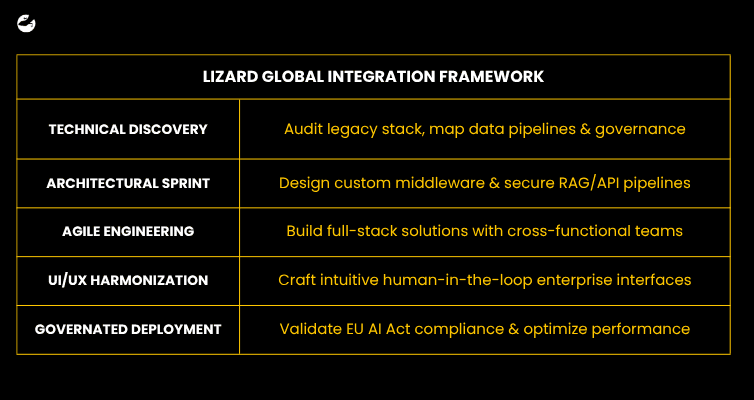
Our commitment to security and regulatory alignment is built directly into our product strategy frameworks. We design custom digital platforms with strict data segregation, encrypted data pipelines, and compliance-first architectures. By prioritizing these governance controls early in the technical discovery phase, we protect our enterprise partners from legal exposure while ensuring their intelligent systems remain fully audit-ready.
Key Buyer Checklist for Dutch AI Procurement
When evaluating AI integration proposals in the Netherlands, ensure the following terms are clarified:
- IP & Code Ownership: Confirm whether you receive total ownership of custom agent code, data pipelines, and prompt architectures, or if you are licensing a proprietary agency platform.
- EU AI Act & Data Residency: Verify where model context/embeddings are processed. Agencies operating in the Netherlands should be able to guarantee EU-based data hosting (e.g., Frankfurt/Amsterdam cloud regions) and compliance with strict data processing agreements (AVG/GDPR).
- Human-in-the-Loop (HITL) Architecture: For workflows carrying legal, financial, or operational risk, ensure the vendor builds explicit human approval steps into the workflow rather than over-promising 100% autonomous execution.
What Role Does Human-Centered UI/UX Play in Successful AI Adoption?
An intelligent algorithm is only as effective as the human interface through which your staff or customers interact with it. Complex predictive models and automated workflows fail to generate ROI if end users find the interface confusing, slow, or unintuitive. We emphasize that successful AI adoption requires blending deep backend data science with world-class user experience (UX) and interface (UI) design.
Integrating artificial intelligence into business workflows introduces unique UI/UX challenges, such as handling model latency, presenting probabilistic data clearly, and establishing user trust through system transparency. Agencies must design interfaces that simplify complex automated processes into intuitive actions, allowing employees to supervise, guide, and override automated decisions effortlessly. Exceptional UX design bridges technical complexity and daily operations, accelerating internal adoption rates across the organization.
Our design philosophy centers on making complex digital systems frictionless for end users. For example, during our collaboration with CompEasy AI, we focused on building clean, high-performance interfaces designed to manage massive visual data streams smoothly. In the healthcare sector, our work with Cognify required turning complex algorithmic risk assessments into clear, reassuring visual feedback for users. Applying these human-centric design principles to AI integrations ensures that complex data processes become practical, daily tools for your enterprise team.
How Should Enterprise Decision-Makers Structure Their Vendor Selection Process?
Selecting the right commercial vendor demands a structured evaluation process rather than relying on marketing pitches or generic case studies. Executive leadership should initiate vendor selection by issuing precise commercial audits that test an agency’s technical problem-solving capabilities, IP ownership terms, and team structure. We recommend evaluating partners based on their software engineering discipline, cross-industry experience, and willingness to co-create custom solutions.
To streamline your vendor evaluation, use this practical framework to score candidate agencies across critical operational dimensions:
- Engineering Rigor and Stack Versatility: Assess whether the agency employs full-stack software engineers alongside data specialists to guarantee smooth backend integration and long-term codebase maintainability.
- Rapid Feasibility Prototyping: Verify that the vendor offers structured discovery phases to build functional proofs-of-concept (PoCs) before asking for full commercial commitments.
- Complete Intellectual Property Ownership: Ensure that all custom code, trained models, data pipelines, and system architectures remain 100% your exclusive corporate property.
- Cross-Industry Innovation Transfer: Look for partners with proven track records across varied sectors, as cross-industry experience yields more resilient problem-solving frameworks.
- Transparent Agile Delivery: Confirm the agency utilizes transparent sprint tracking, clear commercial milestones, and continuous integration/continuous deployment (CI/CD) practices.
Partner with Lizard Global to engineer your enterprise AI integration
Our global track record reflects this comprehensive approach to digital product engineering. Whether building complex fintech infrastructure like ActNow, optimizing maritime logistics platforms like eBOL, or designing real-time operational platforms like Morph, we bring cross-industry engineering precision to every build. We partner closely with executive teams to transform complex technological hurdles into proprietary, scalable software assets.
Our full-stack software engineering teams build secure, scalable, and compliant AI solutions tailored to your legacy infrastructure. Contact our strategy team today to schedule a technical discovery session and accelerate your digital transformation.
FAQs

What distinguishes a specialized AI integration agency from a traditional software dev shop?
How long does a enterprise custom AI integration project typically take from start to finish?
How do local Amsterdam agencies handle data privacy and compliance under the EU AI Act?
Can an AI integration partner connect modern models to our existing legacy ERP or CRM systems?
What is the expected ROI model when investing in enterprise AI integration services?
Who owns the intellectual property and custom code developed during an AI integration project?
Why should enterprise companies choose Lizard Global for their AI integration and software development?
similar reads

Software Development
Who Are the Top Software Development Vendors in Amsterdam for 2026?
26 August 2026

Software Development
How Much Does It Cost to Develop an App in Amsterdam, The Netherlands? (2026 Market Entry Blueprint)
2 September 2026

Software Development
How Much Does App Development Cost in the Netherlands?
5 November 2024
Stuck between a great idea and the right team to build it?Let's talk.
We work with corporate innovation teams and ambitious scale-ups across the Netherlands, Singapore, and Australia, and wherever great software needs to be built. Drop us a message and we'll get back to you within one business day.


Markus Monnikendam
Global Commercial Director
hello@lizard.global