Mobile App Development
Custom Software Development
+ 1 more ...
Custom Software vs Internal Tools: What CTOs Should Decide First
18 Mar 2026
by Team Lizard Global
Editor: Nadiy, Senior Content Writer
18 Mar 2026
by Team Lizard Global
Editor: Nadiy, Senior Content Writer
Mobile App Development
Custom Software Development
Internal Tools
Custom Software vs Internal Tools: What CTOs Should Decide First
Table of contents
Contact us
We will get back to you in the next 48 hours.
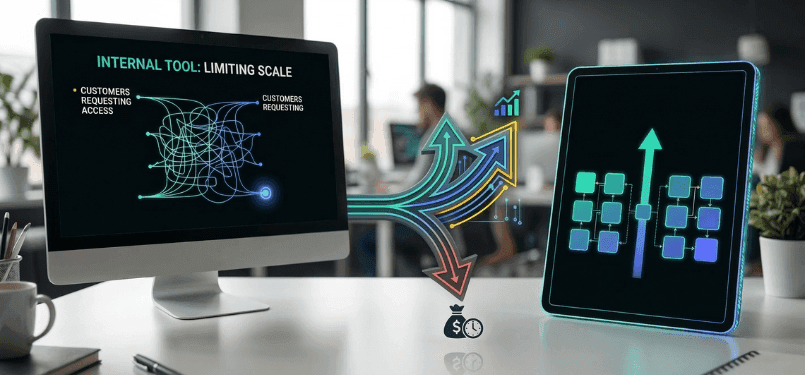
As companies scale, CTOs face a critical architectural and strategic decision: build internal tools quickly to solve immediate operational pain, or invest in custom software that drives long-term competitive advantage. The wrong decision can result in technical debt, fragmented systems, and stalled growth. The right one creates scalability, efficiency, and market differentiation. In this blog, we break down how to decide between internal tools and custom platforms, when to transition from one to the other, and how a digital transformation partner can help align technology with business strategy. We also reference real-world projects delivered by Lizard Global to illustrate what works, and why.
key takeaways
Every scaling company eventually reaches a tipping point. Spreadsheets multiply. Teams rely on disconnected SaaS tools. Workarounds become permanent solutions. At that moment, CTOs must make a strategic call: Should we build internal tools to optimize operations? Or should we invest in scalable custom software that drives growth?
Although both approaches solve problems, they serve very different purposes. More importantly, choosing the wrong one at the wrong time can stall innovation and increase costs. Let’s break it down clearly and strategically.
1. Internal Tools vs Custom Software: Understanding the Strategic Difference
Before deciding, you need to define what you’re building, and why. Internal tools are operational enablers. They streamline workflows, automate repetitive tasks, and improve internal visibility. For example, internal dashboards, CRM add-ons, inventory systems, or reporting portals often fall into this category. Custom software, on the other hand, is typically market-facing or core to your business model. It differentiates you. It becomes part of your value proposition. It scales with users, partners, and revenue.
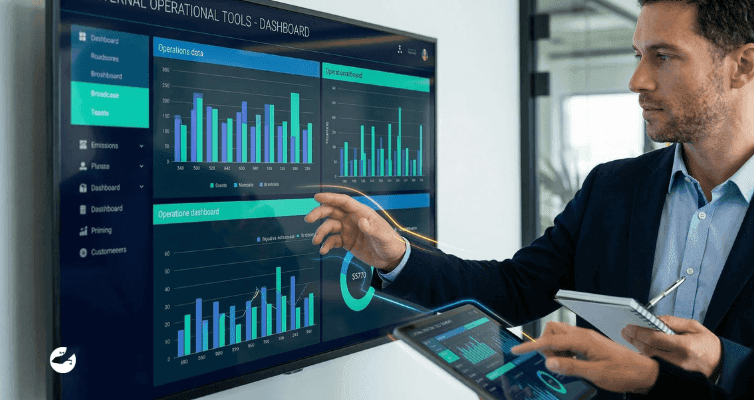
A CTO must first ask: Are we solving an operational bottleneck, or are we building a competitive advantage? This is where working with a custom software development company or a digital consultancy services provider becomes valuable. The right partner doesn’t just write code. They challenge assumptions and align technology decisions with business outcomes.
At Lizard Global, for example, projects in the portfolio show this distinction clearly. Some engagements focused on digital transformation of internal systems. Others built full-scale digital platforms designed for market expansion. Understanding the difference is the first strategic decision.
2. When Internal Tools Make Sense (And When They Don’t)
Internal tools are often the fastest path to efficiency. They are ideal when:
- Teams are growing rapidly
- Manual workflows are slowing execution
- Off-the-shelf SaaS tools don’t fully fit your process
- Data is fragmented across departments

For instance, in complex healthcare environments like the Feet Clinic, specialized internal platforms can streamline patient data and clinical workflows. While customer-facing interfaces are critical, internal process automation ensures scalability and accuracy.
However, internal tools can become problematic when:
- They evolve into customer-facing systems unintentionally
- They lack scalability planning
- Security and compliance requirements increase
- Multiple internal tools create data silos
This is where CTOs often underestimate future growth. What starts as a “quick internal solution” becomes a mission-critical system without proper architecture. A full-stack digital solutions agency helps you future-proof internal tools so they don’t become technical debt.
3. When Custom Software Becomes a Competitive Advantage
Now let’s shift perspective. Custom software is not just about functionality. It’s about positioning. When Lizard Global developed DEXTR, it wasn’t just an internal workflow tool. It was a scalable platform designed to disrupt the taxi and transport industry, essentially becoming a digital infrastructure layer for a specific market. That’s the difference.
Custom software becomes essential when:
- Your digital product is your business model
- You require complex integrations (APIs, CRM integration services, fintech layers)
- Scalability and performance impact revenue
- You need tailored UX to outperform competitors
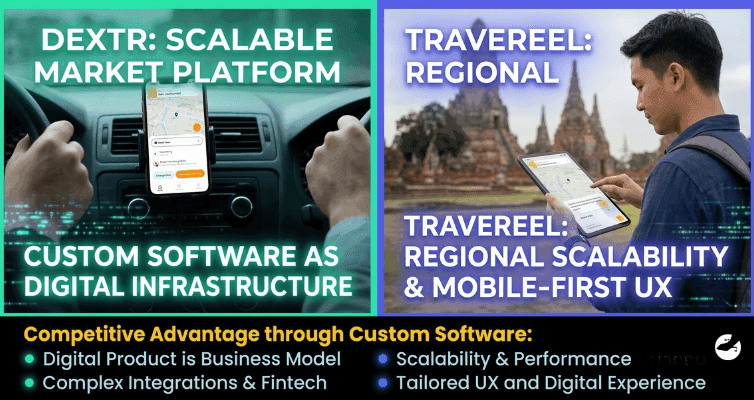
Another example from the Lizard Global portfolio includes mobile-first platforms like Travereel, which required seamless iOS and Android app development, along with backend infrastructure that could scale across regions.
This is not something internal tools are designed for. When customer acquisition, monetization, and digital experience define your growth, you need web app development services, mobile app development agency expertise, and strategic UI/UX design services from day one.
4. The Architecture Question: Build for Today or Scale for Tomorrow?
CTOs often fall into the “minimum viable architecture” trap. Internal tools can be built quickly. However, scaling them later often costs more than building properly from the start. For example, Lizard Global’s approach to scalable platforms, visible across several case studies on their Works page, focuses on modular architecture, API-first design, and long-term maintainability. This ensures that when companies evolve from MVP to enterprise-grade systems, they don’t need a complete rebuild.
Similarly, projects involving cross-platform development or progressive web app development require architectural decisions early. Choosing between native and hybrid impacts cost, speed, and scalability.
If your roadmap includes:
- International expansion
- High transaction volumes
- Multi-role user environments
- Regulatory compliance
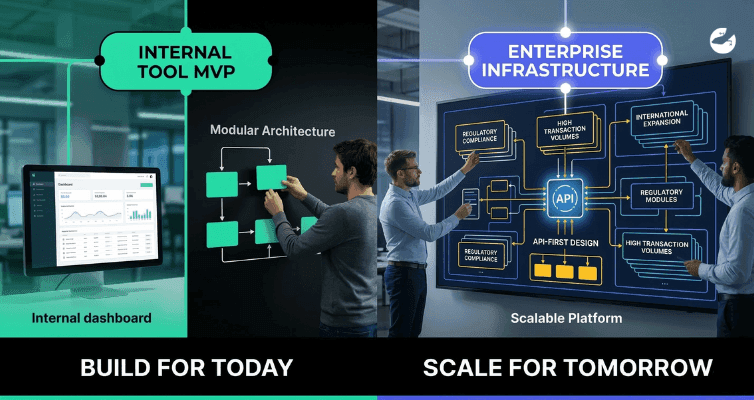
Then you’re no longer building an internal tool. You’re building enterprise infrastructure. At this point, partnering with a digital transformation partner ensures that architectural decisions align with business forecasts, not just current needs.
5. The UX Factor: Internal Efficiency vs Market Experience
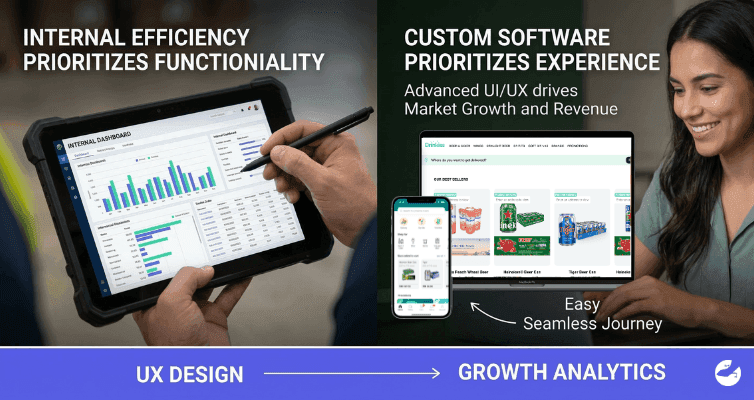
- Internal tools prioritize functionality.
- Custom software prioritizes experience.
- That distinction changes everything. Internal dashboards may tolerate complexity.
However, customer-facing platforms require seamless journeys, intuitive flows, and emotional engagement. This is where advanced UI/UX design services become critical. Looking at Lizard Global’s work with Heineken Drinkies, you’ll notice a consistent focus on user-centered design in consumer-facing eCommerce platforms. Clean interfaces, clear navigation structures, and data-driven iteration all play a role. For CTOs, the decision becomes strategic: If UX drives revenue, it must be prioritized from the start.
Moreover, combining UX design with growth analytics consulting ensures that product decisions are backed by behavioral data. Internal tools rarely require that level of sophistication. Market platforms always do.
6. Budget Allocation: Operational Cost vs Strategic Investment
Let’s address the financial side. Internal tools are usually categorized as operational expenses. They reduce costs. They optimize workflows. Custom software, however, is a strategic investment. It creates revenue streams, increases valuation, and strengthens competitive positioning. For example, in a digital ecosystem like Brickler, technology is not just a cost center.
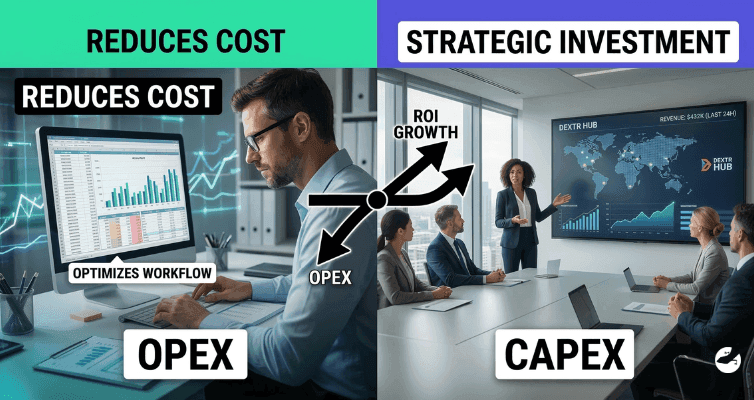
It directly impacts user acquisition, customer retention, and operational scalability. CTOs must decide early: Are we optimizing cost, or investing in growth? Working with a custom software development company that also offers digital consultancy services helps quantify ROI before development begins.
Clear roadmaps, phased releases, and measurable KPIs prevent overinvestment while ensuring scalability. For those in the early planning stages, using a software cost estimator can provide immediate clarity on budget requirements. This is where a digital marketing strategy layer can also support product launches, aligning tech with go-to-market planning.
7. Transitioning from Internal Tool to Custom Platform
Here’s the reality: many companies start with internal tools. That’s fine. The problem occurs when they fail to recognize the transition point.
Warning signs include:
- Customers requesting access to internal systems
- Complex integrations piling up
- Performance issues under load
- Security audits raising concerns
- Product-market fit validated but tech stack limiting scale
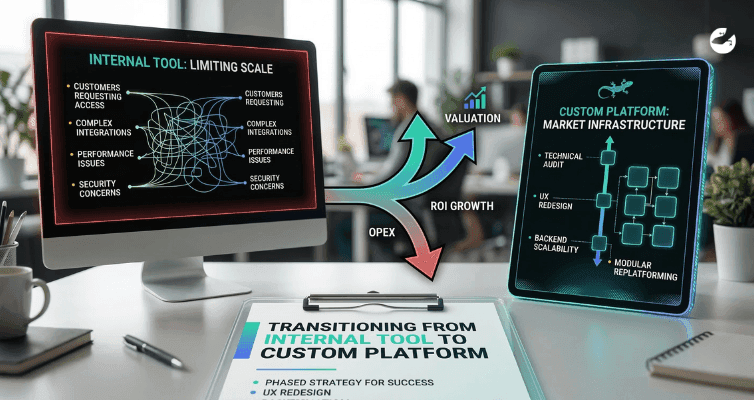
At this stage, refactoring is inevitable. A structured transition, guided by a full-stack digital solutions agency, ensures continuity while rebuilding architecture properly.
Lizard Global’s approach in several digital product engagements, such as Saleduck, includes:
- Technical audits
- Roadmap restructuring
- Modular replatforming
- UX redesign
- Backend scalability optimization
Ready to Decide What to Build First?
The choice between internal tools and custom software isn’t just technical, it’s strategic. If you’re evaluating scalability, modernization, or digital product expansion, now is the time to align your roadmap with long-term growth.
Partner with a custom software development company that understands architecture, UX, scalability, and business strategy, not just development. Let’s build technology that supports where your company is going, not just where it is today.
👉 Talk to Lizard Global and turn your technology decisions into competitive advantage.
As companies scale, CTOs face a critical architectural and strategic decision: build internal tools quickly to solve immediate operational pain, or invest in custom software that drives long-term competitive advantage. The wrong decision can result in technical debt, fragmented systems, and stalled growth. The right one creates scalability, efficiency, and market differentiation. In this blog, we break down how to decide between internal tools and custom platforms, when to transition from one to the other, and how a digital transformation partner can help align technology with business strategy. We also reference real-world projects delivered by Lizard Global to illustrate what works, and why.
Every scaling company eventually reaches a tipping point. Spreadsheets multiply. Teams rely on disconnected SaaS tools. Workarounds become permanent solutions. At that moment, CTOs must make a strategic call: Should we build internal tools to optimize operations? Or should we invest in scalable custom software that drives growth?
Although both approaches solve problems, they serve very different purposes. More importantly, choosing the wrong one at the wrong time can stall innovation and increase costs. Let’s break it down clearly and strategically.
1. Internal Tools vs Custom Software: Understanding the Strategic Difference
Before deciding, you need to define what you’re building, and why. Internal tools are operational enablers. They streamline workflows, automate repetitive tasks, and improve internal visibility. For example, internal dashboards, CRM add-ons, inventory systems, or reporting portals often fall into this category. Custom software, on the other hand, is typically market-facing or core to your business model. It differentiates you. It becomes part of your value proposition. It scales with users, partners, and revenue.
A CTO must first ask: Are we solving an operational bottleneck, or are we building a competitive advantage? This is where working with a custom software development company or a digital consultancy services provider becomes valuable. The right partner doesn’t just write code. They challenge assumptions and align technology decisions with business outcomes.
At Lizard Global, for example, projects in the portfolio show this distinction clearly. Some engagements focused on digital transformation of internal systems. Others built full-scale digital platforms designed for market expansion. Understanding the difference is the first strategic decision.
2. When Internal Tools Make Sense (And When They Don’t)
Internal tools are often the fastest path to efficiency. They are ideal when:
- Teams are growing rapidly
- Manual workflows are slowing execution
- Off-the-shelf SaaS tools don’t fully fit your process
- Data is fragmented across departments
For instance, in complex healthcare environments like the Feet Clinic, specialized internal platforms can streamline patient data and clinical workflows. While customer-facing interfaces are critical, internal process automation ensures scalability and accuracy.
However, internal tools can become problematic when:
- They evolve into customer-facing systems unintentionally
- They lack scalability planning
- Security and compliance requirements increase
- Multiple internal tools create data silos
This is where CTOs often underestimate future growth. What starts as a “quick internal solution” becomes a mission-critical system without proper architecture. A full-stack digital solutions agency helps you future-proof internal tools so they don’t become technical debt.
3. When Custom Software Becomes a Competitive Advantage
Now let’s shift perspective. Custom software is not just about functionality. It’s about positioning. When Lizard Global developed DEXTR, it wasn’t just an internal workflow tool. It was a scalable platform designed to disrupt the taxi and transport industry, essentially becoming a digital infrastructure layer for a specific market. That’s the difference.
Custom software becomes essential when:
- Your digital product is your business model
- You require complex integrations (APIs, CRM integration services, fintech layers)
- Scalability and performance impact revenue
- You need tailored UX to outperform competitors
Another example from the Lizard Global portfolio includes mobile-first platforms like Travereel, which required seamless iOS and Android app development, along with backend infrastructure that could scale across regions.
This is not something internal tools are designed for. When customer acquisition, monetization, and digital experience define your growth, you need web app development services, mobile app development agency expertise, and strategic UI/UX design services from day one.
4. The Architecture Question: Build for Today or Scale for Tomorrow?
CTOs often fall into the “minimum viable architecture” trap. Internal tools can be built quickly. However, scaling them later often costs more than building properly from the start. For example, Lizard Global’s approach to scalable platforms, visible across several case studies on their Works page, focuses on modular architecture, API-first design, and long-term maintainability. This ensures that when companies evolve from MVP to enterprise-grade systems, they don’t need a complete rebuild.
Similarly, projects involving cross-platform development or progressive web app development require architectural decisions early. Choosing between native and hybrid impacts cost, speed, and scalability.
If your roadmap includes:
- International expansion
- High transaction volumes
- Multi-role user environments
- Regulatory compliance
Then you’re no longer building an internal tool. You’re building enterprise infrastructure. At this point, partnering with a digital transformation partner ensures that architectural decisions align with business forecasts, not just current needs.
5. The UX Factor: Internal Efficiency vs Market Experience
- Internal tools prioritize functionality.
- Custom software prioritizes experience.
- That distinction changes everything. Internal dashboards may tolerate complexity.
However, customer-facing platforms require seamless journeys, intuitive flows, and emotional engagement. This is where advanced UI/UX design services become critical. Looking at Lizard Global’s work with Heineken Drinkies, you’ll notice a consistent focus on user-centered design in consumer-facing eCommerce platforms. Clean interfaces, clear navigation structures, and data-driven iteration all play a role. For CTOs, the decision becomes strategic: If UX drives revenue, it must be prioritized from the start.
Moreover, combining UX design with growth analytics consulting ensures that product decisions are backed by behavioral data. Internal tools rarely require that level of sophistication. Market platforms always do.
6. Budget Allocation: Operational Cost vs Strategic Investment
Let’s address the financial side. Internal tools are usually categorized as operational expenses. They reduce costs. They optimize workflows. Custom software, however, is a strategic investment. It creates revenue streams, increases valuation, and strengthens competitive positioning. For example, in a digital ecosystem like Brickler, technology is not just a cost center.
It directly impacts user acquisition, customer retention, and operational scalability. CTOs must decide early: Are we optimizing cost, or investing in growth? Working with a custom software development company that also offers digital consultancy services helps quantify ROI before development begins.
Clear roadmaps, phased releases, and measurable KPIs prevent overinvestment while ensuring scalability. For those in the early planning stages, using a software cost estimator can provide immediate clarity on budget requirements. This is where a digital marketing strategy layer can also support product launches, aligning tech with go-to-market planning.
7. Transitioning from Internal Tool to Custom Platform
Here’s the reality: many companies start with internal tools. That’s fine. The problem occurs when they fail to recognize the transition point.
Warning signs include:
- Customers requesting access to internal systems
- Complex integrations piling up
- Performance issues under load
- Security audits raising concerns
- Product-market fit validated but tech stack limiting scale
At this stage, refactoring is inevitable. A structured transition, guided by a full-stack digital solutions agency, ensures continuity while rebuilding architecture properly.
Lizard Global’s approach in several digital product engagements, such as Saleduck, includes:
- Technical audits
- Roadmap restructuring
- Modular replatforming
- UX redesign
- Backend scalability optimization
Ready to Decide What to Build First?
The choice between internal tools and custom software isn’t just technical, it’s strategic. If you’re evaluating scalability, modernization, or digital product expansion, now is the time to align your roadmap with long-term growth.
Partner with a custom software development company that understands architecture, UX, scalability, and business strategy, not just development. Let’s build technology that supports where your company is going, not just where it is today.
👉 Talk to Lizard Global and turn your technology decisions into competitive advantage.
FAQs
When should a company move from internal tools to custom enterprise software?
How do CTOs evaluate ROI for custom software development?
Is hybrid app development suitable for enterprise platforms?
How does UI/UX design impact enterprise software success?
What role does CRM integration play in scaling custom platforms?
Can internal tools evolve into full digital products?
Why work with a digital transformation partner instead of hiring in-house?
similar reads