From MVP to Enterprise: How Software Needs Change at Every Stage
17 Mar 2026
by Team Lizard Global
Editor: Nadiy, Senior Content Writer
17 Mar 2026
by Team Lizard Global
Editor: Nadiy, Senior Content Writer
From MVP to Enterprise: How Software Needs Change at Every Stage
Table of contents
Contact us
We will get back to you in the next 48 hours.

Every software product’s journey is unique, but there’s a predictable evolution that most solutions follow, from a Minimal Viable Product (MVP) designed for rapid testing to enterprise‑grade software engineered for performance, compliance, and global scale. In this blog, we’ll explore how priorities shift at each stage, what teams need to succeed, and how a trusted digital transformation partner like Lizard Global helps organizations navigate this transition with strategic insight, robust web app development services, and industry‑leading UI/UX design services.
key takeaways
When a visionary founder has an idea, they often start with a Minimal Viable Product (MVP). This early version isn’t meant to be perfect, nor is it designed to carry millions of users right out of the gate. Instead, it’s a lean, focused tool that validates assumptions, gathers user feedback, and de‑risks early investment.
As the product gains traction, however, its needs change dramatically. The systems that once worked for a few hundred users become inadequate for thousands or millions, requiring different architectural strategies, compliance frameworks, and operational processes. Understanding this evolutionary path isn’t just academic, it’s critical if you want your software to survive and thrive in competitive markets.
At Lizard Global, we’ve walked this path with countless teams. From early‑stage mobile and web MVPs to enterprise‑grade platforms that power complex workflows and integrations, our custom software development company expertise ensures that products evolve responsibly, sustainably, and intentionally for long‑term success.
Let’s take a look at what we’ve learnt over a decade in this industry.
Stage 1: MVP – Test Fast, Validate Faster
The MVP stage is about speed. The goal isn’t to build the perfect product, it’s to learn what works and what doesn’t. Teams focus on core value propositions, stripping away anything non‑essential to get something usable into the hands of real users.
At this stage, the focus lies on rapid prototyping, lean feature sets, and validating key hypotheses. A mobile development agency or web development services partner helps you launch early, often using frameworks and stacks that accelerate development without over‑engineering. You’re not thinking about global security compliance or complex data aggregation yet, you’re validating that what you’ve built solves real problems.
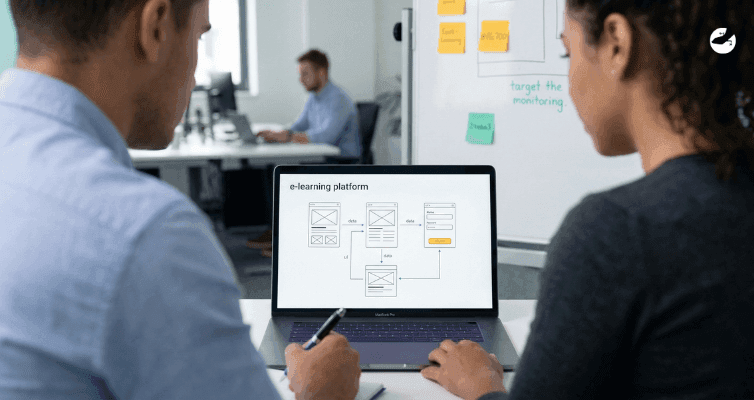
Take the case of SHFT, an e‑learning platform created to address employment gaps for fresh graduates. Rather than attempting a full enterprise LMS straight away, the focus was on delivering core value, dynamic learning modules connected to industry partners. This MVP approach helped gather early insights and determine which features mattered most.
Stage 2: Post‑MVP Growth and Refinement
Once validation is clear, the next phase is growth. You begin refining your product based on real user feedback. Features expand, user flows improve, and initial data starts to tell a story. Teams now need more structure, including analytics, performance monitoring, and A/B testing practices.
This is when design services become invaluable. Beyond looking good, design needs to be intuitive and scalable. Users are now consistent, and their expectations evolve, they want smooth interactions, faster load times, and predictable experiences.
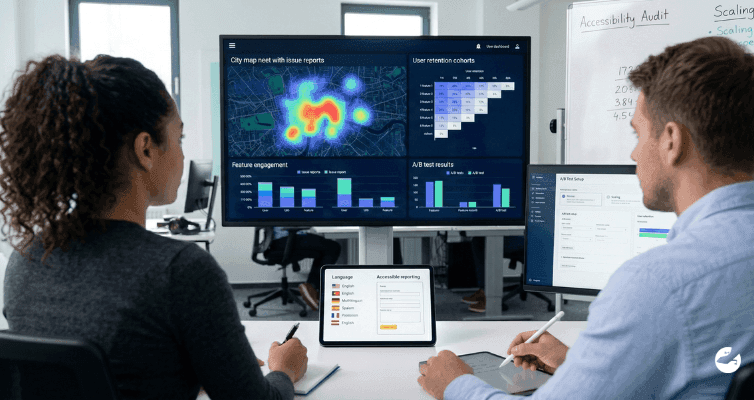
For example, platforms like ACTnow, designed to streamline municipal issue reporting, benefited from iterative refinement post MVP. Users needed accessibility, multilingual support, and seamless reporting flows as adoption grew. Building these improvements required thoughtful expansion of both UI and backend capabilities as the product matured.
This stage also introduces the need for data excellence. Growth analytics consulting and performance metrics help determine what users engage with most and where bottlenecks occur. A strong digital transformation partner can set up dashboards and metrics that inform strategic decisions rather than gut instincts.
Stage 3: Scaling Infrastructure for Performance
Scaling isn’t just about adding servers. It’s about architecting systems that can reliably support thousands to millions of users without degradation. At this phase, teams prioritize scalability, data integrity, performance optimization, and resilience.
Architectural decisions made during MVP might not hold up under heavy load, so many teams opt for microservices, cloud‑native infrastructure, and automated scaling mechanisms. Security becomes non‑negotiable too. Authentication, encryption, and compliance with industry standards are essential as you accumulate more sensitive user data.

Consider GrowTribe Solutions, co‑developed with PeopleHive. What started as a product to connect individual growth with organizational performance required both web and mobile components integrated tightly, and built to handle real‑time performance insights across roles. This wasn’t a basic app anymore; it was a platform built for enterprise use.
For this level of maturity, partnering with a full‑stack digital solutions agency ensures that you’re not just scaling, you’re doing so sustainably and securely.
Stage 4: Integration with Enterprise Systems
Enterprise environments rarely operate in isolation. Your software must communicate with existing systems such as payroll, ERP, CRM, or legacy databases. Integration becomes a significant concern. Whether you’re bringing in CRM services or connecting to third‑party APIs, this stage requires careful planning and robust engineering.
Enterprises demand data consistency, compliance, and controlled access. Middleware, API gateways, and secure data pipelines often become core components of the solution architecture. This isn’t simply throwing features at a problem, it’s harmonizing your product with an ecosystem of tools and platforms.

At this crossroads, your development partner transitions from a builder to a strategic consultant. We’ve seen this with clients who have enterprise‑level needs for performance tracking, compliance, and analytics. Whether integrating with HR systems, customer management databases, or industry‑specific software, your partner needs expertise that spans beyond development into orchestration and governance.
Stage 5: Enterprise Readiness – Compliance, Governance, and Security
When your software becomes mission‑critical, governance and compliance join performance as top priorities. You’re not just a product team anymore, you’re a steward of customer data and business outcomes.
Security protocols such as role‑based access control (RBAC), multi‑factor authentication (MFA), and audit logging become mandatory. Compliance might mean adhering to GDPR, SOC 2, ISO standards, or industry‑specific regulations like HIPAA.
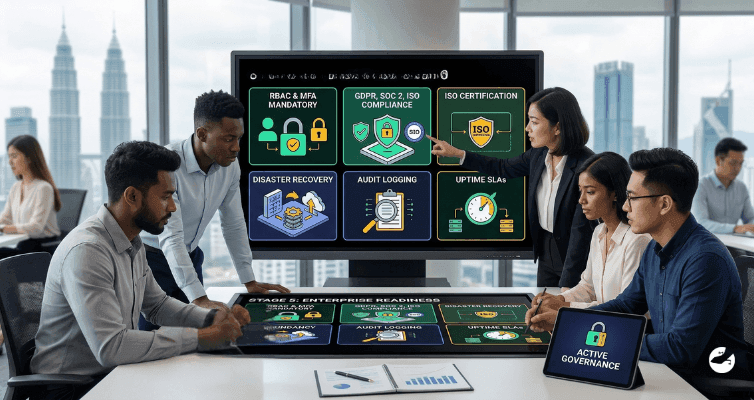
Scalability now includes governance: who can access what, when, and how. Performance monitoring includes uptime SLAs, disaster recovery plans, and redundancy. This level of maturity often requires cross‑functional teams with expertise in DevOps, security, legal, and data governance.
Large enterprise products like enterprise software development solutions, financial systems, or mass‑market mobile ecosystems fall into this category. Success here doesn’t happen overnight; it happens through disciplined evolution and strong partnerships.
Stage 6: Continuous Optimization and Innovation
Once your software is enterprise‑ready, the journey continues. Continual refinement based on usage data, competitor intelligence, and business strategy is essential, complacency leads to obsolescence.
With enterprise systems, digital evolution never stops. You’ll be exploring AI implementations, predictive analytics, automated workflows, or new platform extensions. Lean analytics helps surface opportunities that keep your product ahead of market expectations.
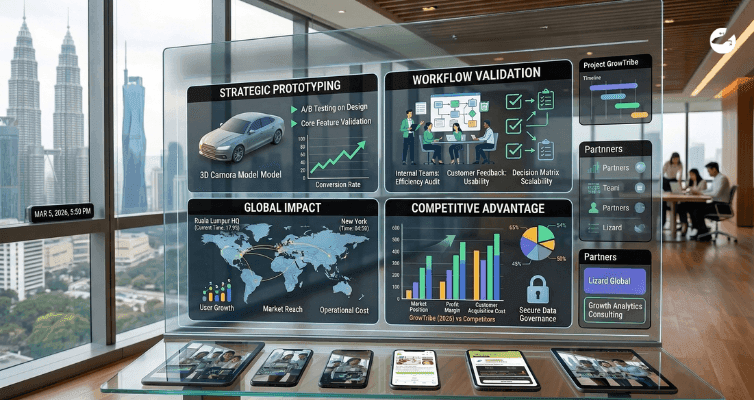
At Lizard Global, this is where long‑term partnerships shine. Whether it’s performance tuning, feature expansions, or launching progressive web app development options, continuous innovation keeps your product relevant and valuable.
Embracing Change, Empowering Growth
Understanding software evolution, from MVP to enterprise scale, is essential for founders, product leaders, and CTOs alike. Each stage requires different priorities, skills, and mindsets. But there’s one constant: intentionality. You must build with foresight, not fear.
Choosing the right partner changes everything. A digital consultancy services firm like Lizard Global brings strategic clarity, technical expertise, and executional excellence at every step. From UI/UX design to mobile and web development, we help bridge gaps, anticipate challenges, and prepare your software for tomorrow, today.
Ready to Transform Your Software for Scale?
Whether you’re launching your first MVP or steering an enterprise‑grade platform, you deserve a partner who understands the full journey. Lizard Global combines strategy, design, and engineering to help companies innovate with confidence.

Partner with a trusted digital transformation leader, book a workshop with us today to chart your path from MVP to lasting enterprise success.
Every software product’s journey is unique, but there’s a predictable evolution that most solutions follow, from a Minimal Viable Product (MVP) designed for rapid testing to enterprise‑grade software engineered for performance, compliance, and global scale. In this blog, we’ll explore how priorities shift at each stage, what teams need to succeed, and how a trusted digital transformation partner like Lizard Global helps organizations navigate this transition with strategic insight, robust web app development services, and industry‑leading UI/UX design services.
When a visionary founder has an idea, they often start with a Minimal Viable Product (MVP). This early version isn’t meant to be perfect, nor is it designed to carry millions of users right out of the gate. Instead, it’s a lean, focused tool that validates assumptions, gathers user feedback, and de‑risks early investment.
As the product gains traction, however, its needs change dramatically. The systems that once worked for a few hundred users become inadequate for thousands or millions, requiring different architectural strategies, compliance frameworks, and operational processes. Understanding this evolutionary path isn’t just academic, it’s critical if you want your software to survive and thrive in competitive markets.
At Lizard Global, we’ve walked this path with countless teams. From early‑stage mobile and web MVPs to enterprise‑grade platforms that power complex workflows and integrations, our custom software development company expertise ensures that products evolve responsibly, sustainably, and intentionally for long‑term success.
Let’s take a look at what we’ve learnt over a decade in this industry.
Stage 1: MVP – Test Fast, Validate Faster
The MVP stage is about speed. The goal isn’t to build the perfect product, it’s to learn what works and what doesn’t. Teams focus on core value propositions, stripping away anything non‑essential to get something usable into the hands of real users.
At this stage, the focus lies on rapid prototyping, lean feature sets, and validating key hypotheses. A mobile development agency or web development services partner helps you launch early, often using frameworks and stacks that accelerate development without over‑engineering. You’re not thinking about global security compliance or complex data aggregation yet, you’re validating that what you’ve built solves real problems.
Take the case of SHFT, an e‑learning platform created to address employment gaps for fresh graduates. Rather than attempting a full enterprise LMS straight away, the focus was on delivering core value, dynamic learning modules connected to industry partners. This MVP approach helped gather early insights and determine which features mattered most.
Stage 2: Post‑MVP Growth and Refinement
Once validation is clear, the next phase is growth. You begin refining your product based on real user feedback. Features expand, user flows improve, and initial data starts to tell a story. Teams now need more structure, including analytics, performance monitoring, and A/B testing practices.
This is when design services become invaluable. Beyond looking good, design needs to be intuitive and scalable. Users are now consistent, and their expectations evolve, they want smooth interactions, faster load times, and predictable experiences.
For example, platforms like ACTnow, designed to streamline municipal issue reporting, benefited from iterative refinement post MVP. Users needed accessibility, multilingual support, and seamless reporting flows as adoption grew. Building these improvements required thoughtful expansion of both UI and backend capabilities as the product matured.
This stage also introduces the need for data excellence. Growth analytics consulting and performance metrics help determine what users engage with most and where bottlenecks occur. A strong digital transformation partner can set up dashboards and metrics that inform strategic decisions rather than gut instincts.
Stage 3: Scaling Infrastructure for Performance
Scaling isn’t just about adding servers. It’s about architecting systems that can reliably support thousands to millions of users without degradation. At this phase, teams prioritize scalability, data integrity, performance optimization, and resilience.
Architectural decisions made during MVP might not hold up under heavy load, so many teams opt for microservices, cloud‑native infrastructure, and automated scaling mechanisms. Security becomes non‑negotiable too. Authentication, encryption, and compliance with industry standards are essential as you accumulate more sensitive user data.
Consider GrowTribe Solutions, co‑developed with PeopleHive. What started as a product to connect individual growth with organizational performance required both web and mobile components integrated tightly, and built to handle real‑time performance insights across roles. This wasn’t a basic app anymore; it was a platform built for enterprise use.
For this level of maturity, partnering with a full‑stack digital solutions agency ensures that you’re not just scaling, you’re doing so sustainably and securely.
Stage 4: Integration with Enterprise Systems
Enterprise environments rarely operate in isolation. Your software must communicate with existing systems such as payroll, ERP, CRM, or legacy databases. Integration becomes a significant concern. Whether you’re bringing in CRM services or connecting to third‑party APIs, this stage requires careful planning and robust engineering.
Enterprises demand data consistency, compliance, and controlled access. Middleware, API gateways, and secure data pipelines often become core components of the solution architecture. This isn’t simply throwing features at a problem, it’s harmonizing your product with an ecosystem of tools and platforms.
At this crossroads, your development partner transitions from a builder to a strategic consultant. We’ve seen this with clients who have enterprise‑level needs for performance tracking, compliance, and analytics. Whether integrating with HR systems, customer management databases, or industry‑specific software, your partner needs expertise that spans beyond development into orchestration and governance.
Stage 5: Enterprise Readiness – Compliance, Governance, and Security
When your software becomes mission‑critical, governance and compliance join performance as top priorities. You’re not just a product team anymore, you’re a steward of customer data and business outcomes.
Security protocols such as role‑based access control (RBAC), multi‑factor authentication (MFA), and audit logging become mandatory. Compliance might mean adhering to GDPR, SOC 2, ISO standards, or industry‑specific regulations like HIPAA.
Scalability now includes governance: who can access what, when, and how. Performance monitoring includes uptime SLAs, disaster recovery plans, and redundancy. This level of maturity often requires cross‑functional teams with expertise in DevOps, security, legal, and data governance.
Large enterprise products like enterprise software development solutions, financial systems, or mass‑market mobile ecosystems fall into this category. Success here doesn’t happen overnight; it happens through disciplined evolution and strong partnerships.
Stage 6: Continuous Optimization and Innovation
Once your software is enterprise‑ready, the journey continues. Continual refinement based on usage data, competitor intelligence, and business strategy is essential, complacency leads to obsolescence.
With enterprise systems, digital evolution never stops. You’ll be exploring AI implementations, predictive analytics, automated workflows, or new platform extensions. Lean analytics helps surface opportunities that keep your product ahead of market expectations.
At Lizard Global, this is where long‑term partnerships shine. Whether it’s performance tuning, feature expansions, or launching progressive web app development options, continuous innovation keeps your product relevant and valuable.
Embracing Change, Empowering Growth
Understanding software evolution, from MVP to enterprise scale, is essential for founders, product leaders, and CTOs alike. Each stage requires different priorities, skills, and mindsets. But there’s one constant: intentionality. You must build with foresight, not fear.
Choosing the right partner changes everything. A digital consultancy services firm like Lizard Global brings strategic clarity, technical expertise, and executional excellence at every step. From UI/UX design to mobile and web development, we help bridge gaps, anticipate challenges, and prepare your software for tomorrow, today.
Ready to Transform Your Software for Scale?
Whether you’re launching your first MVP or steering an enterprise‑grade platform, you deserve a partner who understands the full journey. Lizard Global combines strategy, design, and engineering to help companies innovate with confidence.
Partner with a trusted digital transformation leader, book a workshop with us today to chart your path from MVP to lasting enterprise success.
FAQs
What’s the biggest challenge when transitioning an MVP to an enterprise system?
At what point should a company consider professional digital transformation partner support?
How do enterprise applications handle complex integrations?
What role does UX/UI design play in enterprise‑grade software?
How critical is security compliance for enterprise solutions?
Can an MVP‑focused tech stack still be useful at scale?
How do digital consultancy services add value at the enterprise stage?
similar reads

Case Studies & Interviews
Client Review: Building A Custom Engagement App For MRT Corp
20 August 2026

Case Studies & Interviews
Lereng Tanah: Developing a Direct Booking Platform Malaysian Boutique Villa
29 January 2026

Case Studies & Interviews
Tactlink: How a Malaysian Entrepreneur Turned Networking Chaos into a Digital Community
22 January 2026
Stuck between a great idea and the right team to build it?Let's talk.
We work with corporate innovation teams and ambitious scale-ups across the Netherlands, Singapore, and Australia, and wherever great software needs to be built. Drop us a message and we'll get back to you within one business day.


Markus Monnikendam
Global Commercial Director
hello@lizard.global