Building AI Systems That Know When to Ask for Help
11 Jun 2026
by Team Lizard Global
Editor: Nadiy, Senior Content Writer
11 Jun 2026
by Team Lizard Global
Editor: Nadiy, Senior Content Writer
Building AI Systems That Know When to Ask for Help
Table of contents
Contact us
We will get back to you in the next 48 hours.

In the rapidly accelerating landscape of corporate automation, organizations are shifting away from rigid, rule-based software to embrace dynamic, autonomous ecosystems. This blog post explores the critical transition from deterministic systems to autonomous AI agents capable of managing complex enterprise workflows. However, true operational excellence does not come from letting AI run completely unchecked. Instead, it relies on building intelligent frameworks that understand their own boundaries and seamlessly loop in human expertise when anomalies arise. By analyzing structural design paradigms, validation techniques, and real-world software applications, we outline how modern enterprises can deploy scalable, safe, and highly compliant AI digital labor. We also highlight how collaborating with an experienced digital transformation partner helps organizations strike the perfect balance between independent automation and robust human oversight.
key takeaways
Beyond Fixed Rules: Shifting from Deterministic Coding to Agentic AI for Enterprise
For decades, custom software development company architectures relied almost exclusively on predictable, deterministic paths. If a user clicked a specific button, the system executed an exact, pre-written script. While this traditional architecture guarantees reliability for basic data entry, it quickly bottlenecks when applied to fluid, unstructured business scenarios. Modern corporations face massive data streams and rapidly shifting operational requirements that simple, fixed logic cannot handle. Consequently, forward-thinking enterprises are moving away from traditional development frameworks to integrate cognitive flexibility into their central operations.
This technological evolution introduces a sophisticated operational methodology: Agentic AI for Enterprise. Rather than following static, step-by-step algorithms, these advanced systems leverage deep semantic comprehension to analyze complex problems, break them down into smaller tasks, and execute them independently. By utilizing dynamic agentic workflows, software can adjust its execution strategy based on changing real-time data inputs. Transitioning to this modern framework allows enterprises to automate complex, multi-layered initiatives that once demanded constant human management, effectively changing how teams interact with enterprise applications.
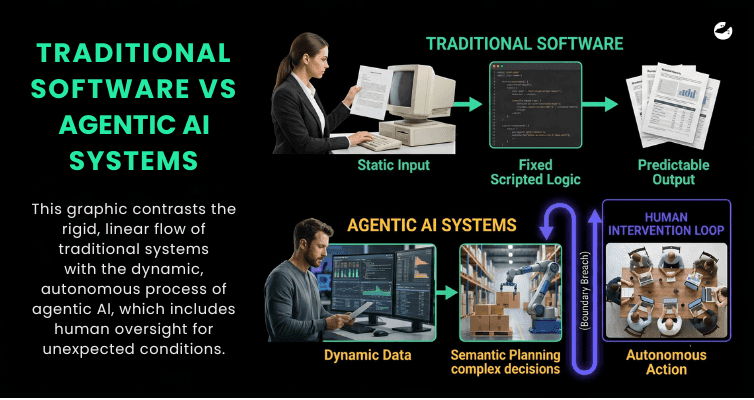
However, achieving high-level automation does not mean companies should completely abandon structural stability. Instead, smart system design merges the absolute predictability of traditional computing with the adaptive power of autonomous AI agents. For example, when building a digital podiatry hub like Feet Clinic, developers must combine strict healthcare compliance rules with flexible data sorting tools. By embedding advanced cognitive models directly into standard business frameworks, companies establish a highly stable environment where automated workflows handle heavy administrative tasks while preserving standard systemic reliability.
Want to find out how much it costs to build your dream app or web app?


Drawing the Line: Establishing Clear Operational Boundaries and AI Guardrails
To deploy automated digital assets successfully, engineering teams must establish precise, unbreakable boundaries around software decision-making power. Left entirely to their own devices, even the most advanced autonomous AI agents can make unexpected errors when encountering highly unusual data points or edge cases. Without structured restrictions, an automated entity might misinterpret an extreme data anomaly, resulting in incorrect financial forecasts, corrupted inventory orders, or flawed customer communications. Therefore, setting clear operational boundaries is a vital prerequisite for any large-scale enterprise AI orchestration strategy.
To protect system integrity, developers implement specialized code layers known as AI guardrails. These programmatic constraints monitor every input, internal thought process, and final output generated by the automated system in real time. If an agent attempts to execute an action that falls outside its predefined permissions—such as authorizing a budget transfer above a specific financial threshold—the guardrail halts the transaction. Furthermore, these security barriers analyze textual outputs to prevent the system from sharing unverified data, leaking proprietary code, or violating regulatory compliance standards.
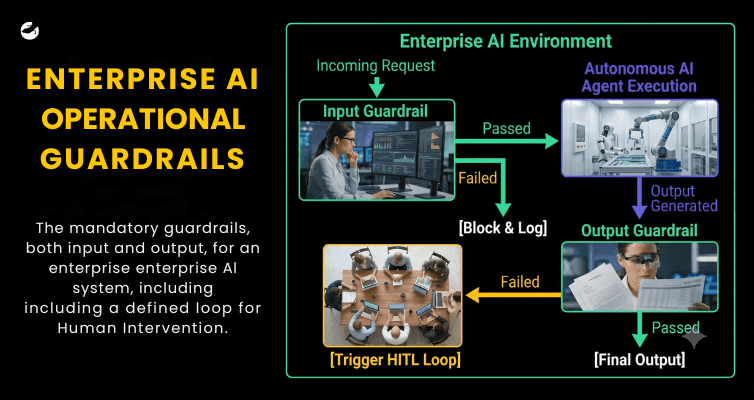
When building these multi-layered safety frameworks, enterprises often collaborate with a dedicated mobile app development agency to ensure these security layers perform seamlessly on cross-platform systems. For instance, in real-time supply chain applications like WAPA, which tracks maritime vessels and voyages, predictive algorithms must process fast-moving telemetry data without making erratic path corrections. By building rigid operational boundaries directly into the application, the software handles standard logistics independently, but instantly flags major exceptions for review. This careful architectural approach ensures that automated processes optimize efficiency without exposing the business to unnecessary operational risks.
Designing the Handshake: Optimizing the Human-in-the-Loop (HITL) Workflow Interface
An effective automated system should not aim to eliminate human involvement entirely; rather, it should optimize how humans and machines collaborate. This collaborative methodology relies on a structured Human-in-the-Loop (HITL) architecture, which ensures that automated agents handle heavy data processing while human experts retain final decision-making authority over critical tasks. The primary technical challenge lies in managing the transition phase—the precise moment an autonomous agent encounters an issue outside its scope and safely hands control over to a human manager.
To facilitate this handover, software teams must design highly intuitive, context-aware interface dashboards. When an AI digital labor agent encounters an unresolved issue, it should never simply throw a generic system error or crash. Instead, the interface must display a clear breakdown of the problem, summarize the steps taken so far, explain why it paused, and present a list of recommended actions for the human reviewer. Providing this comprehensive summary allows human operators to understand the situation in seconds, enabling them to make fast, informed decisions without digging through messy background logs.
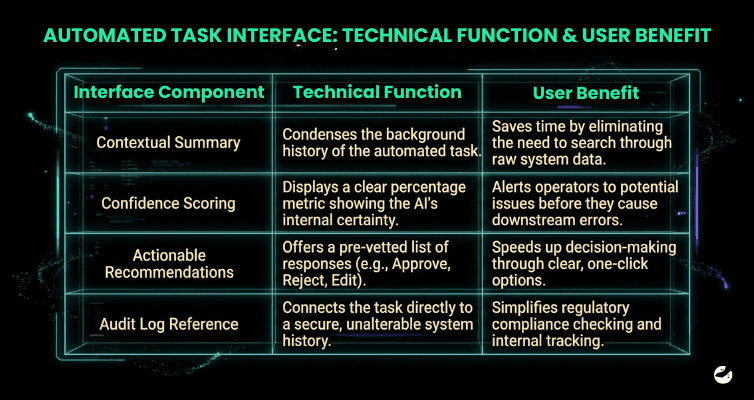
Delivering this level of clarity requires world-class UI/UX design services. If an interface is cluttered or confusing, the human operator may misinterpret the AI's request, causing costly delays or operational mistakes. For example, during the development of Perpetual Memorial Park, a complex digital platform featuring automated eCommerce tools and multilevel CRM integration services, creating smooth user journeys was essential for managing sales tracking and customer data. By prioritizing clean visual hierarchies and intuitive layouts, developers ensure that whenever a system requires human validation, the interaction remains fast, accurate, and completely stress-free.
Absolute Transparency: Maintaining Corporate Accountability via AI Observability and Audit Logs
As corporate workflows become increasingly automated, maintaining complete visibility into how software systems make decisions is paramount. If an automated system operates like an unresolvable "black box," tracing the root cause of an operational error or a compliance breach becomes nearly impossible. This lack of transparency can expose an organization to severe financial liabilities, regulatory penalties, and a loss of client trust. Consequently, modern enterprise AI orchestration requires the integration of deep AI observability tools that record every step of an agent's reasoning process.
Building a secure infrastructure means creating unalterable AI Observability & Audit Logs that track all automated actions, background API requests, data updates, and human handovers. If a system modifies a client profile, alters an order status, or calculates an unexpected financial forecast, the software automatically logs the exact event timeline, the underlying model prompt, and the internal confidence score. This immutable ledger provides engineering and compliance teams with a clear roadmap to inspect historical actions, verify data handling procedures, and quickly resolve system errors.
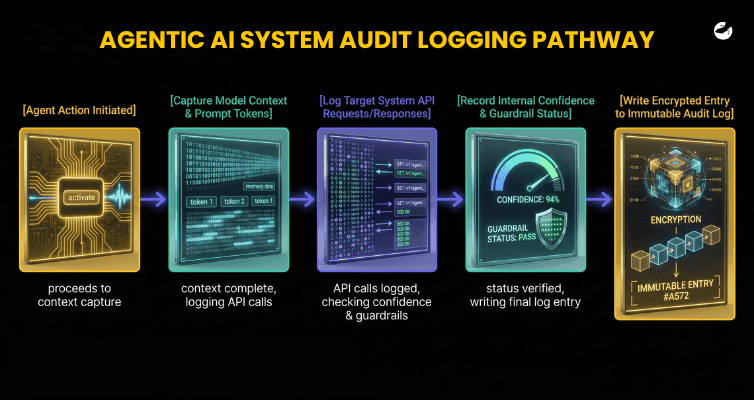
This focus on absolute transparency is particularly vital for web app development services handling sensitive data, such as advanced fintech platforms or automated order management solutions like Reach, in high-stakes transactional environments, every automated update must be completely transparent and open to inspection. By maintaining detailed, clear logs of all system activity, businesses protect themselves against regulatory non-compliance, streamline internal troubleshooting, and demonstrate clear operational accountability to external auditors and corporate stakeholders.
Enforcing Order: Implementing Agentic Governance & Compliance Frameworks
Deploying autonomous digital assets within an enterprise environment requires strict alignment with global data privacy laws and industry-specific regulations. Organizations cannot afford to let automated systems operate without strict governance, especially when handling personal information covered by GDPR, PDPA, or specialized corporate compliance policies. Without a centralized oversight framework, independent digital agents might accidentally share private customer information or process data in ways that violate consumer protection laws. Therefore, establishing a comprehensive Agentic Governance & Compliance framework is critical to protecting modern corporate operations.
This specialized governance architecture sets clear boundaries regarding how automated agents interact with databases, what types of customer information they can access, and when they must delete temporary records. Furthermore, these safety protocols ensure that all automated workflows respect user preferences and data permissions across every corporate tool. By enforcing these rules at the structural level, enterprises can confidently scale their automation efforts, safe in the knowledge that their systems will never breach legal or internal compliance boundaries.
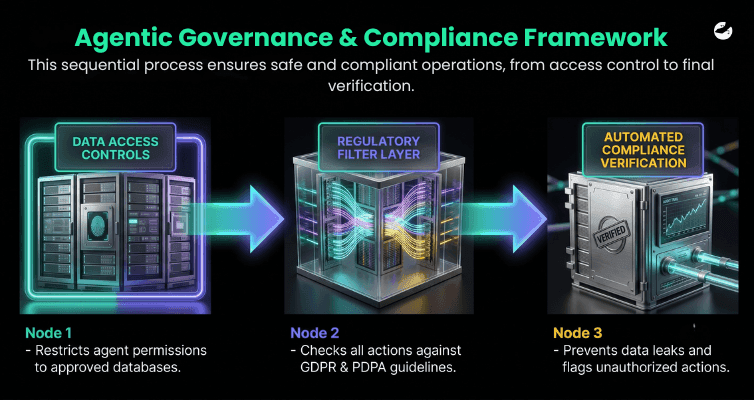
Developing these complex compliance layers requires deep expertise across multiple digital disciplines. To build a secure, compliant infrastructure, enterprises typically partner with a full-stack digital solutions agency capable of handling advanced systems architecture, data encryption, and responsive interface design. For example, when creating a digital tracking tool like My New Behaviour, which manages structured personal advancement programs, ensuring complete data privacy and strict user confidentiality was an absolute priority. By building robust governance checks into the core database architecture, the platform protects user information while delivering an optimized, highly personalized digital experience.
Building for the Future: Driving Long-Term Growth with a Full-Stack Digital Transformation Partner
Successfully integrating autonomous systems into an existing corporate ecosystem requires much more than just deployment; it demands a long-term commitment to product strategy, ongoing performance monitoring, and iterative development. Enterprise systems are highly complex networks of legacy databases, third-party APIs, and custom internal tools. Trying to insert advanced autonomous agents into these environments without a clear, holistic plan can result in broken workflows and disconnected software applications. To avoid these issues, companies must treat AI integration as an ongoing strategic journey rather than a one-time IT fix.
This long-term perspective highlights the immense value of working alongside a trusted digital consultancy services partner. A true digital partner does not simply deliver standard lines of code and walk away; they immerse themselves in your business to optimize your overall product strategy, refine internal workflows, and prepare your technology stack for future expansion. From running initial design thinking workshops to deploying full-stack digital solutions, an experienced partner guides your team through every phase of the transformation process, ensuring your technology actively drives measurable corporate growth.
At Lizard Global, we leverage over 14 years of industry-leading experience to help organizations navigate these complex technological shifts. As a full-stack digital transformation partner, we have successfully shipped over 120 cross-platform web and mobile application projects across 27 diverse industries worldwide. Whether you need to build advanced progressive web app development projects, optimize system performance with growth analytics consulting, or implement specialized CRM integration services, our team delivers scalable, future-proof software tailored to your business goals. By combining deep technical engineering with user-focused product design, we help you build reliable, highly automated systems that optimize operations today while laying a strong foundation for tomorrow's innovations.
Redesign Your Enterprise with Smarter AI Automation
Struggling with disconnected business systems, rigid legacy software, or complex workflows that slow down your team? It is time to take control of your digital future. Partner with a proven full-stack digital solutions agency that understands how to balance advanced system automation with robust human control.
Contact Lizard Global
today to schedule a comprehensive digital advice session. Let our expert product engineers, UI/UX designers, and enterprise consultants help you design, build, and scale future-proof software applications that streamline operations and accelerate business growth. Let's Build Something Great Together!
In the rapidly accelerating landscape of corporate automation, organizations are shifting away from rigid, rule-based software to embrace dynamic, autonomous ecosystems. This blog post explores the critical transition from deterministic systems to autonomous AI agents capable of managing complex enterprise workflows. However, true operational excellence does not come from letting AI run completely unchecked. Instead, it relies on building intelligent frameworks that understand their own boundaries and seamlessly loop in human expertise when anomalies arise. By analyzing structural design paradigms, validation techniques, and real-world software applications, we outline how modern enterprises can deploy scalable, safe, and highly compliant AI digital labor. We also highlight how collaborating with an experienced digital transformation partner helps organizations strike the perfect balance between independent automation and robust human oversight.
Beyond Fixed Rules: Shifting from Deterministic Coding to Agentic AI for Enterprise
For decades, custom software development company architectures relied almost exclusively on predictable, deterministic paths. If a user clicked a specific button, the system executed an exact, pre-written script. While this traditional architecture guarantees reliability for basic data entry, it quickly bottlenecks when applied to fluid, unstructured business scenarios. Modern corporations face massive data streams and rapidly shifting operational requirements that simple, fixed logic cannot handle. Consequently, forward-thinking enterprises are moving away from traditional development frameworks to integrate cognitive flexibility into their central operations.
This technological evolution introduces a sophisticated operational methodology: Agentic AI for Enterprise. Rather than following static, step-by-step algorithms, these advanced systems leverage deep semantic comprehension to analyze complex problems, break them down into smaller tasks, and execute them independently. By utilizing dynamic agentic workflows, software can adjust its execution strategy based on changing real-time data inputs. Transitioning to this modern framework allows enterprises to automate complex, multi-layered initiatives that once demanded constant human management, effectively changing how teams interact with enterprise applications.
However, achieving high-level automation does not mean companies should completely abandon structural stability. Instead, smart system design merges the absolute predictability of traditional computing with the adaptive power of autonomous AI agents. For example, when building a digital podiatry hub like Feet Clinic, developers must combine strict healthcare compliance rules with flexible data sorting tools. By embedding advanced cognitive models directly into standard business frameworks, companies establish a highly stable environment where automated workflows handle heavy administrative tasks while preserving standard systemic reliability.
Want to find out how much it costs to build your dream app or web app?
Drawing the Line: Establishing Clear Operational Boundaries and AI Guardrails
To deploy automated digital assets successfully, engineering teams must establish precise, unbreakable boundaries around software decision-making power. Left entirely to their own devices, even the most advanced autonomous AI agents can make unexpected errors when encountering highly unusual data points or edge cases. Without structured restrictions, an automated entity might misinterpret an extreme data anomaly, resulting in incorrect financial forecasts, corrupted inventory orders, or flawed customer communications. Therefore, setting clear operational boundaries is a vital prerequisite for any large-scale enterprise AI orchestration strategy.
To protect system integrity, developers implement specialized code layers known as AI guardrails. These programmatic constraints monitor every input, internal thought process, and final output generated by the automated system in real time. If an agent attempts to execute an action that falls outside its predefined permissions—such as authorizing a budget transfer above a specific financial threshold—the guardrail halts the transaction. Furthermore, these security barriers analyze textual outputs to prevent the system from sharing unverified data, leaking proprietary code, or violating regulatory compliance standards.
When building these multi-layered safety frameworks, enterprises often collaborate with a dedicated mobile app development agency to ensure these security layers perform seamlessly on cross-platform systems. For instance, in real-time supply chain applications like WAPA, which tracks maritime vessels and voyages, predictive algorithms must process fast-moving telemetry data without making erratic path corrections. By building rigid operational boundaries directly into the application, the software handles standard logistics independently, but instantly flags major exceptions for review. This careful architectural approach ensures that automated processes optimize efficiency without exposing the business to unnecessary operational risks.
Designing the Handshake: Optimizing the Human-in-the-Loop (HITL) Workflow Interface
An effective automated system should not aim to eliminate human involvement entirely; rather, it should optimize how humans and machines collaborate. This collaborative methodology relies on a structured Human-in-the-Loop (HITL) architecture, which ensures that automated agents handle heavy data processing while human experts retain final decision-making authority over critical tasks. The primary technical challenge lies in managing the transition phase—the precise moment an autonomous agent encounters an issue outside its scope and safely hands control over to a human manager.
To facilitate this handover, software teams must design highly intuitive, context-aware interface dashboards. When an AI digital labor agent encounters an unresolved issue, it should never simply throw a generic system error or crash. Instead, the interface must display a clear breakdown of the problem, summarize the steps taken so far, explain why it paused, and present a list of recommended actions for the human reviewer. Providing this comprehensive summary allows human operators to understand the situation in seconds, enabling them to make fast, informed decisions without digging through messy background logs.
Delivering this level of clarity requires world-class UI/UX design services. If an interface is cluttered or confusing, the human operator may misinterpret the AI's request, causing costly delays or operational mistakes. For example, during the development of Perpetual Memorial Park, a complex digital platform featuring automated eCommerce tools and multilevel CRM integration services, creating smooth user journeys was essential for managing sales tracking and customer data. By prioritizing clean visual hierarchies and intuitive layouts, developers ensure that whenever a system requires human validation, the interaction remains fast, accurate, and completely stress-free.
Absolute Transparency: Maintaining Corporate Accountability via AI Observability and Audit Logs
As corporate workflows become increasingly automated, maintaining complete visibility into how software systems make decisions is paramount. If an automated system operates like an unresolvable "black box," tracing the root cause of an operational error or a compliance breach becomes nearly impossible. This lack of transparency can expose an organization to severe financial liabilities, regulatory penalties, and a loss of client trust. Consequently, modern enterprise AI orchestration requires the integration of deep AI observability tools that record every step of an agent's reasoning process.
Building a secure infrastructure means creating unalterable AI Observability & Audit Logs that track all automated actions, background API requests, data updates, and human handovers. If a system modifies a client profile, alters an order status, or calculates an unexpected financial forecast, the software automatically logs the exact event timeline, the underlying model prompt, and the internal confidence score. This immutable ledger provides engineering and compliance teams with a clear roadmap to inspect historical actions, verify data handling procedures, and quickly resolve system errors.
This focus on absolute transparency is particularly vital for web app development services handling sensitive data, such as advanced fintech platforms or automated order management solutions like Reach, in high-stakes transactional environments, every automated update must be completely transparent and open to inspection. By maintaining detailed, clear logs of all system activity, businesses protect themselves against regulatory non-compliance, streamline internal troubleshooting, and demonstrate clear operational accountability to external auditors and corporate stakeholders.
Enforcing Order: Implementing Agentic Governance & Compliance Frameworks
Deploying autonomous digital assets within an enterprise environment requires strict alignment with global data privacy laws and industry-specific regulations. Organizations cannot afford to let automated systems operate without strict governance, especially when handling personal information covered by GDPR, PDPA, or specialized corporate compliance policies. Without a centralized oversight framework, independent digital agents might accidentally share private customer information or process data in ways that violate consumer protection laws. Therefore, establishing a comprehensive Agentic Governance & Compliance framework is critical to protecting modern corporate operations.
This specialized governance architecture sets clear boundaries regarding how automated agents interact with databases, what types of customer information they can access, and when they must delete temporary records. Furthermore, these safety protocols ensure that all automated workflows respect user preferences and data permissions across every corporate tool. By enforcing these rules at the structural level, enterprises can confidently scale their automation efforts, safe in the knowledge that their systems will never breach legal or internal compliance boundaries.
Developing these complex compliance layers requires deep expertise across multiple digital disciplines. To build a secure, compliant infrastructure, enterprises typically partner with a full-stack digital solutions agency capable of handling advanced systems architecture, data encryption, and responsive interface design. For example, when creating a digital tracking tool like My New Behaviour, which manages structured personal advancement programs, ensuring complete data privacy and strict user confidentiality was an absolute priority. By building robust governance checks into the core database architecture, the platform protects user information while delivering an optimized, highly personalized digital experience.
Building for the Future: Driving Long-Term Growth with a Full-Stack Digital Transformation Partner
Successfully integrating autonomous systems into an existing corporate ecosystem requires much more than just deployment; it demands a long-term commitment to product strategy, ongoing performance monitoring, and iterative development. Enterprise systems are highly complex networks of legacy databases, third-party APIs, and custom internal tools. Trying to insert advanced autonomous agents into these environments without a clear, holistic plan can result in broken workflows and disconnected software applications. To avoid these issues, companies must treat AI integration as an ongoing strategic journey rather than a one-time IT fix.
This long-term perspective highlights the immense value of working alongside a trusted digital consultancy services partner. A true digital partner does not simply deliver standard lines of code and walk away; they immerse themselves in your business to optimize your overall product strategy, refine internal workflows, and prepare your technology stack for future expansion. From running initial design thinking workshops to deploying full-stack digital solutions, an experienced partner guides your team through every phase of the transformation process, ensuring your technology actively drives measurable corporate growth.
At Lizard Global, we leverage over 14 years of industry-leading experience to help organizations navigate these complex technological shifts. As a full-stack digital transformation partner, we have successfully shipped over 120 cross-platform web and mobile application projects across 27 diverse industries worldwide. Whether you need to build advanced progressive web app development projects, optimize system performance with growth analytics consulting, or implement specialized CRM integration services, our team delivers scalable, future-proof software tailored to your business goals. By combining deep technical engineering with user-focused product design, we help you build reliable, highly automated systems that optimize operations today while laying a strong foundation for tomorrow's innovations.
Redesign Your Enterprise with Smarter AI Automation
Struggling with disconnected business systems, rigid legacy software, or complex workflows that slow down your team? It is time to take control of your digital future. Partner with a proven full-stack digital solutions agency that understands how to balance advanced system automation with robust human control.
Contact Lizard Global
today to schedule a comprehensive digital advice session. Let our expert product engineers, UI/UX designers, and enterprise consultants help you design, build, and scale future-proof software applications that streamline operations and accelerate business growth. Let's Build Something Great Together!
FAQs

What is the difference between deterministic software and agentic AI systems?
How do AI guardrails protect enterprise applications from operational errors?
Why is a human-in-the-loop (HITL) framework necessary for enterprise workflows?
What role do observability and audit logs play in automated software compliance?
Can agentic workflows integrate with our existing legacy CRMs and databases?
How do global data privacy laws like GDPR and PDPA impact autonomous AI agents?
Why should our company work with a full-stack digital partner instead of a coding agency?
similar reads

Case Studies & Interviews
How Vind een Buddy Is Transforming Parental Support in the Netherlands: An Exclusive Interview With Dagmar Halfhide
15 May 2025

Case Studies & Interviews
Driving Digital Inclusion: How the Strivers' Hub is Empowering Women Entrepreneurs in Malaysia
22 April 2025

Case Studies & Interviews
Integrating Autonomous AI Agents into Enterprise Mobile Applications An Architectural Blueprint
7 July 2026
Stuck between a great idea and the right team to build it?Let's talk.
We work with corporate innovation teams and ambitious scale-ups across the Netherlands, Singapore, and Australia, and wherever great software needs to be built. Drop us a message and we'll get back to you within one business day.


Markus Monnikendam
Global Commercial Director
hello@lizard.global