How to Measure ROI from Enterprise AI Implementations
11 May 2026
by Team Lizard Global
Editor: Nadiy, Senior Content Writer
11 May 2026
by Team Lizard Global
Editor: Nadiy, Senior Content Writer
How to Measure ROI from Enterprise AI Implementations
Table of contents
Contact us
We will get back to you in the next 48 hours.

Measuring ROI from enterprise AI implementations is no longer a theoretical exercise. As organizations adopt Agentic AI for Enterprise, Autonomous AI Agents, and Agentic Workflows, the need for structured, transparent, and business-aligned ROI frameworks has become critical. However, traditional ROI models often fail to capture the full value of AI-driven transformation, especially when AI operates across workflows, decision systems, and digital labor ecosystems. This blog breaks down how enterprises can accurately measure AI ROI across operational, financial, and strategic dimensions. It also explores how Enterprise AI Orchestration, governance frameworks, and Human-in-the-Loop (HITL) systems help organizations create measurable, scalable, and sustainable AI value. Finally, we highlight how a digital transformation partner like Lizard Global helps enterprises operationalize AI ROI with clarity and confidence.
key takeaways
Enterprise AI is no longer confined to simple automation tasks. Today, organizations deploy Agentic AI for Enterprise systems that learn, decide, and act across business functions. As a result, ROI measurement becomes more complex because value is no longer linear or isolated. Instead, it is distributed across workflows, systems, and human-AI collaboration layers.
Traditionally, ROI focused on cost reduction and efficiency gains. However, with Autonomous AI Agents and AI Digital Labor entering enterprise environments, value now includes decision acceleration, reduced operational friction, and enhanced customer experiences. Therefore, organizations must rethink how they define success metrics from the ground up.
Moreover, AI systems now interact dynamically with multiple enterprise platforms. This makes attribution difficult. For instance, when AI improves customer retention, is the value attributed to marketing, sales, or the AI system itself? This complexity demands a more structured approach to Enterprise AI Orchestration and measurement frameworks, often supported through product analytics and digital strategy and consultancy.
Want to find out how much it costs to build your dream app or web app?


Redefining ROI Through Agentic AI for Enterprise
To measure ROI effectively, enterprises must first redefine what value means in the context of Agentic AI for Enterprise. Unlike deterministic systems, agentic systems adapt, reason, and execute tasks autonomously. This fundamentally changes how outcomes are generated and measured.
In deterministic vs. agentic AI models, deterministic systems follow fixed rules, while agentic systems dynamically optimize decisions. As a result, ROI is no longer just output-based; it becomes outcome-based. This includes speed of execution, decision quality, and adaptability across changing business environments.
Additionally, Agentic Workflows introduce compounding value. Instead of isolated task automation, AI agents collaborate across systems, creating cascading efficiency gains. For example, a single automated decision in supply chain planning can impact procurement, logistics, and customer delivery simultaneously.
Therefore, enterprises must expand ROI frameworks to include systemic impact. This includes measuring how AI improves agility, reduces cognitive load, and enhances cross-functional alignment.
Establishing Baselines and Identifying AI Value Streams
Before measuring ROI, organizations must establish clear baselines. Without understanding current performance metrics, AI impact cannot be accurately quantified. This includes operational KPIs, customer engagement metrics, and cost structures, often defined through market research and validation and data and architecture design.
Once baselines are defined, enterprises can identify AI value streams. These include productivity gains from AI Digital Labor, reduced manual workload, and improved decision cycles. For example, Autonomous AI Agents can handle repetitive processes such as data reconciliation, freeing human teams for higher-value work.
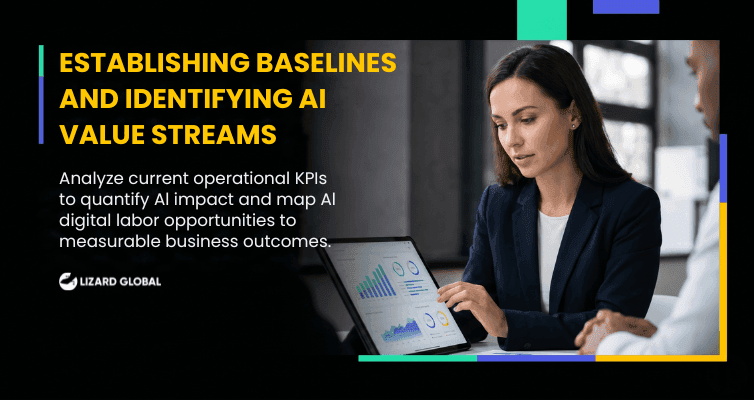
Furthermore, AI-driven systems often generate secondary value streams. These include improved employee satisfaction, faster time-to-market, and enhanced customer personalization. While these may not always appear in financial statements immediately, they significantly influence long-term ROI, especially when supported by growth analytics.
At this stage, collaboration with a full-stack digital solutions agency becomes essential. Teams like Lizard Global help enterprises map AI capabilities to measurable business outcomes using structured digital strategy and consultancy frameworks and digital transformation methodologies.
Measuring Operational Impact of Autonomous AI Agents
Operational ROI is one of the most immediate indicators of AI success. Autonomous AI Agents impact this layer by reducing cycle times, eliminating bottlenecks, and optimizing workflows in real time.
For example, in customer support systems, AI agents can resolve queries instantly, reducing ticket resolution time and operational overhead. Similarly, in finance operations, AI can automate reconciliation and reporting processes, increasing accuracy while reducing human intervention.
However, operational measurement must go beyond speed and efficiency. Enterprises should also track error reduction, decision consistency, and workload redistribution. These indicators provide a more complete picture of AI effectiveness.
In addition, integrating Human-in-the-Loop (HITL) systems ensures that human oversight remains part of the process. This balance improves trust and ensures that AI-driven decisions remain aligned with business goals and compliance standards.
Enterprise AI Governance, Observability, and Compliance
As AI systems scale, governance becomes a critical component of ROI measurement. Without proper controls, enterprises risk losing visibility into how AI systems make decisions. This is where AI Observability & Audit Logs become essential.
AI Observability allows organizations to track system behavior, decision paths, and performance metrics in real time. This ensures that every action taken by an AI system can be analyzed and optimized for better outcomes.
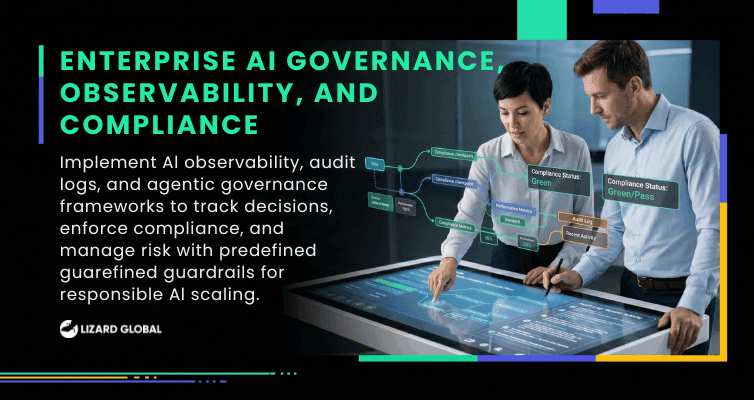
At the same time, Agentic Governance & Compliance frameworks ensure that AI systems operate within regulatory and ethical boundaries. This is particularly important for industries like finance, healthcare, and logistics where decision transparency is critical.
Additionally, AI Guardrails help prevent unintended outcomes by restricting AI behavior within predefined constraints. When combined with Enterprise AI Orchestration, these systems create a controlled yet flexible environment for scaling AI responsibly.
Financial ROI Models for AI Transformation
Financial ROI remains a core pillar of AI evaluation, but it must now be expanded to include both direct and indirect value. Direct value includes cost savings from automation, reduced headcount requirements, and operational efficiency gains.
Indirect value, however, is equally important. This includes revenue growth from improved customer experience, faster product delivery, and enhanced personalization. In many cases, AI-driven systems unlock entirely new revenue streams that did not exist before.
For example, integrating AI into mobile and web platforms through a web and mobile development approach or mobile app development agency approach can significantly improve customer engagement and conversion rates. Similarly, UI design and UX design services play a crucial role in ensuring that AI-powered experiences are intuitive and effective.
Ultimately, financial ROI should be viewed as a multi-layered model that includes cost optimization, revenue acceleration, and strategic business expansion.
The Role of a Digital Transformation Partner in Scaling AI ROI
Measuring ROI from enterprise AI is not just a technical exercise. It requires strategic alignment, cross-functional coordination, and continuous optimization. This is where a digital transformation partner becomes essential.
A company like Lizard Global supports enterprises in designing, implementing, and scaling AI systems that are measurable and outcome-driven. As a custom software development company and digital consultancy services provider, it helps organizations connect AI capabilities directly to business KPIs.
Moreover, expertise in iOS app development, Android app development, hybrid app development, and progressive web app development ensures that AI solutions are embedded across digital ecosystems. This creates a unified approach to Enterprise AI Orchestration and performance measurement.
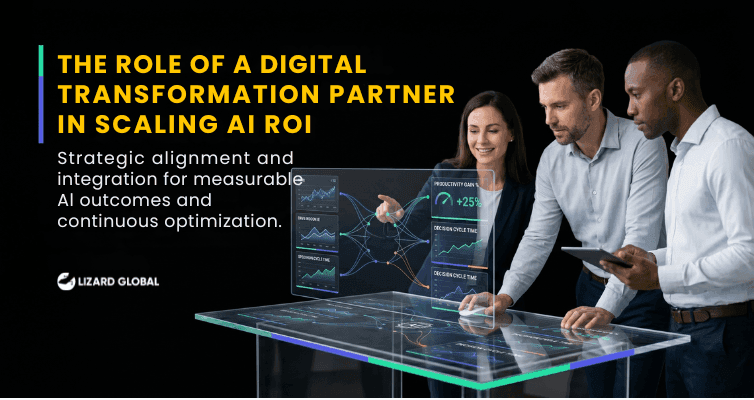
By combining UX/UI product design, CRM integration services, and growth analytics consulting, organizations gain a holistic view of AI impact. This ensures that ROI is not just measured but continuously improved over time.
Real-world implementations across digital ecosystems such as Travereel, ChatLicense, and Heineken Drinkies demonstrate how integrated platforms and data-driven systems translate AI capabilities into measurable business outcomes.
Make Enterprise AI Measurable, Scalable, and Real
Measuring ROI from enterprise AI implementations requires more than financial tracking. It demands a structured approach that combines governance, orchestration, operational insights, and strategic alignment. As AI systems become more autonomous and integrated, organizations must evolve their measurement frameworks to capture real business value.
If your organization is looking to move beyond experimentation and build measurable, scalable AI systems, partnering with the right expert is critical.

Work with Lizard Global to design, build, and optimize enterprise AI solutions that deliver real, provable ROI. From Agentic AI for Enterprise to full-stack digital transformation, we help you turn AI ambition into measurable business impact.
Measuring ROI from enterprise AI implementations is no longer a theoretical exercise. As organizations adopt Agentic AI for Enterprise, Autonomous AI Agents, and Agentic Workflows, the need for structured, transparent, and business-aligned ROI frameworks has become critical. However, traditional ROI models often fail to capture the full value of AI-driven transformation, especially when AI operates across workflows, decision systems, and digital labor ecosystems. This blog breaks down how enterprises can accurately measure AI ROI across operational, financial, and strategic dimensions. It also explores how Enterprise AI Orchestration, governance frameworks, and Human-in-the-Loop (HITL) systems help organizations create measurable, scalable, and sustainable AI value. Finally, we highlight how a digital transformation partner like Lizard Global helps enterprises operationalize AI ROI with clarity and confidence.
Enterprise AI is no longer confined to simple automation tasks. Today, organizations deploy Agentic AI for Enterprise systems that learn, decide, and act across business functions. As a result, ROI measurement becomes more complex because value is no longer linear or isolated. Instead, it is distributed across workflows, systems, and human-AI collaboration layers.
Traditionally, ROI focused on cost reduction and efficiency gains. However, with Autonomous AI Agents and AI Digital Labor entering enterprise environments, value now includes decision acceleration, reduced operational friction, and enhanced customer experiences. Therefore, organizations must rethink how they define success metrics from the ground up.
Moreover, AI systems now interact dynamically with multiple enterprise platforms. This makes attribution difficult. For instance, when AI improves customer retention, is the value attributed to marketing, sales, or the AI system itself? This complexity demands a more structured approach to Enterprise AI Orchestration and measurement frameworks, often supported through product analytics and digital strategy and consultancy.
Want to find out how much it costs to build your dream app or web app?
Redefining ROI Through Agentic AI for Enterprise
To measure ROI effectively, enterprises must first redefine what value means in the context of Agentic AI for Enterprise. Unlike deterministic systems, agentic systems adapt, reason, and execute tasks autonomously. This fundamentally changes how outcomes are generated and measured.
In deterministic vs. agentic AI models, deterministic systems follow fixed rules, while agentic systems dynamically optimize decisions. As a result, ROI is no longer just output-based; it becomes outcome-based. This includes speed of execution, decision quality, and adaptability across changing business environments.
Additionally, Agentic Workflows introduce compounding value. Instead of isolated task automation, AI agents collaborate across systems, creating cascading efficiency gains. For example, a single automated decision in supply chain planning can impact procurement, logistics, and customer delivery simultaneously.
Therefore, enterprises must expand ROI frameworks to include systemic impact. This includes measuring how AI improves agility, reduces cognitive load, and enhances cross-functional alignment.
Establishing Baselines and Identifying AI Value Streams
Before measuring ROI, organizations must establish clear baselines. Without understanding current performance metrics, AI impact cannot be accurately quantified. This includes operational KPIs, customer engagement metrics, and cost structures, often defined through market research and validation and data and architecture design.
Once baselines are defined, enterprises can identify AI value streams. These include productivity gains from AI Digital Labor, reduced manual workload, and improved decision cycles. For example, Autonomous AI Agents can handle repetitive processes such as data reconciliation, freeing human teams for higher-value work.
Furthermore, AI-driven systems often generate secondary value streams. These include improved employee satisfaction, faster time-to-market, and enhanced customer personalization. While these may not always appear in financial statements immediately, they significantly influence long-term ROI, especially when supported by growth analytics.
At this stage, collaboration with a full-stack digital solutions agency becomes essential. Teams like Lizard Global help enterprises map AI capabilities to measurable business outcomes using structured digital strategy and consultancy frameworks and digital transformation methodologies.
Measuring Operational Impact of Autonomous AI Agents
Operational ROI is one of the most immediate indicators of AI success. Autonomous AI Agents impact this layer by reducing cycle times, eliminating bottlenecks, and optimizing workflows in real time.
For example, in customer support systems, AI agents can resolve queries instantly, reducing ticket resolution time and operational overhead. Similarly, in finance operations, AI can automate reconciliation and reporting processes, increasing accuracy while reducing human intervention.
However, operational measurement must go beyond speed and efficiency. Enterprises should also track error reduction, decision consistency, and workload redistribution. These indicators provide a more complete picture of AI effectiveness.
In addition, integrating Human-in-the-Loop (HITL) systems ensures that human oversight remains part of the process. This balance improves trust and ensures that AI-driven decisions remain aligned with business goals and compliance standards.
Enterprise AI Governance, Observability, and Compliance
As AI systems scale, governance becomes a critical component of ROI measurement. Without proper controls, enterprises risk losing visibility into how AI systems make decisions. This is where AI Observability & Audit Logs become essential.
AI Observability allows organizations to track system behavior, decision paths, and performance metrics in real time. This ensures that every action taken by an AI system can be analyzed and optimized for better outcomes.
At the same time, Agentic Governance & Compliance frameworks ensure that AI systems operate within regulatory and ethical boundaries. This is particularly important for industries like finance, healthcare, and logistics where decision transparency is critical.
Additionally, AI Guardrails help prevent unintended outcomes by restricting AI behavior within predefined constraints. When combined with Enterprise AI Orchestration, these systems create a controlled yet flexible environment for scaling AI responsibly.
Financial ROI Models for AI Transformation
Financial ROI remains a core pillar of AI evaluation, but it must now be expanded to include both direct and indirect value. Direct value includes cost savings from automation, reduced headcount requirements, and operational efficiency gains.
Indirect value, however, is equally important. This includes revenue growth from improved customer experience, faster product delivery, and enhanced personalization. In many cases, AI-driven systems unlock entirely new revenue streams that did not exist before.
For example, integrating AI into mobile and web platforms through a web and mobile development approach or mobile app development agency approach can significantly improve customer engagement and conversion rates. Similarly, UI design and UX design services play a crucial role in ensuring that AI-powered experiences are intuitive and effective.
Ultimately, financial ROI should be viewed as a multi-layered model that includes cost optimization, revenue acceleration, and strategic business expansion.
The Role of a Digital Transformation Partner in Scaling AI ROI
Measuring ROI from enterprise AI is not just a technical exercise. It requires strategic alignment, cross-functional coordination, and continuous optimization. This is where a digital transformation partner becomes essential.
A company like Lizard Global supports enterprises in designing, implementing, and scaling AI systems that are measurable and outcome-driven. As a custom software development company and digital consultancy services provider, it helps organizations connect AI capabilities directly to business KPIs.
Moreover, expertise in iOS app development, Android app development, hybrid app development, and progressive web app development ensures that AI solutions are embedded across digital ecosystems. This creates a unified approach to Enterprise AI Orchestration and performance measurement.
By combining UX/UI product design, CRM integration services, and growth analytics consulting, organizations gain a holistic view of AI impact. This ensures that ROI is not just measured but continuously improved over time.
Real-world implementations across digital ecosystems such as Travereel, ChatLicense, and Heineken Drinkies demonstrate how integrated platforms and data-driven systems translate AI capabilities into measurable business outcomes.
Make Enterprise AI Measurable, Scalable, and Real
Measuring ROI from enterprise AI implementations requires more than financial tracking. It demands a structured approach that combines governance, orchestration, operational insights, and strategic alignment. As AI systems become more autonomous and integrated, organizations must evolve their measurement frameworks to capture real business value.
If your organization is looking to move beyond experimentation and build measurable, scalable AI systems, partnering with the right expert is critical.
Work with Lizard Global to design, build, and optimize enterprise AI solutions that deliver real, provable ROI. From Agentic AI for Enterprise to full-stack digital transformation, we help you turn AI ambition into measurable business impact.
FAQs

How do enterprises measure ROI from Agentic AI for Enterprise systems?
What makes AI ROI different from traditional digital transformation ROI?
Why is AI Observability important for ROI tracking?
How do Autonomous AI Agents impact business performance?
What role does Human-in-the-Loop (HITL) play in AI ROI?
How does Enterprise AI Orchestration improve ROI measurement?
Why should enterprises work with a digital transformation partner for AI ROI?
similar reads

Case Studies & Interviews
Client Review: Building A Custom Engagement App For MRT Corp
20 August 2026

AI & Machine Learning
How to Identify Your Highest-ROI AI Workflow Before Spending a Cent
31 August 2026

AI & Machine Learning
Enterprise Digital Transformation Services Powered by AI Integration
15 June 2026
Stuck between a great idea and the right team to build it?Let's talk.
We work with corporate innovation teams and ambitious scale-ups across the Netherlands, Singapore, and Australia, and wherever great software needs to be built. Drop us a message and we'll get back to you within one business day.


Markus Monnikendam
Global Commercial Director
hello@lizard.global