AI Governance in the Enterprise: Scaling Generative AI Securely and Responsibly

26 Feb 2026
by Team Lizard Global
Editor: Nadiy, Senior Content Writer
26 Feb 2026
by Team Lizard Global
Editor: Nadiy, Senior Content Writer
AI Governance in the Enterprise: Scaling Generative AI Securely and Responsibly
Table of contents
Contact us
We will get back to you in the next 48 hours.

Generative AI is transforming how enterprises operate, innovate, and compete. However, without structured enterprise AI governance, organizations risk data breaches, regulatory violations, biased outputs, and reputational damage. This blog explores how companies can scale generative AI securely and responsibly through governance frameworks, architecture-first security, risk management, and compliance alignment. Drawing on real-world portfolio examples across fintech, education, and AI-powered enterprise platforms, it demonstrates how a custom software development company and full-stack digital solutions agency supports governance through secure web app development services, mobile app development agency expertise, UI/UX design services, CRM integration services, and growth analytics consulting. For organizations seeking a reliable digital transformation partner, this guide provides a practical roadmap to operationalize AI responsibly while unlocking measurable business outcomes.
key takeaways
As a result, many organizations face a critical tension: how do you scale generative AI without increasing regulatory, operational, or reputational risk? The answer lies in structured AI governance — a framework that aligns technology, policy, risk management, and user experience into one coherent strategy.
In this blog, we explore how enterprises can scale AI responsibly while maintaining agility. We also draw insights from real-world digital transformation projects that demonstrate what responsible AI deployment looks like in practice.
Why AI Governance Is Now a Board-Level Priority
AI governance has rapidly moved from a technical discussion to a strategic one. Boards now ask questions about model transparency, data ownership, intellectual property risks, bias mitigation, and cybersecurity exposure. And rightly so.
Generative AI systems interact directly with customer data, operational insights, and proprietary knowledge. If deployed without guardrails, they can produce inaccurate outputs, expose sensitive information, or create compliance liabilities. Therefore, governance must exist before scaling, not after incidents occur.
Consider Sentry, Parexus AI, developed for pipeline pre-commissioning operations. In industries like oil and gas, predictive analytics and AI monitoring must operate within strict regulatory and safety parameters. Real-time decision systems cannot afford hallucinations or data leakage. Governance, in such environments, is not optional — it is foundational.
A custom software development company that supports enterprise AI must therefore integrate governance architecture from day one. This includes audit trails, access controls, data lineage tracking, and policy enforcement mechanisms.
In short, AI governance protects enterprise value while enabling innovation.
Building an Enterprise AI Governance Framework That Scales
AI governance is not a single policy document. Instead, it is a layered system covering data, models, users, infrastructure, and compliance.
First, organizations must define data governance rules. What data can AI systems access? Is personal data anonymized? Are there restrictions on training datasets? Without clarity, generative models may unintentionally process protected information.
Second, model governance is critical. Enterprises should establish validation processes, human-in-the-loop oversight, and continuous performance monitoring. For example, RE2 International Computer School implemented an AI-powered grading system designed to maintain rubric-based consistency while allowing teachers to override AI decisions. This hybrid oversight structure demonstrates responsible AI in action.
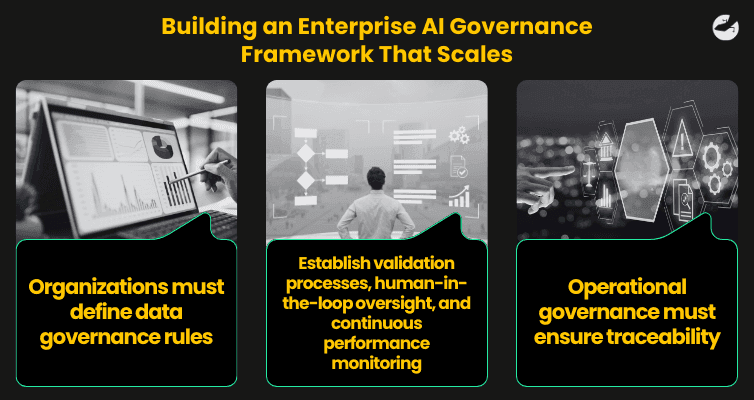
Third, operational governance must ensure traceability. Logging outputs, tracking decisions, and documenting model changes reduce legal exposure and support audits.
When a digital transformation partner integrates governance into development cycles, scaling becomes safer. Governance frameworks should be embedded into DevOps pipelines, supported by full-stack digital solutions agency expertise, and aligned with enterprise risk teams.
Ultimately, governance must scale alongside infrastructure.
Responsible AI in Education and Knowledge Platforms
Education platforms are among the most sensitive AI use cases because they influence learning outcomes, child development, and academic fairness.
Take Narrates.ai, a digital publishing platform within the online vertical. AI systems supporting storytelling, personalization, or content generation must ensure age-appropriate outputs, intellectual property protection, and bias mitigation. Governance here includes moderation systems, structured data controls, and clear accountability.
Similarly, RE2 International Computer School’s AI grading system reduces teacher administrative burden while preserving pedagogical control. Instead of fully automating grading decisions, the system supports educators with structured feedback suggestions. This is a powerful governance principle: augmentation over replacement.
Enterprises offering web app development services or mobile app development agency capabilities in EdTech must prioritize explainability and transparency. Parents and teachers need clarity on how AI reaches conclusions. Therefore, UX design plays a crucial role.
Strong UX/UI product design services ensure AI insights are understandable, not opaque. Clear dashboards, override mechanisms, and visual audit logs transform AI from a black box into a collaborative tool.
Governance, therefore, extends beyond code. It includes interface design and human control.
Security, Compliance, and Data Privacy in Generative AI
Security risks multiply when AI systems integrate across enterprise infrastructure. Generative AI models often connect with CRM systems, databases, document repositories, and cloud services.
Therefore, enterprises must implement:
- Role-based access control
- Encrypted data pipelines
- API monitoring
- Model sandbox environments
- GDPR and regional compliance alignment.

For example, digital platforms developed with blockchain features — like secure contract systems — demonstrate how traceability and transparency can be engineered directly into the architecture. Similarly, Sentry’s Parexus AI required controlled monitoring systems within industrial operations.
A digital consultancy services provider must evaluate AI risk exposure before integration. Governance teams should collaborate with cybersecurity teams early in the roadmap.
Additionally, enterprises expanding into iOS app development, Android app development, or hybrid app development must ensure mobile environments adhere to the same governance standards as desktop systems. AI-enabled mobile experiences introduce additional security layers, including device-level vulnerabilities and API exposures.
Scaling responsibly means eliminating governance blind spots across channels.
Governance-Driven AI for Operational Efficiency and Analytics
Generative AI often promises operational efficiency. However, without governance, efficiency gains can introduce new risks.
For instance, growth-focused platforms require AI-driven analytics for optimization. Integrating growth analytics consulting within AI ecosystems demands strict metric validation. Enterprises must confirm that predictive outputs are statistically reliable and ethically neutral.
Similarly, platforms offering CRM integration services must prevent AI from accessing restricted customer data fields. Data segmentation and anonymization processes protect against misuse.
Sentry’s Parexus AI illustrates governance-driven analytics in industrial contexts. Real-time monitoring systems must operate under defined safety parameters. Governance structures define acceptable thresholds, escalation procedures, and manual overrides.
A full-stack digital solutions agency designing AI for analytics must embed compliance monitoring within dashboards. Governance becomes visible, measurable, and enforceable.
Efficiency without oversight is fragile. Efficiency with governance is scalable.
Aligning AI Governance With Digital Transformation Strategy
AI governance cannot operate in isolation. It must align with broader digital transformation initiatives.
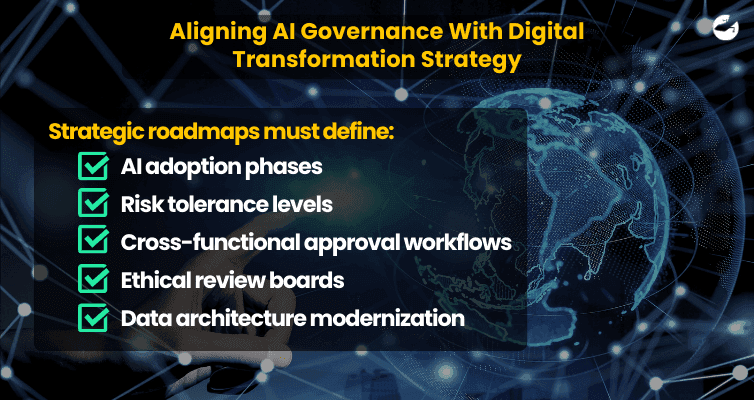
When organizations partner with a digital transformation partner, governance should be part of the transformation blueprint. Strategic roadmaps must define:
- AI adoption phases
- Risk tolerance levels
- Cross-functional approval workflows
- Ethical review boards
- Data architecture modernization
For example, RE2’s strategic roadmap for AI grading included phased implementation. Starting with web-based rollout, governance measures could be tested before expansion.
Enterprises pursuing progressive web app developmentword of choice or enterprise-scale platforms must synchronize AI rollout with infrastructure upgrades. Governance maturity should match system complexity.
Additionally, AI governance should integrate with digital marketing strategy services. Marketing AI tools must comply with advertising standards, privacy laws, and brand voice controls.
Transformation without governance leads to reactive crisis management. Transformation with governance builds sustainable competitive advantage.
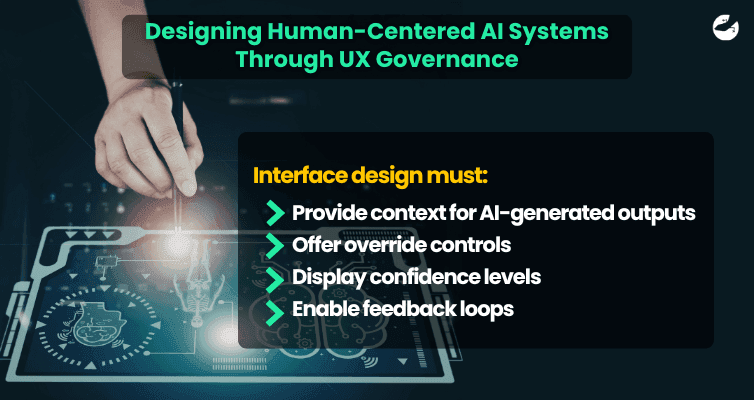
Designing Human-Centered AI Systems Through UX Governance
Often overlooked, UX governance is central to responsible AI. When users do not understand how AI decisions are made, trust erodes.
Therefore, interface design must:
- Provide context for AI-generated outputs
- Offer override controls
- Display confidence levels
- Enable feedback loops
Narrates.ai and RE2 demonstrate how AI systems can augment user experience instead of replacing it. Teachers retain grading authority. Content creators retain editorial control.
This is where UI/UX design services differentiate responsible AI from risky automation. A mobile app development agency building AI-enabled products must design transparency into the experience. Whether through mobile dashboards or web admin panels, governance must be visible.
Human-centered governance strengthens adoption and reduces resistance.
The Future of Enterprise AI Governance: Proactive, Not Reactive
Regulation will continue evolving. The EU AI Act, data protection frameworks, and industry-specific standards will shape enterprise responsibilities.
However, enterprises should not wait for regulatory enforcement. Proactive governance enables faster experimentation because guardrails are already defined.
Forward-thinking enterprises treat governance as innovation infrastructure. Just as cloud architecture enables scalability, governance architecture enables responsible AI growth.
A custom software development company with expertise in web app development services, enterprise mobility, and digital consultancy must embed compliance-ready frameworks into every AI initiative.
Those who scale without governance risk costly corrections. Those who scale responsibly build trust, resilience, and long-term value.
Lizard Global Helps You Scale AI With Confidence
Generative AI should accelerate your enterprise — not expose it to unnecessary risk.
At Lizard Global, we combine strategic governance frameworks with end-to-end development expertise as a custom software development company, mobile app development agency, and digital transformation partner. From AI-powered web platforms to secure enterprise analytics environments, we design solutions that scale responsibly.

If your organization is ready to implement generative AI with confidence, security, and compliance at its core — let’s build it together.
👉 Contact us today to design your enterprise AI governance roadmap.
Generative AI is transforming how enterprises operate, innovate, and compete. However, without structured enterprise AI governance, organizations risk data breaches, regulatory violations, biased outputs, and reputational damage. This blog explores how companies can scale generative AI securely and responsibly through governance frameworks, architecture-first security, risk management, and compliance alignment. Drawing on real-world portfolio examples across fintech, education, and AI-powered enterprise platforms, it demonstrates how a custom software development company and full-stack digital solutions agency supports governance through secure web app development services, mobile app development agency expertise, UI/UX design services, CRM integration services, and growth analytics consulting. For organizations seeking a reliable digital transformation partner, this guide provides a practical roadmap to operationalize AI responsibly while unlocking measurable business outcomes.
As a result, many organizations face a critical tension: how do you scale generative AI without increasing regulatory, operational, or reputational risk? The answer lies in structured AI governance — a framework that aligns technology, policy, risk management, and user experience into one coherent strategy.
In this blog, we explore how enterprises can scale AI responsibly while maintaining agility. We also draw insights from real-world digital transformation projects that demonstrate what responsible AI deployment looks like in practice.
Why AI Governance Is Now a Board-Level Priority
AI governance has rapidly moved from a technical discussion to a strategic one. Boards now ask questions about model transparency, data ownership, intellectual property risks, bias mitigation, and cybersecurity exposure. And rightly so.
Generative AI systems interact directly with customer data, operational insights, and proprietary knowledge. If deployed without guardrails, they can produce inaccurate outputs, expose sensitive information, or create compliance liabilities. Therefore, governance must exist before scaling, not after incidents occur.
Consider Sentry, Parexus AI, developed for pipeline pre-commissioning operations. In industries like oil and gas, predictive analytics and AI monitoring must operate within strict regulatory and safety parameters. Real-time decision systems cannot afford hallucinations or data leakage. Governance, in such environments, is not optional — it is foundational.
A custom software development company that supports enterprise AI must therefore integrate governance architecture from day one. This includes audit trails, access controls, data lineage tracking, and policy enforcement mechanisms.
In short, AI governance protects enterprise value while enabling innovation.
Building an Enterprise AI Governance Framework That Scales
AI governance is not a single policy document. Instead, it is a layered system covering data, models, users, infrastructure, and compliance.
First, organizations must define data governance rules. What data can AI systems access? Is personal data anonymized? Are there restrictions on training datasets? Without clarity, generative models may unintentionally process protected information.
Second, model governance is critical. Enterprises should establish validation processes, human-in-the-loop oversight, and continuous performance monitoring. For example, RE2 International Computer School implemented an AI-powered grading system designed to maintain rubric-based consistency while allowing teachers to override AI decisions. This hybrid oversight structure demonstrates responsible AI in action.
Third, operational governance must ensure traceability. Logging outputs, tracking decisions, and documenting model changes reduce legal exposure and support audits.
When a digital transformation partner integrates governance into development cycles, scaling becomes safer. Governance frameworks should be embedded into DevOps pipelines, supported by full-stack digital solutions agency expertise, and aligned with enterprise risk teams.
Ultimately, governance must scale alongside infrastructure.
Responsible AI in Education and Knowledge Platforms
Education platforms are among the most sensitive AI use cases because they influence learning outcomes, child development, and academic fairness.
Take Narrates.ai, a digital publishing platform within the online vertical. AI systems supporting storytelling, personalization, or content generation must ensure age-appropriate outputs, intellectual property protection, and bias mitigation. Governance here includes moderation systems, structured data controls, and clear accountability.
Similarly, RE2 International Computer School’s AI grading system reduces teacher administrative burden while preserving pedagogical control. Instead of fully automating grading decisions, the system supports educators with structured feedback suggestions. This is a powerful governance principle: augmentation over replacement.
Enterprises offering web app development services or mobile app development agency capabilities in EdTech must prioritize explainability and transparency. Parents and teachers need clarity on how AI reaches conclusions. Therefore, UX design plays a crucial role.
Strong UX/UI product design services ensure AI insights are understandable, not opaque. Clear dashboards, override mechanisms, and visual audit logs transform AI from a black box into a collaborative tool.
Governance, therefore, extends beyond code. It includes interface design and human control.
Security, Compliance, and Data Privacy in Generative AI
Security risks multiply when AI systems integrate across enterprise infrastructure. Generative AI models often connect with CRM systems, databases, document repositories, and cloud services.
Therefore, enterprises must implement:
- Role-based access control
- Encrypted data pipelines
- API monitoring
- Model sandbox environments
- GDPR and regional compliance alignment.
For example, digital platforms developed with blockchain features — like secure contract systems — demonstrate how traceability and transparency can be engineered directly into the architecture. Similarly, Sentry’s Parexus AI required controlled monitoring systems within industrial operations.
A digital consultancy services provider must evaluate AI risk exposure before integration. Governance teams should collaborate with cybersecurity teams early in the roadmap.
Additionally, enterprises expanding into iOS app development, Android app development, or hybrid app development must ensure mobile environments adhere to the same governance standards as desktop systems. AI-enabled mobile experiences introduce additional security layers, including device-level vulnerabilities and API exposures.
Scaling responsibly means eliminating governance blind spots across channels.
Governance-Driven AI for Operational Efficiency and Analytics
Generative AI often promises operational efficiency. However, without governance, efficiency gains can introduce new risks.
For instance, growth-focused platforms require AI-driven analytics for optimization. Integrating growth analytics consulting within AI ecosystems demands strict metric validation. Enterprises must confirm that predictive outputs are statistically reliable and ethically neutral.
Similarly, platforms offering CRM integration services must prevent AI from accessing restricted customer data fields. Data segmentation and anonymization processes protect against misuse.
Sentry’s Parexus AI illustrates governance-driven analytics in industrial contexts. Real-time monitoring systems must operate under defined safety parameters. Governance structures define acceptable thresholds, escalation procedures, and manual overrides.
A full-stack digital solutions agency designing AI for analytics must embed compliance monitoring within dashboards. Governance becomes visible, measurable, and enforceable.
Efficiency without oversight is fragile. Efficiency with governance is scalable.
Aligning AI Governance With Digital Transformation Strategy
AI governance cannot operate in isolation. It must align with broader digital transformation initiatives.
When organizations partner with a digital transformation partner, governance should be part of the transformation blueprint. Strategic roadmaps must define:
- AI adoption phases
- Risk tolerance levels
- Cross-functional approval workflows
- Ethical review boards
- Data architecture modernization
For example, RE2’s strategic roadmap for AI grading included phased implementation. Starting with web-based rollout, governance measures could be tested before expansion.
Enterprises pursuing progressive web app developmentword of choice or enterprise-scale platforms must synchronize AI rollout with infrastructure upgrades. Governance maturity should match system complexity.
Additionally, AI governance should integrate with digital marketing strategy services. Marketing AI tools must comply with advertising standards, privacy laws, and brand voice controls.
Transformation without governance leads to reactive crisis management. Transformation with governance builds sustainable competitive advantage.
Designing Human-Centered AI Systems Through UX Governance
Often overlooked, UX governance is central to responsible AI. When users do not understand how AI decisions are made, trust erodes.
Therefore, interface design must:
- Provide context for AI-generated outputs
- Offer override controls
- Display confidence levels
- Enable feedback loops
Narrates.ai and RE2 demonstrate how AI systems can augment user experience instead of replacing it. Teachers retain grading authority. Content creators retain editorial control.
This is where UI/UX design services differentiate responsible AI from risky automation. A mobile app development agency building AI-enabled products must design transparency into the experience. Whether through mobile dashboards or web admin panels, governance must be visible.
Human-centered governance strengthens adoption and reduces resistance.
The Future of Enterprise AI Governance: Proactive, Not Reactive
Regulation will continue evolving. The EU AI Act, data protection frameworks, and industry-specific standards will shape enterprise responsibilities.
However, enterprises should not wait for regulatory enforcement. Proactive governance enables faster experimentation because guardrails are already defined.
Forward-thinking enterprises treat governance as innovation infrastructure. Just as cloud architecture enables scalability, governance architecture enables responsible AI growth.
A custom software development company with expertise in web app development services, enterprise mobility, and digital consultancy must embed compliance-ready frameworks into every AI initiative.
Those who scale without governance risk costly corrections. Those who scale responsibly build trust, resilience, and long-term value.
Lizard Global Helps You Scale AI With Confidence
Generative AI should accelerate your enterprise — not expose it to unnecessary risk.
At Lizard Global, we combine strategic governance frameworks with end-to-end development expertise as a custom software development company, mobile app development agency, and digital transformation partner. From AI-powered web platforms to secure enterprise analytics environments, we design solutions that scale responsibly.
If your organization is ready to implement generative AI with confidence, security, and compliance at its core — let’s build it together.
👉 Contact us today to design your enterprise AI governance roadmap.
FAQs

What is AI governance in the enterprise?
Why is AI governance critical when scaling generative AI?
How can enterprises ensure AI compliance with regulations?
What role does UX/UI design play in AI governance?
How does AI governance apply to mobile and web app development?
Can generative AI be integrated safely into fintech or regulated platforms?
What is the first step toward enterprise AI governance?
similar reads

Case Studies & Interviews
Client Review: Building A Custom Engagement App For MRT Corp
20 August 2026

Case Studies & Interviews
Lereng Tanah: Developing a Direct Booking Platform Malaysian Boutique Villa
29 January 2026

Case Studies & Interviews
Tactlink: How a Malaysian Entrepreneur Turned Networking Chaos into a Digital Community
22 January 2026
Stuck between a great idea and the right team to build it?Let's talk.
We work with corporate innovation teams and ambitious scale-ups across the Netherlands, Singapore, and Australia, and wherever great software needs to be built. Drop us a message and we'll get back to you within one business day.


Markus Monnikendam
Global Commercial Director
hello@lizard.global