Enterprise App Lifecycle Costs: From Build to Maintenance, Compliance & Scaling
27 Feb 2026
by Team Lizard Global
Editor: Nadiy, Senior Content Writer
27 Feb 2026
by Team Lizard Global
Editor: Nadiy, Senior Content Writer
Enterprise App Lifecycle Costs: From Build to Maintenance, Compliance & Scaling
Table of contents
Contact us
We will get back to you in the next 48 hours.

Enterprise apps are not one-time investments. They evolve. From initial strategy and UX/UI product design to ongoing maintenance, compliance updates, CRM integration services, and scaling architecture, lifecycle costs define long-term success. This blog explores the full cost journey of enterprise software, supported by real-world examples from Lizard Global’s portfolio across fintech, HR, real estate, education, and e-commerce. Whether you are considering iOS app development, Android app development, hybrid app development, or progressive web app development, understanding lifecycle economics helps prevent budget overruns and operational risk. Discover how partnering with a custom software development company and full-stack digital solutions agency ensures sustainable growth rather than short-term delivery.
key takeaways
Enterprise app lifecycle costs go far beyond initial development. They include strategy, UX/UI product design, engineering, CRM integration services, compliance updates, infrastructure scaling, and ongoing maintenance. Yet many enterprises still calculate software budgets based only on build costs—ignoring the long-term financial impact.
The result? Budget overruns, technical debt, compliance risks, and costly rebuilds.
Whether you are investing in iOS app development, Android app development, hybrid app development, or progressive web app development, the true return on investment depends on how well you manage the entire lifecycle. From architecture planning to DevOps and growth analytics consulting, every phase influences operational efficiency and scalability.
Enterprise software should be treated as a strategic asset, not a one-time project. In this guide, we break down the full cost journey—from build to maintenance, compliance, and scaling—using real enterprise examples and proven digital transformation strategies.
Want to find out how much it costs to build your dream app or web app?


Understanding the Full Enterprise App Lifecycle Cost Model
When organizations evaluate enterprise software investments, they often focus on the initial build. However, the real financial story begins long before launch and continues long after deployment. Enterprise app lifecycle costs include discovery, UX/UI product design, engineering, integrations, compliance, maintenance, infrastructure, analytics, and continuous optimization.
In fact, many enterprises underestimate ongoing operational costs. Maintenance alone can represent 15–25% of initial development costs annually. Furthermore, compliance updates, performance optimization, and infrastructure scaling introduce recurring expenses that compound over time. Therefore, working with a digital transformation partner that understands lifecycle economics becomes critical.
A custom software development company does more than deliver code. It designs systems that evolve safely and predictably. That is why forward-thinking organizations treat enterprise apps as long-term assets rather than short-term projects.
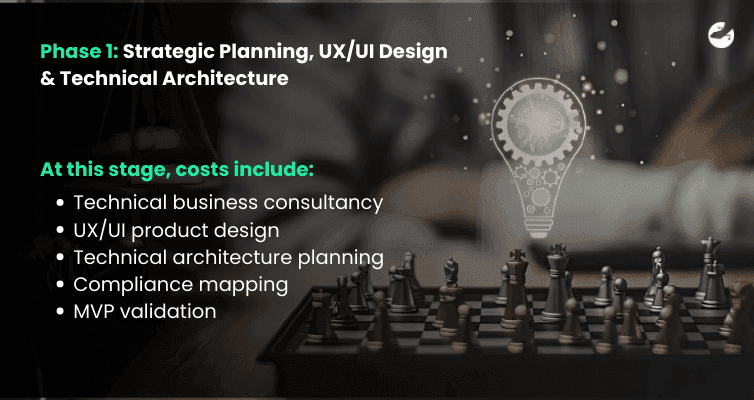
Phase 1: Strategic Planning, UX/UI Design & Technical Architecture
Every sustainable enterprise application starts with strategy. Before writing a single line of code, companies must define business objectives, user journeys, system dependencies, and compliance requirements. Skipping this step leads to rework, technical debt, and inflated costs later.
For example, in the development of Drinkies for Heineken, the goal extended beyond simple on-demand ordering. The platform required loyalty & rewards integration, GPS tracking, secure online payments, and scalable delivery operations. This required careful UX/UI design services combined with strong backend architecture planning.
Similarly, the HR risk analytics platform RiA developed with Human Capital Services had to comply with complex Dutch social security regulations. Compliance and documentation were embedded into the system architecture from day one. As a result, long-term legal and operational risks were reduced.
At this stage, costs include:
- Technical business consultancy
- UX/UI product design
- Technical architecture planning
- Compliance mapping
- MVP validation
A mobile app development agency that prioritizes architecture at this stage prevents costly rebuilds later.
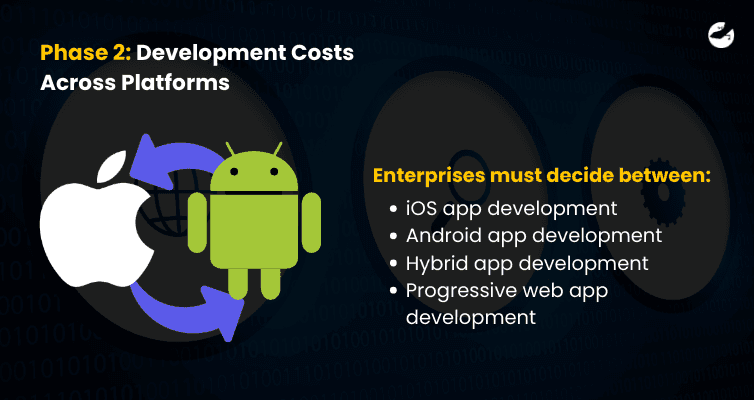
Phase 2: Development Costs Across Platforms (iOS, Android, Web & Hybrid)
Development costs vary significantly depending on platform strategy. Enterprises must decide between:
- iOS app development or Android app development
- Hybrid app development
- Progressive web app development
- Full web app development services
Each approach impacts lifecycle costs differently. For instance, Suspicious Antwerp App required both iOS and Android app development to bring the brand experience directly into customers’ pockets. While dual-platform native development increases upfront costs, it enhances performance, retention, and brand control.
On the other hand, platforms like Lumira Circle leveraged a browser-based responsive web approach. This progressive web app development strategy reduced app store dependency and simplified version control. Consequently, maintenance and deployment costs became more predictable.
Meanwhile, fintech solutions such as GWAP required both mobile and web ecosystems. Secure transaction management and currency processing demanded enterprise-grade backend systems. Here, the cost drivers included security layers, API integrations, and infrastructure reliability.
As a full-stack digital solutions agency, understanding these trade-offs allows enterprises to choose the right technical model—not just the cheapest one.
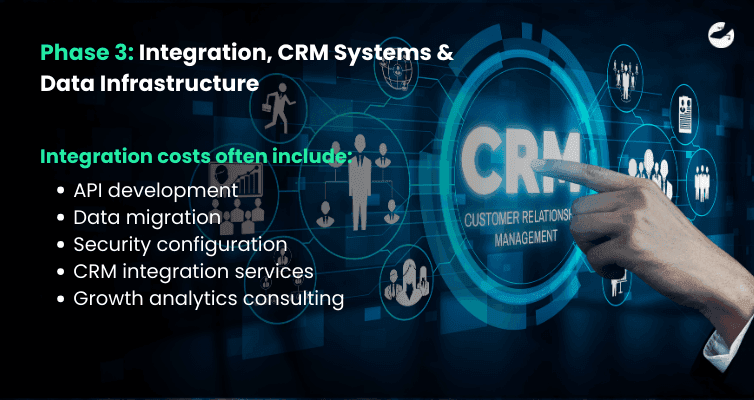
Phase 3: Integration, CRM Systems & Data Infrastructure
After launch, integration costs begin to shape operational efficiency. Enterprise apps rarely function in isolation. They connect to CRMs, ERPs, payment gateways, HR systems, marketing platforms, and analytics tools.
A strong example is Brunott, where CRM integration services and Salesforce automation centralized customer data. By grouping retail information into a unified system, employees gained actionable insights while preserving user privacy. Although CRM integration introduces implementation costs, it significantly reduces long-term operational inefficiencies.
Similarly, REACH - ROMS required real-time order synchronization across resellers, providers, and consumers. API integration and customizable modules added complexity to development. However, they improved long-term scalability and customer satisfaction.
Integration costs often include:
- API development
- Data migration
- Security configuration
- CRM integration services
- Growth analytics consulting
Without proper integration planning, enterprises create data silos that increase future migration and maintenance costs.
Phase 4: Compliance, Security & Regulatory Adaptation
Compliance is not a one-time checkbox. It evolves continuously. Take Contract Chain, developed to align with GDPR regulations introduced in 2018. Blockchain technology ensured contracts were traceable and irreversible. However, regulatory frameworks change. Therefore, security patches and legal updates must be ongoing budget considerations.
In HR solutions like UnlocQed, privacy-by-design architecture ensured data protection remained central. As governments tighten digital privacy laws globally, maintenance budgets must account for security audits, encryption updates, and regulatory compliance reviews.
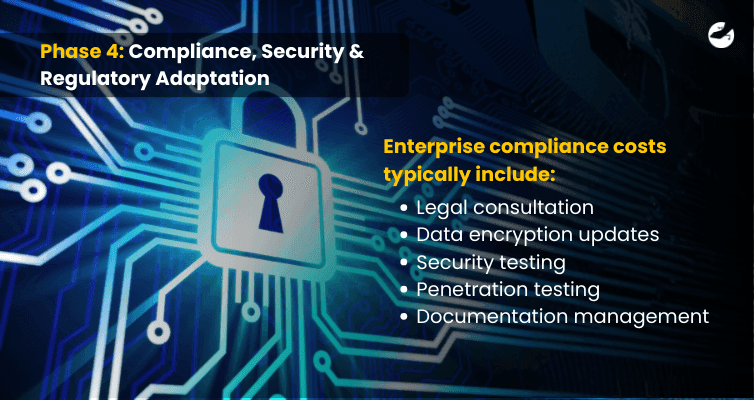
Enterprise compliance costs typically include:
- Legal consultation
- Data encryption updates
- Security testing
- Penetration testing
- Documentation management
A digital consultancy services partner ensures compliance is proactive rather than reactive.
Phase 5: Maintenance, Optimization & Growth Analytics
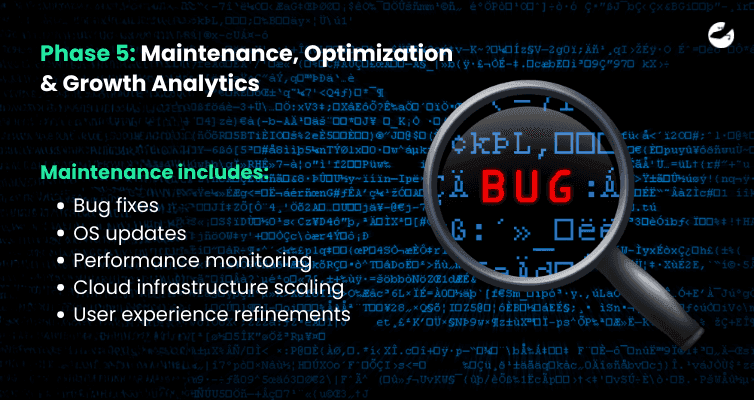
Once the app is live, maintenance becomes the primary cost driver. Maintenance includes bug fixes, OS updates, performance monitoring, cloud infrastructure scaling, and user experience refinements.
For example, platforms like GrowTribe rely on continuous data science improvements to align individual growth with organizational performance. Growth analytics consulting enables smarter feature prioritization and higher ROI.
Similarly, e-commerce ecosystems such as CNCRD require performance optimization to handle two-sided marketplace traffic. Load balancing, real-time matching algorithms, and personalization engines demand ongoing technical support.
Maintenance costs often scale with user growth. However, when architecture is well-designed, scaling becomes predictable instead of chaotic.
Phase 6: Scaling Infrastructure & Long-Term Digital Transformation
Scaling is where enterprise apps either thrive or collapse. Consider real estate platforms like Bricklinq, which provide real-time portfolio valuation. As property databases grow, database performance and search optimization must evolve accordingly.
In fintech environments such as Viropay, scaling introduces transaction throughput demands and strict uptime requirements. Downtime costs money—and reputation.
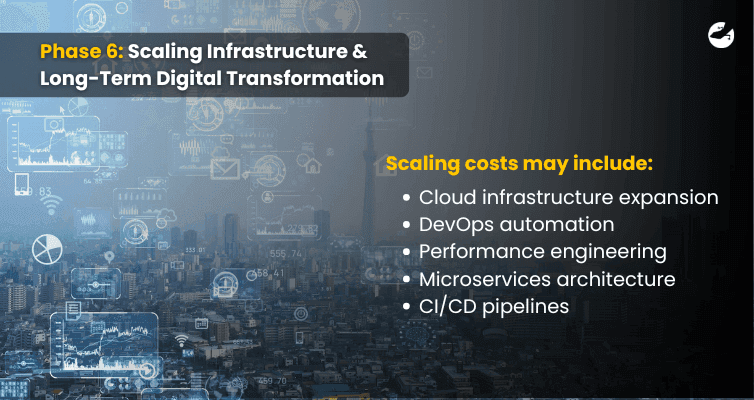
Scaling costs may include:
DevOps automation
Performance engineering
- Microservices architecture
This is where partnering with a custom software development company that acts as a long-term digital transformation partner becomes invaluable. Instead of reacting to traffic spikes or compliance crises, the organization scales confidently.
Lizard Global Builds Enterprise Software That Scales Intelligently
Enterprise apps are strategic assets—not short-term deliverables.
If your organization is planning a new platform or struggling with lifecycle costs, partner with a full-stack digital solutions agency that thinks beyond launch.

Lizard Global combines web app development services, mobile app development agency expertise, digital consultancy services, growth analytics consulting, and CRM integration services to future-proof enterprise ecosystems. Ready to build software that scales intelligently and remains compliant long-term? Whatsapp us today..
Enterprise apps are not one-time investments. They evolve. From initial strategy and UX/UI product design to ongoing maintenance, compliance updates, CRM integration services, and scaling architecture, lifecycle costs define long-term success. This blog explores the full cost journey of enterprise software, supported by real-world examples from Lizard Global’s portfolio across fintech, HR, real estate, education, and e-commerce. Whether you are considering iOS app development, Android app development, hybrid app development, or progressive web app development, understanding lifecycle economics helps prevent budget overruns and operational risk. Discover how partnering with a custom software development company and full-stack digital solutions agency ensures sustainable growth rather than short-term delivery.
Enterprise app lifecycle costs go far beyond initial development. They include strategy, UX/UI product design, engineering, CRM integration services, compliance updates, infrastructure scaling, and ongoing maintenance. Yet many enterprises still calculate software budgets based only on build costs—ignoring the long-term financial impact.
The result? Budget overruns, technical debt, compliance risks, and costly rebuilds.
Whether you are investing in iOS app development, Android app development, hybrid app development, or progressive web app development, the true return on investment depends on how well you manage the entire lifecycle. From architecture planning to DevOps and growth analytics consulting, every phase influences operational efficiency and scalability.
Enterprise software should be treated as a strategic asset, not a one-time project. In this guide, we break down the full cost journey—from build to maintenance, compliance, and scaling—using real enterprise examples and proven digital transformation strategies.
Want to find out how much it costs to build your dream app or web app?
Understanding the Full Enterprise App Lifecycle Cost Model
When organizations evaluate enterprise software investments, they often focus on the initial build. However, the real financial story begins long before launch and continues long after deployment. Enterprise app lifecycle costs include discovery, UX/UI product design, engineering, integrations, compliance, maintenance, infrastructure, analytics, and continuous optimization.
In fact, many enterprises underestimate ongoing operational costs. Maintenance alone can represent 15–25% of initial development costs annually. Furthermore, compliance updates, performance optimization, and infrastructure scaling introduce recurring expenses that compound over time. Therefore, working with a digital transformation partner that understands lifecycle economics becomes critical.
A custom software development company does more than deliver code. It designs systems that evolve safely and predictably. That is why forward-thinking organizations treat enterprise apps as long-term assets rather than short-term projects.
Phase 1: Strategic Planning, UX/UI Design & Technical Architecture
Every sustainable enterprise application starts with strategy. Before writing a single line of code, companies must define business objectives, user journeys, system dependencies, and compliance requirements. Skipping this step leads to rework, technical debt, and inflated costs later.
For example, in the development of Drinkies for Heineken, the goal extended beyond simple on-demand ordering. The platform required loyalty & rewards integration, GPS tracking, secure online payments, and scalable delivery operations. This required careful UX/UI design services combined with strong backend architecture planning.
Similarly, the HR risk analytics platform RiA developed with Human Capital Services had to comply with complex Dutch social security regulations. Compliance and documentation were embedded into the system architecture from day one. As a result, long-term legal and operational risks were reduced.
At this stage, costs include:
- Technical business consultancy
- UX/UI product design
- Technical architecture planning
- Compliance mapping
- MVP validation
A mobile app development agency that prioritizes architecture at this stage prevents costly rebuilds later.
Phase 2: Development Costs Across Platforms (iOS, Android, Web & Hybrid)
Development costs vary significantly depending on platform strategy. Enterprises must decide between:
- iOS app development or Android app development
- Hybrid app development
- Progressive web app development
- Full web app development services
Each approach impacts lifecycle costs differently. For instance, Suspicious Antwerp App required both iOS and Android app development to bring the brand experience directly into customers’ pockets. While dual-platform native development increases upfront costs, it enhances performance, retention, and brand control.
On the other hand, platforms like Lumira Circle leveraged a browser-based responsive web approach. This progressive web app development strategy reduced app store dependency and simplified version control. Consequently, maintenance and deployment costs became more predictable.
Meanwhile, fintech solutions such as GWAP required both mobile and web ecosystems. Secure transaction management and currency processing demanded enterprise-grade backend systems. Here, the cost drivers included security layers, API integrations, and infrastructure reliability.
As a full-stack digital solutions agency, understanding these trade-offs allows enterprises to choose the right technical model—not just the cheapest one.
Phase 3: Integration, CRM Systems & Data Infrastructure
After launch, integration costs begin to shape operational efficiency. Enterprise apps rarely function in isolation. They connect to CRMs, ERPs, payment gateways, HR systems, marketing platforms, and analytics tools.
A strong example is Brunott, where CRM integration services and Salesforce automation centralized customer data. By grouping retail information into a unified system, employees gained actionable insights while preserving user privacy. Although CRM integration introduces implementation costs, it significantly reduces long-term operational inefficiencies.
Similarly, REACH - ROMS required real-time order synchronization across resellers, providers, and consumers. API integration and customizable modules added complexity to development. However, they improved long-term scalability and customer satisfaction.
Integration costs often include:
- API development
- Data migration
- Security configuration
- CRM integration services
- Growth analytics consulting
Without proper integration planning, enterprises create data silos that increase future migration and maintenance costs.
Phase 4: Compliance, Security & Regulatory Adaptation
Compliance is not a one-time checkbox. It evolves continuously. Take Contract Chain, developed to align with GDPR regulations introduced in 2018. Blockchain technology ensured contracts were traceable and irreversible. However, regulatory frameworks change. Therefore, security patches and legal updates must be ongoing budget considerations.
In HR solutions like UnlocQed, privacy-by-design architecture ensured data protection remained central. As governments tighten digital privacy laws globally, maintenance budgets must account for security audits, encryption updates, and regulatory compliance reviews.
Enterprise compliance costs typically include:
- Legal consultation
- Data encryption updates
- Security testing
- Penetration testing
- Documentation management
A digital consultancy services partner ensures compliance is proactive rather than reactive.
Phase 5: Maintenance, Optimization & Growth Analytics
Once the app is live, maintenance becomes the primary cost driver. Maintenance includes bug fixes, OS updates, performance monitoring, cloud infrastructure scaling, and user experience refinements.
For example, platforms like GrowTribe rely on continuous data science improvements to align individual growth with organizational performance. Growth analytics consulting enables smarter feature prioritization and higher ROI.
Similarly, e-commerce ecosystems such as CNCRD require performance optimization to handle two-sided marketplace traffic. Load balancing, real-time matching algorithms, and personalization engines demand ongoing technical support.
Maintenance costs often scale with user growth. However, when architecture is well-designed, scaling becomes predictable instead of chaotic.
Phase 6: Scaling Infrastructure & Long-Term Digital Transformation
Scaling is where enterprise apps either thrive or collapse. Consider real estate platforms like Bricklinq, which provide real-time portfolio valuation. As property databases grow, database performance and search optimization must evolve accordingly.
In fintech environments such as Viropay, scaling introduces transaction throughput demands and strict uptime requirements. Downtime costs money—and reputation.
Scaling costs may include:
DevOps automation
Performance engineering
- Microservices architecture
This is where partnering with a custom software development company that acts as a long-term digital transformation partner becomes invaluable. Instead of reacting to traffic spikes or compliance crises, the organization scales confidently.
Lizard Global Builds Enterprise Software That Scales Intelligently
Enterprise apps are strategic assets—not short-term deliverables.
If your organization is planning a new platform or struggling with lifecycle costs, partner with a full-stack digital solutions agency that thinks beyond launch.
Lizard Global combines web app development services, mobile app development agency expertise, digital consultancy services, growth analytics consulting, and CRM integration services to future-proof enterprise ecosystems. Ready to build software that scales intelligently and remains compliant long-term? Whatsapp us today..
FAQs

What are enterprise app lifecycle costs?
Why do maintenance costs increase over time?
Is hybrid app development cheaper long-term?
How does CRM integration affect enterprise app costs?
Why is compliance budgeting important?
What role does UX/UI product design play in cost control?
How can a digital transformation partner reduce long-term costs?
similar reads

Case Studies & Interviews
Client Review: Building A Custom Engagement App For MRT Corp
20 August 2026

Case Studies & Interviews
Lereng Tanah: Developing a Direct Booking Platform Malaysian Boutique Villa
29 January 2026

Case Studies & Interviews
Tactlink: How a Malaysian Entrepreneur Turned Networking Chaos into a Digital Community
22 January 2026
Stuck between a great idea and the right team to build it?Let's talk.
We work with corporate innovation teams and ambitious scale-ups across the Netherlands, Singapore, and Australia, and wherever great software needs to be built. Drop us a message and we'll get back to you within one business day.


Markus Monnikendam
Global Commercial Director
hello@lizard.global