Navingo: How Migrating from Legacy WordPress to a Headless CMS Accelerates Platform Growth

16 Sep 2026
by Nadiy, Senior Content Writer
Guido van Beek, CTO & Co-founder
16 Sep 2026
by Nadiy, Senior Content Writer
Guido van Beek, CTO & Co-founder
Navingo: How Migrating from Legacy WordPress to a Headless CMS Accelerates Platform Growth
Table of contents
Contact us
We will get back to you in the next 48 hours.
Legacy content management systems like WordPress often turn into operational bottlenecks as businesses scale. Running multiple independent digital assets, managing bloated plugin stacks, and assembling web pages dynamically on server requests degrades site performance and creates massive technical maintenance debt. Moving away from PHP templating frameworks to a modern headless CMS architecture allows organizations to consolidate infrastructure into a single, multi-tenant application core. By pre-rendering content at the edge using Next.js and Payload CMS, high-volume digital platforms eliminate server overhead, protect search equity, and streamline editorial workflows. This comprehensive guide outlines the technical process, architectural benefits, data isolation strategies, and monetization improvements of migrating enterprise publishing setups to modern headless systems.
key takeaways
Migrating from a legacy PHP templating framework like WordPress to a modern headless CMS architecture allows high-traffic web properties to achieve instant page rendering, reduce technical overhead, and unify multiple platforms into a single codebase. Modernizing enterprise digital platforms removes performance bottlenecks by separating content management from front-end presentation, serving edge-cached content globally with zero downtime.
Legacy monolithic platforms execute server-side PHP scripts, run heavy plugin stacks, and query databases dynamically on every single user visit. This dynamic server assembly slows down page speed, degrades user retention, and exposes applications to security vulnerabilities. By migrating to a multi-tenant headless stack using tools like Next.js and Payload CMS, web platforms pre-render content globally while maintaining strict data isolation, simplified editorial workflows, and automated SEO preservation.
Why Are Legacy Monolithic CMS Stacks Slowing Down Enterprise Scaling?
We regularly observe established companies reaching the upper limits of what traditional monolithic content management systems can handle. When digital properties operate for over a decade, their underlying architectures naturally accumulate layers of technical debt. Every new feature, security patch, or marketing request often requires adding another plugin to an already bloated stack. Consequently, application servers spend vital processing time running server-side PHP code and querying databases fresh for every single request, even when the underlying page content has not changed in hours.
Furthermore, managing multiple digital properties under legacy systems multiplies operational complexity. When companies run distinct sites across separate software installations, editorial teams must navigate fragmented administrative logins, maintain multiple codebases, and patch security flaws individually across every single site. This fragmentation slows down feature distribution and increases operational overhead. Moving to a headless CMS architecture eliminates these compounding bottlenecks by decoupling content storage from front-end rendering, providing a centralized framework built for rapid enterprise growth.
![[Key Features] Navingo.png](/_next/image?url=https%3A%2F%2Fres.cloudinary.com%2Flizardwebsite%2Fimage%2Fupload%2Fv1789573273%2Flizard_website2025%2FKey_Features_Navingo_15a7030fa6.png&w=3840&q=75&dpl=dpl_6vhYPGCiXL4L4UxNdwfVdWPSVz6N)
How Does Multi-Tenant Headless Architecture Unify Disparate Codebases?
Transitioning from multiple legacy setups to a single headless architecture allows organizations to consolidate their software engineering assets. Rather than deploying separate backend engines for every brand or market, we construct a unified multi-tenant architecture using Next.js and Payload CMS. Payload's native multi-tenancy capabilities enforce strict tenant isolation directly at the database layer, keeping each brand's data completely separate while allowing all properties to run on one shared codebase.
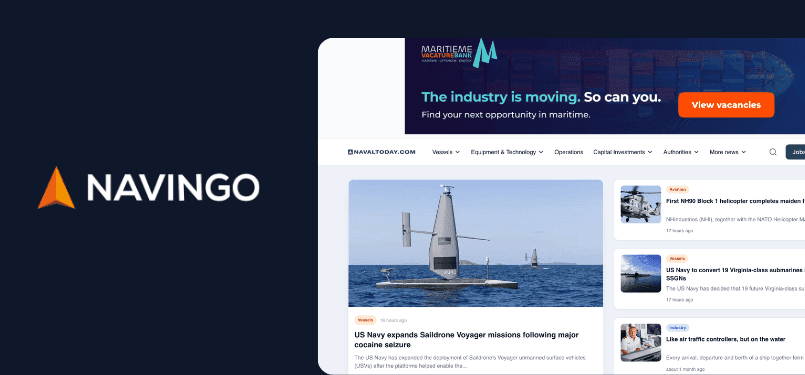
We implemented this exact strategy during our modernization project for Navingo, a major maritime trade publisher. Navingo operated four distinct industry titles: Offshore Energy, Offshore Wind, Dredging Today, and Naval Today. Their platform managed over 370,000 articles and served more than 750,000 monthly user sessions across four separate WordPress installations. Each title required its own plugin stack and maintenance workflow. We consolidated all four titles into a single Next.js and Payload CMS engine, allowing their editorial team to switch between tenant brands smoothly within one single administrative portal.
What Process Ensures Zero Downtime and SEO Preservation During Migration?
Migrating decades of historical content demands absolute precision to protect organic search rankings and ongoing commercial operations. A careless cutover risks destroying established search engine equity and disrupting user monetization channels. To eliminate these risks, we enforce an incremental migration process guided by pre-validated architecture decision records and automated verification tools. We extract content from legacy databases, convert unstructured text into clean Lexical format, re-host media assets, and verify 301 redirect mappings before initiating live DNS updates.
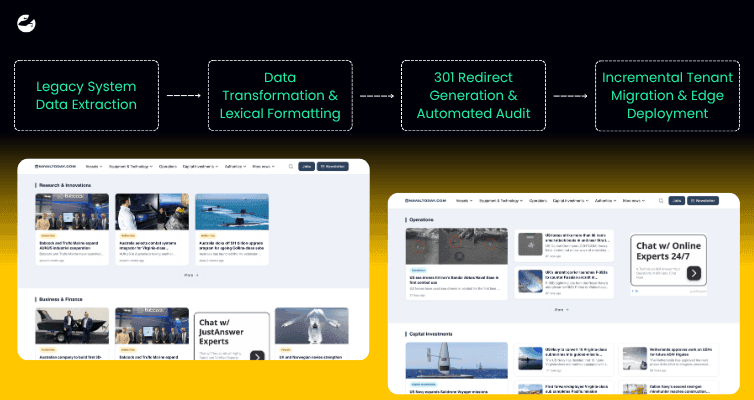
During the Navingo platform cutover, we prioritized zero downtime across their entire reader ecosystem. We migrated Naval Today first as a live validation test, carefully preserving historical URL structures and search equity before rolling out the architecture across the remaining three publications. This staged methodology enabled the entire platform migration to achieve zero days of operational downtime across 370,000 articles.
How Does Edge Rendering Maximize Global Speed and Performance?
Traditional application platforms suffer because every visitor triggers dynamic server processing. Conversely, a modern headless architecture powered by Incremental Static Regeneration (ISR) pre-renders public pages at the edge, serving static HTML files globally from content delivery networks. As a result, page loads occur almost instantaneously, regardless of geographic distance or user device. The underlying application server only processes requests for highly dynamic elements, such as checkout systems, real-time analytics, or gated admin dashboards.
When content authors publish or edit an article inside Payload CMS, the platform automatically revalidates only the affected edge pages in real time. This approach ensures site visitors receive updated information instantly without forcing the core server to re-render unchanged site sections. By relieving database pressure during traffic spikes, edge rendering improves website performance, enhances user engagement, and drastically reduces server infrastructure costs.
![[Workshop] Navingo.png](/_next/image?url=https%3A%2F%2Fres.cloudinary.com%2Flizardwebsite%2Fimage%2Fupload%2Fv1789573273%2Flizard_website2025%2FWorkshop_Navingo_3de841d485.png&w=3840&q=75&dpl=dpl_6vhYPGCiXL4L4UxNdwfVdWPSVz6N)
How Can Shared Design Systems Maintain Distinct Visual Identities?
Legacy publishing setups often rely on divergent themes that lock visual layouts into custom stylesheets. To streamline visual upgrades without altering recognizable layouts, we construct centralized atomic design systems using Tailwind CSS. We organize design elements into modular components shared across all digital properties, applying brand-specific styling through design tokens rather than divergent stylesheets.
For Navingo, their visual identity previously lived on basic style guides that could not support modern component design. We established formal design briefs for each publication, defining specific color roles, typography scales, and component states. We then deployed a single atomic component library that powered all four trade websites. Consequently, Navingo achieved a visual refresh without confusing their audience; readers still enjoy the familiar homepage grid, article layouts, and navigation menus they rely on daily.
How Do Headless Systems Streamline Monetization and Compliance?
Monetizing legacy monolithic applications typically requires bolting on separate third-party plugins across every individual site installation. In a modern headless ecosystem, monetization and regulatory compliance are integrated directly into core application architecture. System administrators can configure subscription rules, paywalls, and advertising scripts globally or customize settings for specific brand tenants.
In our implementation for Navingo, we built flexible metered paywalls along with native Stripe billing and Google Ad Manager integrations directly into the shared platform layer. Editorial teams maintain granular control over whether paywalls or ad modules apply on a per-article basis. Furthermore, strict multi-tenant boundaries enforce GDPR compliance by default, gating analytics scripts behind consent logic and keeping transaction data off primary servers.
![[Impact] Navingo.png](/_next/image?url=https%3A%2F%2Fres.cloudinary.com%2Flizardwebsite%2Fimage%2Fupload%2Fv1789573273%2Flizard_website2025%2FImpact_Navingo_73671df559.png&w=3840&q=75&dpl=dpl_6vhYPGCiXL4L4UxNdwfVdWPSVz6N)
Partner with Lizard Global for Enterprise Modernization
At Lizard Global, we specialize in helping established platforms move beyond legacy software limitations. We work with publishers, enterprise teams, and digital scale-ups to transform complex technical debt into high-performing, multi-tenant digital assets. If your current web infrastructure is limiting business growth, our engineering team provides the architectural discipline required to modernize your platform safely.

Is a legacy CMS platform constraining your business growth? Contact Lizard Global today to discuss how our headless modernization services can elevate your digital operations.
Legacy content management systems like WordPress often turn into operational bottlenecks as businesses scale. Running multiple independent digital assets, managing bloated plugin stacks, and assembling web pages dynamically on server requests degrades site performance and creates massive technical maintenance debt. Moving away from PHP templating frameworks to a modern headless CMS architecture allows organizations to consolidate infrastructure into a single, multi-tenant application core. By pre-rendering content at the edge using Next.js and Payload CMS, high-volume digital platforms eliminate server overhead, protect search equity, and streamline editorial workflows. This comprehensive guide outlines the technical process, architectural benefits, data isolation strategies, and monetization improvements of migrating enterprise publishing setups to modern headless systems.
Migrating from a legacy PHP templating framework like WordPress to a modern headless CMS architecture allows high-traffic web properties to achieve instant page rendering, reduce technical overhead, and unify multiple platforms into a single codebase. Modernizing enterprise digital platforms removes performance bottlenecks by separating content management from front-end presentation, serving edge-cached content globally with zero downtime.
Legacy monolithic platforms execute server-side PHP scripts, run heavy plugin stacks, and query databases dynamically on every single user visit. This dynamic server assembly slows down page speed, degrades user retention, and exposes applications to security vulnerabilities. By migrating to a multi-tenant headless stack using tools like Next.js and Payload CMS, web platforms pre-render content globally while maintaining strict data isolation, simplified editorial workflows, and automated SEO preservation.
Why Are Legacy Monolithic CMS Stacks Slowing Down Enterprise Scaling?
We regularly observe established companies reaching the upper limits of what traditional monolithic content management systems can handle. When digital properties operate for over a decade, their underlying architectures naturally accumulate layers of technical debt. Every new feature, security patch, or marketing request often requires adding another plugin to an already bloated stack. Consequently, application servers spend vital processing time running server-side PHP code and querying databases fresh for every single request, even when the underlying page content has not changed in hours.
Furthermore, managing multiple digital properties under legacy systems multiplies operational complexity. When companies run distinct sites across separate software installations, editorial teams must navigate fragmented administrative logins, maintain multiple codebases, and patch security flaws individually across every single site. This fragmentation slows down feature distribution and increases operational overhead. Moving to a headless CMS architecture eliminates these compounding bottlenecks by decoupling content storage from front-end rendering, providing a centralized framework built for rapid enterprise growth.
How Does Multi-Tenant Headless Architecture Unify Disparate Codebases?
Transitioning from multiple legacy setups to a single headless architecture allows organizations to consolidate their software engineering assets. Rather than deploying separate backend engines for every brand or market, we construct a unified multi-tenant architecture using Next.js and Payload CMS. Payload's native multi-tenancy capabilities enforce strict tenant isolation directly at the database layer, keeping each brand's data completely separate while allowing all properties to run on one shared codebase.
We implemented this exact strategy during our modernization project for Navingo, a major maritime trade publisher. Navingo operated four distinct industry titles: Offshore Energy, Offshore Wind, Dredging Today, and Naval Today. Their platform managed over 370,000 articles and served more than 750,000 monthly user sessions across four separate WordPress installations. Each title required its own plugin stack and maintenance workflow. We consolidated all four titles into a single Next.js and Payload CMS engine, allowing their editorial team to switch between tenant brands smoothly within one single administrative portal.
What Process Ensures Zero Downtime and SEO Preservation During Migration?
Migrating decades of historical content demands absolute precision to protect organic search rankings and ongoing commercial operations. A careless cutover risks destroying established search engine equity and disrupting user monetization channels. To eliminate these risks, we enforce an incremental migration process guided by pre-validated architecture decision records and automated verification tools. We extract content from legacy databases, convert unstructured text into clean Lexical format, re-host media assets, and verify 301 redirect mappings before initiating live DNS updates.
During the Navingo platform cutover, we prioritized zero downtime across their entire reader ecosystem. We migrated Naval Today first as a live validation test, carefully preserving historical URL structures and search equity before rolling out the architecture across the remaining three publications. This staged methodology enabled the entire platform migration to achieve zero days of operational downtime across 370,000 articles.
How Does Edge Rendering Maximize Global Speed and Performance?
Traditional application platforms suffer because every visitor triggers dynamic server processing. Conversely, a modern headless architecture powered by Incremental Static Regeneration (ISR) pre-renders public pages at the edge, serving static HTML files globally from content delivery networks. As a result, page loads occur almost instantaneously, regardless of geographic distance or user device. The underlying application server only processes requests for highly dynamic elements, such as checkout systems, real-time analytics, or gated admin dashboards.
When content authors publish or edit an article inside Payload CMS, the platform automatically revalidates only the affected edge pages in real time. This approach ensures site visitors receive updated information instantly without forcing the core server to re-render unchanged site sections. By relieving database pressure during traffic spikes, edge rendering improves website performance, enhances user engagement, and drastically reduces server infrastructure costs.
How Can Shared Design Systems Maintain Distinct Visual Identities?
Legacy publishing setups often rely on divergent themes that lock visual layouts into custom stylesheets. To streamline visual upgrades without altering recognizable layouts, we construct centralized atomic design systems using Tailwind CSS. We organize design elements into modular components shared across all digital properties, applying brand-specific styling through design tokens rather than divergent stylesheets.
For Navingo, their visual identity previously lived on basic style guides that could not support modern component design. We established formal design briefs for each publication, defining specific color roles, typography scales, and component states. We then deployed a single atomic component library that powered all four trade websites. Consequently, Navingo achieved a visual refresh without confusing their audience; readers still enjoy the familiar homepage grid, article layouts, and navigation menus they rely on daily.
How Do Headless Systems Streamline Monetization and Compliance?
Monetizing legacy monolithic applications typically requires bolting on separate third-party plugins across every individual site installation. In a modern headless ecosystem, monetization and regulatory compliance are integrated directly into core application architecture. System administrators can configure subscription rules, paywalls, and advertising scripts globally or customize settings for specific brand tenants.
In our implementation for Navingo, we built flexible metered paywalls along with native Stripe billing and Google Ad Manager integrations directly into the shared platform layer. Editorial teams maintain granular control over whether paywalls or ad modules apply on a per-article basis. Furthermore, strict multi-tenant boundaries enforce GDPR compliance by default, gating analytics scripts behind consent logic and keeping transaction data off primary servers.
Partner with Lizard Global for Enterprise Modernization
At Lizard Global, we specialize in helping established platforms move beyond legacy software limitations. We work with publishers, enterprise teams, and digital scale-ups to transform complex technical debt into high-performing, multi-tenant digital assets. If your current web infrastructure is limiting business growth, our engineering team provides the architectural discipline required to modernize your platform safely.
Is a legacy CMS platform constraining your business growth? Contact Lizard Global today to discuss how our headless modernization services can elevate your digital operations.
FAQs
What is the main advantage of moving from WordPress to Payload CMS?
How does multi-tenancy lower software maintenance costs for digital platforms?
Will migrating to a headless CMS disrupt existing organic SEO rankings?
How does Incremental Static Regeneration improve high-volume website performance?
Can a single design system support multiple brands with different styles?
How do headless architectures handle global compliance regulations like GDPR?
How long does it take to migrate legacy sites to a headless platform?
similar reads

Software Development
Platform Modernization
Software Modernization: When Legacy Systems Block Business Growth
18 March 2026

AI & Machine Learning
Platform Modernization
Modernize or Rebuild? A Cost-and-Risk Decision Tree For legacy Enterprise B2B platforms
20 July 2026

Case Studies & Interviews
Navingo: How Migrating from Legacy WordPress to a Headless CMS Accelerates Platform Growth
16 September 2026
Stuck between a great idea and the right team to build it?Let's talk.
We work with corporate innovation teams and ambitious scale-ups across the Netherlands, Singapore, and Australia, and wherever great software needs to be built. Drop us a message and we'll get back to you within one business day.


Markus Monnikendam
Global Commercial Director
hello@lizard.global