
The "Winchester Mystery House" Trap: Navigating the Architectural Complexity of Continuous Agentic Deployments

28 Aug 2026
by Nadiy, Senior Content Writer
28 Aug 2026
by Nadiy, Senior Content Writer
The "Winchester Mystery House" Trap: Navigating the Architectural Complexity of Continuous Agentic Deployments
Table of contents
Why Do Continuous Agentic Deployments Spiral Out of Control?
How Does Context Drift Create Hidden Architectural Debt?
What Engineering Principles Stop Recursive Agent Loops?
How Can Enterprise Data Governance Prevent Unsanctioned Agent Actions?
How Did We Architect Scalable Enterprise AI at Lizard Global?
How Do You Transition from Fragile AI Experiments to Production-Ready Architecture?
Ready to Build Scalable, Enterprise-Grade AI Systems?
Contact us
We will get back to you in the next 48 hours.
Enterprise organizations scaling autonomous AI workflows often encounter architectural bloat, uncoordinated multi-agent loops, and operational debt, a phenomenon we term the "Winchester Mystery House" trap. This comprehensive guide explores why adding autonomous LLM agents without unified orchestration creates chaotic software environments. We examine structural flaws in continuous agentic deployments, including context drift, dynamic tool access risks, and recursive feedback loops. Drawing directly from our real-world enterprise engineering experience at Lizard Global, we outline architectural blueprints required to maintain systemic control. We break down concrete design principles such as single-responsibility agent scoping, strict Model Context Protocol (MCP) implementations, structured schema handoffs, and deterministic human-in-the-loop checkpoints. Readers will gain actionable frameworks to transition from fragile AI experiments to audit-ready, scalable enterprise deployments that deliver measurable business ROI.
key takeaways
Continuous agentic deployments fail when enterprise tech stacks begin to mirror the famous Winchester Mystery House: a labyrinth of ad-hoc rooms, doors that open into solid brick walls, and stairs that lead nowhere.
We see engineering teams continually add autonomous agents to solve localized workflow gaps without establishing a foundational blueprint. As a result, systems grow increasingly complex, costly, and fragile.
To build reliable enterprise AI, we must replace random structural expansion with deterministic orchestration, rigorous governance, and scalable software architecture.
Why Do Continuous Agentic Deployments Spiral Out of Control?
When we scale agentic workflows across complex enterprise environments, system architectures frequently break under the weight of uncoordinated autonomy. Developers often launch individual agents to automate discrete tasks such as data ingestion, context matching, or API triggering. However, without centralized state management, these agents begin to interact in unpredictable ways.
The primary cause of this collapse is the reliance on prompt engineering to fix underlying architectural flaws. Prompting can guide model behavior, but it cannot enforce state consistency or transactional boundaries across multi-agent pipelines. When agents operate with overlapping permissions and ambiguous handoff protocols, minor context shifts cascade into system-wide failures.
How Does Context Drift Create Hidden Architectural Debt?
Context drift occurs when sequential agents pass unvalidated, natural-language outputs down a processing pipeline. We observe that as the distance from the original data source increases, the semantic accuracy of the working memory degrades significantly. Each agent in the chain interprets context through its own model parameters, compounding minor hallucinations into critical errors.

This structural decay creates invisible technical debt within enterprise software systems. Debugging a multi-agent environment where state is maintained purely in conversational memory becomes nearly impossible. Without clear schemas, engineering teams spend hundreds of hours diagnosing why an downstream agent executed an invalid action based on corrupted context.
What Engineering Principles Stop Recursive Agent Loops?
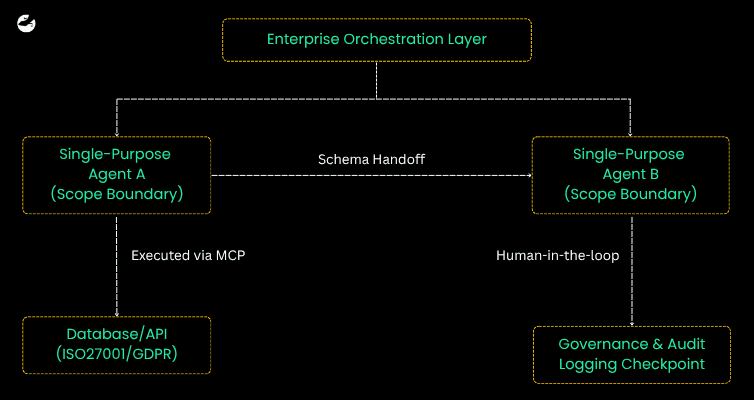
To prevent agents from entering endless execution loops or calling unnecessary APIs, we must apply traditional software engineering rigor to agentic systems. We structure autonomous networks around strict single-responsibility boundaries, explicit schemas, and standard interfaces.
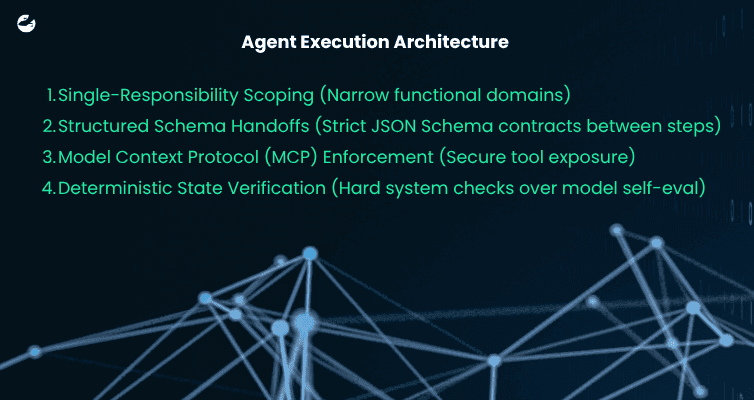
1. Enforce Single-Responsibility Agent Scoping
We limit each agent to a singular, isolated function within the enterprise pipeline. Rather than building a massive, all-knowing agent, we deploy focused micro-agents dedicated exclusively to individual tasks like database queries, data extraction, or format validation.
2. Standardize Handoffs with Structured Schemas
Natural language is an unreliable medium for inter-agent communication. We mandate that agents exchange data using strict JSON Schemas, ensuring that output parameters are explicitly validated before triggering subsequent steps in the pipeline.
3. Implement Model Context Protocol (MCP) Integrations
To manage how agents interact with internal APIs and databases, we utilize Model Context Protocol (MCP) standards. This abstracts tool execution, enforces authorization boundaries, and stops agents from taking unapproved, out-of-scope system actions.
4. Replace Model Self-Evaluation with Systemic Checks
Agents should never validate their own success. We implement deterministic system assertions outside the model environment to verify that an agent's output satisfies hard business logic before state changes commit to production.
How Can Enterprise Data Governance Prevent Unsanctioned Agent Actions?
Enterprise AI adoption hinges entirely on security, data privacy, and compliance. Allowing autonomous agents to access production databases without native guardrails introduces immense regulatory risk under frameworks such as GDPR and ISO 27001 standards.
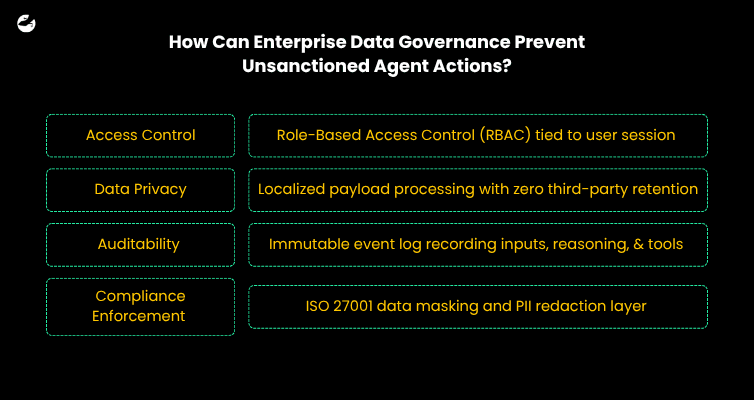
We integrate strict Role-Based Access Control (RBAC) directly into the agent orchestration layer. Every tool execution request must pass through an authentication gate that verifies user permissions, preventing escalation of privilege. Additionally, we enforce immutable audit logging across every model step, capturing the prompt input, agent reasoning, tool payloads, and system responses for complete enterprise traceability.
How Did We Architect Scalable Enterprise AI at Lizard Global?
At Lizard Global, we transition companies away from fragile AI pilots and toward enterprise-grade, deterministic software ecosystems. We leverage our expertise across mobile app development, cloud architecture, and strategic digital transformation to integrate autonomous AI directly into complex business operations.
For instance, when building multi-agent workflows for enterprise partners in the Netherlands and across global markets, we introduced strict architectural boundaries to handle live operational demands:
- Real-Time Operational Support: We engineered decision-support pipelines for call centers in Rotterdam, utilizing multi-agent orchestrations that fetch customer data, analyze intent, and present next best actions to live human agents without latency.
- Automated Data Consolidation: We built unified cross-platform financial dashboards and automated CRM audit engines. By substituting loose prompting with structured schema handoffs and MCP integration, we eliminated data hallucinations and secured cross-system synchronizations.
- Domain-Specific Workflows: Across custom applications such as Travereel (social media and AI itinerary booking integration), WAPA for Vanbreda (real-time data visibility in fintech), and Aposto (educational data insights), we embedded AI modules into existing product architectures without compromising performance or data safety.
- Human-in-the-Loop Checkpoints: In all our deployments, high-risk actions, such as financial updates or external communications, require explicit approval through hard-coded administrative interfaces before execution. By combining our deep experience in Agile Scrum, UI/UX product design, and cloud engineering, we ensure that AI integrations serve as robust, long-term business drivers rather than fragile software experiments.
How Do You Transition from Fragile AI Experiments to Production-Ready Architecture?
Moving from an experimental prototype to a production-grade agentic system requires a complete shift in technical strategy. Enterprise organizations must stop treating AI as an isolated, magical feature and begin treating it as an interconnected software component.
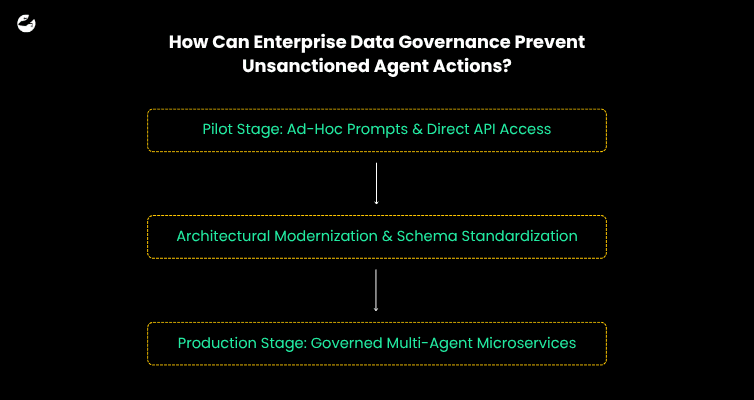
We work alongside internal enterprise teams to audit existing tech stacks, identify architectural bottlenecks, and implement centralized orchestration frameworks. We establish clear boundaries around model behavior, design responsive administrative control panels, and build native data pipelines that scale reliably as traffic increases. When enterprise software is designed with structural clarity, continuous deployments become predictable, secure, and highly efficient.
Ready to Build Scalable, Enterprise-Grade AI Systems?
Avoid the trap of architectural bloat and fragile AI deployments. At Lizard Global, we help enterprise leaders design, engineer, and scale secure, agentic AI workflows and custom software solutions tailored to their exact business needs.

Contact our technical experts
today to schedule a digital transformation workshop and modernize your software ecosystem.
FAQs

What is the Winchester Mystery House trap in AI deployments?
How do structured schema handoffs prevent multi-agent system failures?
What role does the Model Context Protocol (MCP) play in agent governance?
How does Lizard Global ensure enterprise compliance in agentic deployments?
Why are human-in-the-loop checkpoints critical for enterprise AI workflows?
How do multi-agent architectures differ from traditional rule-based automation systems?
How can enterprise organizations modernize legacy software for agentic AI integration?

Stuck between a great idea and the right team to build it?Let's talk.
We work with corporate innovation teams and ambitious scale-ups across the Netherlands, Singapore, and Australia, and wherever great software needs to be built. Drop us a message and we'll get back to you within one business day.


Markus Monnikendam
Global Commercial Director
hello@lizard.global