Platform Engineering vs Outsourcing: Choosing a Sustainable Enterprise Delivery Model

25 Feb 2026
by Team Lizard Global
Editor: Nadiy, Senior Content Writer
25 Feb 2026
by Team Lizard Global
Editor: Nadiy, Senior Content Writer
Platform Engineering vs Outsourcing: Choosing a Sustainable Enterprise Delivery Model
Table of contents
Contact us
We will get back to you in the next 48 hours.

Enterprise leaders constantly face a critical question: should we build internal platform engineering capabilities or outsource to a custom software development company? The decision impacts scalability, innovation speed, long-term operating costs, and digital maturity. In this in-depth guide, we explore the strategic trade-offs between platform engineering and outsourcing. We analyze cost structures, risk management, speed to market, governance, and long-term sustainability. Using real portfolio examples across fintech, e-commerce, HR, education, and real estate, we show how enterprises successfully design delivery models that balance internal ownership with external expertise. Whether you are seeking a digital transformation partner, mobile app development agency, or full-stack digital solutions agency, this article will help you determine which model aligns with your enterprise ambitions.
key takeaways
Enterprise digital initiatives rarely fail because of technology alone. Instead, they fail due to delivery model misalignment. When organizations choose the wrong structure—whether fully outsourced or fully internal—they create friction, inflate long-term costs, and slow innovation.
Today, enterprise leaders must evaluate whether to build internal platform engineering teams or partner with a custom software development company that provides web app development services, UI/UX design services, and digital consultancy services. The stakes are high. Your decision determines scalability, knowledge retention, security posture, and operational resilience.
Let’s unpack both models in detail—and more importantly, explore how sustainable enterprises combine them strategically.
What Is Platform Engineering in an Enterprise Context?
Platform engineering refers to building internal teams responsible for creating reusable infrastructure, development frameworks, DevOps pipelines, and shared services that accelerate product delivery across business units.
Instead of reinventing the wheel for every initiative, platform engineering teams create internal platforms that standardize:
- CI/CD pipelines
- Cloud infrastructure
- Security governance
- API frameworks
- CRM integration services
- Analytics tooling
As a result, product teams can focus on building features rather than managing infrastructure.
However, building this capability requires significant upfront investment. You must hire experienced engineers, DevOps specialists, UX/UI product design experts, and data analysts. Moreover, internal platform maturity can take years to develop.
For enterprises undergoing rapid digital transformation, this timeline may conflict with market pressure.
What Does Outsourcing to a Custom Software Development Company Involve?
Outsourcing shifts delivery responsibility to an external custom software development company or mobile app development agency. These partners provide full-stack digital solutions agency capabilities, including:
- iOS app development
- Android app development
- Hybrid app development
- Progressive web app development
- UI/UX design services
- Growth analytics consulting
- Digital marketing strategy services
Instead of building infrastructure internally, enterprises leverage pre-existing expertise.
For example, when Heineken Malaysia launched Drinkies, the on-demand food and beverage platform required mobile app development, GPS tracking, secure payments, and loyalty integration. Rather than building everything internally, they collaborated with Lizard Global on a scalable solution that included loyalty & rewards functionality, secure payment systems, and real-time tracking.
This approach accelerated time to market and reduced early-stage risk.
However, outsourcing without governance can create dependency. If knowledge transfer is weak, organizations risk vendor lock-in. Therefore, outsourcing must be strategic—not transactional.
Real-World Delivery Models in Action: Lizard Global Business Cases
Let’s explore how different enterprises approached this decision.
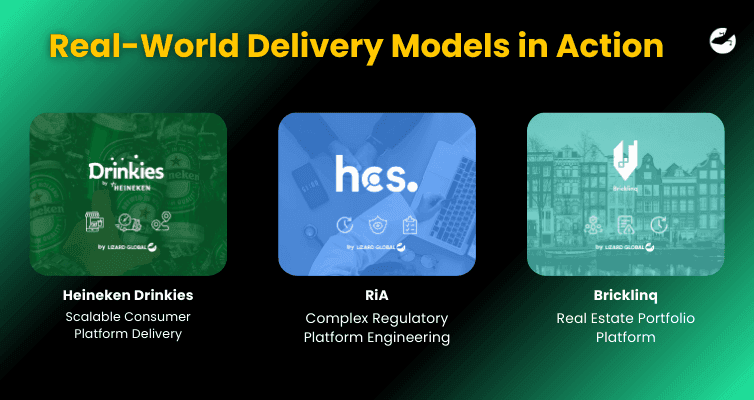
1. Heineken – Scalable Consumer Platform Delivery
The Drinkies platform required:
- On-demand ordering
- Secure online payments
- GPS-based availability
- Loyalty & rewards integration
A mobile-first experience demanded strong iOS app development and Android app development capabilities, alongside seamless CRM integration services for customer data.
The success came from combining external development velocity with structured governance. Over time, loyalty features such as “Star Bars” were expanded, demonstrating scalable architecture rather than a one-off app build.
This reflects a hybrid delivery model—external acceleration with long-term scalability planning.
2. RiA – Complex Regulatory Platform Engineering
The RiA risk analytics platform in the HR (Human Resource) domain required deep compliance alignment, complex questionnaires, and structured analytics.
This was not simply an app. It required:
- Custom risk analytics engines
- Data science integration
- Regulatory compliance workflows
- Structured UX/UI product design
In this scenario, domain complexity required deep digital consultancy services and iterative MVP delivery. The system reduced risk analysis time from six hours to ninety minutes—proving that strong architecture decisions directly influence operational efficiency.
This case shows that sustainable outsourcing resembles platform thinking—building reusable, scalable systems rather than quick fixes.
3. Bricklinq – Real Estate Portfolio Platform
The Bricklinq platform required a scalable property management solution offering real-time portfolio valuation and tenant management.
Instead of building internal infrastructure from scratch, they leveraged web app development services combined with growth consultancy and lean analytics. The result was a digital platform supporting property owners with centralized oversight.
This model demonstrates how outsourcing can accelerate domain innovation while preserving scalability.
4. RE2 International Computer School – AI-Driven Education Platform
RE2 required an AI-powered grading system to reduce administrative burden and deliver personalized feedback.
The project began with strategic workshops and roadmap definition. It then evolved into a scalable web platform capable of AI-assisted grading, analytics dashboards, and long-term product expansion.
This reflects how a digital transformation partner can co-create platform architecture aligned with future scalability rather than short-term execution.
Platform Engineering vs Outsourcing: Strategic Trade-Offs
Now, let’s compare both models directly.
1. Speed to Market
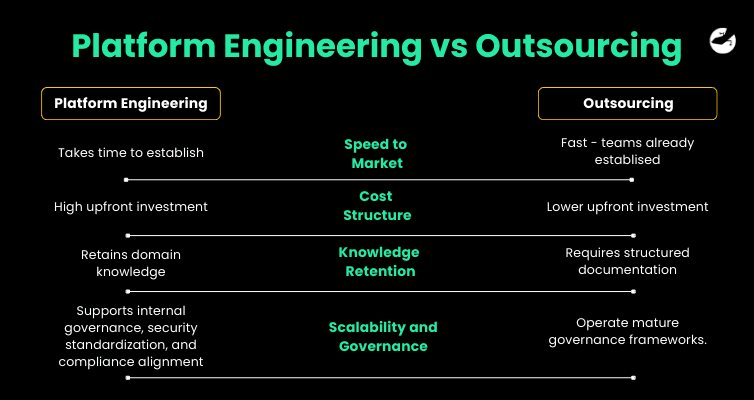
Outsourcing typically wins in early speed. A mobile app development agency already has the tooling, DevOps frameworks, and specialized talent.
Platform engineering takes longer to establish. Hiring, onboarding, and internal alignment can delay initial releases.
However, once mature, platform engineering accelerates internal product launches significantly.
2. Cost Structure: Upfront vs Long-Term
Platform engineering demands high upfront investment:
- Hiring senior engineers
- Cloud architecture
- Internal DevOps pipelines
Outsourcing shifts costs to project-based or retainer-based structures. This reduces upfront investment but may increase recurring external spend.
Sustainable enterprises evaluate total cost of ownership (TCO), not just project costs.
3. Knowledge Retention
Internal platform engineering retains domain knowledge. This reduces dependency and increases institutional learning.
Outsourcing requires structured documentation, co-development practices, and knowledge transfer to prevent long-term lock-in.
The best digital consultancy services focus on capability transfer—not dependency creation.
4. Scalability and Governance
Platform engineering supports internal governance, security standardization, and compliance alignment.
However, experienced full-stack digital solutions agencies already operate mature governance frameworks.
For highly regulated industries like fintech or HR compliance, hybrid governance models often perform best.
The Hybrid Model: The Sustainable Enterprise Approach
Increasingly, enterprises adopt hybrid delivery models:
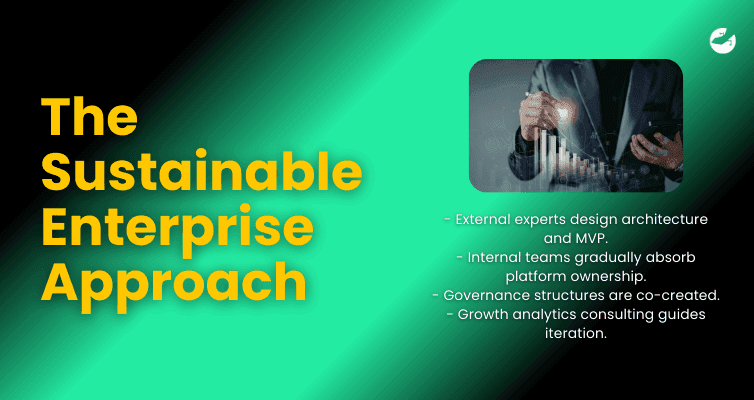
- External experts design architecture and MVP.
- Internal teams gradually absorb platform ownership.
- Governance structures are co-created.
- Growth analytics consulting guides iteration.
This model reduces risk while building long-term capability.
For example, fintech platforms like GWAP and Viropay required secure transaction management and API integrations. Early-stage acceleration came from specialized expertise. Over time, platform maturity allowed internal scaling.
Hybrid models combine:
- Strategic digital consultancy services
- UI/UX design services
- Custom software development company execution
- Internal platform ownership
This ensures both speed and sustainability.
When Should Enterprises Choose Platform Engineering?
Choose platform engineering if:
- You operate multiple digital products across business units.
- You require strict regulatory compliance governance.
- You prioritize long-term internal capability building.
- You plan continuous innovation over a 5–10 year horizon.
Large-scale organizations with recurring product launches benefit most from internalized infrastructure.
When Should Enterprises Choose Outsourcing?
Choose outsourcing if:
- You need rapid MVP validation.
- You lack internal technical leadership.
- Your organization is in early-stage digital transformation.
- You require specialized capabilities like progressive web app development or hybrid app development.
Outsourcing works especially well for innovation units, new market entry, or pilot programs.
Transform Your Enterprise Delivery Model with the Right Digital Partner
Digital transformation is not just about technology—it’s about choosing the right delivery model.
If your enterprise is evaluating platform engineering, outsourcing, or a hybrid structure, speak with a digital transformation partner that understands scalability, governance, and growth.
Let’s design a sustainable enterprise delivery model tailored to your long-term ambitions - let’s start the conversation today.
Enterprise leaders constantly face a critical question: should we build internal platform engineering capabilities or outsource to a custom software development company? The decision impacts scalability, innovation speed, long-term operating costs, and digital maturity. In this in-depth guide, we explore the strategic trade-offs between platform engineering and outsourcing. We analyze cost structures, risk management, speed to market, governance, and long-term sustainability. Using real portfolio examples across fintech, e-commerce, HR, education, and real estate, we show how enterprises successfully design delivery models that balance internal ownership with external expertise. Whether you are seeking a digital transformation partner, mobile app development agency, or full-stack digital solutions agency, this article will help you determine which model aligns with your enterprise ambitions.
Enterprise digital initiatives rarely fail because of technology alone. Instead, they fail due to delivery model misalignment. When organizations choose the wrong structure—whether fully outsourced or fully internal—they create friction, inflate long-term costs, and slow innovation.
Today, enterprise leaders must evaluate whether to build internal platform engineering teams or partner with a custom software development company that provides web app development services, UI/UX design services, and digital consultancy services. The stakes are high. Your decision determines scalability, knowledge retention, security posture, and operational resilience.
Let’s unpack both models in detail—and more importantly, explore how sustainable enterprises combine them strategically.
What Is Platform Engineering in an Enterprise Context?
Platform engineering refers to building internal teams responsible for creating reusable infrastructure, development frameworks, DevOps pipelines, and shared services that accelerate product delivery across business units.
Instead of reinventing the wheel for every initiative, platform engineering teams create internal platforms that standardize:
- CI/CD pipelines
- Cloud infrastructure
- Security governance
- API frameworks
- CRM integration services
- Analytics tooling
As a result, product teams can focus on building features rather than managing infrastructure.
However, building this capability requires significant upfront investment. You must hire experienced engineers, DevOps specialists, UX/UI product design experts, and data analysts. Moreover, internal platform maturity can take years to develop.
For enterprises undergoing rapid digital transformation, this timeline may conflict with market pressure.
What Does Outsourcing to a Custom Software Development Company Involve?
Outsourcing shifts delivery responsibility to an external custom software development company or mobile app development agency. These partners provide full-stack digital solutions agency capabilities, including:
- iOS app development
- Android app development
- Hybrid app development
- Progressive web app development
- UI/UX design services
- Growth analytics consulting
- Digital marketing strategy services
Instead of building infrastructure internally, enterprises leverage pre-existing expertise.
For example, when Heineken Malaysia launched Drinkies, the on-demand food and beverage platform required mobile app development, GPS tracking, secure payments, and loyalty integration. Rather than building everything internally, they collaborated with Lizard Global on a scalable solution that included loyalty & rewards functionality, secure payment systems, and real-time tracking.
This approach accelerated time to market and reduced early-stage risk.
However, outsourcing without governance can create dependency. If knowledge transfer is weak, organizations risk vendor lock-in. Therefore, outsourcing must be strategic—not transactional.
Real-World Delivery Models in Action: Lizard Global Business Cases
Let’s explore how different enterprises approached this decision.
1. Heineken – Scalable Consumer Platform Delivery
The Drinkies platform required:
- On-demand ordering
- Secure online payments
- GPS-based availability
- Loyalty & rewards integration
A mobile-first experience demanded strong iOS app development and Android app development capabilities, alongside seamless CRM integration services for customer data.
The success came from combining external development velocity with structured governance. Over time, loyalty features such as “Star Bars” were expanded, demonstrating scalable architecture rather than a one-off app build.
This reflects a hybrid delivery model—external acceleration with long-term scalability planning.
2. RiA – Complex Regulatory Platform Engineering
The RiA risk analytics platform in the HR (Human Resource) domain required deep compliance alignment, complex questionnaires, and structured analytics.
This was not simply an app. It required:
- Custom risk analytics engines
- Data science integration
- Regulatory compliance workflows
- Structured UX/UI product design
In this scenario, domain complexity required deep digital consultancy services and iterative MVP delivery. The system reduced risk analysis time from six hours to ninety minutes—proving that strong architecture decisions directly influence operational efficiency.
This case shows that sustainable outsourcing resembles platform thinking—building reusable, scalable systems rather than quick fixes.
3. Bricklinq – Real Estate Portfolio Platform
The Bricklinq platform required a scalable property management solution offering real-time portfolio valuation and tenant management.
Instead of building internal infrastructure from scratch, they leveraged web app development services combined with growth consultancy and lean analytics. The result was a digital platform supporting property owners with centralized oversight.
This model demonstrates how outsourcing can accelerate domain innovation while preserving scalability.
4. RE2 International Computer School – AI-Driven Education Platform
RE2 required an AI-powered grading system to reduce administrative burden and deliver personalized feedback.
The project began with strategic workshops and roadmap definition. It then evolved into a scalable web platform capable of AI-assisted grading, analytics dashboards, and long-term product expansion.
This reflects how a digital transformation partner can co-create platform architecture aligned with future scalability rather than short-term execution.
Platform Engineering vs Outsourcing: Strategic Trade-Offs
Now, let’s compare both models directly.
1. Speed to Market
Outsourcing typically wins in early speed. A mobile app development agency already has the tooling, DevOps frameworks, and specialized talent.
Platform engineering takes longer to establish. Hiring, onboarding, and internal alignment can delay initial releases.
However, once mature, platform engineering accelerates internal product launches significantly.
2. Cost Structure: Upfront vs Long-Term
Platform engineering demands high upfront investment:
- Hiring senior engineers
- Cloud architecture
- Internal DevOps pipelines
Outsourcing shifts costs to project-based or retainer-based structures. This reduces upfront investment but may increase recurring external spend.
Sustainable enterprises evaluate total cost of ownership (TCO), not just project costs.
3. Knowledge Retention
Internal platform engineering retains domain knowledge. This reduces dependency and increases institutional learning.
Outsourcing requires structured documentation, co-development practices, and knowledge transfer to prevent long-term lock-in.
The best digital consultancy services focus on capability transfer—not dependency creation.
4. Scalability and Governance
Platform engineering supports internal governance, security standardization, and compliance alignment.
However, experienced full-stack digital solutions agencies already operate mature governance frameworks.
For highly regulated industries like fintech or HR compliance, hybrid governance models often perform best.
The Hybrid Model: The Sustainable Enterprise Approach
Increasingly, enterprises adopt hybrid delivery models:
- External experts design architecture and MVP.
- Internal teams gradually absorb platform ownership.
- Governance structures are co-created.
- Growth analytics consulting guides iteration.
This model reduces risk while building long-term capability.
For example, fintech platforms like GWAP and Viropay required secure transaction management and API integrations. Early-stage acceleration came from specialized expertise. Over time, platform maturity allowed internal scaling.
Hybrid models combine:
- Strategic digital consultancy services
- UI/UX design services
- Custom software development company execution
- Internal platform ownership
This ensures both speed and sustainability.
When Should Enterprises Choose Platform Engineering?
Choose platform engineering if:
- You operate multiple digital products across business units.
- You require strict regulatory compliance governance.
- You prioritize long-term internal capability building.
- You plan continuous innovation over a 5–10 year horizon.
Large-scale organizations with recurring product launches benefit most from internalized infrastructure.
When Should Enterprises Choose Outsourcing?
Choose outsourcing if:
- You need rapid MVP validation.
- You lack internal technical leadership.
- Your organization is in early-stage digital transformation.
- You require specialized capabilities like progressive web app development or hybrid app development.
Outsourcing works especially well for innovation units, new market entry, or pilot programs.
Transform Your Enterprise Delivery Model with the Right Digital Partner
Digital transformation is not just about technology—it’s about choosing the right delivery model.
If your enterprise is evaluating platform engineering, outsourcing, or a hybrid structure, speak with a digital transformation partner that understands scalability, governance, and growth.
Let’s design a sustainable enterprise delivery model tailored to your long-term ambitions - let’s start the conversation today.
FAQs

What is the difference between platform engineering and outsourcing software development?
Is outsourcing to a custom software development company more cost-effective than building an internal platform team?
When should enterprises invest in platform engineering instead of using a mobile app development agency?
Can a hybrid model combine platform engineering and outsourcing effectively?
How does UI/UX design influence platform engineering and outsourcing success?
What risks should enterprises consider when outsourcing digital transformation initiatives?
How do platform engineering and outsourcing impact long-term digital transformation strategy?
similar reads

Case Studies & Interviews
Lereng Tanah: Developing a Direct Booking Platform Malaysian Boutique Villa
29 January 2026

Case Studies & Interviews
Tactlink: How a Malaysian Entrepreneur Turned Networking Chaos into a Digital Community
22 January 2026

Software Development
Who Are the Top Software Development Vendors in Amsterdam for 2026?
26 August 2026
Stuck between a great idea and the right team to build it?Let's talk.
We work with corporate innovation teams and ambitious scale-ups across the Netherlands, Singapore, and Australia, and wherever great software needs to be built. Drop us a message and we'll get back to you within one business day.


Markus Monnikendam
Global Commercial Director
hello@lizard.global