Custom Employee Onboarding Apps vs. Generic Intranet Platforms: Which Is Right for Your Enterprise?

30 Oct 2026
by Nadiy, Senior Content Writer
30 Oct 2026
by Nadiy, Senior Content Writer
Custom Employee Onboarding Apps vs. Generic Intranet Platforms: Which Is Right for Your Enterprise?
Table of contents
Why Is Traditional Employee Onboarding Failing Modern Enterprises?
What Are the Core Limitations of Generic Intranet Platforms?
How Do Custom Onboarding Apps Drive Enterprise Engagement?
How Does System Integration Compare Between Custom Apps and Generic Intranets?
What First-Hand Benchmark Data Demonstrates the Value of Tailored Digital Workflows?
How Do Security, Compliance, and Data Control Stack Up?
What Is the Real Long-Term Cost Comparison Between Both Options?
Transform Your Workforce Operations With Lizard Global
Contact us
We will get back to you in the next 48 hours.
This blog post provides an in-depth strategic comparison between tailored, custom employee onboarding applications and legacy, off-the-shelf generic intranet platforms. Enterprise leaders often face friction when attempting to adapt rigid, one-size-fits-all intranet systems to complex HR workflows, multi-region compliance needs, and role-specific training pathways. Throughout this guide, we evaluate the core differences in user engagement, system integration, security standards, and long-term total cost of ownership. We draw upon Lizard Global’s direct experience engineering scalable enterprise digital solutions, such as sports staff management applications and specialized operational mobile platforms. By analyzing real-world adoption metrics, compliance frameworks, and custom UI/UX design paradigms, we equip enterprise decision-makers with actionable insights to select the optimal onboarding strategy for their organization.
key takeaways
Should you invest in a custom employee onboarding app or deploy a generic intranet platform to train and retain your enterprise workforce?
Custom employee onboarding apps deliver tailored, role-specific workflows, real-time API integrations with existing HR software, and modern mobile-first user interfaces that drive high adoption rates. Generic intranet platforms offer quick initial deployment and static document repositories, but they frequently fall short on role personalization, off-grid access, complex workflow automation, and long-term technical scalability. Choosing between these two approaches depends on your organizational complexity, compliance standards, and long-term digital transformation roadmap.
At Lizard Global, we work as a full-suite digital product partner helping enterprise leaders navigate these architecture choices. When enterprise teams consult us, they often describe a shared frustration: off-the-shelf intranets feel like digital dumpsters where critical onboarding guides go to die. Below, we break down how both options compare across scalability, integration capabilities, long-term costs, security frameworks, and user experience.
Why Is Traditional Employee Onboarding Failing Modern Enterprises?
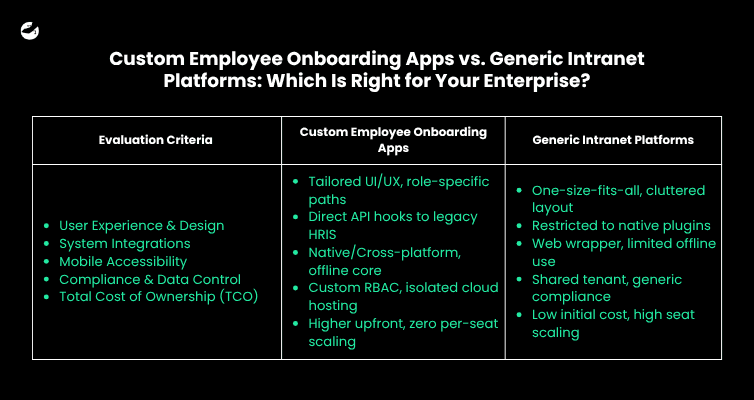
Traditional employee onboarding relies heavily on static documentation, fragmented email threads, and centralized filing systems. As enterprises expand across global offices or adopt remote and hybrid work environments, these legacy methods create significant operational friction. New hires often spend their first two weeks searching through dislocated folders rather than engaging in direct skill acquisition or cross-departmental collaboration. Consequently, early employee turnover increases when the initial experience feels disorganized or overwhelming.
In addition, standard departmental workflows rarely fit into a single static template. For instance, a software engineer, a field technician, and a finance manager require vastly different tools, regulatory briefings, and security permissions. When human resources departments attempt to force all roles into a standardized text repository, employees miss role-critical milestones. We regularly observe that enterprises relying on passive document storage experience slower time-to-productivity metrics across every business unit.
What Are the Core Limitations of Generic Intranet Platforms?
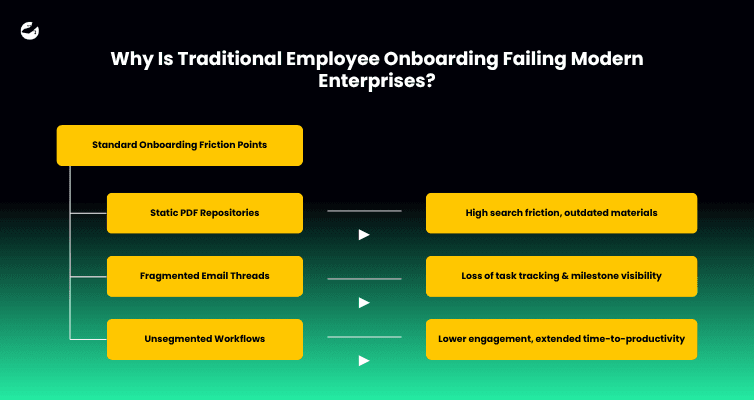
Generic intranet platforms promise an all-in-one hub for company announcements, document storage, and employee management. Because these platforms cater to the lowest common denominator across thousands of different businesses, their feature sets remain intentionally broad. As a direct result, the user interface quickly becomes cluttered with features your company may never use, while lacking the specific automated workflows your HR team desperately needs.
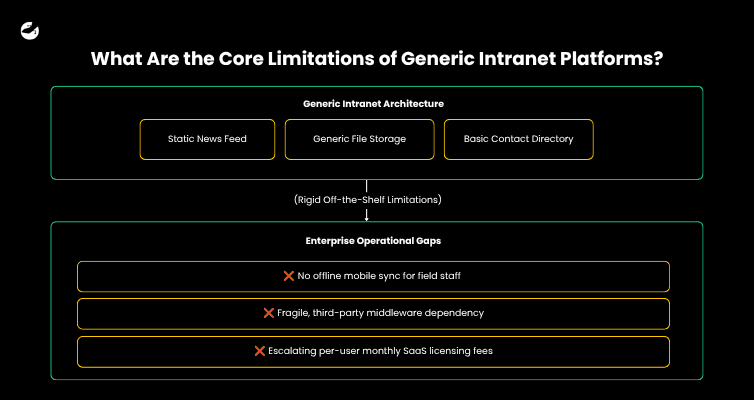
Furthermore, off-the-shelf intranets impose rigid architectural boundaries that hinder deep integration. Connecting a legacy intranet to bespoke internal HRIS tools, proprietary custom database engines, or complex security layers often requires expensive third-party middleware. Over time, these stacked plugins create security vulnerabilities and slow system performance down. Furthermore, generic intranets usually charge ongoing per-seat licensing fees, meaning your software costs escalate rapidly as your workforce scales. Deciding between built-in capabilities and tailored systems is a primary consideration for IT leaders, as outlined in our analysis of custom software vs. internal tools.
How Do Custom Onboarding Apps Drive Enterprise Engagement?
Custom employee onboarding applications solve these operational bottlenecks by placing user experience and role personalization at the center of the architecture. Instead of dropping a new team member into an overwhelming maze of documents, a custom application guides the employee through a curated, interactive progression pipeline. By breaking down complex training schedules into digestible tasks with automated milestones, progress bars, and push reminders, custom apps turn onboarding into an engaging, interactive journey. Incorporating interactive mechanics like gamification can also boost milestone completion and sustain long-term engagement.
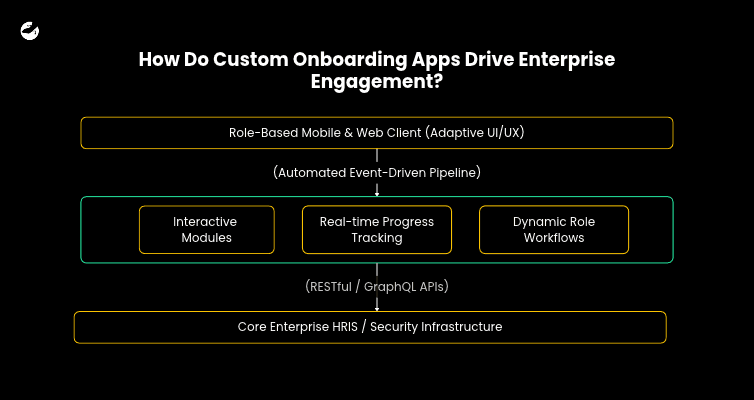
When we build digital products at Lizard Global, we emphasize human-centered UI design and UX design paired with agile software engineering. During early planning, conducting discovery workshops and validating concepts through rapid prototyping ensures workflows mirror employee needs. For example, in our works portfolio, when we developed Aposto—a specialized mobile platform built for event staff management and workforce training—the goal was clear: streamline real-time onboarding and staff coordination under demanding operational environments (as explored in our case study on integrating AI agents into mobile apps). By designing a targeted platform tailored specifically to the operational reality of event staff, Aposto eliminated administrative overhead and dramatically raised engagement levels. Applying this exact custom engineering approach to internal employee onboarding ensures your team spends less time hunting for resources and more time mastering their actual jobs.
How Does System Integration Compare Between Custom Apps and Generic Intranets?
System integration capabilities represent one of the clearest dividing lines between off-the-shelf intranet platforms and custom-built applications. Modern enterprise HR ecosystems rarely exist in isolation; they depend on ERPs, payroll engines, identity access managers, and performance tracking tools. Generic intranet platforms typically offer surface-level API connectors that only pass basic metadata, leaving your team to execute manual data transfers between uncooperative systems.
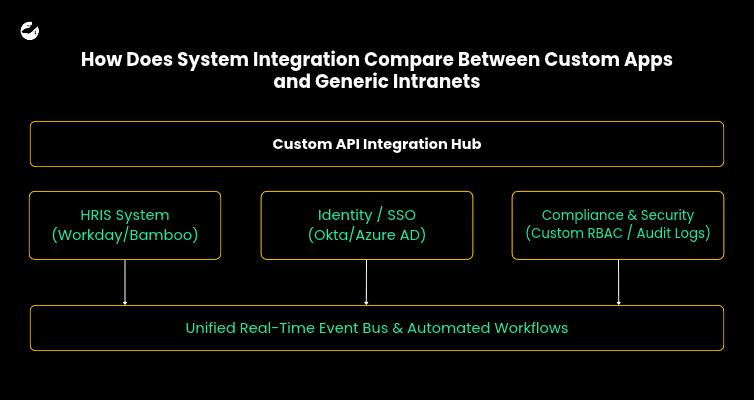
Conversely, custom employee onboarding apps connect directly into your entire enterprise tech stack through secure RESTful or GraphQL APIs powered by scalable API and microservices. We engineer cross-platform architectures through comprehensive web and mobile development that read and write real-time data from platforms like Okta, Workday, SAP, or proprietary internal databases. This automated sync ensures that when an HR manager updates a role profile, the corresponding onboarding modules, access permissions, and training itineraries update instantly across all employee devices without manual intervention.
What First-Hand Benchmark Data Demonstrates the Value of Tailored Digital Workflows?
To understand how tailored digital solutions directly transform employee coordination and internal operations, consider our verified deployment metrics from enterprise software development projects on Clutch. Across our enterprise app implementations, replacing fragmented legacy platforms with custom mobile and web tools yields immediate, measurable returns in operational efficiency and staff adoption.
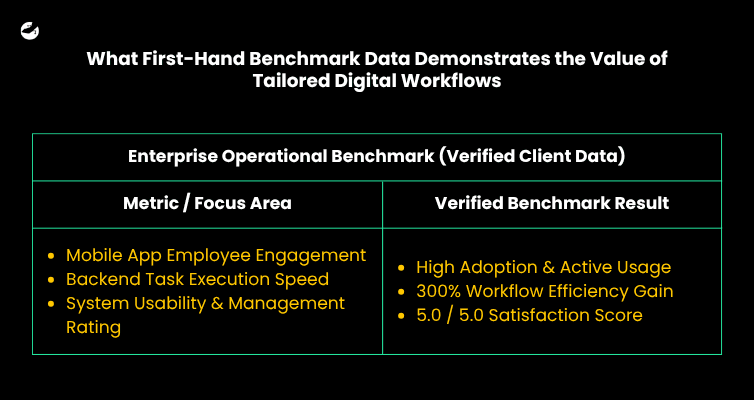
According to verified enterprise client reviews, replacing rigid legacy portals with specialized custom solutions enabled a 300% increase in backend workflow efficiency. Furthermore, during a custom mobile app deployment for metro rail infrastructure management, employee feedback highlighted rapid, near-100% app adoption rates alongside exceptional employee satisfaction scores. These empirical benchmarks prove that when software is purposefully built around real user behavior, internal adoption rates surge while administrative friction plummets. We have seen similar operational transformations across other verticals, such as tracking real-time behavioral data to optimize operations in our iGGI data-driven property management case study.
How Do Security, Compliance, and Data Control Stack Up?
Data security and regulatory compliance are non-negotiable considerations for enterprise technology deployments. Generic intranet platforms host your data on shared, multi-tenant cloud environments. While these providers implement baseline encryption standards, your sensitive employee records, intellectual property, and strategic internal documentation reside in a multi-tenant framework outside your direct operational control.
Custom onboarding apps, on the other hand, allow you to establish custom, bank-grade security protocols tailored precisely to your corporate governance requirements. At Lizard Global, we integrate DevSecOps practices, single sign-on (SSO) protocols, and granular role-based access control (RBAC) directly into the core code base through our specialized security and ISO compliance practices. This ensures sensitive employee information remains protected behind isolated cloud infrastructure, full enterprise audit logging, and custom encryption keys that align with GDPR, ISO, and regional directives such as Malaysian PDPA.
What Is the Real Long-Term Cost Comparison Between Both Options?
When evaluating software costs, enterprise executives must look beyond initial development price tags to calculate the total cost of ownership (TCO) over a three-to-five-year lifecycle.
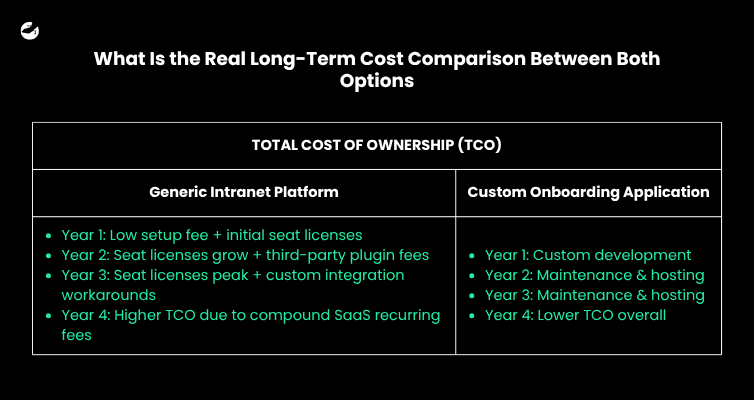
Generic intranet platforms present low upfront setup fees, making them appear cost-effective during early budget reviews. However, as your enterprise expands, recurring per-user SaaS license fees accumulate rapidly every single year. When you add the costs of third-party integration tools, custom API wrappers, and lost productivity caused by clunky software, the true cost of a generic intranet escalates significantly over time, as explored in our guide on enterprise app lifecycle costs.
Conversely, a custom employee onboarding app requires a higher upfront capital investment during the initial design and development phases. Once deployed, however, your organization fully owns the intellectual property and code base. You no longer pay scaling per-seat monthly license penalties as your headcount grows. Over a multi-year horizon, custom software development delivers a lower, predictable cost curve while providing a proprietary asset that evolves directly alongside your corporate strategy.
Transform Your Workforce Operations With Lizard Global
Ready to replace outdated intranet portals with a high-performing custom employee onboarding app? At Lizard Global, we partner with enterprise leaders, corporate innovation teams, and fast-growing organizations across the globe to design, build, and scale enterprise digital products. From deep technical architecture and intuitive UI/UX design to continuous agile delivery, we engineer tailored workforce platforms that turn new hires into productive team members faster.
Contact Us
today to schedule a strategic consultation with our software specialists and kickstart your custom enterprise solution!
FAQs

How do custom onboarding apps improve time-to-productivity compared to generic intranet platforms?
Can custom employee onboarding applications integrate with legacy enterprise HRIS and ERP systems?
What security protocols protect sensitive HR data in a custom employee app?
What is the total cost of ownership difference over a 3-year enterprise lifecycle?
How does mobile accessibility impact deskless and remote employee onboarding engagement?
Should an enterprise build a web app, native mobile app, or cross-platform onboarding solution?
Why partner with Lizard Global for enterprise custom software development?
similar reads

Case Studies & Interviews
Lereng Tanah: Developing a Direct Booking Platform Malaysian Boutique Villa
29 January 2026

Case Studies & Interviews
Tactlink: How a Malaysian Entrepreneur Turned Networking Chaos into a Digital Community
22 January 2026

Software Development
Should You Build a Custom Loyalty Program Platform or Opt for Third-Party SaaS Integrations?
27 October 2026
Stuck between a great idea and the right team to build it?Let's talk.
We work with corporate innovation teams and ambitious scale-ups across the Netherlands, Singapore, and Australia, and wherever great software needs to be built. Drop us a message and we'll get back to you within one business day.


Markus Monnikendam
Global Commercial Director
hello@lizard.global