How AI Agents are Revolutionizing Financial Trading Desks
08 Jun 2026
by Team Lizard Global
Editor: Nadiy, Senior Content Writer
08 Jun 2026
by Team Lizard Global
Editor: Nadiy, Senior Content Writer
How AI Agents are Revolutionizing Financial Trading Desks
Table of contents
Contact us
We will get back to you in the next 48 hours.
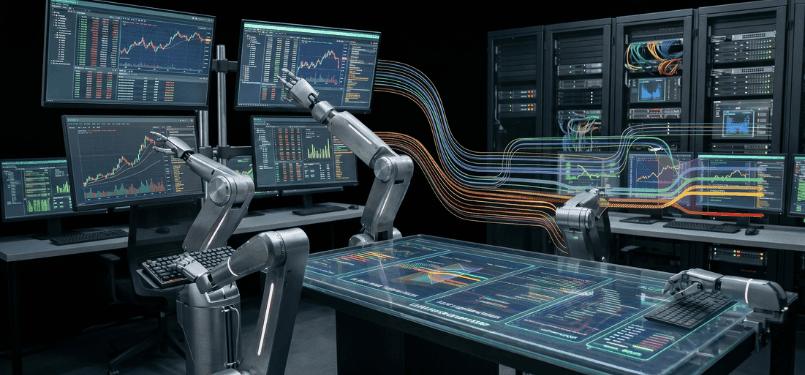
The financial sector stands on the brink of a monumental paradigm shift. For years, algorithmic trading relied heavily on rigid, rules-based logic to execute high-speed market transactions. However, the modern financial landscape requires a much deeper level of adaptability and continuous cognitive processing. Enter the era of Agentic AI for Enterprise. Rather than simply executing hard-coded instructions, these cognitive systems operate with reasoning capabilities, independent decision-making frameworks, and continuous learning loops. This comprehensive blog post explores how financial institutions leverage autonomous software systems to overhaul legacy infrastructure, navigate complex risk environments, and discover alpha in unpredictable global markets. We will break down the structural differences between traditional automation and agentic frameworks, analyze real-world trading floor applications, and discuss the technical governance frameworks required to keep these systems secure, compliant, and highly profitable.
key takeaways
The competitive environment of global financial trading desks has always been defined by velocity and precision. In the past, achieving an edge meant building faster execution plumbing or optimizing statistical arbitrage scripts. While legacy algorithmic trading systems excel at processing numbers at blistering speeds, they remain fundamentally brittle. They lack the context needed to adapt when unexpected geopolitical shifts, breaking news, or sudden liquidity drains disrupt historical patterns. Consequently, institutions often find themselves trapped in manual intervention loops when market volatility spikes.
To overcome these structural limitations, forward-thinking financial enterprises are rapidly deploying Agentic AI for Enterprise ecosystems. This evolution marks a distinct shift from simple data calculation to active digital reasoning. Autonomous AI Agents do not wait around for a software developer to explicitly code a new rule for every emerging market scenario. Instead, they digest extensive multi-modal inputs—ranging from real-time order book imbalances to sudden regulatory filings, and formulate execution strategies based on broad strategic parameters.
Implementing these sophisticated cognitive systems requires a deliberate structural overhaul. Financial institutions cannot simply drop an advanced AI model into an unoptimized legacy system and expect consistent, secure enterprise-level results. It requires deep technical alignment across internal networks, database layers, and application interfaces. This is exactly where a seasoned digital transformation partner like Lizard Global provides immense value. By building resilient system connections and secure, scalable data architecture, we empower trading firms to smoothly transition from old-school automated scripts to highly advanced, autonomous trading frameworks.
Our extensive background in building high-performance FinTech solutions allows us to design powerful ecosystems that handle complex matching and data environments, similar to our strategic work developing the ebol platform to optimize marketplace dynamics.
Breaking Down the Technical Architecture of Agentic Workflows
To truly understand this technological leap, it helps to contrast traditional quantitative software with modern, autonomous design patterns. The core differentiator lies in Deterministic vs. Agentic AI engineering styles. A deterministic trading algorithm operates like a complex series of "if-then" statements; it is highly predictable, but entirely incapable of creative problem-solving. Conversely, an agentic framework treats the AI as a proactive decision-maker capable of adjusting its own step-by-step logic through dynamic Agentic Workflows.
Within a live trading ecosystem, these advanced workflows divide broad strategic goals into highly specialized micro-tasks. For example, a primary portfolio management agent might decide to reduce exposure in a specific asset class. Instead of blindly executing a massive market sell order, it triggers a chain of subordinate digital workflows. One agent focuses entirely on analyzing real-time order book liquidity across different venues, while another watches social sentiment shifts and sudden financial news breaks. By communicating and working together in real time, these specialized modules discover the optimal execution paths automatically. Scaling these dynamic configurations requires deep cross-disciplinary software expertise.
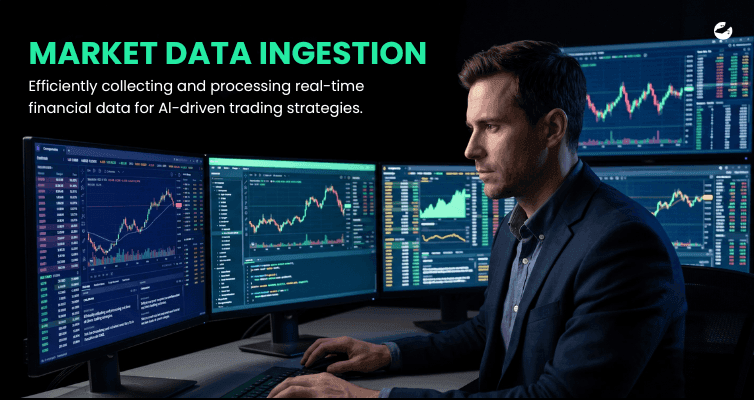
Designing multi-agent environments demands an exceptional command of API and microservices architecture, distributed system management, and real-time data streaming. Through our dedicated Full-stack development solutions agency, trading firms gain access to the precise engineering talent required to deploy these complex systems. We build the high-performance backends and low-latency infrastructure needed to keep multi-agent trading environments running flawlessly under heavy transaction loads, applying deep expertise similar to our work handling predictive environments like SkyEcho.
How Enterprise AI Orchestration Harmonizes Modern Trading Desks
On a fast-paced institutional trading floor, having isolated smart software applications is not enough; they must work together like a well-rehearsed orchestra. This level of synchronization demands comprehensive Enterprise AI Orchestration. An orchestration layer acts as the centralized nervous system for your digital workspace, managing data access, balancing computational workloads, and ensuring all active agents operate with a unified understanding of market risks and capital limits.
When implemented correctly, orchestration transforms raw computational power into highly organized AI Digital Labor. This digital workforce handles time-consuming, highly complex operational tasks that used to bog down human analysts for hours. For example, the system can automate continuous portfolio rebalancing, parse thousands of multi-language earnings reports in seconds, and cross-reference real-time transactions against historic volatility indexes. This dramatically cuts operational overhead while ensuring the desk never misses a fleeting market opportunity.
Building a powerful orchestration layer requires more than just clean backend code; it demands an intuitive user interface so human risk managers can easily monitor operations. Through our specialized UI design services and comprehensive UX design product workflows, we bridge the gap between complex machine reasoning and human decision-makers. We build clear, responsive trading dashboards that display agent activities, real-time risk calculations, and strategic performance metrics at a glance, keeping your human teams fully informed and in control, an approach we mastered when delivering advanced operational data panels for platforms like Van Eijck.
Establishing Rigorous Guardrails and Regulatory Compliance Frameworks
In the highly regulated world of institutional finance, deploying completely unconstrained autonomous software is a massive liability. The absolute speed and independence of agentic systems mean that an unchecked loop could execute catastrophic trades in a matter of milliseconds. Therefore, deploying institutional-grade agents requires the implementation of ironclad AI Guardrails. These guardrails act as programmatic boundaries, setting hard caps on maximum order sizes, restricting permitted asset classes, and enforcing strict risk exposure limits that the AI cannot override under any circumstances.
Beyond basic programmatic constraints, building a secure enterprise setup requires comprehensive Agentic Governance & Compliance systems. Because financial regulators demand total transparency, black-box AI models simply will not cut it on Wall Street or in global banking hubs. Trading platforms must integrate dedicated auditing pipelines that record every single step of the AI's reasoning process. If an agent executes an unusual trade at 2:00 AM, the compliance team must be able to pull up an explicit, step-by-step text log showing exactly what data points and internal logic caused that specific decision.
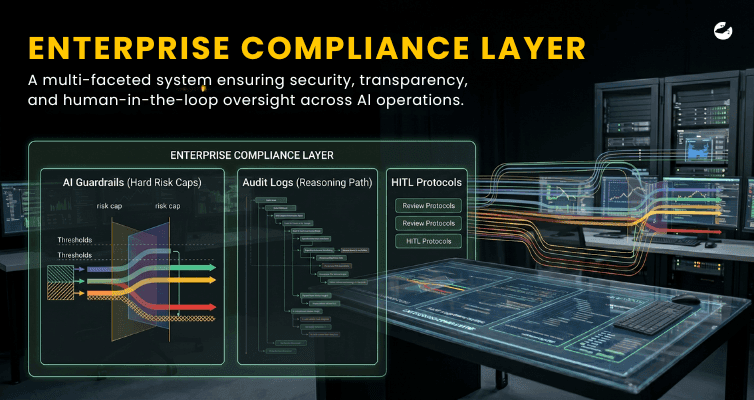
To maintain total safety, these corporate governance systems rely heavily on a structured Human-in-the-Loop (HITL) architecture. While agents are free to handle routine market analysis and everyday trade execution independently, high-stakes actions require explicit human sign-off.
At Lizard Global, our digital strategy and consultancy services help financial enterprises design these vital compliance frameworks. We meticulously map out your operational workflows to determine exactly when an agent can run autonomously and when it must pause to wait for human validation. This level of protective architecture is built directly on our experience with stringent regulatory frameworks, as seen in our Aposto case study.
Tailoring Full-Stack Technology Solutions for High-Performance Trading
Every financial institution operates on a unique blend of legacy software, proprietary data models, and specific asset focuses. Because of this, off-the-shelf AI tools rarely deliver a true competitive edge. To maximize your return on investment, your cognitive infrastructure must be custom-built to match your exact trading workflows. Choosing a specialized custom software development model over generic software packages ensures that your autonomous workflows plug directly into your proprietary data pipelines without creating major security vulnerabilities.
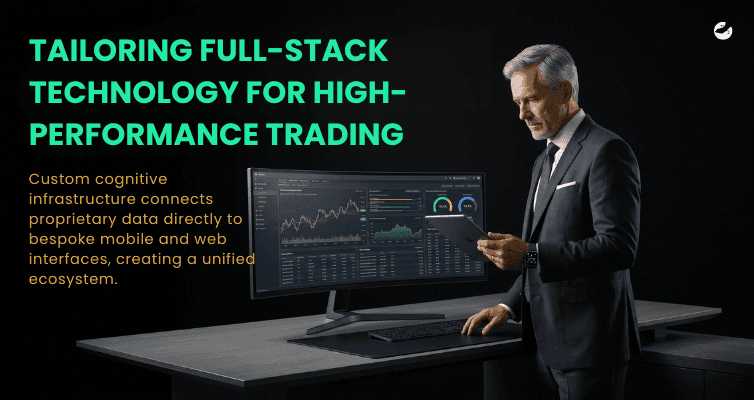
A modern trading desk also requires seamless access to these advanced systems across multiple platforms. Portfolio managers and senior partners cannot be chained to a desktop terminal all day; they need secure, real-time access to their automated systems while on the move. Partnering with an elite mobile development agency allows firms to extend their trading infrastructure safely to mobile devices. Having a dedicated mobile channel ensures your leadership team can monitor AI performance, adjust risk guardrails, and approve high-value transactions from anywhere in the world, matching the strict enterprise mobile scalability we achieved for IGGI.
Furthermore, these modern mobile and web interfaces must connect directly to your core business systems to be truly effective. This requires seamless integration and custom web development services to keep your customer management tools, investor reporting systems, and back-office clearing houses fully synced with your live AI trading desks. By building an interconnected, multi-platform ecosystem, you eliminate data silos and give your entire organization a single, real-time view of market performance.
Driving Long-Term Value and Growth with an Elite Tech Partner
Deploying autonomous systems to your trading desk is not a one-time software installation; it is a long-term strategic commitment. Because global financial markets are constantly evolving, an AI model that performs flawlessly today might struggle tomorrow as market liquidity shifts or new regulatory updates roll out. To stay ahead of the curve, firms need a continuous development process focused on scaling architecture, monitoring performance, and fine-tuning model logic over time.
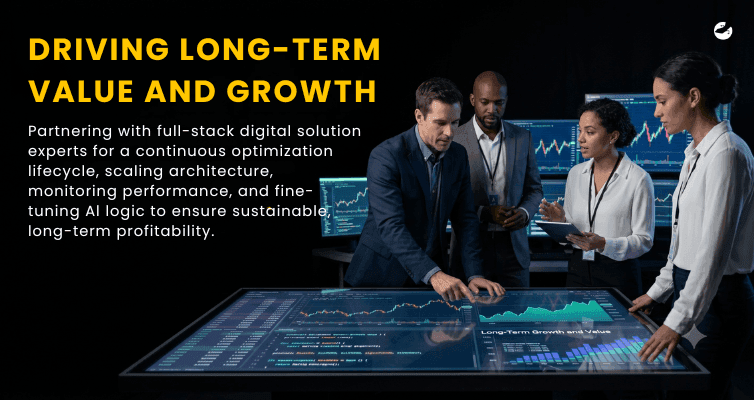
This need for continuous optimization is why leading financial firms look for an end-to-end full-stack partner rather than a basic software vendor. Long-term success requires a partner who can handle every stage of the lifecycle—from initial systems engineering to deep growth analytics consulting. By continuously analyzing your trading data and user engagement metrics, we help you spot operational bottlenecks early, optimize computational costs, and consistently refine your AI strategies to drive sustainable, long-term profitability, just as we did when driving ongoing retention metrics for Heineken's Drinkies.
At Lizard Global, we pride ourselves on being more than just an engineering resource; we are an invested digital growth partner. We combine top-tier software engineering with strategic business insight to ensure your technology investments deliver clear, measurable business results. As your business scales and markets shift, we update and evolve your digital ecosystems, ensuring your trading desks remain agile, compliant, and highly competitive in an AI-driven financial world.
Maximize Your Trading Edge with Lizard Global
Ready to revolutionize your trading operations? Transitioning from rigid algorithmic scripts to fully autonomous, enterprise-grade AI requires deep technical expertise, secure data architectures, and bulletproof compliance design.

As your trusted digital transformation partner, Lizard Global brings the exact cross-disciplinary engineering talent, advanced UI/UX design, and strategic consultancy your institution needs to build secure, scalable, and highly profitable trading environments.
Contact Lizard Global's Expert Team Todayto schedule an enterprise consultation and discover how our custom software solutions can future-proof your financial trading desks.
The financial sector stands on the brink of a monumental paradigm shift. For years, algorithmic trading relied heavily on rigid, rules-based logic to execute high-speed market transactions. However, the modern financial landscape requires a much deeper level of adaptability and continuous cognitive processing. Enter the era of Agentic AI for Enterprise. Rather than simply executing hard-coded instructions, these cognitive systems operate with reasoning capabilities, independent decision-making frameworks, and continuous learning loops. This comprehensive blog post explores how financial institutions leverage autonomous software systems to overhaul legacy infrastructure, navigate complex risk environments, and discover alpha in unpredictable global markets. We will break down the structural differences between traditional automation and agentic frameworks, analyze real-world trading floor applications, and discuss the technical governance frameworks required to keep these systems secure, compliant, and highly profitable.
The competitive environment of global financial trading desks has always been defined by velocity and precision. In the past, achieving an edge meant building faster execution plumbing or optimizing statistical arbitrage scripts. While legacy algorithmic trading systems excel at processing numbers at blistering speeds, they remain fundamentally brittle. They lack the context needed to adapt when unexpected geopolitical shifts, breaking news, or sudden liquidity drains disrupt historical patterns. Consequently, institutions often find themselves trapped in manual intervention loops when market volatility spikes.
To overcome these structural limitations, forward-thinking financial enterprises are rapidly deploying Agentic AI for Enterprise ecosystems. This evolution marks a distinct shift from simple data calculation to active digital reasoning. Autonomous AI Agents do not wait around for a software developer to explicitly code a new rule for every emerging market scenario. Instead, they digest extensive multi-modal inputs—ranging from real-time order book imbalances to sudden regulatory filings, and formulate execution strategies based on broad strategic parameters.
Implementing these sophisticated cognitive systems requires a deliberate structural overhaul. Financial institutions cannot simply drop an advanced AI model into an unoptimized legacy system and expect consistent, secure enterprise-level results. It requires deep technical alignment across internal networks, database layers, and application interfaces. This is exactly where a seasoned digital transformation partner like Lizard Global provides immense value. By building resilient system connections and secure, scalable data architecture, we empower trading firms to smoothly transition from old-school automated scripts to highly advanced, autonomous trading frameworks.
Our extensive background in building high-performance FinTech solutions allows us to design powerful ecosystems that handle complex matching and data environments, similar to our strategic work developing the ebol platform to optimize marketplace dynamics.
Breaking Down the Technical Architecture of Agentic Workflows
To truly understand this technological leap, it helps to contrast traditional quantitative software with modern, autonomous design patterns. The core differentiator lies in Deterministic vs. Agentic AI engineering styles. A deterministic trading algorithm operates like a complex series of "if-then" statements; it is highly predictable, but entirely incapable of creative problem-solving. Conversely, an agentic framework treats the AI as a proactive decision-maker capable of adjusting its own step-by-step logic through dynamic Agentic Workflows.
Within a live trading ecosystem, these advanced workflows divide broad strategic goals into highly specialized micro-tasks. For example, a primary portfolio management agent might decide to reduce exposure in a specific asset class. Instead of blindly executing a massive market sell order, it triggers a chain of subordinate digital workflows. One agent focuses entirely on analyzing real-time order book liquidity across different venues, while another watches social sentiment shifts and sudden financial news breaks. By communicating and working together in real time, these specialized modules discover the optimal execution paths automatically. Scaling these dynamic configurations requires deep cross-disciplinary software expertise.
Designing multi-agent environments demands an exceptional command of API and microservices architecture, distributed system management, and real-time data streaming. Through our dedicated Full-stack development solutions agency, trading firms gain access to the precise engineering talent required to deploy these complex systems. We build the high-performance backends and low-latency infrastructure needed to keep multi-agent trading environments running flawlessly under heavy transaction loads, applying deep expertise similar to our work handling predictive environments like SkyEcho.
How Enterprise AI Orchestration Harmonizes Modern Trading Desks
On a fast-paced institutional trading floor, having isolated smart software applications is not enough; they must work together like a well-rehearsed orchestra. This level of synchronization demands comprehensive Enterprise AI Orchestration. An orchestration layer acts as the centralized nervous system for your digital workspace, managing data access, balancing computational workloads, and ensuring all active agents operate with a unified understanding of market risks and capital limits.
When implemented correctly, orchestration transforms raw computational power into highly organized AI Digital Labor. This digital workforce handles time-consuming, highly complex operational tasks that used to bog down human analysts for hours. For example, the system can automate continuous portfolio rebalancing, parse thousands of multi-language earnings reports in seconds, and cross-reference real-time transactions against historic volatility indexes. This dramatically cuts operational overhead while ensuring the desk never misses a fleeting market opportunity.
Building a powerful orchestration layer requires more than just clean backend code; it demands an intuitive user interface so human risk managers can easily monitor operations. Through our specialized UI design services and comprehensive UX design product workflows, we bridge the gap between complex machine reasoning and human decision-makers. We build clear, responsive trading dashboards that display agent activities, real-time risk calculations, and strategic performance metrics at a glance, keeping your human teams fully informed and in control, an approach we mastered when delivering advanced operational data panels for platforms like Van Eijck.
Establishing Rigorous Guardrails and Regulatory Compliance Frameworks
In the highly regulated world of institutional finance, deploying completely unconstrained autonomous software is a massive liability. The absolute speed and independence of agentic systems mean that an unchecked loop could execute catastrophic trades in a matter of milliseconds. Therefore, deploying institutional-grade agents requires the implementation of ironclad AI Guardrails. These guardrails act as programmatic boundaries, setting hard caps on maximum order sizes, restricting permitted asset classes, and enforcing strict risk exposure limits that the AI cannot override under any circumstances.
Beyond basic programmatic constraints, building a secure enterprise setup requires comprehensive Agentic Governance & Compliance systems. Because financial regulators demand total transparency, black-box AI models simply will not cut it on Wall Street or in global banking hubs. Trading platforms must integrate dedicated auditing pipelines that record every single step of the AI's reasoning process. If an agent executes an unusual trade at 2:00 AM, the compliance team must be able to pull up an explicit, step-by-step text log showing exactly what data points and internal logic caused that specific decision.
To maintain total safety, these corporate governance systems rely heavily on a structured Human-in-the-Loop (HITL) architecture. While agents are free to handle routine market analysis and everyday trade execution independently, high-stakes actions require explicit human sign-off.
At Lizard Global, our digital strategy and consultancy services help financial enterprises design these vital compliance frameworks. We meticulously map out your operational workflows to determine exactly when an agent can run autonomously and when it must pause to wait for human validation. This level of protective architecture is built directly on our experience with stringent regulatory frameworks, as seen in our Aposto case study.
Tailoring Full-Stack Technology Solutions for High-Performance Trading
Every financial institution operates on a unique blend of legacy software, proprietary data models, and specific asset focuses. Because of this, off-the-shelf AI tools rarely deliver a true competitive edge. To maximize your return on investment, your cognitive infrastructure must be custom-built to match your exact trading workflows. Choosing a specialized custom software development model over generic software packages ensures that your autonomous workflows plug directly into your proprietary data pipelines without creating major security vulnerabilities.
A modern trading desk also requires seamless access to these advanced systems across multiple platforms. Portfolio managers and senior partners cannot be chained to a desktop terminal all day; they need secure, real-time access to their automated systems while on the move. Partnering with an elite mobile development agency allows firms to extend their trading infrastructure safely to mobile devices. Having a dedicated mobile channel ensures your leadership team can monitor AI performance, adjust risk guardrails, and approve high-value transactions from anywhere in the world, matching the strict enterprise mobile scalability we achieved for IGGI.
Furthermore, these modern mobile and web interfaces must connect directly to your core business systems to be truly effective. This requires seamless integration and custom web development services to keep your customer management tools, investor reporting systems, and back-office clearing houses fully synced with your live AI trading desks. By building an interconnected, multi-platform ecosystem, you eliminate data silos and give your entire organization a single, real-time view of market performance.
Driving Long-Term Value and Growth with an Elite Tech Partner
Deploying autonomous systems to your trading desk is not a one-time software installation; it is a long-term strategic commitment. Because global financial markets are constantly evolving, an AI model that performs flawlessly today might struggle tomorrow as market liquidity shifts or new regulatory updates roll out. To stay ahead of the curve, firms need a continuous development process focused on scaling architecture, monitoring performance, and fine-tuning model logic over time.
This need for continuous optimization is why leading financial firms look for an end-to-end full-stack partner rather than a basic software vendor. Long-term success requires a partner who can handle every stage of the lifecycle—from initial systems engineering to deep growth analytics consulting. By continuously analyzing your trading data and user engagement metrics, we help you spot operational bottlenecks early, optimize computational costs, and consistently refine your AI strategies to drive sustainable, long-term profitability, just as we did when driving ongoing retention metrics for Heineken's Drinkies.
At Lizard Global, we pride ourselves on being more than just an engineering resource; we are an invested digital growth partner. We combine top-tier software engineering with strategic business insight to ensure your technology investments deliver clear, measurable business results. As your business scales and markets shift, we update and evolve your digital ecosystems, ensuring your trading desks remain agile, compliant, and highly competitive in an AI-driven financial world.
Maximize Your Trading Edge with Lizard Global
Ready to revolutionize your trading operations? Transitioning from rigid algorithmic scripts to fully autonomous, enterprise-grade AI requires deep technical expertise, secure data architectures, and bulletproof compliance design.
As your trusted digital transformation partner, Lizard Global brings the exact cross-disciplinary engineering talent, advanced UI/UX design, and strategic consultancy your institution needs to build secure, scalable, and highly profitable trading environments.
Contact Lizard Global's Expert Team Todayto schedule an enterprise consultation and discover how our custom software solutions can future-proof your financial trading desks.
FAQs

How does Agentic AI differ from traditional algorithmic trading systems?
What role does a digital transformation partner play in deploying trading AI?
Why is Enterprise AI Orchestration necessary for institutional financial trading?
How do AI Guardrails protect trading desks from catastrophic market losses?
What is the value of Human-in-the-Loop (HITL) protocols in autonomous trading?
Why should trading platforms invest in custom software development over off-the-shelf tools?
How do AI Observability and Audit Logs assist with financial regulatory compliance?
similar reads

Case Studies & Interviews
Integrating Autonomous AI Agents into Enterprise Mobile Applications An Architectural Blueprint
7 July 2026

AI & Machine Learning
How AI Agents are Revolutionizing Financial Trading Desks
4 June 2026

AI & Machine Learning
Beyond the Prompt: How AI Agents are Turning Workers into Strategic Decision Makers
28 April 2026
Stuck between a great idea and the right team to build it?Let's talk.
We work with corporate innovation teams and ambitious scale-ups across the Netherlands, Singapore, and Australia, and wherever great software needs to be built. Drop us a message and we'll get back to you within one business day.


Markus Monnikendam
Global Commercial Director
hello@lizard.global