Beyond the Prompt: How AI Agents are Turning Workers into Strategic Decision Makers

28 Apr 2026
by Nadiy, Senior Content Writer
Guido, Co-Founder & CTO
28 Apr 2026
by Nadiy, Senior Content Writer
Guido, Co-Founder & CTO
Beyond the Prompt: How AI Agents are Turning Workers into Strategic Decision Makers
Table of contents
Contact us
We will get back to you in the next 48 hours.

AI is no longer limited to answering prompts. Today, autonomous systems are actively executing tasks, coordinating workflows, and supporting high-level decision-making. This shift toward Agentic AI for Enterprise is redefining how organizations operate. Instead of replacing workers, AI agents amplify human capabilities, enabling teams to focus on strategy, innovation, and growth. In this blog, we explore how autonomous AI agents and agentic workflows are reshaping enterprise environments. We also examine the importance of governance, human oversight, and scalable infrastructure in deploying AI responsibly. Finally, we highlight how businesses can leverage a full-stack digital solutions agency like Lizard Global to design, build, and scale intelligent systems that deliver measurable impact.
key takeaways
For years, AI has largely been reactive. Users input prompts, and systems generate outputs. While powerful, this model limits AI to a supportive role. However, the emergence of Agentic AI for Enterprise marks a significant shift. AI is no longer waiting for instructions. Instead, it proactively plans, executes, and iterates on tasks.
This evolution introduces autonomous AI agents that can independently manage workflows. These agents can retrieve data, trigger actions, and collaborate across systems. As a result, businesses are moving from isolated AI use cases to fully integrated agentic workflows. This is where AI begins to function as a digital workforce rather than a tool.
Consequently, organizations must rethink how work gets done. Employees are no longer just executing tasks. Instead, they are overseeing intelligent systems, making strategic decisions, and focusing on high-impact initiatives. This transition is not just technological. It is operational and cultural, often beginning with a deep dive into digital strategy and consultancy to map out the future.
Understanding Autonomous AI Agents and AI Digital Labor
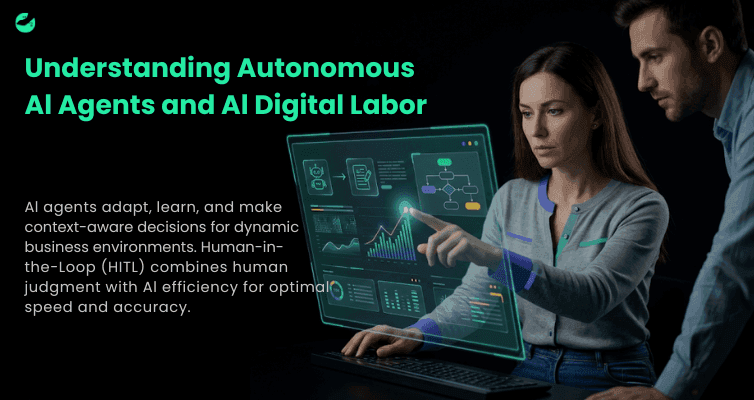
At the core of this transformation lies the concept of AI digital labor. Unlike traditional automation, which follows predefined rules, autonomous AI agents can adapt, learn, and make context-aware decisions. This makes them significantly more versatile and valuable in dynamic business environments.
For example, an AI agent in a customer service environment can analyze incoming queries, access CRM systems, draft responses, and escalate complex issues. We saw the power of such automated intelligence in the Saleduck case study, where AI was used to revolutionize online shopping. Meanwhile, another agent can monitor performance metrics and recommend optimizations. Together, they form a coordinated system of agentic workflows that operate continuously.
However, this does not eliminate the need for human involvement. Instead, it shifts the focus. Employees now supervise these systems, validate outputs, and intervene when necessary. This is where the concept of Human-in-the-Loop (HITL) becomes essential. By combining human judgment with AI efficiency, businesses can achieve both speed and accuracy, much like the Compeasy AI solution which streamlines complex data processing.
From Task Execution to Strategic Decision Making
One of the most profound impacts of agentic AI is the transformation of human roles. Traditionally, employees spent a significant portion of their time on repetitive tasks. With autonomous AI agents taking over these responsibilities, workers can now focus on strategic decision-making.
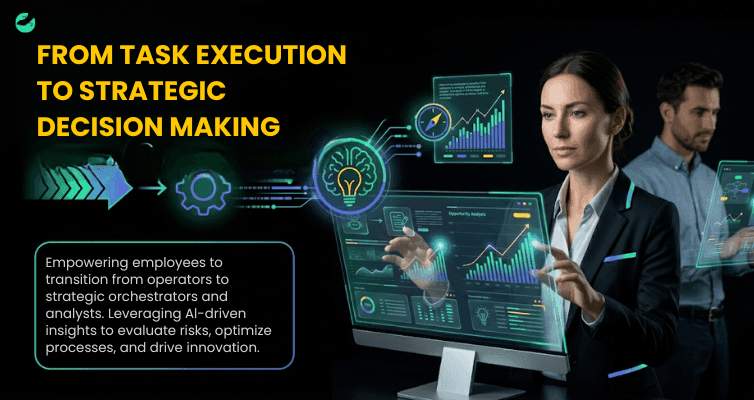
This shift creates a new type of workforce. Employees are no longer operators. They become orchestrators, analysts, and strategists. They interpret insights generated by AI, evaluate risks, and make informed decisions that drive business outcomes.
Moreover, this transformation enhances productivity and innovation. When teams are freed from operational burdens, they can explore new opportunities, optimize processes, and deliver greater value. This is particularly relevant for enterprises undergoing digital transformation, where agility and adaptability are critical.
A forward-thinking digital transformation partner plays a crucial role in enabling this shift. By aligning technology with business goals, organizations can ensure that AI adoption delivers measurable impact rather than isolated improvements, as demonstrated by the success of Travereel in redefining social travel.
The Role of Enterprise AI Orchestration in Scaling Agentic Workflows
While the potential of agentic AI is immense, its success depends on effective enterprise AI orchestration. Without proper coordination, AI agents can become fragmented, leading to inefficiencies and inconsistencies.
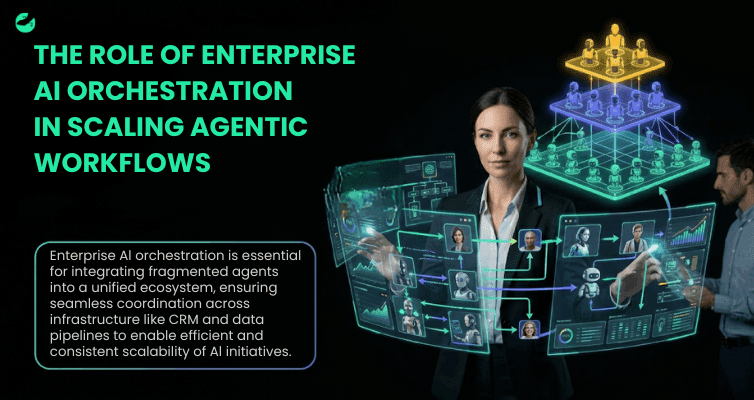
Enterprise AI orchestration ensures that multiple agents work together seamlessly. It integrates AI systems with existing infrastructure, including CRM platforms, data pipelines, and enterprise applications. This creates a unified ecosystem where AI can operate effectively.
Additionally, orchestration enables scalability. As organizations grow, they can deploy more agents without increasing complexity. This is essential for enterprises that aim to scale AI initiatives across departments and regions.
A full-stack digital solutions agency brings the technical expertise required to design and implement these systems. From backend architecture to frontend interfaces, every component must be aligned to support agentic workflows. This includes robust web app development services, intuitive dashboards, and seamless integrations, similar to the complex system built for Van Eijck to manage large-scale logistics.
Building Trust with AI Guardrails, Observability, and Governance
As AI systems become more autonomous, trust becomes a critical factor. Businesses must ensure that AI operates within defined boundaries and complies with regulations. This is where AI guardrails and agentic governance & compliance come into play.
AI guardrails define what agents can and cannot do. They prevent unintended actions and ensure alignment with business objectives. Meanwhile, governance frameworks establish accountability and transparency.
Another essential component is AI observability & audit logs. These tools provide visibility into AI actions, enabling organizations to monitor performance, detect anomalies, and ensure compliance. This is particularly important in regulated industries where accountability is non-negotiable.
Furthermore, understanding the difference between deterministic vs. agentic AI helps organizations choose the right approach for each use case. While deterministic systems are predictable and rule-based, agentic systems offer flexibility and adaptability. A balanced approach often delivers the best results, as seen in the Rivercruise platform.
A strong digital consultancy services provider can guide organizations through these complexities, ensuring that AI adoption is both effective and responsible.
Want to find out how much it costs to build your dream app or web app?


Designing Human-Centric AI Systems with UI/UX Excellence
Despite the advanced capabilities of AI, user experience remains a critical factor. Employees must be able to interact with AI systems intuitively and confidently. This is where UI/UX design services play a vital role.
Well-designed interfaces enable users to understand AI outputs, provide feedback, and make informed decisions. This enhances trust and adoption. For example, dashboards that visualize agent performance and decision pathways can help users quickly assess outcomes.
Moreover, human-centric design ensures that AI systems align with user needs. This includes accessibility, usability, and responsiveness. Whether it is a web platform or a mobile application, the experience must be seamless.
A leading mobile app development agency and custom software development company understands how to bridge the gap between complex AI systems and user-friendly interfaces. By combining technical expertise with design excellence, organizations can create solutions that are both powerful and intuitive, as seen in the ChatLicense app.
Integrating AI Agents into Enterprise Ecosystems
To fully realize the benefits of agentic AI, organizations must integrate AI agents into their existing ecosystems. This includes CRM systems, analytics platforms, and operational tools. Effective CRM integration services ensure that AI agents have access to relevant data and can deliver meaningful insights.
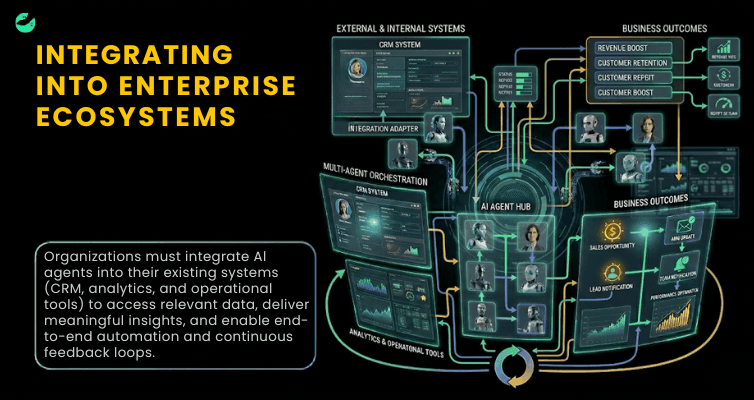
Additionally, integration enables end-to-end automation. For example, an AI agent can identify a sales opportunity, update the CRM, notify the sales team, and track outcomes. This creates a continuous feedback loop that drives improvement.
Modern enterprises also require flexible deployment options. Whether through progressive web app development, iOS app development, or Android app development, AI systems must be accessible across devices. This ensures that employees can interact with AI anytime, anywhere.
A provider with expertise in scalable architectures can support these requirements. By leveraging modern technologies, organizations can build systems that are both robust and adaptable, much like the infrastructure supporting Skoon.
Why Lizard Global Leads in Agentic AI and Digital Transformation
Implementing agentic AI is not just about technology. It requires a holistic approach that combines strategy, design, and development. This is where Lizard Global stands out as a leader.
As a full-stack digital solutions agency, Lizard Global brings together expertise in AI, software development, and UX design. The team understands how to translate business challenges into scalable solutions. From concept to deployment, every step is aligned with strategic objectives.
Moreover, Lizard Global’s approach emphasizes collaboration and innovation. By working closely with clients, the team ensures that solutions are tailored to specific needs. This includes everything from growth analytics consulting to advanced AI implementations.
As a trusted digital transformation partner, Lizard Global helps organizations navigate the complexities of AI adoption. The focus is not just on building technology but on delivering measurable impact, as seen in our work with Hitachi Air Partners. This positions businesses to thrive in an increasingly competitive landscape.
The Future of Work: Humans and AI Agents in Partnership
Looking ahead, the role of AI in the workplace will continue to evolve. Autonomous AI agents will become more sophisticated, capable of handling increasingly complex tasks. However, the importance of human oversight will remain.
The future of work is not about replacing humans. It is about enhancing their capabilities. By combining human creativity with AI efficiency, organizations can achieve new levels of performance.
This partnership also requires continuous learning and adaptation. Employees must develop new skills, including data literacy and strategic thinking. At the same time, organizations must invest in the right infrastructure and partnerships.
Ultimately, the success of agentic AI depends on how well businesses can integrate technology with human expertise. Those who get it right will gain a significant competitive advantage.
Ready to Turn AI into Your Strategic Advantage?
AI is no longer just a tool. It is becoming a workforce. The question is whether your organization is ready to lead this transformation.
At Lizard Global, we help enterprises design, build, and scale intelligent systems powered by Agentic AI for Enterprise. From autonomous AI agents to fully orchestrated workflows, we deliver solutions that drive real business outcomes.
Speak to our specialists todayand discover how AI digital labor can transform your organization into a strategic powerhouse.
AI is no longer limited to answering prompts. Today, autonomous systems are actively executing tasks, coordinating workflows, and supporting high-level decision-making. This shift toward Agentic AI for Enterprise is redefining how organizations operate. Instead of replacing workers, AI agents amplify human capabilities, enabling teams to focus on strategy, innovation, and growth. In this blog, we explore how autonomous AI agents and agentic workflows are reshaping enterprise environments. We also examine the importance of governance, human oversight, and scalable infrastructure in deploying AI responsibly. Finally, we highlight how businesses can leverage a full-stack digital solutions agency like Lizard Global to design, build, and scale intelligent systems that deliver measurable impact.
For years, AI has largely been reactive. Users input prompts, and systems generate outputs. While powerful, this model limits AI to a supportive role. However, the emergence of Agentic AI for Enterprise marks a significant shift. AI is no longer waiting for instructions. Instead, it proactively plans, executes, and iterates on tasks.
This evolution introduces autonomous AI agents that can independently manage workflows. These agents can retrieve data, trigger actions, and collaborate across systems. As a result, businesses are moving from isolated AI use cases to fully integrated agentic workflows. This is where AI begins to function as a digital workforce rather than a tool.
Consequently, organizations must rethink how work gets done. Employees are no longer just executing tasks. Instead, they are overseeing intelligent systems, making strategic decisions, and focusing on high-impact initiatives. This transition is not just technological. It is operational and cultural, often beginning with a deep dive into digital strategy and consultancy to map out the future.
Understanding Autonomous AI Agents and AI Digital Labor
At the core of this transformation lies the concept of AI digital labor. Unlike traditional automation, which follows predefined rules, autonomous AI agents can adapt, learn, and make context-aware decisions. This makes them significantly more versatile and valuable in dynamic business environments.
For example, an AI agent in a customer service environment can analyze incoming queries, access CRM systems, draft responses, and escalate complex issues. We saw the power of such automated intelligence in the Saleduck case study, where AI was used to revolutionize online shopping. Meanwhile, another agent can monitor performance metrics and recommend optimizations. Together, they form a coordinated system of agentic workflows that operate continuously.
However, this does not eliminate the need for human involvement. Instead, it shifts the focus. Employees now supervise these systems, validate outputs, and intervene when necessary. This is where the concept of Human-in-the-Loop (HITL) becomes essential. By combining human judgment with AI efficiency, businesses can achieve both speed and accuracy, much like the Compeasy AI solution which streamlines complex data processing.
From Task Execution to Strategic Decision Making
One of the most profound impacts of agentic AI is the transformation of human roles. Traditionally, employees spent a significant portion of their time on repetitive tasks. With autonomous AI agents taking over these responsibilities, workers can now focus on strategic decision-making.
This shift creates a new type of workforce. Employees are no longer operators. They become orchestrators, analysts, and strategists. They interpret insights generated by AI, evaluate risks, and make informed decisions that drive business outcomes.
Moreover, this transformation enhances productivity and innovation. When teams are freed from operational burdens, they can explore new opportunities, optimize processes, and deliver greater value. This is particularly relevant for enterprises undergoing digital transformation, where agility and adaptability are critical.
A forward-thinking digital transformation partner plays a crucial role in enabling this shift. By aligning technology with business goals, organizations can ensure that AI adoption delivers measurable impact rather than isolated improvements, as demonstrated by the success of Travereel in redefining social travel.
The Role of Enterprise AI Orchestration in Scaling Agentic Workflows
While the potential of agentic AI is immense, its success depends on effective enterprise AI orchestration. Without proper coordination, AI agents can become fragmented, leading to inefficiencies and inconsistencies.
Enterprise AI orchestration ensures that multiple agents work together seamlessly. It integrates AI systems with existing infrastructure, including CRM platforms, data pipelines, and enterprise applications. This creates a unified ecosystem where AI can operate effectively.
Additionally, orchestration enables scalability. As organizations grow, they can deploy more agents without increasing complexity. This is essential for enterprises that aim to scale AI initiatives across departments and regions.
A full-stack digital solutions agency brings the technical expertise required to design and implement these systems. From backend architecture to frontend interfaces, every component must be aligned to support agentic workflows. This includes robust web app development services, intuitive dashboards, and seamless integrations, similar to the complex system built for Van Eijck to manage large-scale logistics.
Building Trust with AI Guardrails, Observability, and Governance
As AI systems become more autonomous, trust becomes a critical factor. Businesses must ensure that AI operates within defined boundaries and complies with regulations. This is where AI guardrails and agentic governance & compliance come into play.
AI guardrails define what agents can and cannot do. They prevent unintended actions and ensure alignment with business objectives. Meanwhile, governance frameworks establish accountability and transparency.
Another essential component is AI observability & audit logs. These tools provide visibility into AI actions, enabling organizations to monitor performance, detect anomalies, and ensure compliance. This is particularly important in regulated industries where accountability is non-negotiable.
Furthermore, understanding the difference between deterministic vs. agentic AI helps organizations choose the right approach for each use case. While deterministic systems are predictable and rule-based, agentic systems offer flexibility and adaptability. A balanced approach often delivers the best results, as seen in the Rivercruise platform.
A strong digital consultancy services provider can guide organizations through these complexities, ensuring that AI adoption is both effective and responsible.
Want to find out how much it costs to build your dream app or web app?
Designing Human-Centric AI Systems with UI/UX Excellence
Despite the advanced capabilities of AI, user experience remains a critical factor. Employees must be able to interact with AI systems intuitively and confidently. This is where UI/UX design services play a vital role.
Well-designed interfaces enable users to understand AI outputs, provide feedback, and make informed decisions. This enhances trust and adoption. For example, dashboards that visualize agent performance and decision pathways can help users quickly assess outcomes.
Moreover, human-centric design ensures that AI systems align with user needs. This includes accessibility, usability, and responsiveness. Whether it is a web platform or a mobile application, the experience must be seamless.
A leading mobile app development agency and custom software development company understands how to bridge the gap between complex AI systems and user-friendly interfaces. By combining technical expertise with design excellence, organizations can create solutions that are both powerful and intuitive, as seen in the ChatLicense app.
Integrating AI Agents into Enterprise Ecosystems
To fully realize the benefits of agentic AI, organizations must integrate AI agents into their existing ecosystems. This includes CRM systems, analytics platforms, and operational tools. Effective CRM integration services ensure that AI agents have access to relevant data and can deliver meaningful insights.
Additionally, integration enables end-to-end automation. For example, an AI agent can identify a sales opportunity, update the CRM, notify the sales team, and track outcomes. This creates a continuous feedback loop that drives improvement.
Modern enterprises also require flexible deployment options. Whether through progressive web app development, iOS app development, or Android app development, AI systems must be accessible across devices. This ensures that employees can interact with AI anytime, anywhere.
A provider with expertise in scalable architectures can support these requirements. By leveraging modern technologies, organizations can build systems that are both robust and adaptable, much like the infrastructure supporting Skoon.
Why Lizard Global Leads in Agentic AI and Digital Transformation
Implementing agentic AI is not just about technology. It requires a holistic approach that combines strategy, design, and development. This is where Lizard Global stands out as a leader.
As a full-stack digital solutions agency, Lizard Global brings together expertise in AI, software development, and UX design. The team understands how to translate business challenges into scalable solutions. From concept to deployment, every step is aligned with strategic objectives.
Moreover, Lizard Global’s approach emphasizes collaboration and innovation. By working closely with clients, the team ensures that solutions are tailored to specific needs. This includes everything from growth analytics consulting to advanced AI implementations.
As a trusted digital transformation partner, Lizard Global helps organizations navigate the complexities of AI adoption. The focus is not just on building technology but on delivering measurable impact, as seen in our work with Hitachi Air Partners. This positions businesses to thrive in an increasingly competitive landscape.
The Future of Work: Humans and AI Agents in Partnership
Looking ahead, the role of AI in the workplace will continue to evolve. Autonomous AI agents will become more sophisticated, capable of handling increasingly complex tasks. However, the importance of human oversight will remain.
The future of work is not about replacing humans. It is about enhancing their capabilities. By combining human creativity with AI efficiency, organizations can achieve new levels of performance.
This partnership also requires continuous learning and adaptation. Employees must develop new skills, including data literacy and strategic thinking. At the same time, organizations must invest in the right infrastructure and partnerships.
Ultimately, the success of agentic AI depends on how well businesses can integrate technology with human expertise. Those who get it right will gain a significant competitive advantage.
Ready to Turn AI into Your Strategic Advantage?
AI is no longer just a tool. It is becoming a workforce. The question is whether your organization is ready to lead this transformation.
At Lizard Global, we help enterprises design, build, and scale intelligent systems powered by Agentic AI for Enterprise. From autonomous AI agents to fully orchestrated workflows, we deliver solutions that drive real business outcomes.
Speak to our specialists todayand discover how AI digital labor can transform your organization into a strategic powerhouse.
FAQs

What is Agentic AI for Enterprise and how does it differ from traditional AI?
How do autonomous AI agents improve business operations?
What is the role of Human-in-the-Loop in agentic workflows?
How can enterprises ensure AI governance and compliance?
What is enterprise AI orchestration and why is it important?
How does UI/UX design impact AI adoption in enterprises?
Why should enterprises partner with a full-stack digital solutions agency?
similar reads

AI & Machine Learning
Agentic AI for Enterprise Transformation: Choosing the Right Delivery Partner
7 May 2026

Case Studies & Interviews
Integrating Autonomous AI Agents into Enterprise Mobile Applications An Architectural Blueprint
7 July 2026

Case Studies & Interviews
Zeno AI: Building a Privacy-First AI Mental Health Companion for Personal Growth
7 July 2026
Stuck between a great idea and the right team to build it?Let's talk.
We work with corporate innovation teams and ambitious scale-ups across the Netherlands, Singapore, and Australia, and wherever great software needs to be built. Drop us a message and we'll get back to you within one business day.


Markus Monnikendam
Global Commercial Director
hello@lizard.global