Why Post-Deployment AI Support Determines Enterprise Success

14 May 2026
by Nadiy, Senior Content Writer
14 May 2026
by Nadiy, Senior Content Writer
Why Post-Deployment AI Support Determines Enterprise Success
Table of contents
Contact us
We will get back to you in the next 48 hours.
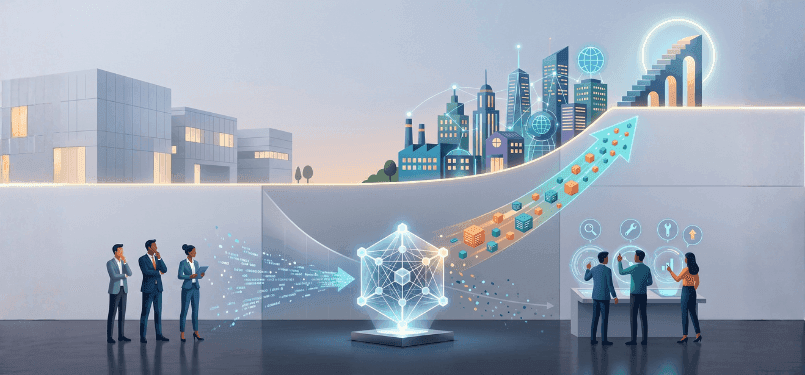
Deploying AI is no longer the finish line for enterprises. It is just the beginning. The real challenge starts after deployment, when systems begin interacting with real users, unpredictable data, and evolving business conditions. Without structured post-deployment support, AI systems can drift, lose accuracy, or even create operational risks. This blog explores why post-deployment AI support determines enterprise success. It explains how continuous monitoring, optimization, governance, and orchestration of AI systems ensure long-term ROI. It also highlights how Agentic AI for Enterprise, Autonomous AI Agents, and Enterprise AI Orchestration are reshaping modern digital operations. Finally, it shows how Lizard Global, as a digital transformation partner and full-stack digital solutions agency, helps enterprises maintain and scale AI systems through structured post-launch strategies, ensuring performance, compliance, and sustainable growth.
key takeaways
Many enterprises mistakenly treat AI deployment as a final milestone. In reality, it is only the start of a continuous lifecycle. Once systems go live, they begin interacting with real-world data, users, and business variability that cannot be fully simulated during development.
This is where post-deployment AI support becomes critical. Without it, even the most advanced models begin to degrade in performance. Data drift, changing user behavior, and evolving business rules quickly reduce the effectiveness of deployed systems. As a result, enterprises lose both accuracy and ROI over time.
To avoid this, organizations must adopt a lifecycle mindset. Continuous evaluation and refinement ensure that AI remains aligned with business goals. This is especially important for companies implementing Agentic AI for Enterprise and Autonomous AI Agents, where systems actively make decisions rather than simply assist users.
Lizard Global approaches AI not as a static product, but as a living system. Through structured post-deployment frameworks, enterprises ensure their AI continues delivering measurable business value long after launch.
Want to find out how much it costs to build your dream app or web app?


The Hidden Risk of AI Drift and System Degradation
One of the most overlooked challenges in enterprise AI is model drift. Over time, the environment in which AI operates changes. Customer behavior evolves, market conditions shift, and data inputs become increasingly complex.
Without post-deployment monitoring, models slowly lose relevance. This phenomenon is known as AI drift. It leads to inaccurate predictions, poor recommendations, and unreliable automation outcomes. In enterprise environments, this can directly impact revenue and customer experience.
This is where AI Observability & Audit Logs become essential. They allow organizations to track system behavior in real time, identify anomalies, and understand decision pathways. Combined with AI Guardrails, enterprises can prevent unsafe or inefficient outcomes before they affect operations.
As a digital consultancy services provider, Lizard Global emphasizes proactive monitoring rather than reactive fixes. This ensures enterprises maintain stable performance across all AI-driven systems, including AI Digital Labor and Enterprise AI Orchestration platforms.
Additionally, leveraging performance insights and robust data foundations helps prevent long-term degradation and strengthens system resilience. Sustainable AI operations further ensure efficiency at scale.
Why Agentic AI Requires Continuous Governance and Human Oversight
The rise of Agentic AI for Enterprise and Autonomous AI Agents introduces new complexity into enterprise systems. Unlike traditional automation, agentic systems can independently execute tasks, make decisions, and coordinate workflows.
While this increases efficiency, it also raises governance challenges. Without proper oversight, agentic systems can drift from business intent or operate in unexpected ways. This is why Agentic Governance & Compliance becomes a core requirement post-deployment.
Human-in-the-Loop (HITL) frameworks ensure that critical decisions remain supervised. Instead of replacing humans, AI collaborates with them. This balance reduces risk while maintaining agility in decision-making.
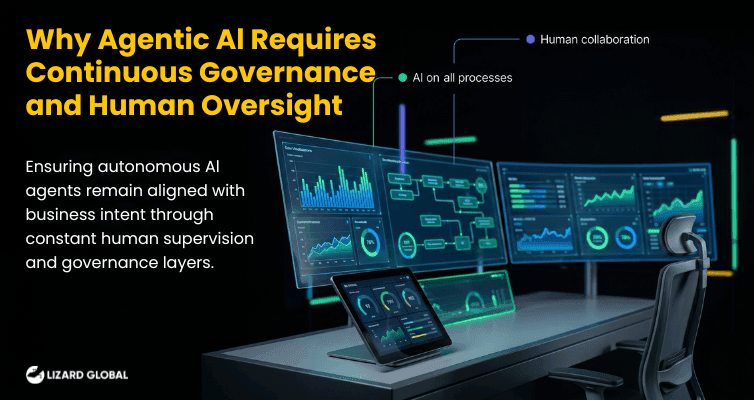
Lizard Global integrates governance layers into every AI system it supports through structured workshops and continuous validation practices. Combined with user feedback loops, enterprises maintain alignment between AI behavior and business intent.
This approach is reinforced by design thinking principles, ensuring systems remain human-centered. It also addresses challenges highlighted in enterprise UX alignment, where disconnected systems often fail to deliver value.
Enterprise AI Orchestration: Turning Isolated Models into Connected Intelligence
Most enterprises do not struggle with AI models themselves. They struggle with fragmentation. Different systems operate in silos, leading to inconsistent insights and duplicated effort.
Enterprise AI Orchestration solves this problem by connecting models, workflows, and data pipelines into a unified system. Instead of isolated tools, businesses gain a coordinated AI ecosystem that shares intelligence across functions.
Post-deployment support plays a crucial role here. Orchestration is not a one-time setup. It requires continuous tuning to ensure models communicate effectively and adapt to changing workflows. This is especially important when integrating CRM systems, analytics platforms, and operational tools.
As a full-stack digital solutions agency, Lizard Global specializes in building and maintaining these orchestration layers using API-driven architecture and full-stack engineering.
Platforms like Tactlink demonstrate how connected ecosystems improve operational efficiency. This is further strengthened by scalable architectures discussed in modern SaaS scaling strategies.
The Role of AI Digital Labor in Post-Deployment Optimization
The concept of AI Digital Labor is transforming how enterprises think about workforce augmentation. Instead of treating AI as a tool, organizations are now deploying it as a digital workforce capable of handling repetitive, data-driven tasks.
However, like human employees, AI Digital Labor requires continuous training, supervision, and optimization. Without post-deployment support, digital labor systems can become inefficient or misaligned with business priorities.
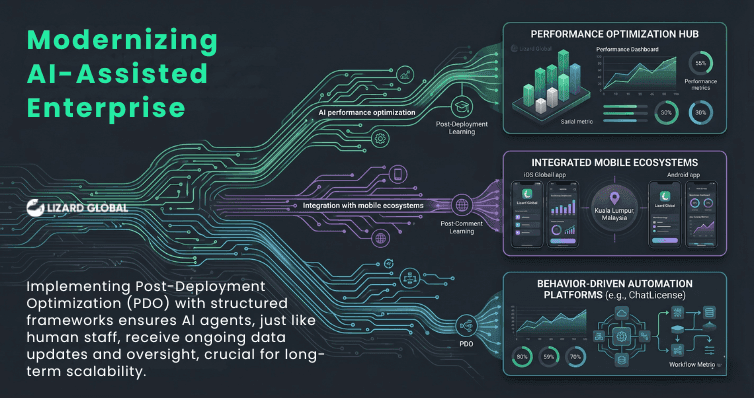
This is where structured support frameworks come in. They ensure that AI agents continue learning from new data, improving decision accuracy, and aligning with evolving workflows. It also ensures that both iOS app development and Android app development environments remain optimized when AI is embedded into mobile experiences.
Lizard Global supports enterprises in building scalable AI Digital Labor ecosystems across behavior-driven systems and intelligent automation platforms like ChatLicense.
By combining mobile ecosystems, cross-platform development, and user interface design, businesses can create seamless, adaptive digital labor systems.
Deterministic vs. Agentic AI: Why Post-Deployment Strategy Must Differ
Not all AI systems behave the same way. Deterministic AI follows predefined rules and produces consistent outputs. Agentic AI, however, adapts and evolves based on context, goals, and environmental changes.
This difference has major implications for post-deployment support. Deterministic systems require stability monitoring, while agentic systems require behavioral oversight and adaptive governance. Without distinguishing between the two, enterprises risk applying the wrong support strategy.
For example, deterministic systems benefit from structured testing and validation cycles. In contrast, agentic systems require continuous feedback loops, performance tuning, and real-time monitoring through AI Observability & Audit Logs.
Lizard Global helps enterprises design hybrid architectures using technical feasibility analysis and continuous QA processes.
These are reinforced by insights from enterprise modernization strategies, ensuring systems evolve without accumulating technical debt.
Additionally, scalability principles ensure both deterministic and agentic systems remain performant at scale.
Post-Deployment AI as a Driver of Long-Term Digital Transformation
True digital transformation does not end at deployment. It evolves continuously. Post-deployment AI support ensures that enterprises do not just adopt AI, but fully integrate it into their operational DNA.
This ongoing process impacts everything from UX/UI design services to enterprise-wide digital workflows. As systems evolve, user expectations also change, requiring continuous refinement of digital experiences.
Moreover, enterprises that invest in long-term AI support achieve significantly higher ROI compared to those that treat AI as a one-time project. Continuous optimization ensures systems remain efficient, compliant, and aligned with strategic goals.
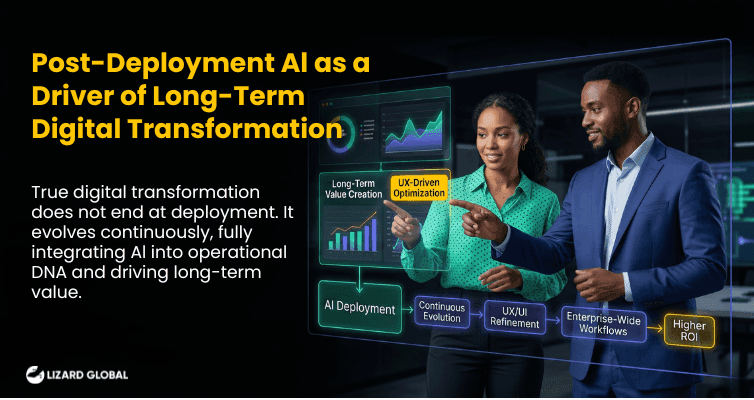
As a custom software development company and digital transformation partner, Lizard Global focuses on long-term value creation through UX-driven optimization, performance enhancement, and ongoing technical support.
Real-world implementations like IGGI demonstrate how continuous evolution drives sustained impact.
Turn AI Deployment into Lasting Enterprise Success
Deploying AI is easy. Making it perform consistently over time is where real enterprise value is created. If your organization is investing in Agentic AI for Enterprise, Autonomous AI Agents, or large-scale digital transformation, post-deployment support will determine your success more than the initial build.
Lizard Global helps enterprises bridge this gap through continuous AI optimization, governance, and orchestration. From strategic custom software development and web development expertise to scalable digital ecosystems like Afflink, we ensure your AI evolves with your business.
Let’s build AI that does not just launch, but lasts. 👉 Connect with Lizard Global to design, scale, and sustain enterprise AI systems that deliver measurable long-term impact.
Deploying AI is no longer the finish line for enterprises. It is just the beginning. The real challenge starts after deployment, when systems begin interacting with real users, unpredictable data, and evolving business conditions. Without structured post-deployment support, AI systems can drift, lose accuracy, or even create operational risks. This blog explores why post-deployment AI support determines enterprise success. It explains how continuous monitoring, optimization, governance, and orchestration of AI systems ensure long-term ROI. It also highlights how Agentic AI for Enterprise, Autonomous AI Agents, and Enterprise AI Orchestration are reshaping modern digital operations. Finally, it shows how Lizard Global, as a digital transformation partner and full-stack digital solutions agency, helps enterprises maintain and scale AI systems through structured post-launch strategies, ensuring performance, compliance, and sustainable growth.
Many enterprises mistakenly treat AI deployment as a final milestone. In reality, it is only the start of a continuous lifecycle. Once systems go live, they begin interacting with real-world data, users, and business variability that cannot be fully simulated during development.
This is where post-deployment AI support becomes critical. Without it, even the most advanced models begin to degrade in performance. Data drift, changing user behavior, and evolving business rules quickly reduce the effectiveness of deployed systems. As a result, enterprises lose both accuracy and ROI over time.
To avoid this, organizations must adopt a lifecycle mindset. Continuous evaluation and refinement ensure that AI remains aligned with business goals. This is especially important for companies implementing Agentic AI for Enterprise and Autonomous AI Agents, where systems actively make decisions rather than simply assist users.
Lizard Global approaches AI not as a static product, but as a living system. Through structured post-deployment frameworks, enterprises ensure their AI continues delivering measurable business value long after launch.
Want to find out how much it costs to build your dream app or web app?
The Hidden Risk of AI Drift and System Degradation
One of the most overlooked challenges in enterprise AI is model drift. Over time, the environment in which AI operates changes. Customer behavior evolves, market conditions shift, and data inputs become increasingly complex.
Without post-deployment monitoring, models slowly lose relevance. This phenomenon is known as AI drift. It leads to inaccurate predictions, poor recommendations, and unreliable automation outcomes. In enterprise environments, this can directly impact revenue and customer experience.
This is where AI Observability & Audit Logs become essential. They allow organizations to track system behavior in real time, identify anomalies, and understand decision pathways. Combined with AI Guardrails, enterprises can prevent unsafe or inefficient outcomes before they affect operations.
As a digital consultancy services provider, Lizard Global emphasizes proactive monitoring rather than reactive fixes. This ensures enterprises maintain stable performance across all AI-driven systems, including AI Digital Labor and Enterprise AI Orchestration platforms.
Additionally, leveraging performance insights and robust data foundations helps prevent long-term degradation and strengthens system resilience. Sustainable AI operations further ensure efficiency at scale.
Why Agentic AI Requires Continuous Governance and Human Oversight
The rise of Agentic AI for Enterprise and Autonomous AI Agents introduces new complexity into enterprise systems. Unlike traditional automation, agentic systems can independently execute tasks, make decisions, and coordinate workflows.
While this increases efficiency, it also raises governance challenges. Without proper oversight, agentic systems can drift from business intent or operate in unexpected ways. This is why Agentic Governance & Compliance becomes a core requirement post-deployment.
Human-in-the-Loop (HITL) frameworks ensure that critical decisions remain supervised. Instead of replacing humans, AI collaborates with them. This balance reduces risk while maintaining agility in decision-making.
Lizard Global integrates governance layers into every AI system it supports through structured workshops and continuous validation practices. Combined with user feedback loops, enterprises maintain alignment between AI behavior and business intent.
This approach is reinforced by design thinking principles, ensuring systems remain human-centered. It also addresses challenges highlighted in enterprise UX alignment, where disconnected systems often fail to deliver value.
Enterprise AI Orchestration: Turning Isolated Models into Connected Intelligence
Most enterprises do not struggle with AI models themselves. They struggle with fragmentation. Different systems operate in silos, leading to inconsistent insights and duplicated effort.
Enterprise AI Orchestration solves this problem by connecting models, workflows, and data pipelines into a unified system. Instead of isolated tools, businesses gain a coordinated AI ecosystem that shares intelligence across functions.
Post-deployment support plays a crucial role here. Orchestration is not a one-time setup. It requires continuous tuning to ensure models communicate effectively and adapt to changing workflows. This is especially important when integrating CRM systems, analytics platforms, and operational tools.
As a full-stack digital solutions agency, Lizard Global specializes in building and maintaining these orchestration layers using API-driven architecture and full-stack engineering.
Platforms like Tactlink demonstrate how connected ecosystems improve operational efficiency. This is further strengthened by scalable architectures discussed in modern SaaS scaling strategies.
The Role of AI Digital Labor in Post-Deployment Optimization
The concept of AI Digital Labor is transforming how enterprises think about workforce augmentation. Instead of treating AI as a tool, organizations are now deploying it as a digital workforce capable of handling repetitive, data-driven tasks.
However, like human employees, AI Digital Labor requires continuous training, supervision, and optimization. Without post-deployment support, digital labor systems can become inefficient or misaligned with business priorities.
This is where structured support frameworks come in. They ensure that AI agents continue learning from new data, improving decision accuracy, and aligning with evolving workflows. It also ensures that both iOS app development and Android app development environments remain optimized when AI is embedded into mobile experiences.
Lizard Global supports enterprises in building scalable AI Digital Labor ecosystems across behavior-driven systems and intelligent automation platforms like ChatLicense.
By combining mobile ecosystems, cross-platform development, and user interface design, businesses can create seamless, adaptive digital labor systems.
Deterministic vs. Agentic AI: Why Post-Deployment Strategy Must Differ
Not all AI systems behave the same way. Deterministic AI follows predefined rules and produces consistent outputs. Agentic AI, however, adapts and evolves based on context, goals, and environmental changes.
This difference has major implications for post-deployment support. Deterministic systems require stability monitoring, while agentic systems require behavioral oversight and adaptive governance. Without distinguishing between the two, enterprises risk applying the wrong support strategy.
For example, deterministic systems benefit from structured testing and validation cycles. In contrast, agentic systems require continuous feedback loops, performance tuning, and real-time monitoring through AI Observability & Audit Logs.
Lizard Global helps enterprises design hybrid architectures using technical feasibility analysis and continuous QA processes.
These are reinforced by insights from enterprise modernization strategies, ensuring systems evolve without accumulating technical debt.
Additionally, scalability principles ensure both deterministic and agentic systems remain performant at scale.
Post-Deployment AI as a Driver of Long-Term Digital Transformation
True digital transformation does not end at deployment. It evolves continuously. Post-deployment AI support ensures that enterprises do not just adopt AI, but fully integrate it into their operational DNA.
This ongoing process impacts everything from UX/UI design services to enterprise-wide digital workflows. As systems evolve, user expectations also change, requiring continuous refinement of digital experiences.
Moreover, enterprises that invest in long-term AI support achieve significantly higher ROI compared to those that treat AI as a one-time project. Continuous optimization ensures systems remain efficient, compliant, and aligned with strategic goals.
As a custom software development company and digital transformation partner, Lizard Global focuses on long-term value creation through UX-driven optimization, performance enhancement, and ongoing technical support.
Real-world implementations like IGGI demonstrate how continuous evolution drives sustained impact.
Turn AI Deployment into Lasting Enterprise Success
Deploying AI is easy. Making it perform consistently over time is where real enterprise value is created. If your organization is investing in Agentic AI for Enterprise, Autonomous AI Agents, or large-scale digital transformation, post-deployment support will determine your success more than the initial build.
Lizard Global helps enterprises bridge this gap through continuous AI optimization, governance, and orchestration. From strategic custom software development and web development expertise to scalable digital ecosystems like Afflink, we ensure your AI evolves with your business.
Let’s build AI that does not just launch, but lasts. 👉 Connect with Lizard Global to design, scale, and sustain enterprise AI systems that deliver measurable long-term impact.
FAQs

Why is post-deployment AI support important for enterprises?
What happens if enterprises ignore AI monitoring after deployment?
How does Agentic AI change post-deployment requirements?
What is AI Observability in enterprise systems?
How does Enterprise AI Orchestration improve performance?
What is the difference between deterministic and agentic AI in maintenance?
How doe agencies support post-deployment AI systems?


Stuck between a great idea and the right team to build it?Let's talk.
We work with corporate innovation teams and ambitious scale-ups across the Netherlands, Singapore, and Australia, and wherever great software needs to be built. Drop us a message and we'll get back to you within one business day.


Markus Monnikendam
Global Commercial Director
hello@lizard.global