Composable Architecture: Why Modular Systems Are Replacing Monolithic Enterprise Platforms
05 Jun 2026
by Team Lizard Global
Editor: Nadiy, Senior Content Writer
05 Jun 2026
by Team Lizard Global
Editor: Nadiy, Senior Content Writer
Composable Architecture: Why Modular Systems Are Replacing Monolithic Enterprise Platforms
Table of contents
Contact us
We will get back to you in the next 48 hours.
The modern enterprise landscape is undergoing a massive shift away from rigid legacy infrastructures. For decades, massive monolithic systems served as the backbone of global operations. However, in today's fast-paced digital economy, these single-tier software architectures are turning into operational bottlenecks. This blog post explores the strategic transition from monolithic setups to flexible, composable architecture. We will analyze how breaking down massive software suites into modular components allows enterprises to rapidly pivot, continuously innovate, and effortlessly scale. Additionally, we examine how the integration of next-generation artificial intelligence—specifically agentic workflows and autonomous digital labor—supercharges modular systems. By partnering with an expert full-stack digital solutions agency, enterprises can transition from slow, high-maintenance legacy platforms to high-performance, future-proof ecosystems designed for long-term growth.
key takeaways
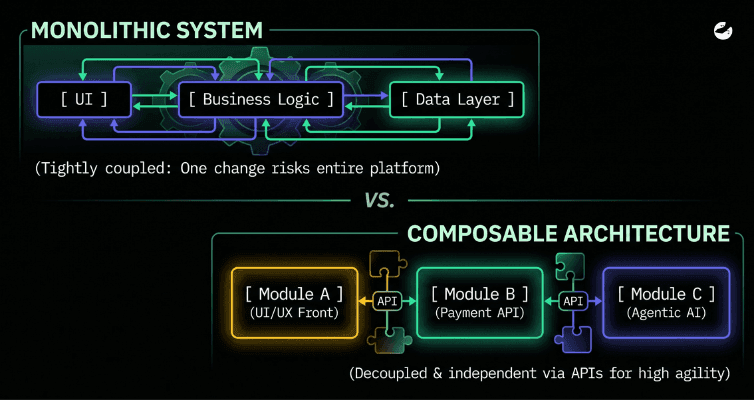
For a long time, the traditional monolithic platform was the gold standard for enterprise software execution. Businesses relied on all-in-one software suites to manage everything from enterprise resource planning (ERP) to customer relationships and inventory. However, these systems present serious maintenance challenges in an era that demands rapid innovation. Because every component within a monolith tightly couples with the next, modifying a single feature requires retesting and redeploying the entire software infrastructure. This interdependency creates extreme operational friction, stalls deployment timelines, and leaves IT departments managing massive amounts of technical debt instead of driving digital progress.
Furthermore, monolithic platforms struggle to keep up with modern data ecosystems. They force enterprises into a rigid environment where data moves slowly across siloed, internal pipelines. When business leaders attempt to implement modern analytical tools or advanced automation, they quickly run into integration barriers. The traditional, static nature of Deterministic vs. Agentic AI highlights this exact limitation. Monolithic environments restrict companies to deterministic systems—software that only follows pre-written, hardcoded paths. This lack of flexibility prevents companies from adopting dynamic, self-optimizing business workflows, which directly hurts their market competitiveness.
To break free from these operational limitations, forward-thinking enterprises are systematically dismantling their legacy suites. They are choosing instead to work with a custom software development company to build flexible, service-oriented infrastructures. Replacing heavy, single-tier software with lightweight, independent services allows companies to upgrade individual parts of their system without risking total platform downtime. Moving away from monolithic systems is no longer just a technical preference; it is a critical strategic move for any enterprise aiming to remain resilient and agile in a rapidly changing digital landscape. Businesses undertaking this shift often begin with a technical preference assessment to identify modernization opportunities.
Understanding Composable Architecture: The Modular Enterprise Advantage
Composable architecture operates on a straightforward principle: break enterprise systems down into independent, plug-and-play components called Packaged Business Capabilities (PBCs). These decoupled modules communicate with one another using standardized application programming interfaces (APIs). This structural shift allows businesses to construct highly tailored software ecosystems where they can easily add, remove, or swap out individual components. If a specific tool no longer meets operational demands, engineers can replace it with a superior alternative without disrupting any other part of the business infrastructure.
This modular structure completely transforms how organizations scale and design user experiences. Rather than settling for the generic interfaces bundled with monolithic platforms, companies can leverage custom UI/UX design services to build bespoke front-end layouts for different business units. A modular framework allows a dedicated web app development services provider to build lightweight, high-performance web applications that connect directly to backend data engines. This ensures that internal teams and customers enjoy fast, intuitive digital experiences while the core infrastructure runs securely in the background.
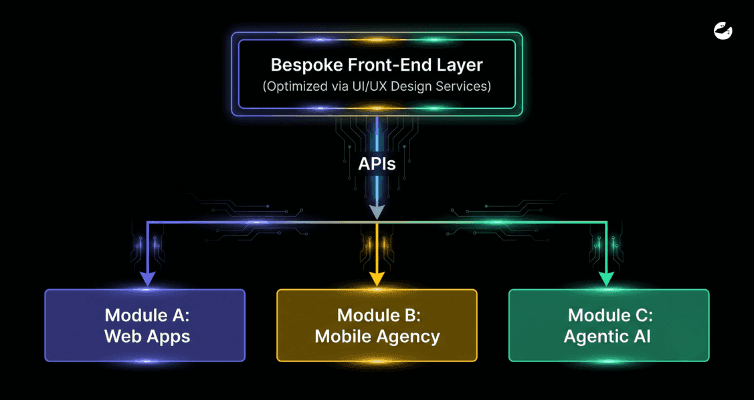
Additionally, this flexibility extends directly to an organization's mobile product strategy. By separating backend databases from user-facing applications, a mobile app development agency can design native applications tailored specifically for field teams or end consumers. This strategy allows engineering teams to implement targeted iOS app development and Android app development cycles independently, eliminating the need to sync with heavy backend update timelines. Composable systems provide enterprises with the freedom to select best-of-breed software solutions, eliminating vendor lock-in and maximizing technology investments. Successful organizations often support these initiatives with robust application programming interfaces (APIs).
Supercharging Modular Frameworks with Agentic AI for Enterprise
The true value of a composable architecture becomes clear when you introduce modern artificial intelligence into the system. While legacy platforms struggle to process unstructured data, modular infrastructures easily integrate advanced cognitive systems. This fluid integration enables the deployment of Agentic AI for Enterprise, shifting technology from a passive data repository into an active, intelligent contributor. Unlike standard automation tools that require constant human prompting, these advanced systems analyze their environment, formulate tactical plans, and execute multi-step tasks autonomously.
Implementing Autonomous AI Agents within a composable framework allows businesses to orchestrate highly efficient operational workflows across multiple business units. For example, instead of manually moving data between a CRM, an ERP, and an inventory management platform, an autonomous agent can monitor these modules simultaneously, handle data reconciliation, and execute background tasks independently. This dynamic automation creates highly adaptive Agentic Workflows that instantly respond to real-time business signals, transforming how companies approach operational design.
To successfully scale these intelligent operations, organizations require sophisticated Enterprise AI Orchestration. This orchestration layer functions as an intelligent central conductor, directing the flow of information between independent microservices and active AI agents. By utilizing a full-stack digital solutions agency to engineer this core architecture, businesses ensure their AI tools smoothly coordinate with critical business modules. This integration turns standard software setups into proactive environments driven by AI Digital Labor, allowing human teams to shift their focus from repetitive data entry to high-value product innovation and strategic growth.
The Critical Role of AI Guardrails, Governance, and Compliance in Modular Systems
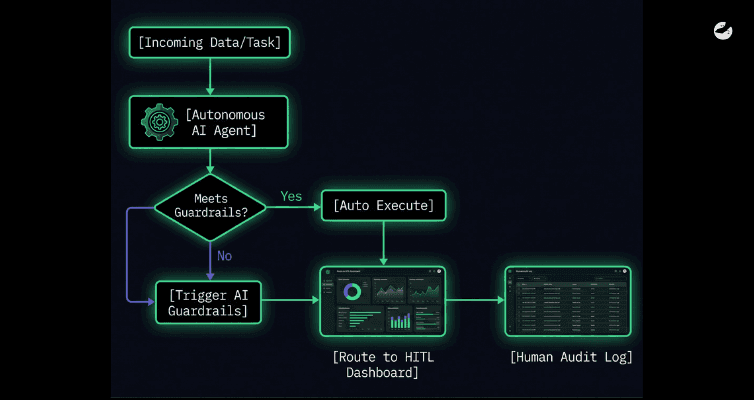
As enterprises deploy autonomous agents across decoupled systems, maintaining strict operational oversight becomes incredibly important. The independent nature of modular systems offers excellent flexibility, but it also requires clear boundaries to prevent automated workflows from executing unapproved actions. To address this challenge, organizations implement comprehensive AI Guardrails. These programmatic rules define the exact operational limits of every autonomous agent, ensuring they cannot access restricted databases, execute unauthorized financial transactions, or alter core application states without explicit clearance.
Maintaining operational safety also relies heavily on building structured Human-in-the-Loop (HITL) processes directly into automated pipelines. While AI agents excel at processing high-volume datasets and handling routine tasks, complex edge cases and high-impact financial decisions still require human validation. A well-designed composable system routes exceptional scenarios to human supervisors via specialized internal dashboards. This collaborative approach combines the rapid processing speed of automated systems with the nuanced judgment of experienced professionals.
To ensure long-term accountability, enterprises must prioritize comprehensive Agentic Governance & Compliance strategies. Every action taken by an autonomous agent must be fully traceable, contextually justified, and easy to review during internal assessments. By leveraging advanced AI Observability & Audit Logs, system administrators can monitor agent interactions across all microservices in real time. This complete operational transparency protects companies against data discrepancies, simplifies compliance reporting, and helps a trusted digital transformation partner continually optimize system performance.
Strategic Engineering: Accelerating App Development and Omnichannel Integration
Transitioning to a composable ecosystem completely redefines how enterprises build, launch, and optimize digital products. In old monolithic environments, launching a new user-facing feature required long development cycles and extensive code updates. Composable systems eliminate these delays by treating every frontend interface as an independent module. This architectural freedom allows a mobile app development agency to simultaneously build out hybrid app development frameworks or launch agile progressive web app development initiatives without impacting core database structures.
This decoupled development model significantly improves an enterprise’s ability to execute a true omnichannel product strategy. Because data travels through standardized API layers, companies can deliver identical features across platforms effortlessly. A specialized software development team can write business logic once and deploy it across web apps, iOS tools, and Android solutions simultaneously. This approach shortens time-to-market and ensures design consistency across touchpoints, creating a cohesive user experience that drives customer retention.
Furthermore, a modular setup simplifies the process of executing critical platform expansions, such as professional CRM integration services. Rather than dealing with the complex data mutations typical of legacy architectures, engineers simply hook the CRM platform directly into the central API framework. This clean connectivity allows businesses to bring in specialized growth analytics consulting partners who can quickly extract insights from clear, well-organized data streams. Ultimately, composable architecture turns software engineering from an expensive corporate burden into a scalable engine for business growth.
Partnering for Transformation: How Lizard Global Engineers Scalable Modular Success
Migrating away from a complex monolithic architecture requires deep engineering expertise and a clear, product-focused strategy. This is why global organizations partner with Lizard Global, an award-winning custom software development company and digital transformation partner. Operating from key innovation hubs in the Netherlands and Malaysia, Lizard Global blends top-tier European product strategy with agile software engineering. This cross-functional approach ensures that enterprise transformations focus on delivering tangible business value rather than just upgrading technical infrastructure.
As an end-to-end full-stack digital solutions agency, Lizard Global provides the comprehensive technical guidance required to deconstruct complex monolithic platforms. Their multidisciplinary teams guide businesses through every stage of modernization, offering specialized digital consultancy services, custom system design, and advanced UX/UI product design. This collaborative method ensures that every individual module aligns perfectly with broader enterprise goals, maintaining high platform stability and operational security throughout the migration process.
Beyond core software development, Lizard Global helps enterprises seamlessly integrate advanced artificial intelligence, including Autonomous AI Agents and automated Agentic Workflows. They ensure your AI applications are built on secure foundations protected by strict AI Guardrails and clear AI Observability & Audit Logs. Partnering with Lizard Global gives your business access to a dedicated external technology team committed to eliminating technical debt, protecting platform reliability, and building a flexible, intelligent digital ecosystem optimized for long-term international growth.
Transform Your Enterprise Infrastructure Today
Don't let a rigid legacy platform slow down your business growth and limit operational innovation. Shift to a flexible, high-performance composable architecture backed by intelligent Agentic AI for Enterprise. Partner with Lizard Global, your trusted full-stack digital transformation partner, to design scalable web applications, native mobile experiences, and autonomous workflows engineered for the modern market.
Contact
the Lizard Global Team Today to book a dedicated technical strategy session and launch your enterprise modernization journey!
The modern enterprise landscape is undergoing a massive shift away from rigid legacy infrastructures. For decades, massive monolithic systems served as the backbone of global operations. However, in today's fast-paced digital economy, these single-tier software architectures are turning into operational bottlenecks. This blog post explores the strategic transition from monolithic setups to flexible, composable architecture. We will analyze how breaking down massive software suites into modular components allows enterprises to rapidly pivot, continuously innovate, and effortlessly scale. Additionally, we examine how the integration of next-generation artificial intelligence—specifically agentic workflows and autonomous digital labor—supercharges modular systems. By partnering with an expert full-stack digital solutions agency, enterprises can transition from slow, high-maintenance legacy platforms to high-performance, future-proof ecosystems designed for long-term growth.
For a long time, the traditional monolithic platform was the gold standard for enterprise software execution. Businesses relied on all-in-one software suites to manage everything from enterprise resource planning (ERP) to customer relationships and inventory. However, these systems present serious maintenance challenges in an era that demands rapid innovation. Because every component within a monolith tightly couples with the next, modifying a single feature requires retesting and redeploying the entire software infrastructure. This interdependency creates extreme operational friction, stalls deployment timelines, and leaves IT departments managing massive amounts of technical debt instead of driving digital progress.
Furthermore, monolithic platforms struggle to keep up with modern data ecosystems. They force enterprises into a rigid environment where data moves slowly across siloed, internal pipelines. When business leaders attempt to implement modern analytical tools or advanced automation, they quickly run into integration barriers. The traditional, static nature of Deterministic vs. Agentic AI highlights this exact limitation. Monolithic environments restrict companies to deterministic systems—software that only follows pre-written, hardcoded paths. This lack of flexibility prevents companies from adopting dynamic, self-optimizing business workflows, which directly hurts their market competitiveness.
To break free from these operational limitations, forward-thinking enterprises are systematically dismantling their legacy suites. They are choosing instead to work with a custom software development company to build flexible, service-oriented infrastructures. Replacing heavy, single-tier software with lightweight, independent services allows companies to upgrade individual parts of their system without risking total platform downtime. Moving away from monolithic systems is no longer just a technical preference; it is a critical strategic move for any enterprise aiming to remain resilient and agile in a rapidly changing digital landscape. Businesses undertaking this shift often begin with a technical preference assessment to identify modernization opportunities.
Understanding Composable Architecture: The Modular Enterprise Advantage
Composable architecture operates on a straightforward principle: break enterprise systems down into independent, plug-and-play components called Packaged Business Capabilities (PBCs). These decoupled modules communicate with one another using standardized application programming interfaces (APIs). This structural shift allows businesses to construct highly tailored software ecosystems where they can easily add, remove, or swap out individual components. If a specific tool no longer meets operational demands, engineers can replace it with a superior alternative without disrupting any other part of the business infrastructure.
This modular structure completely transforms how organizations scale and design user experiences. Rather than settling for the generic interfaces bundled with monolithic platforms, companies can leverage custom UI/UX design services to build bespoke front-end layouts for different business units. A modular framework allows a dedicated web app development services provider to build lightweight, high-performance web applications that connect directly to backend data engines. This ensures that internal teams and customers enjoy fast, intuitive digital experiences while the core infrastructure runs securely in the background.
Additionally, this flexibility extends directly to an organization's mobile product strategy. By separating backend databases from user-facing applications, a mobile app development agency can design native applications tailored specifically for field teams or end consumers. This strategy allows engineering teams to implement targeted iOS app development and Android app development cycles independently, eliminating the need to sync with heavy backend update timelines. Composable systems provide enterprises with the freedom to select best-of-breed software solutions, eliminating vendor lock-in and maximizing technology investments. Successful organizations often support these initiatives with robust application programming interfaces (APIs).
Supercharging Modular Frameworks with Agentic AI for Enterprise
The true value of a composable architecture becomes clear when you introduce modern artificial intelligence into the system. While legacy platforms struggle to process unstructured data, modular infrastructures easily integrate advanced cognitive systems. This fluid integration enables the deployment of Agentic AI for Enterprise, shifting technology from a passive data repository into an active, intelligent contributor. Unlike standard automation tools that require constant human prompting, these advanced systems analyze their environment, formulate tactical plans, and execute multi-step tasks autonomously.
Implementing Autonomous AI Agents within a composable framework allows businesses to orchestrate highly efficient operational workflows across multiple business units. For example, instead of manually moving data between a CRM, an ERP, and an inventory management platform, an autonomous agent can monitor these modules simultaneously, handle data reconciliation, and execute background tasks independently. This dynamic automation creates highly adaptive Agentic Workflows that instantly respond to real-time business signals, transforming how companies approach operational design.
To successfully scale these intelligent operations, organizations require sophisticated Enterprise AI Orchestration. This orchestration layer functions as an intelligent central conductor, directing the flow of information between independent microservices and active AI agents. By utilizing a full-stack digital solutions agency to engineer this core architecture, businesses ensure their AI tools smoothly coordinate with critical business modules. This integration turns standard software setups into proactive environments driven by AI Digital Labor, allowing human teams to shift their focus from repetitive data entry to high-value product innovation and strategic growth.
The Critical Role of AI Guardrails, Governance, and Compliance in Modular Systems
As enterprises deploy autonomous agents across decoupled systems, maintaining strict operational oversight becomes incredibly important. The independent nature of modular systems offers excellent flexibility, but it also requires clear boundaries to prevent automated workflows from executing unapproved actions. To address this challenge, organizations implement comprehensive AI Guardrails. These programmatic rules define the exact operational limits of every autonomous agent, ensuring they cannot access restricted databases, execute unauthorized financial transactions, or alter core application states without explicit clearance.
Maintaining operational safety also relies heavily on building structured Human-in-the-Loop (HITL) processes directly into automated pipelines. While AI agents excel at processing high-volume datasets and handling routine tasks, complex edge cases and high-impact financial decisions still require human validation. A well-designed composable system routes exceptional scenarios to human supervisors via specialized internal dashboards. This collaborative approach combines the rapid processing speed of automated systems with the nuanced judgment of experienced professionals.
To ensure long-term accountability, enterprises must prioritize comprehensive Agentic Governance & Compliance strategies. Every action taken by an autonomous agent must be fully traceable, contextually justified, and easy to review during internal assessments. By leveraging advanced AI Observability & Audit Logs, system administrators can monitor agent interactions across all microservices in real time. This complete operational transparency protects companies against data discrepancies, simplifies compliance reporting, and helps a trusted digital transformation partner continually optimize system performance.
Strategic Engineering: Accelerating App Development and Omnichannel Integration
Transitioning to a composable ecosystem completely redefines how enterprises build, launch, and optimize digital products. In old monolithic environments, launching a new user-facing feature required long development cycles and extensive code updates. Composable systems eliminate these delays by treating every frontend interface as an independent module. This architectural freedom allows a mobile app development agency to simultaneously build out hybrid app development frameworks or launch agile progressive web app development initiatives without impacting core database structures.
This decoupled development model significantly improves an enterprise’s ability to execute a true omnichannel product strategy. Because data travels through standardized API layers, companies can deliver identical features across platforms effortlessly. A specialized software development team can write business logic once and deploy it across web apps, iOS tools, and Android solutions simultaneously. This approach shortens time-to-market and ensures design consistency across touchpoints, creating a cohesive user experience that drives customer retention.
Furthermore, a modular setup simplifies the process of executing critical platform expansions, such as professional CRM integration services. Rather than dealing with the complex data mutations typical of legacy architectures, engineers simply hook the CRM platform directly into the central API framework. This clean connectivity allows businesses to bring in specialized growth analytics consulting partners who can quickly extract insights from clear, well-organized data streams. Ultimately, composable architecture turns software engineering from an expensive corporate burden into a scalable engine for business growth.
Partnering for Transformation: How Lizard Global Engineers Scalable Modular Success
Migrating away from a complex monolithic architecture requires deep engineering expertise and a clear, product-focused strategy. This is why global organizations partner with Lizard Global, an award-winning custom software development company and digital transformation partner. Operating from key innovation hubs in the Netherlands and Malaysia, Lizard Global blends top-tier European product strategy with agile software engineering. This cross-functional approach ensures that enterprise transformations focus on delivering tangible business value rather than just upgrading technical infrastructure.
As an end-to-end full-stack digital solutions agency, Lizard Global provides the comprehensive technical guidance required to deconstruct complex monolithic platforms. Their multidisciplinary teams guide businesses through every stage of modernization, offering specialized digital consultancy services, custom system design, and advanced UX/UI product design. This collaborative method ensures that every individual module aligns perfectly with broader enterprise goals, maintaining high platform stability and operational security throughout the migration process.
Beyond core software development, Lizard Global helps enterprises seamlessly integrate advanced artificial intelligence, including Autonomous AI Agents and automated Agentic Workflows. They ensure your AI applications are built on secure foundations protected by strict AI Guardrails and clear AI Observability & Audit Logs. Partnering with Lizard Global gives your business access to a dedicated external technology team committed to eliminating technical debt, protecting platform reliability, and building a flexible, intelligent digital ecosystem optimized for long-term international growth.
Transform Your Enterprise Infrastructure Today
Don't let a rigid legacy platform slow down your business growth and limit operational innovation. Shift to a flexible, high-performance composable architecture backed by intelligent Agentic AI for Enterprise. Partner with Lizard Global, your trusted full-stack digital transformation partner, to design scalable web applications, native mobile experiences, and autonomous workflows engineered for the modern market.
Contact
the Lizard Global Team Today to book a dedicated technical strategy session and launch your enterprise modernization journey!
FAQs

What is the difference between Deterministic vs. Agentic AI in enterprise systems?
How do Autonomous AI Agents operate safely within a composable architecture?
Why should enterprises choose a custom software development company over standard SaaS platforms?
How do UI/UX design services impact the success of a modular migration?
What are the benefits of integrating progressive web app development into a composable framework?
Why is Agentic Governance & Compliance essential for modern automated enterprises?
How does a digital transformation partner like Lizard Global reduce migration risks?
similar reads

AI & Machine Learning
How to Identify Your Highest-ROI AI Workflow Before Spending a Cent
31 August 2026

Software Development
How Much Does It Cost to Develop an App in Amsterdam, The Netherlands? (2026 Market Entry Blueprint)
2 September 2026

Case Studies & Interviews
Travereel: How a Digital Travel Experience Platform Demonstrates the Power of Strategic AI Product Development
7 May 2026
Stuck between a great idea and the right team to build it?Let's talk.
We work with corporate innovation teams and ambitious scale-ups across the Netherlands, Singapore, and Australia, and wherever great software needs to be built. Drop us a message and we'll get back to you within one business day.


Markus Monnikendam
Global Commercial Director
hello@lizard.global