How Specialized AI Agencies Redesign Enterprise Workflows for Automation
19 May 2026
by Team Lizard Global
Editor: Nadiy, Senior Content Writer
19 May 2026
by Team Lizard Global
Editor: Nadiy, Senior Content Writer
How Specialized AI Agencies Redesign Enterprise Workflows for Automation
Table of contents
Contact us
We will get back to you in the next 48 hours.

Enterprises today are under pressure to move faster, operate leaner, and deliver smarter digital experiences. This shift has accelerated the rise of specialized AI agencies that focus not just on implementing artificial intelligence, but on fundamentally redesigning how work gets done. By leveraging Agentic AI for Enterprise, Autonomous AI Agents, and Agentic Workflows, these agencies go beyond traditional automation. They orchestrate entire ecosystems of AI-driven processes that collaborate with humans, optimize decisions, and continuously improve performance. Companies like Lizard Global play a critical role in this transformation by combining AI strategy, custom software development, and full-stack digital solutions to help enterprises evolve into intelligent, adaptive organizations.
key takeaways
Enterprises are entering a new era of AI adoption, one that goes far beyond simple automation and chatbot integrations. As businesses face increasing operational complexity, the demand for intelligent systems that can reason, adapt, and collaborate across workflows is rapidly growing. This shift has fueled the rise of specialized AI agencies that combine strategy, engineering, and digital transformation expertise to help organizations build scalable, AI-native ecosystems.
From Autonomous AI Agents to Enterprise AI Orchestration, companies are now rethinking how technology, teams, and data work together to drive long-term efficiency, innovation, and competitive advantage.
Want to find out how much it costs to build your dream app or web app?


The Rise of Specialized AI Agencies in Enterprise Transformation
Enterprises are no longer satisfied with basic automation scripts or standalone AI tools. Instead, they are turning toward specialized AI agencies that understand how to redesign entire operational ecosystems. These agencies focus on Agentic AI for Enterprise, where intelligent systems do not just execute tasks but actively reason, decide, and collaborate across workflows.
As a result, businesses are shifting from fragmented automation to cohesive AI-driven operations. This is where the role of a digital transformation partner becomes essential. Agencies that combine strategy, engineering, and AI expertise are now shaping how modern enterprises evolve in a competitive digital landscape.
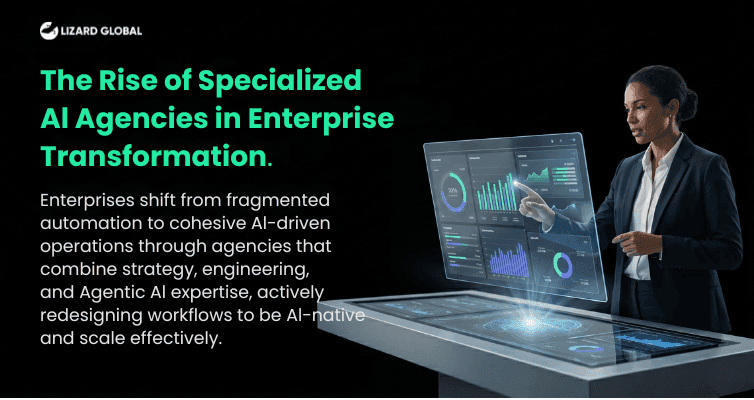
Moreover, this shift is not just technological, it is structural. Organizations are rethinking how teams, systems, and data interact. Rather than optimizing isolated processes, they are redesigning entire workflows to be AI-native from the ground up.
In this space, companies like Lizard Global stand out as full-stack digital solutions agencies that bridge the gap between AI strategy and execution, ensuring enterprises can scale transformation effectively.
From Automation to Agentic Workflows: A Structural Shift
Traditional automation relies heavily on predefined rules. However, Agentic Workflows introduce adaptive intelligence that can respond dynamically to changing conditions. This shift marks a move from deterministic systems to autonomous decision-making environments.
In practice, Enterprise AI Orchestration allows multiple AI systems and services to coordinate seamlessly. Instead of isolated bots, enterprises now deploy interconnected autonomous systems that collaborate across departments such as finance, operations, marketing, and customer service.
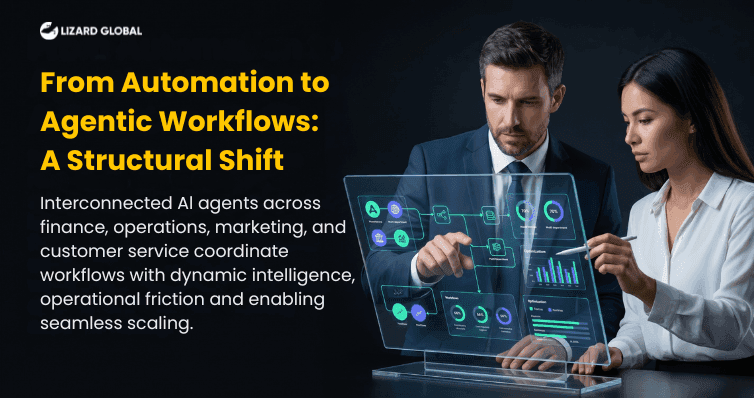
Furthermore, this evolution enables workflows to self-optimize. AI agents can identify inefficiencies, propose improvements, and execute changes with minimal human intervention. This significantly reduces operational friction while increasing scalability.
At the same time, businesses require structured design and engineering expertise to implement such systems. That is why web app development services and mobile app development agency capabilities are increasingly integrated into AI transformation initiatives.
Autonomous AI Agents and the Rise of AI Digital Labor
One of the most transformative developments in enterprise AI is the emergence of Autonomous AI Agents. These agents are capable of performing complex tasks such as data analysis, decision-making, and even cross-system coordination without constant human supervision.
This leads to the concept of AI Digital Labor, where AI agents function as a scalable workforce layer. Unlike traditional automation tools, these agents operate continuously, learn from feedback, and adapt to enterprise goals over time.
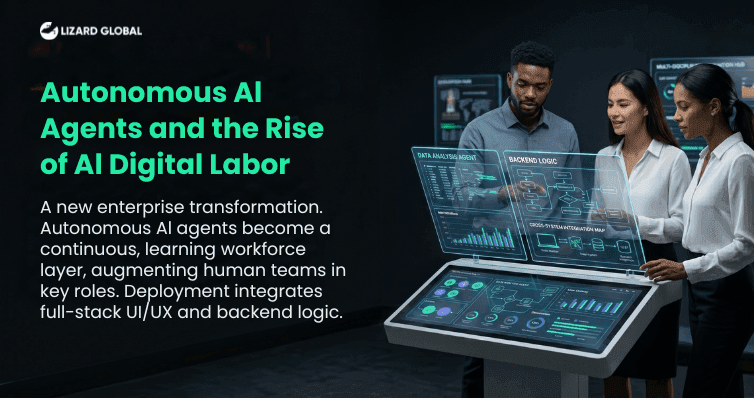
Additionally, this new digital labor model is not about replacing humans but augmenting them. Human teams can focus on strategic and creative work while AI agents handle repetitive or data-heavy operations.
However, deploying such systems requires careful architectural planning. Companies must integrate UX/UI product design, backend logic, and AI models into a unified system. This is where specialized agencies with full-stack capabilities become essential for long-term success.
Governance, Trust, and Control in Agentic AI Systems
As enterprises adopt more autonomous systems, governance becomes a critical concern. Concepts such as AI Guardrails, Human-in-the-Loop (HITL), and Agentic Governance & Compliance ensure that AI systems operate safely, transparently, and ethically.
AI Guardrails define boundaries within which AI agents must operate. Meanwhile, HITL frameworks ensure that humans remain part of the decision loop for sensitive or high-impact actions. This balance maintains trust while enabling automation at scale.
Equally important is AI Observability & Audit Logs. Enterprises need visibility into how AI decisions are made, what data is used, and how outcomes are generated. Without this transparency, scaling AI systems becomes risky.
Therefore, specialized AI agencies design governance frameworks alongside technical architectures. This ensures that enterprises can adopt Agentic AI for Enterprise responsibly while meeting regulatory and operational requirements.
Integrating AI into Enterprise Systems and Digital Ecosystems
AI transformation does not happen in isolation. It must integrate deeply into existing enterprise systems such as CRM platforms, analytics tools, and operational dashboards. This is where CRM integration services and growth analytics consulting become essential components of the transformation journey.
Modern enterprises also require seamless digital experiences across platforms. This includes iOS app development, Android app development, hybrid app development, and progressive web app development, all of which must align with AI-driven backend systems.
Moreover, UX/UI design services play a crucial role in ensuring that AI-powered systems remain intuitive and user-friendly. Without strong design foundations, even the most advanced AI systems risk low adoption and poor usability.
Companies like Lizard Global specialize in combining AI engineering with UX/UI product design and web app development services, enabling enterprises to build cohesive digital ecosystems that are both intelligent and scalable.
Measuring Impact: ROI and Enterprise AI Success Metrics
Implementing AI is not enough, enterprises must measure its impact. Metrics such as operational efficiency, cost reduction, decision speed, and customer satisfaction are critical indicators of success.
Additionally, growth analytics consulting helps organizations understand how AI influences business performance across multiple layers. This includes tracking workflow efficiency, user engagement, and revenue optimization.
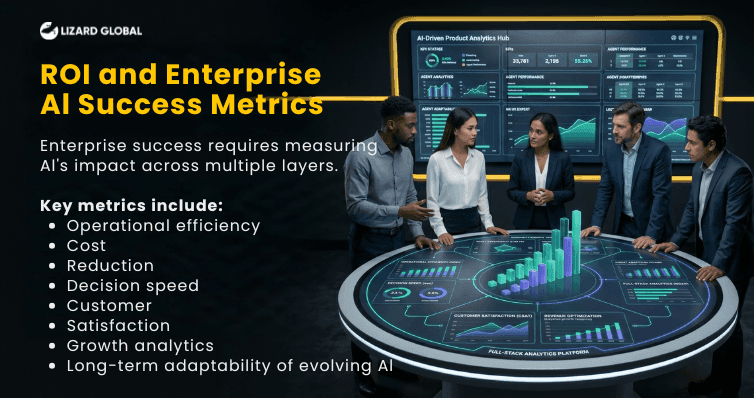
However, measuring ROI in Agentic AI systems is more complex than traditional software. Since AI agents continuously evolve, businesses must evaluate long-term adaptability and learning performance, not just static outputs.
This is why enterprises rely on experienced digital consultancy services that can interpret AI-driven insights and translate them into strategic business decisions alongside AI-driven analytics and product analytics expertise.
The Future of Enterprise AI and the Role of Strategic Partners
Looking ahead, enterprises will increasingly adopt AI-native operating models where Autonomous AI Agents become integral to every workflow. This will redefine how businesses scale, compete, and innovate.
As this evolution continues, the role of a trusted digital transformation partner becomes even more important. Organizations will need partners who understand both technology and business strategy to guide them through complexity.
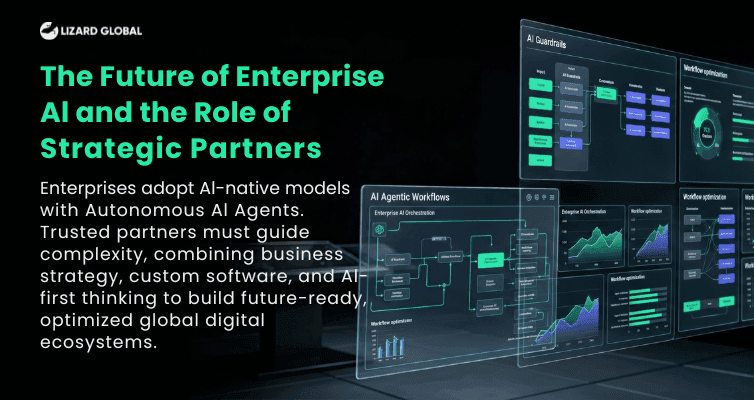
Specialized AI agencies will not only implement systems but also continuously optimize them.This includes refining Agentic Workflows, improving AI Guardrails, and expanding Enterprise AI Orchestration across global operations.
In this landscape, Lizard Global positions itself as a leader by combining custom software development company expertise with AI-first thinking, helping enterprises build future-ready digital ecosystems.
Transform Your Enterprise with AI That Thinks Beyond Automation
The shift toward Agentic AI for Enterprise is not just a technological upgrade, it is a complete redesign of how organizations operate. Specialized AI agencies are at the center of this transformation, enabling enterprises to move from fragmented automation to intelligent, self-optimizing systems.
As businesses adopt Autonomous AI Agents and Enterprise AI Orchestration, the need for strategic guidance, strong engineering, and scalable design becomes critical. That is why partnering with a full-stack digital transformation expert is no longer optional, it is essential.
If your organization is ready to redesign workflows, integrate AI Digital Labor, and unlock next-level efficiency, now is the time to act. Partner with Lizard Global to build intelligent enterprise systems that scale, adapt, and lead.
Enterprises today are under pressure to move faster, operate leaner, and deliver smarter digital experiences. This shift has accelerated the rise of specialized AI agencies that focus not just on implementing artificial intelligence, but on fundamentally redesigning how work gets done. By leveraging Agentic AI for Enterprise, Autonomous AI Agents, and Agentic Workflows, these agencies go beyond traditional automation. They orchestrate entire ecosystems of AI-driven processes that collaborate with humans, optimize decisions, and continuously improve performance. Companies like Lizard Global play a critical role in this transformation by combining AI strategy, custom software development, and full-stack digital solutions to help enterprises evolve into intelligent, adaptive organizations.
Enterprises are entering a new era of AI adoption, one that goes far beyond simple automation and chatbot integrations. As businesses face increasing operational complexity, the demand for intelligent systems that can reason, adapt, and collaborate across workflows is rapidly growing. This shift has fueled the rise of specialized AI agencies that combine strategy, engineering, and digital transformation expertise to help organizations build scalable, AI-native ecosystems.
From Autonomous AI Agents to Enterprise AI Orchestration, companies are now rethinking how technology, teams, and data work together to drive long-term efficiency, innovation, and competitive advantage.
Want to find out how much it costs to build your dream app or web app?
The Rise of Specialized AI Agencies in Enterprise Transformation
Enterprises are no longer satisfied with basic automation scripts or standalone AI tools. Instead, they are turning toward specialized AI agencies that understand how to redesign entire operational ecosystems. These agencies focus on Agentic AI for Enterprise, where intelligent systems do not just execute tasks but actively reason, decide, and collaborate across workflows.
As a result, businesses are shifting from fragmented automation to cohesive AI-driven operations. This is where the role of a digital transformation partner becomes essential. Agencies that combine strategy, engineering, and AI expertise are now shaping how modern enterprises evolve in a competitive digital landscape.
Moreover, this shift is not just technological, it is structural. Organizations are rethinking how teams, systems, and data interact. Rather than optimizing isolated processes, they are redesigning entire workflows to be AI-native from the ground up.
In this space, companies like Lizard Global stand out as full-stack digital solutions agencies that bridge the gap between AI strategy and execution, ensuring enterprises can scale transformation effectively.
From Automation to Agentic Workflows: A Structural Shift
Traditional automation relies heavily on predefined rules. However, Agentic Workflows introduce adaptive intelligence that can respond dynamically to changing conditions. This shift marks a move from deterministic systems to autonomous decision-making environments.
In practice, Enterprise AI Orchestration allows multiple AI systems and services to coordinate seamlessly. Instead of isolated bots, enterprises now deploy interconnected autonomous systems that collaborate across departments such as finance, operations, marketing, and customer service.
Furthermore, this evolution enables workflows to self-optimize. AI agents can identify inefficiencies, propose improvements, and execute changes with minimal human intervention. This significantly reduces operational friction while increasing scalability.
At the same time, businesses require structured design and engineering expertise to implement such systems. That is why web app development services and mobile app development agency capabilities are increasingly integrated into AI transformation initiatives.
Autonomous AI Agents and the Rise of AI Digital Labor
One of the most transformative developments in enterprise AI is the emergence of Autonomous AI Agents. These agents are capable of performing complex tasks such as data analysis, decision-making, and even cross-system coordination without constant human supervision.
This leads to the concept of AI Digital Labor, where AI agents function as a scalable workforce layer. Unlike traditional automation tools, these agents operate continuously, learn from feedback, and adapt to enterprise goals over time.
Additionally, this new digital labor model is not about replacing humans but augmenting them. Human teams can focus on strategic and creative work while AI agents handle repetitive or data-heavy operations.
However, deploying such systems requires careful architectural planning. Companies must integrate UX/UI product design, backend logic, and AI models into a unified system. This is where specialized agencies with full-stack capabilities become essential for long-term success.
Governance, Trust, and Control in Agentic AI Systems
As enterprises adopt more autonomous systems, governance becomes a critical concern. Concepts such as AI Guardrails, Human-in-the-Loop (HITL), and Agentic Governance & Compliance ensure that AI systems operate safely, transparently, and ethically.
AI Guardrails define boundaries within which AI agents must operate. Meanwhile, HITL frameworks ensure that humans remain part of the decision loop for sensitive or high-impact actions. This balance maintains trust while enabling automation at scale.
Equally important is AI Observability & Audit Logs. Enterprises need visibility into how AI decisions are made, what data is used, and how outcomes are generated. Without this transparency, scaling AI systems becomes risky.
Therefore, specialized AI agencies design governance frameworks alongside technical architectures. This ensures that enterprises can adopt Agentic AI for Enterprise responsibly while meeting regulatory and operational requirements.
Integrating AI into Enterprise Systems and Digital Ecosystems
AI transformation does not happen in isolation. It must integrate deeply into existing enterprise systems such as CRM platforms, analytics tools, and operational dashboards. This is where CRM integration services and growth analytics consulting become essential components of the transformation journey.
Modern enterprises also require seamless digital experiences across platforms. This includes iOS app development, Android app development, hybrid app development, and progressive web app development, all of which must align with AI-driven backend systems.
Moreover, UX/UI design services play a crucial role in ensuring that AI-powered systems remain intuitive and user-friendly. Without strong design foundations, even the most advanced AI systems risk low adoption and poor usability.
Companies like Lizard Global specialize in combining AI engineering with UX/UI product design and web app development services, enabling enterprises to build cohesive digital ecosystems that are both intelligent and scalable.
Measuring Impact: ROI and Enterprise AI Success Metrics
Implementing AI is not enough, enterprises must measure its impact. Metrics such as operational efficiency, cost reduction, decision speed, and customer satisfaction are critical indicators of success.
Additionally, growth analytics consulting helps organizations understand how AI influences business performance across multiple layers. This includes tracking workflow efficiency, user engagement, and revenue optimization.
However, measuring ROI in Agentic AI systems is more complex than traditional software. Since AI agents continuously evolve, businesses must evaluate long-term adaptability and learning performance, not just static outputs.
This is why enterprises rely on experienced digital consultancy services that can interpret AI-driven insights and translate them into strategic business decisions alongside AI-driven analytics and product analytics expertise.
The Future of Enterprise AI and the Role of Strategic Partners
Looking ahead, enterprises will increasingly adopt AI-native operating models where Autonomous AI Agents become integral to every workflow. This will redefine how businesses scale, compete, and innovate.
As this evolution continues, the role of a trusted digital transformation partner becomes even more important. Organizations will need partners who understand both technology and business strategy to guide them through complexity.
Specialized AI agencies will not only implement systems but also continuously optimize them.This includes refining Agentic Workflows, improving AI Guardrails, and expanding Enterprise AI Orchestration across global operations.
In this landscape, Lizard Global positions itself as a leader by combining custom software development company expertise with AI-first thinking, helping enterprises build future-ready digital ecosystems.
Transform Your Enterprise with AI That Thinks Beyond Automation
The shift toward Agentic AI for Enterprise is not just a technological upgrade, it is a complete redesign of how organizations operate. Specialized AI agencies are at the center of this transformation, enabling enterprises to move from fragmented automation to intelligent, self-optimizing systems.
As businesses adopt Autonomous AI Agents and Enterprise AI Orchestration, the need for strategic guidance, strong engineering, and scalable design becomes critical. That is why partnering with a full-stack digital transformation expert is no longer optional, it is essential.
If your organization is ready to redesign workflows, integrate AI Digital Labor, and unlock next-level efficiency, now is the time to act. Partner with Lizard Global to build intelligent enterprise systems that scale, adapt, and lead.
FAQs

What is an Agentic AI for Enterprise and how is it different from traditional AI?
How do Autonomous AI Agents improve business operations?
What are Agentic Workflows in enterprise environments?
Why is Enterprise AI Orchestration important?
How do companies ensure safe AI adoption with AI Guardrails?
What role does UX/UI design play in AI transformation?
Why choose a specialized AI agency instead of building in-house?


Stuck between a great idea and the right team to build it?Let's talk.
We work with corporate innovation teams and ambitious scale-ups across the Netherlands, Singapore, and Australia, and wherever great software needs to be built. Drop us a message and we'll get back to you within one business day.


Markus Monnikendam
Global Commercial Director
hello@lizard.global