Modern Architecture Patterns for Enterprise Web Application Development

13 May 2026
by Nadiy, Senior Content Writer
13 May 2026
by Nadiy, Senior Content Writer
Modern Architecture Patterns for Enterprise Web Application Development
Table of contents
Contact us
We will get back to you in the next 48 hours.
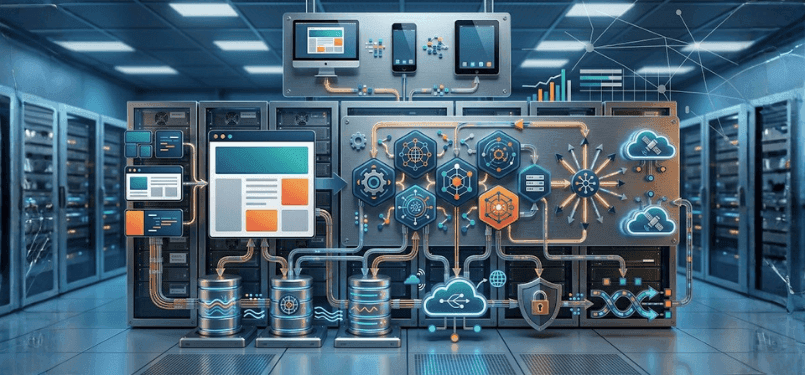
Modern enterprise web applications are no longer just about scalability and performance. They are evolving into intelligent, adaptive ecosystems powered by Agentic AI for Enterprise, Autonomous AI Agents, and sophisticated orchestration layers. As organizations scale, they require architecture patterns that support flexibility, resilience, and continuous evolution. This blog explores the most important modern architecture patterns shaping enterprise web development today, from microservices and event-driven systems to API-first and AI-augmented architectures. It also highlights how a digital transformation partner like Lizard Global helps enterprises design and build future-ready systems using full-stack digital solutions, UX/UI product design, and advanced web app development services. The goal is not just to build software, but to create intelligent, scalable digital ecosystems that drive measurable business impact.
key takeaways
Enterprise web application architecture has changed dramatically over the past decade. What once revolved around monolithic systems has now shifted toward distributed, modular, and intelligence-driven ecosystems. This evolution is being accelerated by the rise of Agentic AI for Enterprise, where systems are no longer static tools but active participants in decision-making and execution.
Today, enterprises are not just building applications; they are designing digital ecosystems. These ecosystems integrate Autonomous AI Agents, data pipelines, APIs, and cloud-native infrastructure to enable continuous adaptation. As a result, organizations are increasingly relying on a digital transformation partner to guide them through this complexity and ensure alignment between business goals and technical architecture.
At Lizard Global, this shift is approached as a holistic transformation challenge rather than just a development exercise. As a full-stack digital solutions agency and digital consultancy services provider, the focus is on building architecture that supports long-term scalability and intelligence integration.
Moreover, the rise of AI Digital Labor is changing how systems are designed. Instead of simply supporting users, applications now collaborate with intelligent agents to automate workflows, optimize decisions, and enhance operational efficiency. Insights from digital transformation trends show how rapidly this evolution is accelerating across industries.
Want to find out how much it costs to build your dream app or web app?


Microservices Architecture as the Backbone of Scalable Enterprise Systems
Microservices architecture remains one of the most widely adopted patterns in enterprise web application development. It breaks down large applications into smaller, independent services that communicate through APIs. This approach significantly improves scalability, maintainability, and deployment flexibility.
However, modern microservices are evolving beyond traditional boundaries. They now serve as foundational building blocks for Enterprise AI Orchestration, where each service can interact with Autonomous AI Agents and external systems in real time. This enables enterprises to build adaptive systems that respond dynamically to changing business conditions.
In practice, a custom software development company like Lizard Global designs microservices with AI-readiness in mind. This means embedding observability, API-first design principles, and modular data structures that support future AI integration.
Additionally, microservices enable seamless integration with API-driven architectures and growth analytics platforms. This ensures that every service contributes to a unified data ecosystem, supporting better decision-making across the enterprise.
Strategic engineering approaches such as platform scalability patterns further demonstrate how distributed systems evolve under high-demand environments.
Event-Driven Architecture and Real-Time Enterprise Responsiveness
Event-driven architecture (EDA) is another critical pattern in modern enterprise systems. Instead of relying on direct requests between services, systems communicate through events. This allows for asynchronous processing, real-time updates, and improved system resilience.
In enterprise environments, EDA plays a crucial role in enabling Agentic Workflows. These workflows allow systems to react autonomously to business events, triggering actions without human intervention. For example, an order placed in an e-commerce system can automatically initiate inventory updates, fraud detection, and personalized marketing actions.
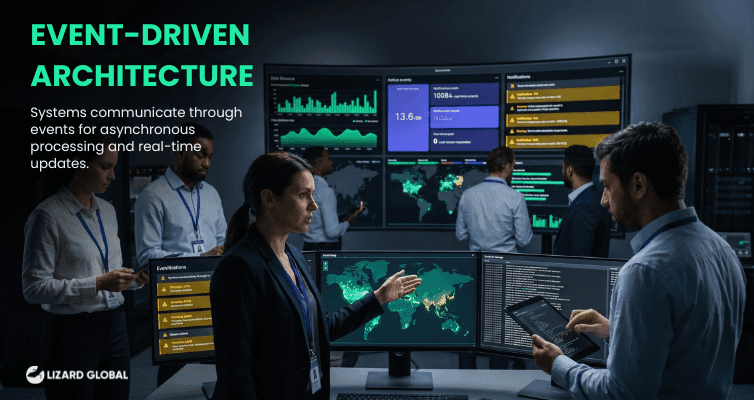
When combined with Autonomous AI Agents, event-driven systems become even more powerful. AI agents can subscribe to events, analyze patterns, and initiate intelligent responses. This is a key step toward building AI Digital Labor systems that augment human teams.
A web app development services provider like Lizard Global typically implements event-driven architectures using cloud-native technologies and message brokers. This is reinforced through disciplined engineering practices such as continuous deployment pipelines and secure system governance.
Real-world implementations such as Travereel demonstrate how event-driven design enhances real-time user experiences at scale.
Furthermore, AI governance frameworks ensure that every event and AI-driven decision remains traceable and compliant.
API-First and Headless Architectures for Enterprise Flexibility
API-first architecture has become a standard in modern enterprise development. It ensures that all system functionalities are exposed through well-defined APIs, enabling integration across platforms, devices, and services.
Headless architecture builds on this concept by decoupling the frontend from the backend entirely. This allows enterprises to deliver consistent experiences across web, mobile, and emerging digital channels such as iOS app development, Android app development, hybrid app development, and progressive web app development.
This separation is particularly important in enterprise environments where speed and flexibility are critical. It enables teams to iterate on frontend experiences without disrupting backend systems, and vice versa.
From a UX/UI product design perspective, headless systems also allow for more experimentation and personalization. Design teams can create tailored experiences without being constrained by backend limitations through UI design services and UX design services.
Advanced structuring through scalable design systems ensures consistency across all digital touchpoints. Industry insights such as ecommerce architecture strategies highlight how headless systems support global scalability.
AI-Driven Architecture: From Deterministic Systems to Agentic Ecosystems
One of the most significant shifts in modern architecture is the move from deterministic systems to agentic systems. Traditional applications follow predefined logic paths, while Agentic AI systems can reason, adapt, and act autonomously within defined boundaries.
This evolution introduces concepts such as AI Guardrails, Human-in-the-Loop (HITL), and Agentic Governance & Compliance. These frameworks ensure that while Autonomous AI Agents operate independently, they remain aligned with business rules, ethical standards, and regulatory requirements.
Enterprise AI Orchestration plays a central role in this architecture. It coordinates multiple AI agents, APIs, and services into cohesive workflows that deliver business outcomes. Instead of isolated automation, enterprises achieve system-wide intelligence.
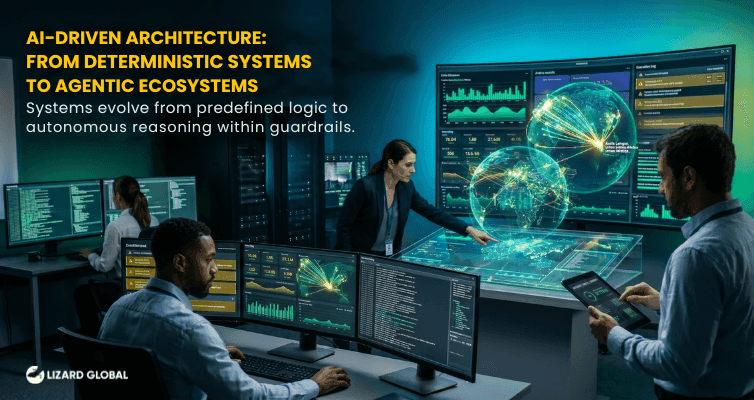
A digital consultancy services provider like Lizard Global integrates these principles into enterprise architecture design using operational support frameworks and performance optimization systems.
Continuous evolution is supported through iterative product development. Meanwhile, data-driven intelligence is enhanced through AI-powered analytics transformation and next-generation information systems.
Cloud-Native Infrastructure and Full-Stack Digital Ecosystems
Cloud-native architecture is the foundation that enables all modern enterprise patterns to function effectively. It provides scalability, resilience, and global accessibility, which are essential for enterprise-grade applications.
When combined with full-stack digital solutions, cloud-native systems allow organizations to build end-to-end platforms that integrate frontend, backend, AI, and analytics layers seamlessly. This holistic approach eliminates silos and improves operational efficiency.
A custom software development company like Lizard Global leverages cloud-native technologies through platform modernisation services. Modern distributed systems are further strengthened by architectural approaches discussed in cloud-native evolution strategies.
Scaling challenges are addressed through insights from high-traffic system design. Technology alignment decisions are guided by enterprise tech stack strategy. Finally, Industry 4.0 ecosystems illustrate how cloud-native infrastructure supports industrial-scale transformation.
The Future of Enterprise Web Architecture: Intelligent, Autonomous, and Composable
The future of enterprise web application architecture is moving toward fully composable and intelligent systems. These systems will combine microservices, event-driven design, and AI orchestration into unified ecosystems that can evolve in real time.
Autonomous AI Agents will increasingly take on operational responsibilities, from data analysis to workflow execution. Meanwhile, Human-in-the-Loop (HITL) frameworks will ensure that humans remain involved in critical decision points.
In this future, Enterprise AI Orchestration will become the central nervous system of digital enterprises. It will coordinate AI, data, and services across the entire organization, enabling unprecedented levels of efficiency and responsiveness.
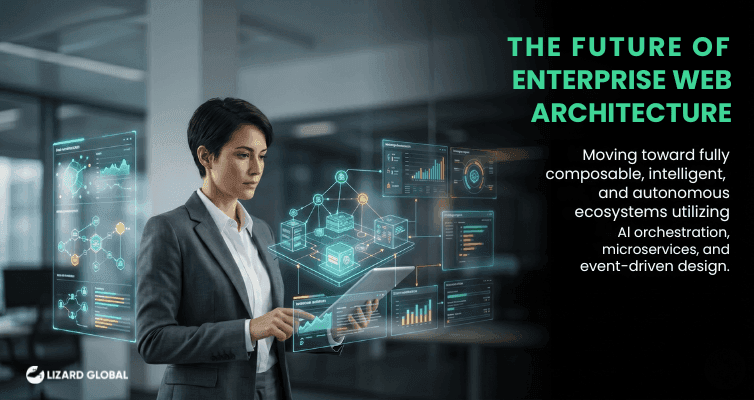
Lizard Global supports this transition through go-to-market strategy alignment and growth analytics systems. Real-world ecosystem thinking is reflected in Tactlink.
Forward-looking engineering insights such as enterprise evolution frameworks and scalability challenges in digital growth highlight the shift toward composable architecture. Ultimately, the organizations that succeed will be those that treat architecture not as infrastructure, but as a strategic capability for innovation.
Let’s Build Intelligent, Scalable, and Autonomous Digital Systems Together
Modern enterprise architecture is no longer just about building systems that work. It is about building systems that think, adapt, and evolve.

If your organization is exploring Agentic AI for Enterprise, modernizing legacy systems, or building scalable digital ecosystems, Lizard Global can help you design and implement future-ready architecture that drives measurable business impact through enterprise support systems, cost estimation planning, and rapid prototyping services.
Let’s build your next-generation enterprise AI system, Connect with Lizard Global to start your transformation journey today.
Modern enterprise web applications are no longer just about scalability and performance. They are evolving into intelligent, adaptive ecosystems powered by Agentic AI for Enterprise, Autonomous AI Agents, and sophisticated orchestration layers. As organizations scale, they require architecture patterns that support flexibility, resilience, and continuous evolution. This blog explores the most important modern architecture patterns shaping enterprise web development today, from microservices and event-driven systems to API-first and AI-augmented architectures. It also highlights how a digital transformation partner like Lizard Global helps enterprises design and build future-ready systems using full-stack digital solutions, UX/UI product design, and advanced web app development services. The goal is not just to build software, but to create intelligent, scalable digital ecosystems that drive measurable business impact.
Enterprise web application architecture has changed dramatically over the past decade. What once revolved around monolithic systems has now shifted toward distributed, modular, and intelligence-driven ecosystems. This evolution is being accelerated by the rise of Agentic AI for Enterprise, where systems are no longer static tools but active participants in decision-making and execution.
Today, enterprises are not just building applications; they are designing digital ecosystems. These ecosystems integrate Autonomous AI Agents, data pipelines, APIs, and cloud-native infrastructure to enable continuous adaptation. As a result, organizations are increasingly relying on a digital transformation partner to guide them through this complexity and ensure alignment between business goals and technical architecture.
At Lizard Global, this shift is approached as a holistic transformation challenge rather than just a development exercise. As a full-stack digital solutions agency and digital consultancy services provider, the focus is on building architecture that supports long-term scalability and intelligence integration.
Moreover, the rise of AI Digital Labor is changing how systems are designed. Instead of simply supporting users, applications now collaborate with intelligent agents to automate workflows, optimize decisions, and enhance operational efficiency. Insights from digital transformation trends show how rapidly this evolution is accelerating across industries.
Want to find out how much it costs to build your dream app or web app?
Microservices Architecture as the Backbone of Scalable Enterprise Systems
Microservices architecture remains one of the most widely adopted patterns in enterprise web application development. It breaks down large applications into smaller, independent services that communicate through APIs. This approach significantly improves scalability, maintainability, and deployment flexibility.
However, modern microservices are evolving beyond traditional boundaries. They now serve as foundational building blocks for Enterprise AI Orchestration, where each service can interact with Autonomous AI Agents and external systems in real time. This enables enterprises to build adaptive systems that respond dynamically to changing business conditions.
In practice, a custom software development company like Lizard Global designs microservices with AI-readiness in mind. This means embedding observability, API-first design principles, and modular data structures that support future AI integration.
Additionally, microservices enable seamless integration with API-driven architectures and growth analytics platforms. This ensures that every service contributes to a unified data ecosystem, supporting better decision-making across the enterprise.
Strategic engineering approaches such as platform scalability patterns further demonstrate how distributed systems evolve under high-demand environments.
Event-Driven Architecture and Real-Time Enterprise Responsiveness
Event-driven architecture (EDA) is another critical pattern in modern enterprise systems. Instead of relying on direct requests between services, systems communicate through events. This allows for asynchronous processing, real-time updates, and improved system resilience.
In enterprise environments, EDA plays a crucial role in enabling Agentic Workflows. These workflows allow systems to react autonomously to business events, triggering actions without human intervention. For example, an order placed in an e-commerce system can automatically initiate inventory updates, fraud detection, and personalized marketing actions.
When combined with Autonomous AI Agents, event-driven systems become even more powerful. AI agents can subscribe to events, analyze patterns, and initiate intelligent responses. This is a key step toward building AI Digital Labor systems that augment human teams.
A web app development services provider like Lizard Global typically implements event-driven architectures using cloud-native technologies and message brokers. This is reinforced through disciplined engineering practices such as continuous deployment pipelines and secure system governance.
Real-world implementations such as Travereel demonstrate how event-driven design enhances real-time user experiences at scale.
Furthermore, AI governance frameworks ensure that every event and AI-driven decision remains traceable and compliant.
API-First and Headless Architectures for Enterprise Flexibility
API-first architecture has become a standard in modern enterprise development. It ensures that all system functionalities are exposed through well-defined APIs, enabling integration across platforms, devices, and services.
Headless architecture builds on this concept by decoupling the frontend from the backend entirely. This allows enterprises to deliver consistent experiences across web, mobile, and emerging digital channels such as iOS app development, Android app development, hybrid app development, and progressive web app development.
This separation is particularly important in enterprise environments where speed and flexibility are critical. It enables teams to iterate on frontend experiences without disrupting backend systems, and vice versa.
From a UX/UI product design perspective, headless systems also allow for more experimentation and personalization. Design teams can create tailored experiences without being constrained by backend limitations through UI design services and UX design services.
Advanced structuring through scalable design systems ensures consistency across all digital touchpoints. Industry insights such as ecommerce architecture strategies highlight how headless systems support global scalability.
AI-Driven Architecture: From Deterministic Systems to Agentic Ecosystems
One of the most significant shifts in modern architecture is the move from deterministic systems to agentic systems. Traditional applications follow predefined logic paths, while Agentic AI systems can reason, adapt, and act autonomously within defined boundaries.
This evolution introduces concepts such as AI Guardrails, Human-in-the-Loop (HITL), and Agentic Governance & Compliance. These frameworks ensure that while Autonomous AI Agents operate independently, they remain aligned with business rules, ethical standards, and regulatory requirements.
Enterprise AI Orchestration plays a central role in this architecture. It coordinates multiple AI agents, APIs, and services into cohesive workflows that deliver business outcomes. Instead of isolated automation, enterprises achieve system-wide intelligence.
A digital consultancy services provider like Lizard Global integrates these principles into enterprise architecture design using operational support frameworks and performance optimization systems.
Continuous evolution is supported through iterative product development. Meanwhile, data-driven intelligence is enhanced through AI-powered analytics transformation and next-generation information systems.
Cloud-Native Infrastructure and Full-Stack Digital Ecosystems
Cloud-native architecture is the foundation that enables all modern enterprise patterns to function effectively. It provides scalability, resilience, and global accessibility, which are essential for enterprise-grade applications.
When combined with full-stack digital solutions, cloud-native systems allow organizations to build end-to-end platforms that integrate frontend, backend, AI, and analytics layers seamlessly. This holistic approach eliminates silos and improves operational efficiency.
A custom software development company like Lizard Global leverages cloud-native technologies through platform modernisation services. Modern distributed systems are further strengthened by architectural approaches discussed in cloud-native evolution strategies.
Scaling challenges are addressed through insights from high-traffic system design. Technology alignment decisions are guided by enterprise tech stack strategy. Finally, Industry 4.0 ecosystems illustrate how cloud-native infrastructure supports industrial-scale transformation.
The Future of Enterprise Web Architecture: Intelligent, Autonomous, and Composable
The future of enterprise web application architecture is moving toward fully composable and intelligent systems. These systems will combine microservices, event-driven design, and AI orchestration into unified ecosystems that can evolve in real time.
Autonomous AI Agents will increasingly take on operational responsibilities, from data analysis to workflow execution. Meanwhile, Human-in-the-Loop (HITL) frameworks will ensure that humans remain involved in critical decision points.
In this future, Enterprise AI Orchestration will become the central nervous system of digital enterprises. It will coordinate AI, data, and services across the entire organization, enabling unprecedented levels of efficiency and responsiveness.
Lizard Global supports this transition through go-to-market strategy alignment and growth analytics systems. Real-world ecosystem thinking is reflected in Tactlink.
Forward-looking engineering insights such as enterprise evolution frameworks and scalability challenges in digital growth highlight the shift toward composable architecture. Ultimately, the organizations that succeed will be those that treat architecture not as infrastructure, but as a strategic capability for innovation.
Let’s Build Intelligent, Scalable, and Autonomous Digital Systems Together
Modern enterprise architecture is no longer just about building systems that work. It is about building systems that think, adapt, and evolve.
If your organization is exploring Agentic AI for Enterprise, modernizing legacy systems, or building scalable digital ecosystems, Lizard Global can help you design and implement future-ready architecture that drives measurable business impact through enterprise support systems, cost estimation planning, and rapid prototyping services.
Let’s build your next-generation enterprise AI system, Connect with Lizard Global to start your transformation journey today.
FAQs

What are modern architecture patterns in enterprise web application development?
How does Agentic AI for Enterprise impact system architecture?
Why is microservices architecture important for enterprise applications?
What is Enterprise AI Orchestration?
How do AI Guardrails and Human-in-the-Loop (HITL) systems work?
What role does a digital transformation partner play in enterprise architecture?
How does Lizard Global support enterprise web application development?
similar reads

AI & Machine Learning
Enterprise Digital Transformation Services Powered by AI Integration
15 June 2026

AI & Machine Learning
How Malaysian Enterprises Can Recover Failing Software Projects with AI-Led Delivery
18 June 2026

AI & Machine Learning
Malaysia’s Top 5 Leading AI Integration Agencies for Enterprise-Scale Systems
24 June 2026
Stuck between a great idea and the right team to build it?Let's talk.
We work with corporate innovation teams and ambitious scale-ups across the Netherlands, Singapore, and Australia, and wherever great software needs to be built. Drop us a message and we'll get back to you within one business day.


Markus Monnikendam
Global Commercial Director
hello@lizard.global