Agentic AI for Enterprise Transformation: Choosing the Right Delivery Partner
08 May 2026
by Team Lizard Global
Editor: Nadiy, Senior Content Writer
08 May 2026
by Team Lizard Global
Editor: Nadiy, Senior Content Writer
Agentic AI for Enterprise Transformation: Choosing the Right Delivery Partner
Table of contents
Contact us
We will get back to you in the next 48 hours.

Agentic AI is rapidly reshaping enterprise operations through Autonomous AI Agents, intelligent workflows, and enterprise-wide orchestration. However, success depends heavily on choosing the right delivery partner. This blog explores how enterprises can evaluate AI partners, implement scalable Agentic Workflows, establish governance frameworks, and unlock measurable business value. It also examines the importance of AI Guardrails, Human-in-the-Loop systems, compliance, observability, and full-stack digital execution. Discover how experienced digital transformation partners like Lizard Global help organizations move from experimentation to enterprise-wide AI adoption with secure, scalable, and business-driven solutions.
key takeaways
Artificial intelligence is no longer limited to simple automation or predictive analytics. Today, enterprises are entering a new phase of digital transformation powered by Agentic AI for Enterprise. Unlike traditional AI systems that respond to prompts or predefined rules, Agentic AI introduces Autonomous AI Agents capable of reasoning, planning, making decisions, and executing tasks across complex workflows.
This shift is changing how enterprises approach operations, customer experiences, and internal productivity. Businesses are now exploring Agentic Workflows that can autonomously coordinate tasks across departments, systems, and digital environments. As a result, Enterprise AI Orchestration has become a strategic priority for organizations aiming to scale AI beyond isolated pilots.
However, implementing Agentic AI successfully requires more than access to large language models or automation tools. Enterprises need a delivery partner capable of combining AI expertise with scalable engineering, UI/UX design services, enterprise architecture, governance frameworks, and long-term operational support. The difference between a successful AI transformation and an expensive experiment often comes down to choosing the right partner.
For organizations navigating this rapidly evolving landscape, partnering with an experienced custom software development company and digital transformation partner is becoming essential. Businesses need teams that understand how to integrate AI into real-world enterprise systems while maintaining compliance, security, observability, and measurable ROI. Organizations evaluating long-term AI scalability can also explore custom software development as a strategic advantage and enterprise-ready software development.
Want to find out how much it costs to build your dream app or web app?


Understanding Agentic AI for Enterprise Environments
Traditional AI systems are designed to complete narrowly defined tasks. They analyze data, generate outputs, or automate repetitive activities based on predetermined rules. Agentic AI, however, operates differently. Autonomous AI Agents can independently assess goals, adapt to changing contexts, coordinate with other systems, and execute multi-step processes with minimal human intervention.
This capability introduces a major leap forward for enterprise operations. Instead of relying on disconnected automations, organizations can deploy AI systems that function more like digital team members. These systems can retrieve data, communicate across platforms, trigger workflows, escalate issues, and continuously optimize processes. For example, an enterprise customer service environment may use Agentic Workflows to autonomously manage support tickets, update CRM systems, analyze customer sentiment, recommend resolutions, and escalate sensitive issues to human teams. Similarly, supply chain operations can leverage Enterprise AI Orchestration to predict disruptions, coordinate procurement actions, and dynamically adjust logistics strategies.
Yet, implementing these capabilities requires deep technical expertise. Enterprises need infrastructure capable of supporting scalable AI orchestration, API integrations, cloud-native architectures, and secure data handling. This is where a full-stack digital solutions agency becomes highly valuable. Businesses benefit from partners that can combine AI engineering with web app development services, mobile app development agency capabilities, and enterprise integration expertise.
More importantly, enterprises must ensure that Agentic AI systems align with business goals rather than operating as isolated technical experiments. The right digital consultancy services partner focuses not only on AI capabilities but also on operational outcomes, process redesign, user adoption, and measurable business impact.
A strong example of scalable platform execution can be seen in Travereel, where intelligent user experiences and scalable digital infrastructure supported complex travel planning workflows. Similar scalability challenges are explored in scaling two-sided marketplace platforms and scaling modern web applications during traffic spikes.
Why Enterprises Need More Than Just AI Developers
Many organizations assume that implementing Agentic AI simply requires hiring AI engineers or integrating a large language model. In reality, enterprise AI transformation is far more complex. Successful deployment requires collaboration between AI specialists, software engineers, product strategists, UI/UX experts, compliance professionals, and infrastructure architects.
This is why enterprises increasingly seek experienced digital transformation partners rather than standalone AI vendors. Agentic AI affects entire operational ecosystems, including customer interfaces, internal workflows, compliance processes, and employee collaboration systems.
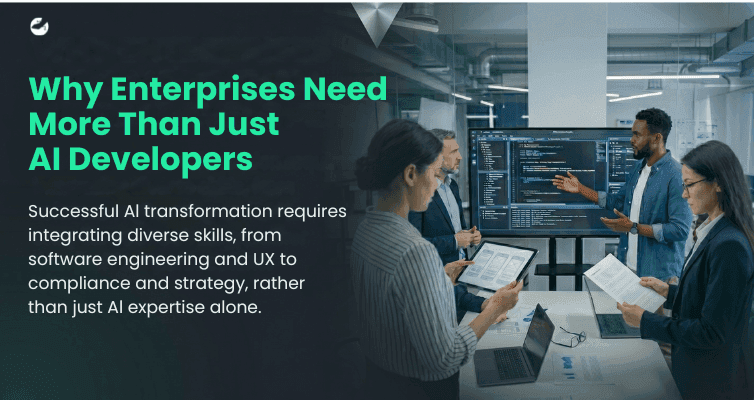
For example, when deploying Autonomous AI Agents across enterprise applications, organizations must ensure seamless integration between backend systems, CRM integration services, analytics tools, cloud infrastructure, and user-facing platforms. Whether the solution involves iOS app development, Android app development, hybrid app development, or progressive web app development, the AI experience must remain intuitive, scalable, and aligned with business objectives.
UI/UX design services play a particularly important role in enterprise AI adoption. Employees need transparency into how AI systems make decisions, when human oversight is required, and how workflows can be adjusted. Poor user experience design often leads to low adoption rates, operational confusion, and resistance to AI-driven processes. Businesses looking to improve enterprise UX strategies can also explore why enterprise UX fails without digital transformation strategy and Lizard Global’s UI/UX design process.
Additionally, enterprises must address operational reliability. Agentic systems continuously interact with live data and dynamic environments. Without strong observability and governance mechanisms, AI agents can create unexpected risks. Experienced full-stack digital solutions agencies understand how to design systems that balance autonomy with operational control.
Lizard Global’s approach reflects this broader perspective. Rather than treating AI as a standalone feature, enterprise AI initiatives should be built into scalable digital ecosystems that support long-term transformation, operational flexibility, and measurable growth.
Projects like ChatLicense and Compeasy AI demonstrate how AI-enabled platforms can be combined with scalable product ecosystems and intuitive user experiences.
For additional insights into enterprise AI implementation and governance, businesses can also explore AI consultancy strategies, AI integration approaches, and self-hosted AI solutions.
The Growing Importance of Enterprise AI Orchestration
As organizations adopt multiple AI tools and agents, orchestration becomes increasingly critical. Enterprise AI Orchestration refers to the coordination of various AI systems, workflows, integrations, and decision-making processes across the enterprise ecosystem.
Without orchestration, businesses often end up with fragmented AI solutions that operate in silos. One department may use AI for customer service while another deploys separate automation tools for operations. These disconnected systems limit scalability and create operational inefficiencies.
Agentic Workflows solve this challenge by enabling Autonomous AI Agents to collaborate across systems and departments. Instead of isolated automations, enterprises can create interconnected workflows that dynamically respond to business conditions.
For instance, a healthcare provider could orchestrate patient scheduling, insurance verification, resource allocation, and follow-up communications through integrated AI agents. Meanwhile, a logistics company could coordinate inventory systems, transportation networks, supplier communications, and predictive maintenance through centralized AI orchestration.
However, orchestration introduces technical and governance challenges. Enterprises must manage data consistency, API reliability, workflow dependencies, and AI decision visibility. This is why businesses benefit from working with experienced custom software development companies that understand enterprise architecture at scale.
A strong delivery partner also ensures that orchestration frameworks remain flexible as technologies evolve. AI capabilities are advancing rapidly, and enterprises need scalable infrastructure that can adapt without requiring constant system rebuilds.
Lizard Global’s expertise in scalable software ecosystems, platform modernisation, and digital consultancy services positions enterprises to build future-ready AI infrastructures rather than short-term experimental solutions.
Organizations exploring scalable enterprise ecosystems may also benefit from insights shared in cloud-native vs serverless architecture, software modernization strategies, and platform engineering vs outsourcing delivery models.
AI Guardrails, Governance, and Human Oversight Are Essential
As enterprises deploy more autonomous systems, governance becomes non-negotiable. Agentic AI introduces enormous operational potential, but it also increases risk if organizations fail to establish proper oversight mechanisms.
This is where AI Guardrails and Agentic Governance & Compliance frameworks become essential. Enterprises need clear controls around how Autonomous AI Agents access data, make decisions, escalate issues, and interact with users.
For example, highly regulated industries such as healthcare, finance, and insurance often require Human-in-the-Loop (HITL) frameworks to ensure that humans validate high-risk decisions before execution. HITL systems help organizations maintain accountability while still benefiting from AI-driven efficiency.
Similarly, AI Observability & Audit Logs provide transparency into how AI agents behave over time. Enterprises need visibility into decision paths, workflow actions, system interactions, and performance metrics. Without observability, troubleshooting and compliance management become extremely difficult.
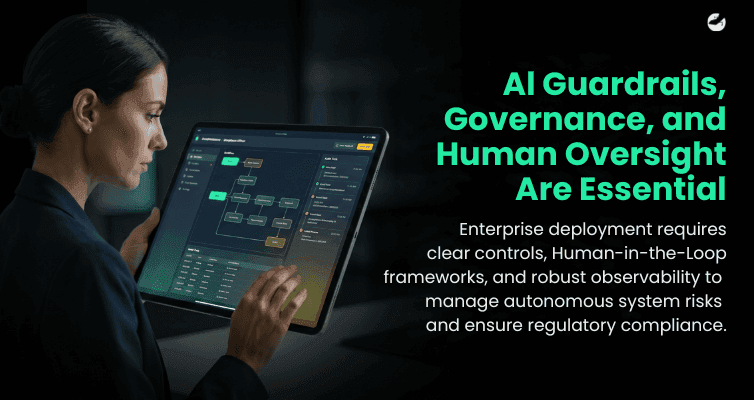
The distinction between Deterministic vs. Agentic AI is also important. Deterministic systems follow predefined rules and predictable workflows, while Agentic AI systems adapt dynamically to changing conditions. Although this adaptability creates greater value, it also increases the need for governance frameworks capable of monitoring evolving behaviors.
Experienced digital transformation partners help enterprises design governance structures from the beginning rather than treating compliance as an afterthought. This includes defining escalation rules, approval layers, audit systems, data permissions, and operational boundaries.
Lizard Global’s enterprise-focused approach emphasizes scalable governance alongside innovation. This balance is critical for organizations seeking to deploy AI responsibly while maintaining operational trust and regulatory alignment. Businesses focused on secure enterprise infrastructure can also explore security and ISO compliance services, along with related insights in AI cybersecurity applications, application security advancements, and the cost of enterprise privacy failures.
Choosing the Right Agentic AI Delivery Partner
Selecting the right delivery partner is one of the most important decisions in any enterprise AI initiative. Many vendors claim AI expertise, but relatively few possess the multidisciplinary capabilities required for enterprise-scale transformation.
The best partners combine AI engineering with enterprise software development, infrastructure scalability, user experience design, and strategic consulting. Enterprises should evaluate potential partners across several critical areas. First, technical depth matters. A reliable custom software development company should demonstrate expertise in AI architecture, cloud-native infrastructure, API ecosystems, security frameworks, and scalable deployment strategies. AI systems rarely operate independently. They must integrate seamlessly with enterprise environments.
Second, businesses should assess product and design capabilities. Strong UI design and UX design ensure that AI systems remain understandable, accessible, and operationally effective. Agentic AI adoption often fails when employees struggle to trust or interact with autonomous systems.
Third, enterprises should prioritize strategic alignment. A true digital transformation partner focuses on business outcomes rather than technology alone. The goal is not simply to deploy AI, but to improve operational efficiency, customer experience, scalability, and competitive advantage.
Fourth, organizations should evaluate post-launch support capabilities. Agentic AI systems require ongoing optimization, monitoring, governance updates, and performance tuning. Enterprises benefit from partners that provide long-term support rather than one-time implementation services.
Lizard Global’s positioning reflects this integrated delivery model. By combining software engineering, AI integration, UI/UX design services, and growth analytics consulting, enterprises gain access to teams capable of delivering end-to-end digital transformation initiatives.
Case studies such as Heineken Drinkies, Bricklinq, and SaleDuck highlight how scalable digital ecosystems can support enterprise growth, analytics, and operational efficiency.
For businesses evaluating long-term transformation partnerships, additional insights can be found in custom software development strategies, enterprise-ready software development, and long-term operating costs in enterprise transformation.
The Future of Digital Labor and Enterprise Operations
The rise of AI Digital Labor is fundamentally reshaping enterprise operations. Businesses are no longer simply automating isolated tasks. They are building intelligent operational ecosystems powered by Autonomous AI Agents capable of handling increasingly sophisticated responsibilities.
Over the next several years, enterprises will likely see AI agents supporting finance operations, customer success, procurement, HR workflows, sales enablement, compliance monitoring, and operational analytics. Agentic Workflows will become deeply embedded into enterprise infrastructure.
This evolution will also change workforce dynamics. Employees will increasingly collaborate with AI agents rather than treating automation as a separate tool. Human teams will focus more on strategic decision-making, exception handling, and innovation while AI systems manage repetitive coordination and execution tasks.
However, organizations that succeed in this transition will not simply adopt the newest AI tools. They will build scalable operational foundations supported by reliable Enterprise AI Orchestration, governance systems, and user-centric design. This creates enormous opportunities for enterprises willing to invest strategically in digital transformation. Companies that move early can gain operational advantages, improve efficiency, accelerate innovation cycles, and create more adaptive business models.
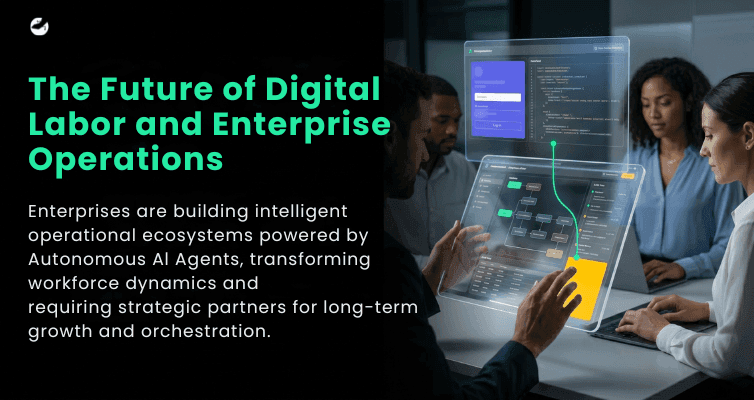
Choosing the right partner becomes especially important in this context. AI transformation is no longer just a technical initiative. It is a long-term business strategy that requires strong execution capabilities across engineering, operations, product design, and organizational change management.
Organizations exploring AI-driven operational models may also benefit from AI governance frameworks, AI-powered business analytics, AI-driven quality assurance strategies, and continuous AI system optimization.
Why Lizard Global Is Positioned to Lead Enterprise Agentic AI Transformation
As enterprises move toward AI-driven operational models, they need partners capable of bridging strategy, technology, and execution. This is where Lizard Global’s expertise becomes particularly relevant.
Modern Agentic AI initiatives require far more than isolated development services. Enterprises need scalable architectures, cross-platform software ecosystems, seamless integrations, user-centered experiences, and governance-ready infrastructures. Lizard Global’s experience as a full-stack digital solutions agency positions organizations to build these capabilities holistically.
From web app development services and mobile app development agency expertise to CRM integration services and digital consultancy services, successful AI transformation depends on aligning every layer of the digital ecosystem. Enterprises benefit from partners that understand both advanced AI technologies and practical business implementation.
Additionally, AI adoption requires adaptability. Technologies evolve quickly, and organizations need flexible infrastructure capable of supporting continuous innovation. Lizard Global’s approach to scalable digital product development helps enterprises remain agile while maintaining operational reliability.
Projects such as Narrates AI, My New Behavior, and Strivers Hub further demonstrate the ability to combine scalable technology ecosystems with user-centered digital transformation initiatives.
The future of enterprise transformation will increasingly depend on Agentic AI for Enterprise. Organizations that invest strategically today will position themselves to lead tomorrow’s competitive landscape.
Ready to Build Enterprise-Grade Agentic AI Solutions?
The shift toward Autonomous AI Agents and intelligent enterprise orchestration is accelerating. Organizations that act now can unlock faster operations, scalable digital labor, stronger customer experiences, and long-term competitive advantages.

Lizard Global helps enterprises transform ambitious AI strategies into scalable business realities through custom software development, enterprise AI integration, UI/UX design services, and full-stack digital transformation expertise.
Whether you are exploring Agentic Workflows, Enterprise AI Orchestration, or enterprise-grade AI governance frameworks, the right delivery partner can determine the success of your transformation journey.
👉 Connect with Lizard Global today to explore how enterprise-ready Agentic AI solutions can accelerate your business growth and operational innovation.
Agentic AI is rapidly reshaping enterprise operations through Autonomous AI Agents, intelligent workflows, and enterprise-wide orchestration. However, success depends heavily on choosing the right delivery partner. This blog explores how enterprises can evaluate AI partners, implement scalable Agentic Workflows, establish governance frameworks, and unlock measurable business value. It also examines the importance of AI Guardrails, Human-in-the-Loop systems, compliance, observability, and full-stack digital execution. Discover how experienced digital transformation partners like Lizard Global help organizations move from experimentation to enterprise-wide AI adoption with secure, scalable, and business-driven solutions.
Artificial intelligence is no longer limited to simple automation or predictive analytics. Today, enterprises are entering a new phase of digital transformation powered by Agentic AI for Enterprise. Unlike traditional AI systems that respond to prompts or predefined rules, Agentic AI introduces Autonomous AI Agents capable of reasoning, planning, making decisions, and executing tasks across complex workflows.
This shift is changing how enterprises approach operations, customer experiences, and internal productivity. Businesses are now exploring Agentic Workflows that can autonomously coordinate tasks across departments, systems, and digital environments. As a result, Enterprise AI Orchestration has become a strategic priority for organizations aiming to scale AI beyond isolated pilots.
However, implementing Agentic AI successfully requires more than access to large language models or automation tools. Enterprises need a delivery partner capable of combining AI expertise with scalable engineering, UI/UX design services, enterprise architecture, governance frameworks, and long-term operational support. The difference between a successful AI transformation and an expensive experiment often comes down to choosing the right partner.
For organizations navigating this rapidly evolving landscape, partnering with an experienced custom software development company and digital transformation partner is becoming essential. Businesses need teams that understand how to integrate AI into real-world enterprise systems while maintaining compliance, security, observability, and measurable ROI. Organizations evaluating long-term AI scalability can also explore custom software development as a strategic advantage and enterprise-ready software development.
Want to find out how much it costs to build your dream app or web app?
Understanding Agentic AI for Enterprise Environments
Traditional AI systems are designed to complete narrowly defined tasks. They analyze data, generate outputs, or automate repetitive activities based on predetermined rules. Agentic AI, however, operates differently. Autonomous AI Agents can independently assess goals, adapt to changing contexts, coordinate with other systems, and execute multi-step processes with minimal human intervention.
This capability introduces a major leap forward for enterprise operations. Instead of relying on disconnected automations, organizations can deploy AI systems that function more like digital team members. These systems can retrieve data, communicate across platforms, trigger workflows, escalate issues, and continuously optimize processes. For example, an enterprise customer service environment may use Agentic Workflows to autonomously manage support tickets, update CRM systems, analyze customer sentiment, recommend resolutions, and escalate sensitive issues to human teams. Similarly, supply chain operations can leverage Enterprise AI Orchestration to predict disruptions, coordinate procurement actions, and dynamically adjust logistics strategies.
Yet, implementing these capabilities requires deep technical expertise. Enterprises need infrastructure capable of supporting scalable AI orchestration, API integrations, cloud-native architectures, and secure data handling. This is where a full-stack digital solutions agency becomes highly valuable. Businesses benefit from partners that can combine AI engineering with web app development services, mobile app development agency capabilities, and enterprise integration expertise.
More importantly, enterprises must ensure that Agentic AI systems align with business goals rather than operating as isolated technical experiments. The right digital consultancy services partner focuses not only on AI capabilities but also on operational outcomes, process redesign, user adoption, and measurable business impact.
A strong example of scalable platform execution can be seen in Travereel, where intelligent user experiences and scalable digital infrastructure supported complex travel planning workflows. Similar scalability challenges are explored in scaling two-sided marketplace platforms and scaling modern web applications during traffic spikes.
Why Enterprises Need More Than Just AI Developers
Many organizations assume that implementing Agentic AI simply requires hiring AI engineers or integrating a large language model. In reality, enterprise AI transformation is far more complex. Successful deployment requires collaboration between AI specialists, software engineers, product strategists, UI/UX experts, compliance professionals, and infrastructure architects.
This is why enterprises increasingly seek experienced digital transformation partners rather than standalone AI vendors. Agentic AI affects entire operational ecosystems, including customer interfaces, internal workflows, compliance processes, and employee collaboration systems.
For example, when deploying Autonomous AI Agents across enterprise applications, organizations must ensure seamless integration between backend systems, CRM integration services, analytics tools, cloud infrastructure, and user-facing platforms. Whether the solution involves iOS app development, Android app development, hybrid app development, or progressive web app development, the AI experience must remain intuitive, scalable, and aligned with business objectives.
UI/UX design services play a particularly important role in enterprise AI adoption. Employees need transparency into how AI systems make decisions, when human oversight is required, and how workflows can be adjusted. Poor user experience design often leads to low adoption rates, operational confusion, and resistance to AI-driven processes. Businesses looking to improve enterprise UX strategies can also explore why enterprise UX fails without digital transformation strategy and Lizard Global’s UI/UX design process.
Additionally, enterprises must address operational reliability. Agentic systems continuously interact with live data and dynamic environments. Without strong observability and governance mechanisms, AI agents can create unexpected risks. Experienced full-stack digital solutions agencies understand how to design systems that balance autonomy with operational control.
Lizard Global’s approach reflects this broader perspective. Rather than treating AI as a standalone feature, enterprise AI initiatives should be built into scalable digital ecosystems that support long-term transformation, operational flexibility, and measurable growth.
Projects like ChatLicense and Compeasy AI demonstrate how AI-enabled platforms can be combined with scalable product ecosystems and intuitive user experiences.
For additional insights into enterprise AI implementation and governance, businesses can also explore AI consultancy strategies, AI integration approaches, and self-hosted AI solutions.
The Growing Importance of Enterprise AI Orchestration
As organizations adopt multiple AI tools and agents, orchestration becomes increasingly critical. Enterprise AI Orchestration refers to the coordination of various AI systems, workflows, integrations, and decision-making processes across the enterprise ecosystem.
Without orchestration, businesses often end up with fragmented AI solutions that operate in silos. One department may use AI for customer service while another deploys separate automation tools for operations. These disconnected systems limit scalability and create operational inefficiencies.
Agentic Workflows solve this challenge by enabling Autonomous AI Agents to collaborate across systems and departments. Instead of isolated automations, enterprises can create interconnected workflows that dynamically respond to business conditions.
For instance, a healthcare provider could orchestrate patient scheduling, insurance verification, resource allocation, and follow-up communications through integrated AI agents. Meanwhile, a logistics company could coordinate inventory systems, transportation networks, supplier communications, and predictive maintenance through centralized AI orchestration.
However, orchestration introduces technical and governance challenges. Enterprises must manage data consistency, API reliability, workflow dependencies, and AI decision visibility. This is why businesses benefit from working with experienced custom software development companies that understand enterprise architecture at scale.
A strong delivery partner also ensures that orchestration frameworks remain flexible as technologies evolve. AI capabilities are advancing rapidly, and enterprises need scalable infrastructure that can adapt without requiring constant system rebuilds.
Lizard Global’s expertise in scalable software ecosystems, platform modernisation, and digital consultancy services positions enterprises to build future-ready AI infrastructures rather than short-term experimental solutions.
Organizations exploring scalable enterprise ecosystems may also benefit from insights shared in cloud-native vs serverless architecture, software modernization strategies, and platform engineering vs outsourcing delivery models.
AI Guardrails, Governance, and Human Oversight Are Essential
As enterprises deploy more autonomous systems, governance becomes non-negotiable. Agentic AI introduces enormous operational potential, but it also increases risk if organizations fail to establish proper oversight mechanisms.
This is where AI Guardrails and Agentic Governance & Compliance frameworks become essential. Enterprises need clear controls around how Autonomous AI Agents access data, make decisions, escalate issues, and interact with users.
For example, highly regulated industries such as healthcare, finance, and insurance often require Human-in-the-Loop (HITL) frameworks to ensure that humans validate high-risk decisions before execution. HITL systems help organizations maintain accountability while still benefiting from AI-driven efficiency.
Similarly, AI Observability & Audit Logs provide transparency into how AI agents behave over time. Enterprises need visibility into decision paths, workflow actions, system interactions, and performance metrics. Without observability, troubleshooting and compliance management become extremely difficult.
The distinction between Deterministic vs. Agentic AI is also important. Deterministic systems follow predefined rules and predictable workflows, while Agentic AI systems adapt dynamically to changing conditions. Although this adaptability creates greater value, it also increases the need for governance frameworks capable of monitoring evolving behaviors.
Experienced digital transformation partners help enterprises design governance structures from the beginning rather than treating compliance as an afterthought. This includes defining escalation rules, approval layers, audit systems, data permissions, and operational boundaries.
Lizard Global’s enterprise-focused approach emphasizes scalable governance alongside innovation. This balance is critical for organizations seeking to deploy AI responsibly while maintaining operational trust and regulatory alignment. Businesses focused on secure enterprise infrastructure can also explore security and ISO compliance services, along with related insights in AI cybersecurity applications, application security advancements, and the cost of enterprise privacy failures.
Choosing the Right Agentic AI Delivery Partner
Selecting the right delivery partner is one of the most important decisions in any enterprise AI initiative. Many vendors claim AI expertise, but relatively few possess the multidisciplinary capabilities required for enterprise-scale transformation.
The best partners combine AI engineering with enterprise software development, infrastructure scalability, user experience design, and strategic consulting. Enterprises should evaluate potential partners across several critical areas. First, technical depth matters. A reliable custom software development company should demonstrate expertise in AI architecture, cloud-native infrastructure, API ecosystems, security frameworks, and scalable deployment strategies. AI systems rarely operate independently. They must integrate seamlessly with enterprise environments.
Second, businesses should assess product and design capabilities. Strong UI design and UX design ensure that AI systems remain understandable, accessible, and operationally effective. Agentic AI adoption often fails when employees struggle to trust or interact with autonomous systems.
Third, enterprises should prioritize strategic alignment. A true digital transformation partner focuses on business outcomes rather than technology alone. The goal is not simply to deploy AI, but to improve operational efficiency, customer experience, scalability, and competitive advantage.
Fourth, organizations should evaluate post-launch support capabilities. Agentic AI systems require ongoing optimization, monitoring, governance updates, and performance tuning. Enterprises benefit from partners that provide long-term support rather than one-time implementation services.
Lizard Global’s positioning reflects this integrated delivery model. By combining software engineering, AI integration, UI/UX design services, and growth analytics consulting, enterprises gain access to teams capable of delivering end-to-end digital transformation initiatives.
Case studies such as Heineken Drinkies, Bricklinq, and SaleDuck highlight how scalable digital ecosystems can support enterprise growth, analytics, and operational efficiency.
For businesses evaluating long-term transformation partnerships, additional insights can be found in custom software development strategies, enterprise-ready software development, and long-term operating costs in enterprise transformation.
The Future of Digital Labor and Enterprise Operations
The rise of AI Digital Labor is fundamentally reshaping enterprise operations. Businesses are no longer simply automating isolated tasks. They are building intelligent operational ecosystems powered by Autonomous AI Agents capable of handling increasingly sophisticated responsibilities.
Over the next several years, enterprises will likely see AI agents supporting finance operations, customer success, procurement, HR workflows, sales enablement, compliance monitoring, and operational analytics. Agentic Workflows will become deeply embedded into enterprise infrastructure.
This evolution will also change workforce dynamics. Employees will increasingly collaborate with AI agents rather than treating automation as a separate tool. Human teams will focus more on strategic decision-making, exception handling, and innovation while AI systems manage repetitive coordination and execution tasks.
However, organizations that succeed in this transition will not simply adopt the newest AI tools. They will build scalable operational foundations supported by reliable Enterprise AI Orchestration, governance systems, and user-centric design. This creates enormous opportunities for enterprises willing to invest strategically in digital transformation. Companies that move early can gain operational advantages, improve efficiency, accelerate innovation cycles, and create more adaptive business models.
Choosing the right partner becomes especially important in this context. AI transformation is no longer just a technical initiative. It is a long-term business strategy that requires strong execution capabilities across engineering, operations, product design, and organizational change management.
Organizations exploring AI-driven operational models may also benefit from AI governance frameworks, AI-powered business analytics, AI-driven quality assurance strategies, and continuous AI system optimization.
Why Lizard Global Is Positioned to Lead Enterprise Agentic AI Transformation
As enterprises move toward AI-driven operational models, they need partners capable of bridging strategy, technology, and execution. This is where Lizard Global’s expertise becomes particularly relevant.
Modern Agentic AI initiatives require far more than isolated development services. Enterprises need scalable architectures, cross-platform software ecosystems, seamless integrations, user-centered experiences, and governance-ready infrastructures. Lizard Global’s experience as a full-stack digital solutions agency positions organizations to build these capabilities holistically.
From web app development services and mobile app development agency expertise to CRM integration services and digital consultancy services, successful AI transformation depends on aligning every layer of the digital ecosystem. Enterprises benefit from partners that understand both advanced AI technologies and practical business implementation.
Additionally, AI adoption requires adaptability. Technologies evolve quickly, and organizations need flexible infrastructure capable of supporting continuous innovation. Lizard Global’s approach to scalable digital product development helps enterprises remain agile while maintaining operational reliability.
Projects such as Narrates AI, My New Behavior, and Strivers Hub further demonstrate the ability to combine scalable technology ecosystems with user-centered digital transformation initiatives.
The future of enterprise transformation will increasingly depend on Agentic AI for Enterprise. Organizations that invest strategically today will position themselves to lead tomorrow’s competitive landscape.
Ready to Build Enterprise-Grade Agentic AI Solutions?
The shift toward Autonomous AI Agents and intelligent enterprise orchestration is accelerating. Organizations that act now can unlock faster operations, scalable digital labor, stronger customer experiences, and long-term competitive advantages.
Lizard Global helps enterprises transform ambitious AI strategies into scalable business realities through custom software development, enterprise AI integration, UI/UX design services, and full-stack digital transformation expertise.
Whether you are exploring Agentic Workflows, Enterprise AI Orchestration, or enterprise-grade AI governance frameworks, the right delivery partner can determine the success of your transformation journey.
👉 Connect with Lizard Global today to explore how enterprise-ready Agentic AI solutions can accelerate your business growth and operational innovation.
FAQs

What is Agentic AI for Enterprise?
How do Autonomous AI Agents differ from traditional automation?
Why is Enterprise AI Orchestration important?
What should enterprises look for in an Agentic AI delivery partner?
How do AI Guardrails improve enterprise AI adoption?
What role does Human-in-the-Loop play in Agentic AI?
Can Agentic AI integrate with existing enterprise systems?
similar reads

Case Studies & Interviews
Travereel: How a Digital Travel Experience Platform Demonstrates the Power of Strategic AI Product Development
7 May 2026

AI & Machine Learning
Enterprise Digital Transformation Services Powered by AI Integration
15 June 2026

Company Culture & Milestones
Lizard Global Thrilled to be Named Among Top Healthcare Software Development Companies in 2024 by Techreviewer.co
22 August 2024
Stuck between a great idea and the right team to build it?Let's talk.
We work with corporate innovation teams and ambitious scale-ups across the Netherlands, Singapore, and Australia, and wherever great software needs to be built. Drop us a message and we'll get back to you within one business day.


Markus Monnikendam
Global Commercial Director
hello@lizard.global