Software Companies vs. Vibe Coders: Why Maintenance and Governance Win Long-Term

04 Nov 2026
by Nadiy, Senior Content Writer
04 Nov 2026
by Nadiy, Senior Content Writer
Software Companies vs. Vibe Coders: Why Maintenance and Governance Win Long-Term
Table of contents
What Is the Core Difference Between Software Engineering and Vibe Coding?
How Does Vibe Coding Create Hidden Technical Debt and Security Risks?
Why Is Continuous Software Governance Essential for Enterprise Applications?
What Does Proven Engineering Look Like in Real-World Digital Transformation?
Benchmark Data: Vibe Coding vs. Governed Software Over a 24-Month Lifecycle
Why Long-Term Maintenance and Optimization Guarantee Software ROI
Ready to Build Scalable, Enterprise-Grade Software That Lasts?
Contact us
We will get back to you in the next 48 hours.
This article evaluates the growing split between professional custom software engineering companies and AI-prompting "vibe coders." While generative AI micro-apps allow non-technical builders to launch basic prototypes rapidly, enterprise digital transformation requires far more than rapid code output. We dive into the critical operational realities of long-term software health: system governance, architectural maintenance, security compliance, and seamless technical scalability. Through industry metrics and real-world project insights, we illustrate how structured software engineering ensures applications remain secure, maintainable, and aligned with complex business logic over years of operational evolution.
key takeaways
is experiencing a massive shift with the rise of "vibe coders"—enthusiasts and founders who rely almost entirely on generative AI prompts to write, debug, and launch application code without deep architectural knowledge. While vibe coding offers undeniable appeal for quick prototyping, relying on ungoverned, automated code generation creates systemic risks for enterprise digital products. Sustainable business growth requires custom software that scales securely, maintains high performance, and adapts cleanly to changing business requirements over time. Professional software engineering companies win long-term over raw AI-prompting because structured governance, proactive maintenance, and rigorous architectural design turn short-term code generation into stable, value-generating enterprise platforms.
At Lizard Global, we see AI tools as powerful accelerators for engineering workflows, but prompt output alone cannot replace comprehensive system architecture. Building digital solutions for global enterprises like Heineken, automated real estate ecosystems like Elfi, and live tracking platforms like VanBreda taught us that real technical value lies in what happens after deployment: ongoing governance, continuous optimization, and reliable infrastructure scaling. In this article, we examine why enterprise software requires structured development over vibe coding, how unmanaged AI code generates compounding technical debt, and why robust governance guarantees long-term return on investment.
What Is the Core Difference Between Software Engineering and Vibe Coding?
Vibe coding relies on conversational AI engines to generate functional scripts based on plain-language prompts, effectively bypassing traditional software design phases. Users describe a desired feature, copy the AI-generated snippet, and paste it directly into their repository without validating underlying dependency structures or security footprints. While this methodology allows creators to build functional user interfaces within hours, it treats software development as a collection of isolated, visual components rather than a unified, secure system ecosystem.
Professional software engineering, by contrast, approaches digital product development through systematic architecture, strict data modeling, and proactive security management. Software engineering companies evaluate every line of code against broader operational goals, assessing how new logic impacts system latency, cross-platform API performance, data privacy regulations, and future feature integration. While vibe coders focus exclusively on immediate surface output, engineered software focuses on operational sustainability, maintainability, and structural reliability under heavy user loads.
Moreover, software engineering establishes clear separation of concerns within codebase foundations. Professional developers structure applications so that updates to front-end components never break core database transactions or third-party service hooks. Vibe coders rarely enforce these boundaries, leading to tightly coupled, fragile code stacks where a minor prompt change in one UI module silently degrades core background processes.
How Does Vibe Coding Create Hidden Technical Debt and Security Risks?
When AI models generate code without human architectural oversight, they repeatedly introduce redundant libraries, outdated dependencies, and fragmented logic blocks. Generative AI models predict code syntax based on training patterns rather than analyzing specific enterprise execution environments. Consequently, prompt-generated applications quickly suffer from structural bloat, resulting in memory leaks, high latency, and fragile integration points that break whenever third-party APIs update their schemas.
Security vulnerabilitiespose an even greater threat in ungoverned AI code generation. Vibe coders frequently bypass fundamental security protocols, including hardcoded API credentials, weak role-based access control (RBAC), and missing input sanitization routines. Because the prompt engineer lacks formal code audit experience, critical flaws like SQL injection vectors, broken object-level authorization, and cross-site scripting vulnerabilities remain buried deep within the software until external audits or active security breaches expose them.
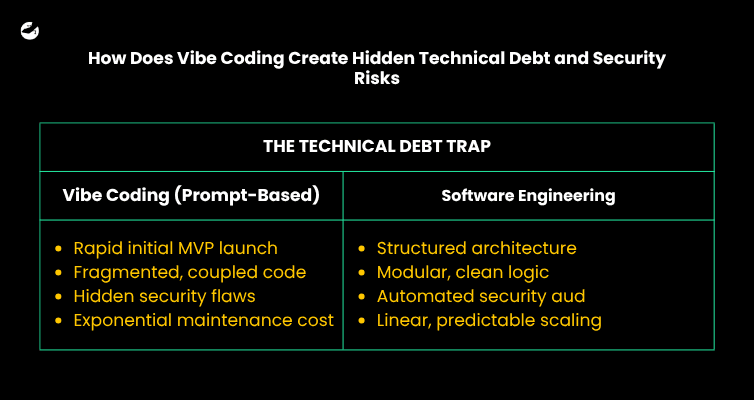
The financial consequences of unmanaged technical debt accumulate rapidly post-launch. Software engineering research indicates that resolving code defects during post-deployment maintenance costs up to fifteen times more than addressing structural flaws during early design phases. As vibe-coded applications grow in operational complexity, fixing a single bug routinely creates cascades of new system errors, eventually forcing organizations to scrap the entire codebase and rebuild from scratch.
Why Is Continuous Software Governance Essential for Enterprise Applications?
Enterprise digital products operate in complex environments requiring compliance with global regulations such as GDPR, HIPAA, and ISO security standards. Software governance provides the operational framework, coding standards, automated testing suites, and continuous deployment pipelines required to guarantee compliance across every release. Without rigorous governance protocols, software platforms inevitably suffer from data leakage, unauthorized permission drift, and non-compliance penalties that damage brand reputation.
At Lizard Global, we integrate enterprise-grade governance directly into our cross-functional agile development processes. Our engineering teams enforce strict peer code reviews, automated static application security testing (SAST), and clear version control methodologies. This disciplined approach ensures that every deployment maintains peak performance metrics, adheres strictly to clean code guidelines, and protects user data across all active endpoints.
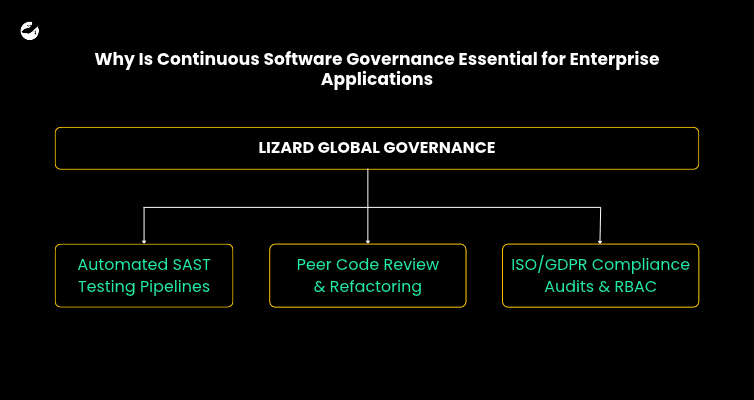
Continuous governance also safeguards long-term digital business continuity. When key team members transition out of an organization, clear documentation, standardized design systems, and modular repository structures allow new developers to onboard instantly. Ungoverned vibe-coded solutions lack standard documentation, turning the application into an impenetrable black box that only the original prompt author can partially navigate.
What Does Proven Engineering Look Like in Real-World Digital Transformation?
The true value of professional software development becomes clear when evaluating complex digital solutions that process high transaction volumes, rely on real-time data inputs, or manage cross-industry logistics. Simple vibe-coding tools fail when tasked with coordinating complex business logic, enterprise multi-tenancy, and multi-system integrations. Delivering stable software platforms at scale requires dedicated human engineering teams that understand system dynamics, infrastructure resilience, and cloud optimization.
Our work across diverse global industries highlights the transformative impact of structured software development:
- Real Estate Automation with Elfi:
We engineered an all-in-one real estate digital platform for Elfi, modernizing rental management across the Netherlands. The system handles tenant onboarding, automated rental contract workflows, payment gateway connections, and maintenance tracking within a unified cloud environment. Achieving seamless operational stability across these touchpoints demanded secure backend integrations, strict access controls, and custom database structures that prompt engineering tools simply cannot coordinate reliably.
- Enterprise Commerce with Heineken:
To support growth analytics and online ordering workflows for global beverage leader Heineken, our developers built custom web application infrastructure designed to process high ordering volumes without downtime. The system integrates custom data pipelines, analytics tracking, and automated inventory sync mechanisms that require continuous system maintenance, high-availability server configurations, and performance optimization.
- Maritime Risk Tracking with VanBreda:
We partnered with VanBreda to build a live vessel tracking and risk-zone maritime insurance solution. By integrating real-time AIS (Automatic Identification System) maritime location feeds with GPS mapping data, our platform calculates dynamic insurance risk scores for global vessels in real time. This level of complex spatial data processing, real-time signal handling, and hardware-software communication requires precision engineering, robust math handling, and continuous system monitoring.
Benchmark Data: Vibe Coding vs. Governed Software Over a 24-Month Lifecycle
To quantify the long-term impact of development approaches, software maintainability models analyze key performance indicators across a standard two-year product lifecycle. While vibe-coded platforms show initial velocity advantages during the concept phase, their operational costs spike dramatically as technical debt mounts post-launch.
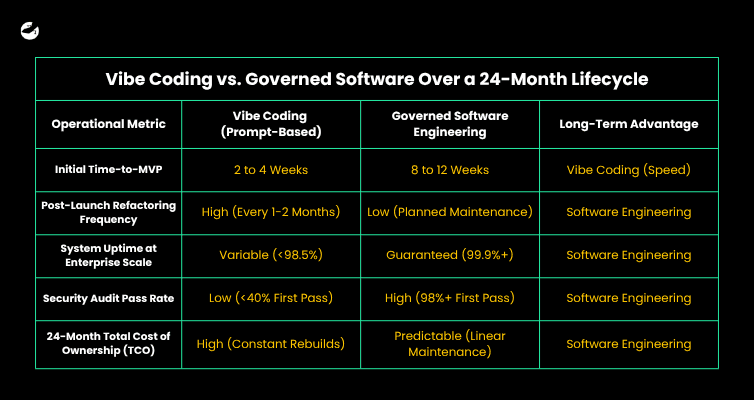
The data proves that while vibe coding delivers quick wins during early prototyping, it incurs severe financial penalties over a 24-month lifespan. The necessity for frequent hotfixes, emergency refactoring, and complete architectural overhauls elevates total cost of ownership far beyond that of a professionally engineered platform.
Why Long-Term Maintenance and Optimization Guarantee Software ROI
Software development is not a one-time project; it is an ongoing investment cycle where the vast majority of total lifetime value is realized post-launch. Over 70% to 80% of total software lifecycle expenditure occurs during the operational maintenance phase. Professional software companies prioritize ongoing technical support, continuous refactoring, performance tuning, and infrastructure scaling to ensure that digital products adapt seamlessly to market shifts and business expansion.
At Lizard Global, our long-term technical partnerships extend far past initial product launch. We manage ongoing software upgrades, perform regular database indexing, update external dependency packages, and monitor server load patterns continuously. By combining advanced technical engineering with human design expertise, we ensure that our partners' applications remain secure, fast, and feature-rich for years to come. Relying on vibe coding for core enterprise operations leaves businesses vulnerable to operational disruption, security risks, and technical obsolescence, proving that governed software engineering remains the gold standard for long-term digital success.
Ready to Build Scalable, Enterprise-Grade Software That Lasts?
Don't let hidden technical debt, unmanaged AI code, and weak security governance compromise your business growth. At Lizard Global, we combine cutting-edge tech innovation with proven software engineering governance, comprehensive technical maintenance, and world-class digital product design. Whether you are modernizing legacy systems, building custom real-time platforms, or scaling an enterprise web application, our expert teams in Rotterdam and Kuala Lumpur are ready to bring your vision to life safely and sustainably.

👉 Partner with Lizard Global Today to build secure, future-proof digital products that drive long-term business value.
FAQs

How does Lizard Global ensure enterprise software security compared to AI vibe coding tools?
Why is post-launch software maintenance critical for digital product survival?
Can AI tools be integrated into a professional software engineering workflow safely?
What are the main financial risks of relying on vibe coding for enterprise applications?
How does custom software development support real-time data integrations like IoT and GPS?
What is the typical lifecycle cost difference between prompt-built MVPs and engineered software platforms?
How does Lizard Global manage long-term software governance for global enterprise clients?
similar reads

Software Development
Software Companies vs. Vibe Coders: Why Maintenance and Governance Win Long-Term
27 October 2026

Software Development
Enterprise App Lifecycle Costs: From Build to Maintenance, Compliance & Scaling
27 February 2026

Software Development
How To Maintain and Update Your Mobile App After Launch?
15 October 2024
Stuck between a great idea and the right team to build it?Let's talk.
We work with corporate innovation teams and ambitious scale-ups across the Netherlands, Singapore, and Australia, and wherever great software needs to be built. Drop us a message and we'll get back to you within one business day.


Markus Monnikendam
Global Commercial Director
hello@lizard.global