App Development Cost
Amsterdam
+ 2 more ...
How Much Does It Cost To Build An App in Amsterdam?

15 Dec 2025
by Nadiy, Senior Content Writer
15 Dec 2025
by Nadiy, Senior Content Writer
App Development Cost
Amsterdam
Mobile App Development
Software Development
How Much Does It Cost To Build An App in Amsterdam?
Table of contents
Contact us
We will get back to you in the next 48 hours.

How Much Does It Cost To Build An App in Amsterdam
App development in Amsterdam comes with world-class talent, cutting-edge innovation, and diverse pricing — but what should you actually budget for? This guide breaks down real costs, key factors, and smart strategies to help you plan your app development project with confidence.
key takeaways
App development budgets in Amsterdam often come with big expectations and even bigger question marks. Businesses know they need a digital solution to compete, but few truly understand what goes into the cost or why the price varies so much between agencies.
Whether you're a startup launching your first Minimum Viable Product (MVP) or an established organisation upgrading your digital ecosystem, understanding app development pricing in Amsterdam helps you make informed decisions and avoid budget surprises.
In this guide, we explore the realistic cost ranges, the factors that influence the price, and what you should expect when working with a leading software development partner in Amsterdam.
What Is the Average Cost to Build an App in Amsterdam?
Before diving into numbers, it’s important to understand the value behind what you're paying for. The cost to build a mobile or web app in Amsterdam typically ranges between €35,000 to €250,000+, depending on the complexity, features, and development partner you choose.
Here’s a simplified breakdown:
- Simple MVP App: €35,000 – €70,000
- Medium Complexity App: €70,000 – €150,000
- High-Complexity or Enterprise-Level App: €150,000 – €250,000+
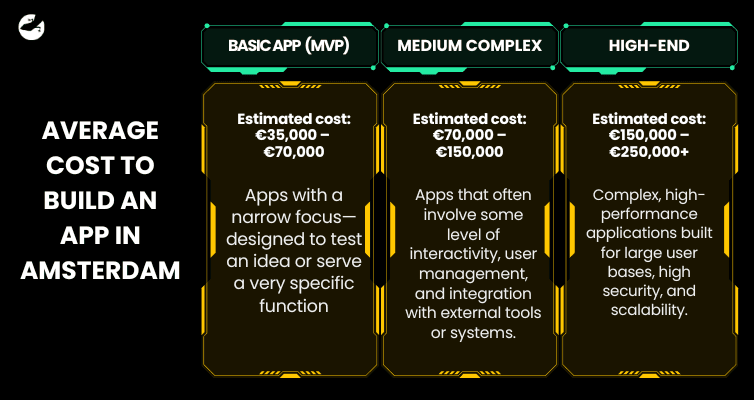
These ranges can shift based on team seniority, design requirements, maintenance needs, and integration with complex systems.
Key Factors That Influence App Development Costs in Amsterdam
Understanding what's driving the cost helps you plan smarter, communicate better with your developers, and avoid scope creep. Below are the core factors.
1. App Complexity and Features
The more features an app has, the more development time is required. Some features seem simple but require deep backend engineering.
Examples of cost-influencing features include:
- User authentication and role management
- Real-time chat or messaging systems
- Booking and scheduling modules
- Live tracking
- Payment gateway integration
- Multi-language support
- AI-powered features such as recommendations or automation
Even minor additions like animations or micro-interactions can increase the development timeline.
2. Platform: iOS, Android, or Both
Choosing the right platform impacts your budget significantly.
- iOS-only or Android-only apps are more affordable.
- Cross-platform apps using frameworks like Flutter or React Native provide cost efficiencies.
- Native development (Swift for iOS, Kotlin for Android) is ideal for performance-heavy applications but often more expensive.
Amsterdam-based companies frequently choose cross-platform solutions for startup MVPs or early-stage products to reduce costs.
3. UI/UX Design Requirements
Amsterdam is known for high design standards. If you want a slick, user-centric interface that feels intuitive and modern, you’ll need a specialised design team. This includes:
- Wireframes and journey mapping
- UI systems and component libraries
- Visual branding and prototyping
- Responsive layouts
A well-designed app can significantly increase user adoption and reduce long-term iterations, but it does add to your upfront investment.
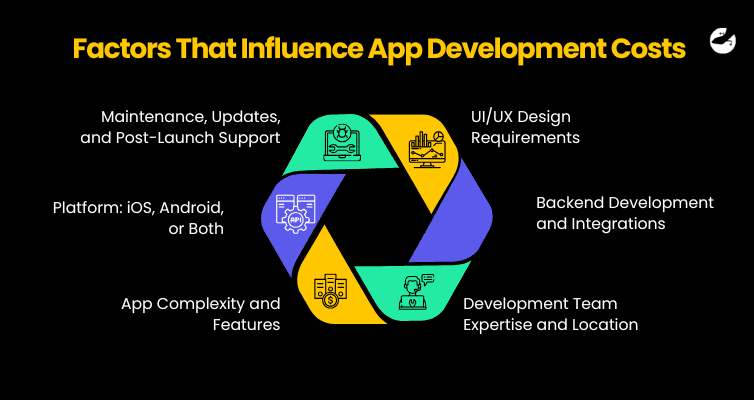
4. Backend Development and Integrations
Backend engineeringis where much of the heavy lifting happens. Costs increase when apps require:
- API integrations
- Complex databases
- User roles and permission systems
- Payment solutions
- Cloud infrastructure
- CRM or ERP integration
Apps that rely on large data processing, AI, or intricate business logic naturally cost more to build.
5. Development Team Expertise and Location
In Amsterdam, you’ll typically find three types of development teams:
- Freelancers: Lower cost, but limited capacity and risks in consistency.
- Local boutique agencies: Mid- to high-range pricing with strong reliability.
- International hybrid teams like Lizard Global: Competitive pricing with senior-level talent, full-stack capabilities, and cross-regional strengths. Your budget aligns closely with the team's skill level, experience, and project-management approach.
6. Maintenance, Updates, and Post-Launch Support
Launching the app is only the beginning. Successful digital products require post-launch maintenance such as:
- Regular updates
- Server monitoring
- Bug fixes
- Minor iterations
- Security patches
- Feature improvements
Businesses should allocate 15% to 25% of the initial development cost annually for maintenance.
Cost Breakdown by Development Stage
To help you budget more accurately, here’s a typical cost distribution across the entire app development lifecycle.
Discovery & Strategy (5–10% of total cost)
This stage includes workshops, user research, persona development, feature roadmapping, and technical assessments. It's crucial for preventing expensive mistakes later. Estimated cost by app type:
- Simple App: €3,500 - €9,000
- Medium App: €7,000 - €22,000
- Complex App: €18,000 - €37,500+
UI/UX Design (15–25%)
Creating user journeys, wireframes, design systems, clickable prototypes, and full visual design for mobile or web screens. Estimated cost by app type:
- Simple App: €5,000 - €12,000
- Medium App: €10,500 - €30,000
- Complex App: €27,000 - €50,000+
Frontend & Backend Development (40–55%)
This is the largest cost section — building the app’s screens, flow, database, servers, APIs, and feature logic.
Estimated cost by app type:
- Simple App: €14,000 - €30,000
- Medium App: €28,000 - €75,000
- Complex App: €72,000 - €125,000+
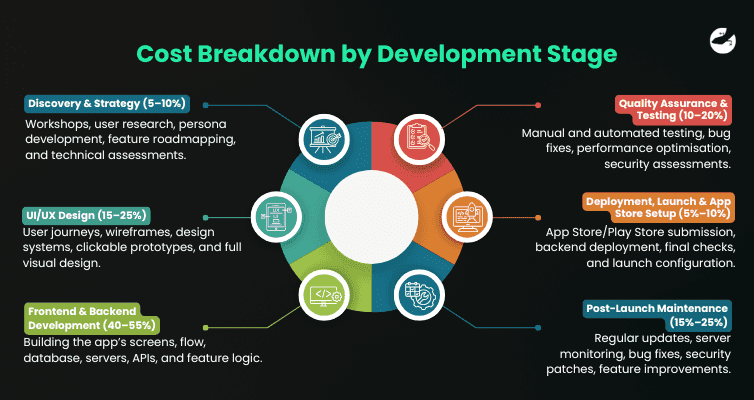
Quality Assurance & Testing (10–20%)
Manual and automated testing, bug fixes, performance optimisation, security assessments, and usability improvements. Estimated cost by app type:
- Simple App: €3,500 - €9,000
- Medium App: €7,000 - €22,000
- Complex App: €18,000 - €37,500+
Deployment, Launch & App Store Setup (5%–10%)
App Store/Play Store submission, backend deployment, final checks, and launch configuration.
Estimated cost by app type:
- Simple App: €1,750 - €6,000
- Medium App: €3,500 - €15,000
- Complex App: €9,000 - €25,000
Post-Launch Maintenance (15%–25% annually)
Maintenanceis usually calculated yearly.
Estimated annual cost:
- Simple App: €5,000 - €12,500/year
- Medium App: €12,000 - €30,000/year
- Complex App: €30,000 - €60,000+/year
How to Reduce App Development Costs Without Sacrificing Quality
Building an app in Amsterdam doesn’t have to drain your entire budget. With smart planning and the right development strategy, you can significantly lower your costs while still delivering a polished, high-performing product.
Below are the most effective ways to optimise your budget without compromising on quality — supported by practical examples and real-world scenarios.
1. Start With a Focused MVP (Minimum Viable Product)
An MVP allows you to launch a simplified version of your app containing only the core features that solve your users’ primary problem. This prevents you from spending heavily on features that users may not need.
Example: A startup comes to Amsterdam to build a fitness app with personalised plans, video coaching, AI recommendations, a community forum, and progress tracking. Instead of building everything at once, the MVP includes:
- user registration
- workout library
- basic progress tracking
This reduces development time from 9 months to 3 months and cuts the initial cost from around €150,000 to €50,000.
2. Choose Cross-Platform Development Instead of Native
Cross-platform frameworks like React Native or Flutter allow one codebase to run on both iOS and Android, reducing development time and maintenance costs.
Example: A mobility app for booking electric scooters is estimated at €120,000 if built natively for iOS and Android separately.
Using React Native, the company can launch both versions for around €70,000, saving nearly 40% while maintaining excellent performance.
3. Reuse Existing APIs and Third-Party Integrations
You don't always need to reinvent the wheel. Many features can be powered by existing, reliable services.
Affordable integrations include:
- Stripe for payments
- Firebase for authentication
- SendBird for chat
- Mapbox for navigation
- Google Cloud Vision for image recognition
Example: Instead of building a custom chat system (which could cost €20,000–€40,000), using SendBird drops that cost to €3,000–€5,000 annually with minimal setup.
4. Keep the Design Clean and Modular
Complex animations, custom illustrations, and micro-interactions increase costs significantly. A clean, modular design keeps things scalable and reduces dev time.
Example: A property rental startup initially requests animated 3D property models in the app. Instead, switching to static images and a simple gallery layout saves around €15,000 in design and frontend development without affecting usability.
Want to find out how much it costs to build your dream app or web app?
5. Prioritize Features According to User Value
Not every idea needs to be built immediately. Collaborate with your development partner to rank features based on:
- user value
- complexity
- business impact
- cost-to-benefit ratio
Example: A food delivery app wants real-time rider tracking, AI-based meal recommendations, and dynamic discounts.
After a feature-prioritisation session, they launch with:
- restaurant listings
- order checkout
- delivery status updates
The rest is added later based on user data — saving an estimated €60,000 during phase one.
6. Avoid Unnecessary Custom Backends
Using backend-as-a-service platforms (Firebase, Supabase, AWS Amplify) can drastically reduce infrastructure setup and maintenance costs.
Example: A social networking MVP requiring authentication, image uploads, and notifications costs around €80,000 with a custom backend.
Using Firebase reduces it to roughly €45,000 for phase one.
7. Work With a Full-Service Development Partner
Amsterdam has many freelancers and niche agencies, but working with a full-service partner ensures that strategy, design, development, and QA are unified. This prevents miscommunication, rework, and hidden costs.
Example: A startup hires separate freelancers for UI, backend, and app development. After three months, misaligned deliverables cause a €20,000 budget overrun.
A full-service team — like Lizard Global — handles everything under one roof, ensuring consistency and cost-efficiency.
8. Conduct User Testing Early and Frequently
Spotting issues early prevents expensive revisions later. User testing sessions during wireframes and prototypes often save weeks of redevelopment.
Example: A travel booking app discovers during early prototype testing that users prefer date-based filters instead of map-based selection.
Catching this early saves an estimated €10,000 in redevelopment that would have occurred after coding started.
9. Plan Your Scope Before Development Starts
Scope creep — adding features during development — is one of the biggest cost drivers.
Having a clear roadmap reduces unnecessary work and protects your budget.
Example: A healthcare app keeps adding new screens mid-development, causing delays and extra costs.
After switching to a fully defined sprint roadmap, the team reduces project waste by 30%.
10. Invest in Scalable Architecture From Day One
It may feel counterintuitive, but choosing a scalable architecture prevents expensive rework later.
Example: An e-commerce app built without scalable backend logic breaks down once traffic grows. Rebuilding the backend costs €40,000.
Starting with a scalable cloud setup would have cost €5,000 extra — but saved €35,000 in future fixes.
Lizard Global Is the Right App Development Partner in Amsterdam
Building an app in Amsterdam is an investment in quality, innovation, and long-term scalability. From determining the ideal budget to navigating technical decisions, having an experienced digital partner makes the entire journey smoother, faster, and far more predictable.
Lizard Global brings a unique combination of award-winning expertise, a full-stack development approach, and a deep understanding of the Dutch market. Whether you’re creating an MVP, modernising an existing product, or building a long-term digital ecosystem, our team handles strategy, design, development, and ongoing support under one roof.
We guide clients through every stage of the process, ensuring the final product is not only beautifully built but also scalable, secure, and aligned with real business outcomes.
If you’re ready to turn your app idea into a powerful digital product for the Amsterdam market, Lizard Global is here to help, let’s build something exceptional together.
Join 2000+ subscribers
Stay in the loop with everything you need to know
How Much Does It Cost To Build An App in Amsterdam
App development in Amsterdam comes with world-class talent, cutting-edge innovation, and diverse pricing — but what should you actually budget for? This guide breaks down real costs, key factors, and smart strategies to help you plan your app development project with confidence.
App development budgets in Amsterdam often come with big expectations and even bigger question marks. Businesses know they need a digital solution to compete, but few truly understand what goes into the cost or why the price varies so much between agencies.
Whether you're a startup launching your first Minimum Viable Product (MVP) or an established organisation upgrading your digital ecosystem, understanding app development pricing in Amsterdam helps you make informed decisions and avoid budget surprises.
In this guide, we explore the realistic cost ranges, the factors that influence the price, and what you should expect when working with a leading software development partner in Amsterdam.
What Is the Average Cost to Build an App in Amsterdam?
Before diving into numbers, it’s important to understand the value behind what you're paying for. The cost to build a mobile or web app in Amsterdam typically ranges between €35,000 to €250,000+, depending on the complexity, features, and development partner you choose.
Here’s a simplified breakdown:
- Simple MVP App: €35,000 – €70,000
- Medium Complexity App: €70,000 – €150,000
- High-Complexity or Enterprise-Level App: €150,000 – €250,000+
These ranges can shift based on team seniority, design requirements, maintenance needs, and integration with complex systems.
Key Factors That Influence App Development Costs in Amsterdam
Understanding what's driving the cost helps you plan smarter, communicate better with your developers, and avoid scope creep. Below are the core factors.
1. App Complexity and Features
The more features an app has, the more development time is required. Some features seem simple but require deep backend engineering.
Examples of cost-influencing features include:
- User authentication and role management
- Real-time chat or messaging systems
- Booking and scheduling modules
- Live tracking
- Payment gateway integration
- Multi-language support
- AI-powered features such as recommendations or automation
Even minor additions like animations or micro-interactions can increase the development timeline.
2. Platform: iOS, Android, or Both
Choosing the right platform impacts your budget significantly.
- iOS-only or Android-only apps are more affordable.
- Cross-platform apps using frameworks like Flutter or React Native provide cost efficiencies.
- Native development (Swift for iOS, Kotlin for Android) is ideal for performance-heavy applications but often more expensive.
Amsterdam-based companies frequently choose cross-platform solutions for startup MVPs or early-stage products to reduce costs.
3. UI/UX Design Requirements
Amsterdam is known for high design standards. If you want a slick, user-centric interface that feels intuitive and modern, you’ll need a specialised design team. This includes:
- Wireframes and journey mapping
- UI systems and component libraries
- Visual branding and prototyping
- Responsive layouts
A well-designed app can significantly increase user adoption and reduce long-term iterations, but it does add to your upfront investment.
4. Backend Development and Integrations
Backend engineeringis where much of the heavy lifting happens. Costs increase when apps require:
- API integrations
- Complex databases
- User roles and permission systems
- Payment solutions
- Cloud infrastructure
- CRM or ERP integration
Apps that rely on large data processing, AI, or intricate business logic naturally cost more to build.
5. Development Team Expertise and Location
In Amsterdam, you’ll typically find three types of development teams:
- Freelancers: Lower cost, but limited capacity and risks in consistency.
- Local boutique agencies: Mid- to high-range pricing with strong reliability.
- International hybrid teams like Lizard Global: Competitive pricing with senior-level talent, full-stack capabilities, and cross-regional strengths. Your budget aligns closely with the team's skill level, experience, and project-management approach.
6. Maintenance, Updates, and Post-Launch Support
Launching the app is only the beginning. Successful digital products require post-launch maintenance such as:
- Regular updates
- Server monitoring
- Bug fixes
- Minor iterations
- Security patches
- Feature improvements
Businesses should allocate 15% to 25% of the initial development cost annually for maintenance.
Cost Breakdown by Development Stage
To help you budget more accurately, here’s a typical cost distribution across the entire app development lifecycle.
Discovery & Strategy (5–10% of total cost)
This stage includes workshops, user research, persona development, feature roadmapping, and technical assessments. It's crucial for preventing expensive mistakes later. Estimated cost by app type:
- Simple App: €3,500 - €9,000
- Medium App: €7,000 - €22,000
- Complex App: €18,000 - €37,500+
UI/UX Design (15–25%)
Creating user journeys, wireframes, design systems, clickable prototypes, and full visual design for mobile or web screens. Estimated cost by app type:
- Simple App: €5,000 - €12,000
- Medium App: €10,500 - €30,000
- Complex App: €27,000 - €50,000+
Frontend & Backend Development (40–55%)
This is the largest cost section — building the app’s screens, flow, database, servers, APIs, and feature logic.
Estimated cost by app type:
- Simple App: €14,000 - €30,000
- Medium App: €28,000 - €75,000
- Complex App: €72,000 - €125,000+
Quality Assurance & Testing (10–20%)
Manual and automated testing, bug fixes, performance optimisation, security assessments, and usability improvements. Estimated cost by app type:
- Simple App: €3,500 - €9,000
- Medium App: €7,000 - €22,000
- Complex App: €18,000 - €37,500+
Deployment, Launch & App Store Setup (5%–10%)
App Store/Play Store submission, backend deployment, final checks, and launch configuration.
Estimated cost by app type:
- Simple App: €1,750 - €6,000
- Medium App: €3,500 - €15,000
- Complex App: €9,000 - €25,000
Post-Launch Maintenance (15%–25% annually)
Maintenanceis usually calculated yearly.
Estimated annual cost:
- Simple App: €5,000 - €12,500/year
- Medium App: €12,000 - €30,000/year
- Complex App: €30,000 - €60,000+/year
How to Reduce App Development Costs Without Sacrificing Quality
Building an app in Amsterdam doesn’t have to drain your entire budget. With smart planning and the right development strategy, you can significantly lower your costs while still delivering a polished, high-performing product.
Below are the most effective ways to optimise your budget without compromising on quality — supported by practical examples and real-world scenarios.
1. Start With a Focused MVP (Minimum Viable Product)
An MVP allows you to launch a simplified version of your app containing only the core features that solve your users’ primary problem. This prevents you from spending heavily on features that users may not need.
Example: A startup comes to Amsterdam to build a fitness app with personalised plans, video coaching, AI recommendations, a community forum, and progress tracking. Instead of building everything at once, the MVP includes:
- user registration
- workout library
- basic progress tracking
This reduces development time from 9 months to 3 months and cuts the initial cost from around €150,000 to €50,000.
2. Choose Cross-Platform Development Instead of Native
Cross-platform frameworks like React Native or Flutter allow one codebase to run on both iOS and Android, reducing development time and maintenance costs.
Example: A mobility app for booking electric scooters is estimated at €120,000 if built natively for iOS and Android separately.
Using React Native, the company can launch both versions for around €70,000, saving nearly 40% while maintaining excellent performance.
3. Reuse Existing APIs and Third-Party Integrations
You don't always need to reinvent the wheel. Many features can be powered by existing, reliable services.
Affordable integrations include:
- Stripe for payments
- Firebase for authentication
- SendBird for chat
- Mapbox for navigation
- Google Cloud Vision for image recognition
Example: Instead of building a custom chat system (which could cost €20,000–€40,000), using SendBird drops that cost to €3,000–€5,000 annually with minimal setup.
4. Keep the Design Clean and Modular
Complex animations, custom illustrations, and micro-interactions increase costs significantly. A clean, modular design keeps things scalable and reduces dev time.
Example: A property rental startup initially requests animated 3D property models in the app. Instead, switching to static images and a simple gallery layout saves around €15,000 in design and frontend development without affecting usability.
Want to find out how much it costs to build your dream app or web app?
5. Prioritize Features According to User Value
Not every idea needs to be built immediately. Collaborate with your development partner to rank features based on:
- user value
- complexity
- business impact
- cost-to-benefit ratio
Example: A food delivery app wants real-time rider tracking, AI-based meal recommendations, and dynamic discounts.
After a feature-prioritisation session, they launch with:
- restaurant listings
- order checkout
- delivery status updates
The rest is added later based on user data — saving an estimated €60,000 during phase one.
6. Avoid Unnecessary Custom Backends
Using backend-as-a-service platforms (Firebase, Supabase, AWS Amplify) can drastically reduce infrastructure setup and maintenance costs.
Example: A social networking MVP requiring authentication, image uploads, and notifications costs around €80,000 with a custom backend.
Using Firebase reduces it to roughly €45,000 for phase one.
7. Work With a Full-Service Development Partner
Amsterdam has many freelancers and niche agencies, but working with a full-service partner ensures that strategy, design, development, and QA are unified. This prevents miscommunication, rework, and hidden costs.
Example: A startup hires separate freelancers for UI, backend, and app development. After three months, misaligned deliverables cause a €20,000 budget overrun.
A full-service team — like Lizard Global — handles everything under one roof, ensuring consistency and cost-efficiency.
8. Conduct User Testing Early and Frequently
Spotting issues early prevents expensive revisions later. User testing sessions during wireframes and prototypes often save weeks of redevelopment.
Example: A travel booking app discovers during early prototype testing that users prefer date-based filters instead of map-based selection.
Catching this early saves an estimated €10,000 in redevelopment that would have occurred after coding started.
9. Plan Your Scope Before Development Starts
Scope creep — adding features during development — is one of the biggest cost drivers.
Having a clear roadmap reduces unnecessary work and protects your budget.
Example: A healthcare app keeps adding new screens mid-development, causing delays and extra costs.
After switching to a fully defined sprint roadmap, the team reduces project waste by 30%.
10. Invest in Scalable Architecture From Day One
It may feel counterintuitive, but choosing a scalable architecture prevents expensive rework later.
Example: An e-commerce app built without scalable backend logic breaks down once traffic grows. Rebuilding the backend costs €40,000.
Starting with a scalable cloud setup would have cost €5,000 extra — but saved €35,000 in future fixes.
Lizard Global Is the Right App Development Partner in Amsterdam
Building an app in Amsterdam is an investment in quality, innovation, and long-term scalability. From determining the ideal budget to navigating technical decisions, having an experienced digital partner makes the entire journey smoother, faster, and far more predictable.
Lizard Global brings a unique combination of award-winning expertise, a full-stack development approach, and a deep understanding of the Dutch market. Whether you’re creating an MVP, modernising an existing product, or building a long-term digital ecosystem, our team handles strategy, design, development, and ongoing support under one roof.
We guide clients through every stage of the process, ensuring the final product is not only beautifully built but also scalable, secure, and aligned with real business outcomes.
If you’re ready to turn your app idea into a powerful digital product for the Amsterdam market, Lizard Global is here to help, let’s build something exceptional together.
Join 2000+ subscribers
Stay in the loop with everything you need to know
FAQs
How much does it cost to develop an app in Amsterdam?
Why is app development more expensive in Amsterdam?
How long does it take to build an app in Amsterdam?
What determines the cost of an app the most?
Is cross-platform development cheaper?
Do I need to build an MVP first?
How much does app maintenance cost after launch?
Do Amsterdam developers work with international clients?
Should I hire freelancers or a development agency?
What industries commonly build apps in Amsterdam?
Can I build an app in Amsterdam on a limited budget?
Do costs differ between mobile and web apps?
How do I choose the right software development company in Amsterdam?
Why choose Lizard Global as your development partner?
similar reads