
Technical Debt at Scale: Why Unchecked AI-Generated Code Destroys Maintainability

02 Nov 2026
by Nadiy, Senior Content Writer
02 Nov 2026
by Nadiy, Senior Content Writer
Technical Debt at Scale: Why Unchecked AI-Generated Code Destroys Maintainability
Table of contents
How Does Unchecked AI-Generated Code Silently Degrade Core Software Architecture?
Why Do Standard Code Reviews Fail to Catch AI-Induced Code Smells?
What Are the Real Business Costs of Synthetic Code Bloat and Architectural Drift?
How Has Lizard Global Solved Maintainability and Scale Challenges in Practice?
What Strategies Can Enterprise Engineering Teams Implement to Control AI Technical Debt?
Build Scalable, Future-Proof Software with Lizard Global
Contact us
We will get back to you in the next 48 hours.
Generative AI tools speed up raw code generation, but unvetted synthetic code introduces structural friction across enterprise repositories. When engineering teams prioritize generation speed over architecture, silent technical debt accumulates rapidly. This post breaks down how unchecked AI-generated code creates unmaintainable software, compromises architectural patterns, and inflates long-term maintenance costs. We outline structural detection strategies and detail how Lizard Global’s software engineering practices stabilize, refactor, and future-proof enterprise codebases.
key takeaways
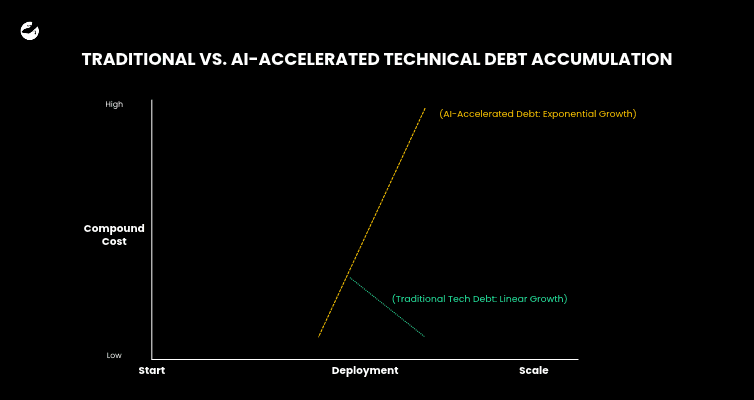
Technical debt at scale represents the compound cost of choosing rapid, short-term code delivery over sustainable architectural design across enterprise applications. When teams adopt artificial intelligence generation tools without strict engineering governance, this technical debt compounds exponentially rather than linearly. Large language models generate syntactically correct code blocks without understanding the broader domain model, system boundaries, or cross-cutting concerns of an enterprise application.
The primary driver of this failure mode is context fragmentation. Generative AI operates within localized context windows, producing solutions tailored only to the immediate prompt rather than the entire software architecture. When developers commit these snippets directly into production repositories, they introduce duplicate abstractions, inconsistent naming conventions, and hidden architectural drift. Over time, these minor inconsistencies accumulate into massive system fragility, slowing down future features and increasing system outages.
How Does Unchecked AI-Generated Code Silently Degrade Core Software Architecture?
Unchecked AI code degrades enterprise architecture by introducing functional drift and breaking structural encapsulation. Generative tools frequently re-implement existing business logic instead of leveraging established utility classes, enterprise design patterns, or shared microservices. This proliferation of redundant logic inflates the codebase volume, making global updates tedious and error-prone for development teams.
Furthermore, synthetic code often bypasses strict domain boundary checks. An AI assistant might write a quick database query directly inside a UI component or API controller to satisfy a prompt, breaking separation of concerns. While the code passes local unit tests, it binds presentation logic to data access layers, destroying maintainability and making future database migrations or infrastructure updates exceptionally complex.
At Lizard Global, we consistently observe that unchecked generation creates fragile dependency structures. When teams accept AI code snippets without evaluating external packages, applications accumulate unnecessary third-party dependencies. This increases security vulnerabilities, inflates bundle sizes, and complicates routine dependency upgrades across the enterprise ecosystem. Addressing this requires instituting rigorous AI governance to oversee implementation and code hygiene across all active repositories.
Why Do Standard Code Reviews Fail to Catch AI-Induced Code Smells?
Standard peer code reviews often miss synthetic code smells because AI-generated code looks clean on the surface. Generative models excel at writing grammatically correct, well-indented, and neatly commented code that mimics human style. Reviewers scanning PRs often focus on syntax and basic functionality, assuming visually polished code adheres to broader architectural rules.
However, deep maintainability issues exist beneath surface readability. AI models frequently introduce subtle logical hallucinations, off-by-one errors, and improper async handle implementations that pass standard syntax checks. Because the generated code looks competent, reviewers experience cognitive fatigue faster, granting approvals without verifying if the underlying pattern fits the enterprise architecture. Understanding why AI agent outputs fail in quality is essential for development teams looking to protect production pipelines.
To mitigate this operational risk, engineering organizations must modernize review workflows. Automated static analysis engines, custom linter configurations, and architectural fitness functions must sit alongside human reviews. At Lizard Global, our development lifecycle pairs senior full-stack developers with rigorous QA and continuous deployment validation pipelines, ensuring that every line of code committed to production aligns with enterprise software quality benchmarks, as seen in our hands-on experience on how we use AI in software development.
What Are the Real Business Costs of Synthetic Code Bloat and Architectural Drift?
Synthetic code bloat significantly increases the total enterprise app lifecycle costs for enterprise software products. As AI tools generate hundreds of lines of boilerplate code in seconds, repositories expand rapidly without a proportional increase in business functionality. Larger codebases require more memory, increase build and deployment times, and slow down integrated development environments (IDEs) for every engineer on the team.
Architectural drift directly reduces developer velocity and increases employee onboarding friction. When new software engineers join a project burdened with inconsistent AI-generated patterns, understanding system data flow becomes a slow, laborious task. Simple feature requests take weeks instead of days because engineers must navigate convoluted logic paths and untangle conflicting code abstractions across multiple services, a common reason why low-cost development fails at scale.
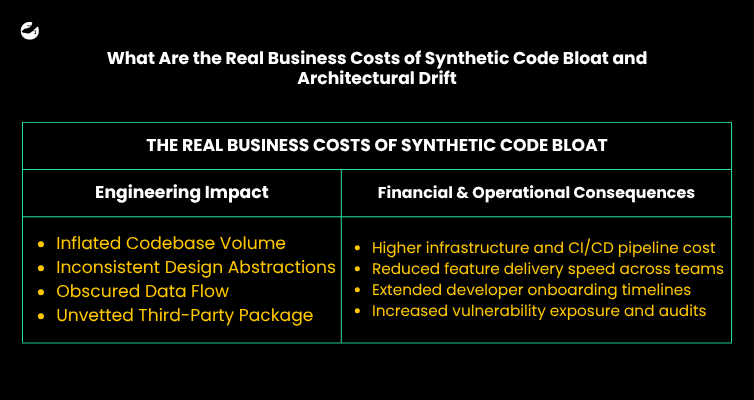
The long-term impact manifests in production instability and inflated maintenance budgets. Enterprise platforms become brittle, where resolving one bug routinely introduces regressions across unrelated modules. Eventually, organizations face catastrophic refactoring cycles, wasting months of development capacity merely to stabilize software that was generated too quickly without proper governance.
How Has Lizard Global Solved Maintainability and Scale Challenges in Practice?
At Lizard Global, we prioritize clean, scalable architecture in every custom software development project we build. Our cross-functional teams establish strict scalable design systems, clear API contracts, and robust continuous integration pipelines from day one. By combining human expertise in React, React Native, Node.js, and cloud-native backend systems with agile development frameworks, we build applications that scale without structural degradation.
Our work across complex industries and published case studies in our works portfolio demonstrates our commitment to architectural integrity and long-term maintainability. For example:
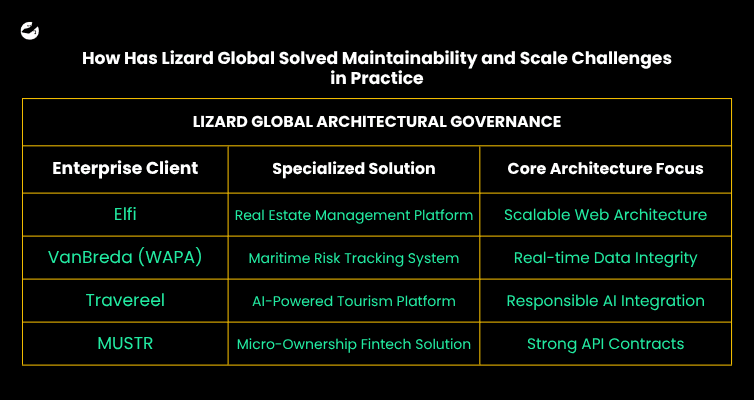
- In the real estate industry, our partnership with Elfi resulted in an all-in-one digital platform for rental property management in the Netherlands, engineered as an intuitive, robust web development solution designed for long-term scalability and seamless operational workflows.
- Similarly, in the maritime sector, our risk-zone tracking integration for VanBreda eliminated vessel exposure through clean, reliable system architecture and precise real-time data processing.
- In digital commerce and consumer engagement, our analytics-driven mobile architecture for Heineken Drinkies significantly optimized conversions and customer retention, as highlighted in our case study on boosting retention and conversion with data for Heineken Drinkies.
- In proptech and smart facilities, our work on iGGi transformed physical property operations through clean data governance and structured workflows, detailed in our breakdown of data-driven property management with iGGi analytics.
- In green energy and maritime logistics, our technical partnership with Skoon enabled sustainable, portable clean energy marketplace infrastructure, which we showcased during our journey to CES with Skoon and Lizard Global.
Whether delivering high-growth fintech solutions like Mustr in Australia or complex logistics platforms like Transvision in the transportation industry, our focus remains unchanged: engineering clean, sustainable codebases. We integrate AI capabilities responsibly, such as in our work on Travereel, an AI-powered tourism platform, documented in our insights on Travereel: integrating AI agents into mobile apps, ensuring that automated logic never compromises system stability, data security, or performance standards.
What Strategies Can Enterprise Engineering Teams Implement to Control AI Technical Debt?
Enterprise engineering teams must establish strict human-in-the-loop validation frameworks for all AI-assisted development, drawing from proven guidelines for building AI systems with human-in-the-loop governance. AI code generators should serve strictly as context-aware drafting assistants, not autonomous developers. Senior engineers must set clear boundary conditions, write comprehensive prompt contexts, and rigorously audit all generated outputs prior to merging code into core branches.
Organizations should implement automated architectural guardrails within their CI/CD pipelines. Static code analysis tools must be configured to detect duplicated code blocks, improper abstraction layers, missing error handlers, and unexpected package dependencies. Coupling automated checks with strict test-driven development (TDD) ensures that synthetic code proves its functional correctness before touching production environments, following the best practices of an established software development workflow strategy.
Finally, engineering leadership must cultivate a culture that rewards code quality and maintainability over raw generation throughput. Rewarding quick code output without accounting for long-term code health inevitably leads to system fragility. Investing in structured digital workshops, continuous code refactoring, and enterprise architectural standards guarantees that your digital platform scales sustainably over time.
Build Scalable, Future-Proof Software with Lizard Global
Ready to eliminate technical debt and build enterprise-grade software that scales seamlessly? At Lizard Global, our expert cross-functional teams design, develop, and maintain robust digital solutions tailored to your unique business goals.

Contact our software engineering experts
today to audit your current codebase or kickstart your next digital transformation project with world-class architectural precision.
FAQs

How does AI-generated code increase long-term software technical debt?
Why do standard CI/CD pipelines fail to catch technical debt from AI code?
What are the best methods for auditing synthetic code quality in enterprise applications?
How can enterprise engineering leaders prevent developer over-reliance on AI codegen tools?
Can refactoring AI-generated code cost more than writing custom architecture initially?
How does Lizard Global ensure custom software applications remain maintainable at scale?
How should enterprises balance AI generation speed with software system reliability?
similar reads

Software Development
How Far Can Vibe Coding Really Scale? The Multi-Million Line Codebase Bottleneck
22 October 2026

Software Development
Best Practices for Developing Secure and Scalable eCommerce Platforms
10 June 2025

Software Development
Scaling Your SaaS: How to Make Sure Your Tech Stack Can Handle Rapid Growth
24 April 2025
Stuck between a great idea and the right team to build it?Let's talk.
We work with corporate innovation teams and ambitious scale-ups across the Netherlands, Singapore, and Australia, and wherever great software needs to be built. Drop us a message and we'll get back to you within one business day.


Markus Monnikendam
Global Commercial Director
hello@lizard.global