App Project Rescue in Malaysia: How to Recover Delayed Enterprise Software Delivery
20 May 2026
by Team Lizard Global
Editor: Nadiy, Senior Content Writer
20 May 2026
by Team Lizard Global
Editor: Nadiy, Senior Content Writer
App Project Rescue in Malaysia: How to Recover Delayed Enterprise Software Delivery
Table of contents
Contact us
We will get back to you in the next 48 hours.
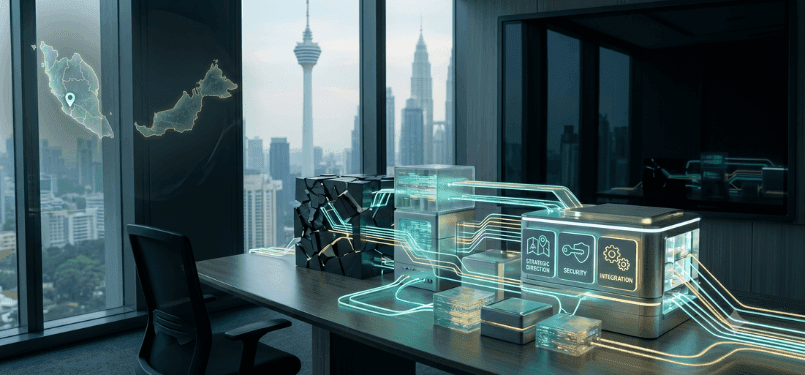
Enterprise app delays are more common than most organizations admit. From missed deadlines and broken sprints to misaligned teams and unstable architectures, software delivery can easily derail. In Malaysia’s fast-growing digital economy, these delays can significantly impact revenue, customer trust, and market competitiveness. This blog explores how app project rescue works in enterprise environments and how organizations can recover stalled or failing software initiatives. It also highlights modern approaches like Agentic AI for Enterprise, Autonomous AI Agents, and Enterprise AI Orchestration to stabilize delivery pipelines and improve execution. Finally, it shows how a digital transformation partner such as Lizard Global can help enterprises regain control and deliver scalable, production-ready systems faster.
key takeaways
Enterprise app failures rarely happen overnight. In Malaysia’s fast-evolving digital landscape, many organizations struggle with delayed software delivery, unstable systems, and applications that no longer align with business goals. As enterprise platforms become more complex, traditional development models often fail to keep pace with changing requirements, integration demands, and scalability expectations.
This is why app project rescue has become a critical strategy for businesses looking to recover stalled initiatives, rebuild delivery confidence, and transform failing systems into scalable digital platforms.
Want to find out how much it costs to build your dream app or web app?


Understanding App Project Rescue in Malaysia’s Enterprise Landscape
Enterprise software projects in Malaysia are growing in scale, complexity, and business criticality. However, with this growth comes a recurring challenge: delayed or failing application delivery. App project rescue is the structured process of diagnosing, stabilizing, and recovering software projects that have fallen behind schedule or drifted from business expectations.
In many cases, these projects are not simply “slow”, they are misaligned. Requirements evolve faster than development cycles, technical debt accumulates silently, and teams often operate in silos. As a result, enterprises end up with partially functional systems that cannot scale or integrate effectively.
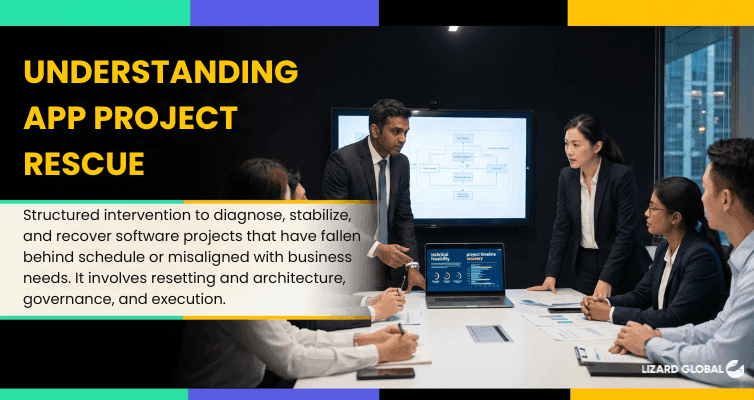
This is where structured rescue intervention becomes essential. Instead of continuing with the same delivery model, organizations need a reset in architecture, governance, and execution strategy to regain control of the project lifecycle through digital consultancy services, technical feasibility analysis, software modernization, and enterprise software development solutions.
Why Enterprise App Projects Fail or Get Delayed
To effectively recover a failing project, it is important to understand why delays happen in the first place. In most enterprise environments, the root causes are rarely just technical. Instead, they emerge from a combination of organizational, architectural, and operational breakdowns.
One major issue is the lack of clear distinction between deterministic vs. agentic development models. Traditional deterministic workflows assume fixed requirements and predictable outputs. However, modern enterprise systems behave more dynamically, requiring adaptive, feedback-driven approaches such as Agentic Workflows and iterative AI-assisted development supported by AI integration, AI consultancy, AI industry expertise, and AI governance.
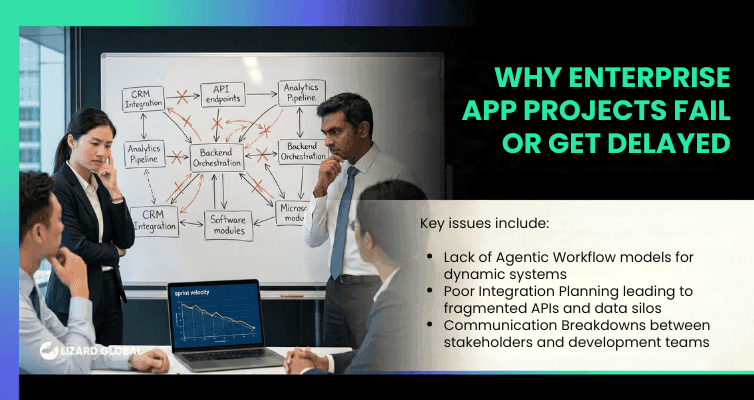
Additionally, poor integration planning often leads to fragmented systems. Without proper CRM integration services, analytics pipelines, and backend orchestration layers, even well-coded applications fail to deliver value. This disconnect slows down delivery and creates long-term maintenance challenges through weak API and microservices, data and architecture design, API development, and API orchestration.
Finally, communication breakdowns between stakeholders and development teams lead to constant rework. Requirements shift mid-sprint, priorities change without structured governance, and delivery teams struggle to maintain alignment with business expectations using agile development, scrum sprint, discovery workshops, and workshops.
Diagnosing the Problem: The First Step in App Rescue
Before any recovery strategy can succeed, enterprises must perform a deep diagnostic phase. This is not just a technical audit, it is a full evaluation of architecture, workflows, team structure, and delivery health.
Modern rescue approaches often leverage AI Observability & Audit Logs to trace where breakdowns occur. These logs help identify bottlenecks in deployment pipelines, inefficient API calls, and failed integration points across systems. Without this visibility, recovery efforts remain guesswork supported by product analytics, growth analytics, agile analytics, and user behavior data.
At this stage, Enterprise AI Orchestration becomes particularly valuable. It enables teams to map dependencies across services, workflows, and microservices, giving a clear picture of system behavior under real-world conditions. This orchestration layer helps uncover hidden inefficiencies that traditional monitoring tools often miss through cloud-native architecture, microservice architecture, platform modernisation, and enterprise technical debt modernization.
In more advanced setups, AI Digital Labor can also assist in automating diagnostic reporting, codebase scanning, and performance benchmarking. This significantly reduces the time required to understand the current state of the project and accelerates decision-making through AI-driven QA, continuous deployment, system monitoring, and software testing.
Rebuilding Delivery with Agentic AI and Smart Workflows
Once the diagnosis is complete, the next step is rebuilding delivery pipelines using modern execution models. This is where Agentic AI for Enterprise plays a transformative role. Unlike traditional automation tools, Agentic AI introduces Autonomous AI Agents that can execute tasks, coordinate workflows, and make contextual decisions within defined guardrails.
These agents can handle repetitive engineering tasks such as test generation, code refactoring suggestions, and deployment validation. This allows human teams to focus on higher-value work such as architecture design and product strategy supported by machine learning, AI applications, AI-powered development, and AI software development.
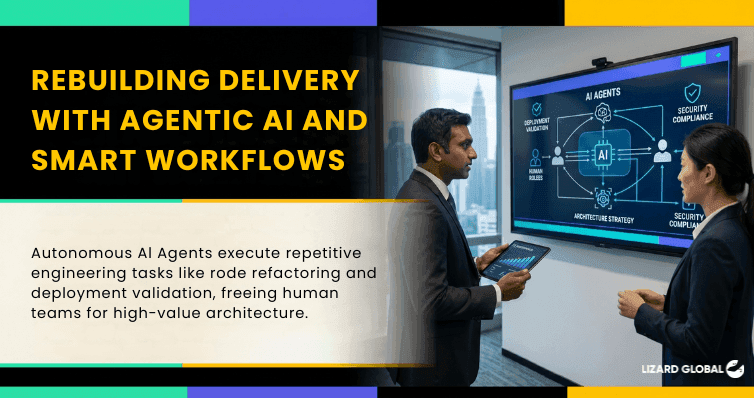
To ensure stability, AI Guardrails and Human-in-the-Loop (HITL) mechanisms are essential. These systems ensure that AI-generated outputs remain compliant with enterprise standards and do not introduce unintended risks into production environments through security and ISO compliance, application security, AI cybersecurity, and data leak protection.
At this stage, Agentic Governance & Compliance frameworks are also introduced. These frameworks define how AI agents interact with systems, what actions they can perform, and how their decisions are audited. This is critical for enterprise environments where security and accountability are non-negotiable using GDPR compliance, PDPA regulations, software security, and cybersecurity.
Re-Engineering the Architecture for Long-Term Stability
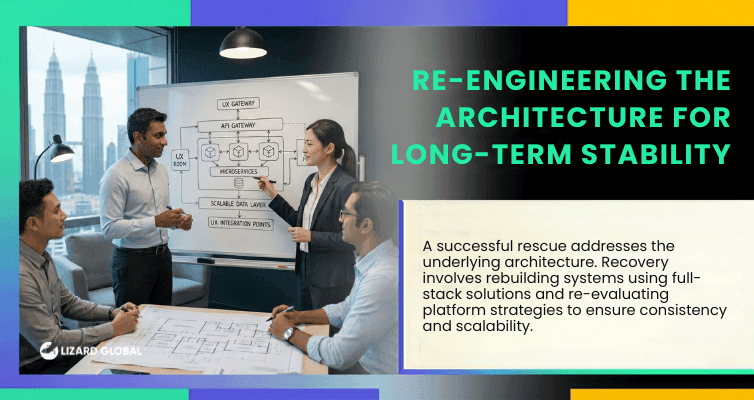
A successful app rescue is not complete without addressing the underlying architecture. Many delayed enterprise projects suffer from brittle systems that cannot scale or integrate efficiently.
Modern recovery efforts often involve rebuilding systems using full-stack digital solutions, including web app development services, mobile app development agency, full-stack digital solutions, and custom software development. This ensures that all layers of the application are aligned and scalable.
For mobile-first enterprises, iOS app development, Android app development, and hybrid app development strategies are often re-evaluated to ensure consistent performance across platforms. Similarly, UX/UI product design is optimized to eliminate friction points that impact user adoption through UI design, UX design, UI/UX process, and UX integration.
In parallel, CRM integration services and growth analytics consulting are implemented to ensure the system is not just functional but also measurable and business-aligned. This allows enterprises to connect technical performance with real business outcomes using lean analytics, North Star metrics, business metrics, and key metric tracking.
A strong custom software development company or digital consultancy services provider plays a crucial role here by ensuring architectural decisions align with long-term scalability goals through strategic software development, tech stack strategy, enterprise tech stack selection, and scalable systems.
Accelerating Delivery with AI-Driven Engineering Practices
Once the architecture is stabilized, the focus shifts to accelerating delivery. This is where modern engineering practices combined with AI-driven systems create a significant advantage.
Enterprise teams increasingly rely on AI Digital Labor to handle repetitive tasks such as testing, documentation, and deployment validation. This reduces manual workload and improves consistency across development cycles through automation testing, mobile testing, performance optimization, and application lifecycle management.
At the same time, Enterprise AI Orchestration ensures that all development pipelines remain synchronized. This orchestration layer coordinates deployments, monitors system health, and dynamically adjusts workflows based on system performance through CI/CD implementation, development environments, workflow strategy, and technical support.
Growth-focused enterprises also integrate growth analytics consulting into their delivery cycles. This ensures that product decisions are continuously informed by user behavior and performance data through rapid iteration analytics, AI business analytics, UX data analytics, and continuous product iteration. Together, these practices transform delivery from a reactive process into a proactive, continuously optimized system.
The Role of a Digital Transformation Partner in App Rescue
App project rescue is not just a technical exercise, it is a strategic transformation effort. This is where experienced partners like Lizard Global become essential.
As a digital transformation partner and full-stack digital solutions agency, they bring together engineering, design, AI strategy, and delivery governance under one umbrella. This integrated approach ensures that recovery is not just about fixing code but rebuilding entire ecosystems.
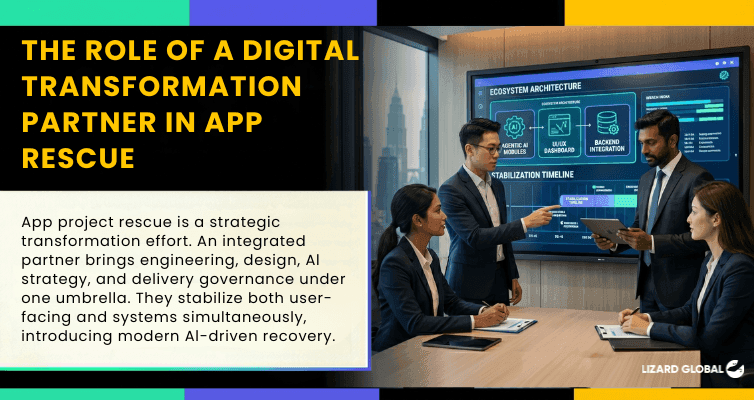
Their expertise in UI/UX design services, web app development services, and mobile app development agency capabilities allows enterprises to stabilize both user-facing and backend systems simultaneously. More importantly, their understanding of Agentic AI for Enterprise and Autonomous AI Agents enables them to introduce modern AI-driven recovery strategies where appropriate.
By combining technical depth with strategic consultancy, they help enterprises move from delayed delivery to scalable execution. This is particularly valuable in Malaysia’s fast-evolving digital economy, where speed and reliability determine competitive advantage through Malaysia software expertise, enterprise development leadership, digital product expertise, and industry recognition.
Turning Failed Projects into Scalable Platforms
App project rescue is no longer about patching broken systems. It is about transforming them into scalable, intelligent, and future-ready platforms. Enterprises in Malaysia and beyond are increasingly realizing that delays are not the end of a project, but a signal that transformation is required.
By leveraging modern approaches such as Agentic Workflows, Enterprise AI Orchestration, and structured governance models, organizations can recover even the most delayed software initiatives. However, success depends heavily on execution discipline and the right strategic partner through enterprise-ready software development, custom software solutions, enterprise software evolution, and scalability transformation.
Redesign Your Business with Autonomous AI Systems
If your enterprise is struggling with delayed software delivery, unstable applications, or failing digital transformation initiatives, it’s time to take control. Partner with experts who understand both engineering depth and enterprise strategy.
Work with Lizard Global to rescue, rebuild, and scale your digital products with confidence. From app project recovery to full-scale AI-enabled transformation, their team helps enterprises move from stalled execution to high-performance delivery systems.
👉Reach out today and turn your delayed project into your next competitive advantage.
Enterprise app delays are more common than most organizations admit. From missed deadlines and broken sprints to misaligned teams and unstable architectures, software delivery can easily derail. In Malaysia’s fast-growing digital economy, these delays can significantly impact revenue, customer trust, and market competitiveness. This blog explores how app project rescue works in enterprise environments and how organizations can recover stalled or failing software initiatives. It also highlights modern approaches like Agentic AI for Enterprise, Autonomous AI Agents, and Enterprise AI Orchestration to stabilize delivery pipelines and improve execution. Finally, it shows how a digital transformation partner such as Lizard Global can help enterprises regain control and deliver scalable, production-ready systems faster.
Enterprise app failures rarely happen overnight. In Malaysia’s fast-evolving digital landscape, many organizations struggle with delayed software delivery, unstable systems, and applications that no longer align with business goals. As enterprise platforms become more complex, traditional development models often fail to keep pace with changing requirements, integration demands, and scalability expectations.
This is why app project rescue has become a critical strategy for businesses looking to recover stalled initiatives, rebuild delivery confidence, and transform failing systems into scalable digital platforms.
Want to find out how much it costs to build your dream app or web app?
Understanding App Project Rescue in Malaysia’s Enterprise Landscape
Enterprise software projects in Malaysia are growing in scale, complexity, and business criticality. However, with this growth comes a recurring challenge: delayed or failing application delivery. App project rescue is the structured process of diagnosing, stabilizing, and recovering software projects that have fallen behind schedule or drifted from business expectations.
In many cases, these projects are not simply “slow”, they are misaligned. Requirements evolve faster than development cycles, technical debt accumulates silently, and teams often operate in silos. As a result, enterprises end up with partially functional systems that cannot scale or integrate effectively.
This is where structured rescue intervention becomes essential. Instead of continuing with the same delivery model, organizations need a reset in architecture, governance, and execution strategy to regain control of the project lifecycle through digital consultancy services, technical feasibility analysis, software modernization, and enterprise software development solutions.
Why Enterprise App Projects Fail or Get Delayed
To effectively recover a failing project, it is important to understand why delays happen in the first place. In most enterprise environments, the root causes are rarely just technical. Instead, they emerge from a combination of organizational, architectural, and operational breakdowns.
One major issue is the lack of clear distinction between deterministic vs. agentic development models. Traditional deterministic workflows assume fixed requirements and predictable outputs. However, modern enterprise systems behave more dynamically, requiring adaptive, feedback-driven approaches such as Agentic Workflows and iterative AI-assisted development supported by AI integration, AI consultancy, AI industry expertise, and AI governance.
Additionally, poor integration planning often leads to fragmented systems. Without proper CRM integration services, analytics pipelines, and backend orchestration layers, even well-coded applications fail to deliver value. This disconnect slows down delivery and creates long-term maintenance challenges through weak API and microservices, data and architecture design, API development, and API orchestration.
Finally, communication breakdowns between stakeholders and development teams lead to constant rework. Requirements shift mid-sprint, priorities change without structured governance, and delivery teams struggle to maintain alignment with business expectations using agile development, scrum sprint, discovery workshops, and workshops.
Diagnosing the Problem: The First Step in App Rescue
Before any recovery strategy can succeed, enterprises must perform a deep diagnostic phase. This is not just a technical audit, it is a full evaluation of architecture, workflows, team structure, and delivery health.
Modern rescue approaches often leverage AI Observability & Audit Logs to trace where breakdowns occur. These logs help identify bottlenecks in deployment pipelines, inefficient API calls, and failed integration points across systems. Without this visibility, recovery efforts remain guesswork supported by product analytics, growth analytics, agile analytics, and user behavior data.
At this stage, Enterprise AI Orchestration becomes particularly valuable. It enables teams to map dependencies across services, workflows, and microservices, giving a clear picture of system behavior under real-world conditions. This orchestration layer helps uncover hidden inefficiencies that traditional monitoring tools often miss through cloud-native architecture, microservice architecture, platform modernisation, and enterprise technical debt modernization.
In more advanced setups, AI Digital Labor can also assist in automating diagnostic reporting, codebase scanning, and performance benchmarking. This significantly reduces the time required to understand the current state of the project and accelerates decision-making through AI-driven QA, continuous deployment, system monitoring, and software testing.
Rebuilding Delivery with Agentic AI and Smart Workflows
Once the diagnosis is complete, the next step is rebuilding delivery pipelines using modern execution models. This is where Agentic AI for Enterprise plays a transformative role. Unlike traditional automation tools, Agentic AI introduces Autonomous AI Agents that can execute tasks, coordinate workflows, and make contextual decisions within defined guardrails.
These agents can handle repetitive engineering tasks such as test generation, code refactoring suggestions, and deployment validation. This allows human teams to focus on higher-value work such as architecture design and product strategy supported by machine learning, AI applications, AI-powered development, and AI software development.
To ensure stability, AI Guardrails and Human-in-the-Loop (HITL) mechanisms are essential. These systems ensure that AI-generated outputs remain compliant with enterprise standards and do not introduce unintended risks into production environments through security and ISO compliance, application security, AI cybersecurity, and data leak protection.
At this stage, Agentic Governance & Compliance frameworks are also introduced. These frameworks define how AI agents interact with systems, what actions they can perform, and how their decisions are audited. This is critical for enterprise environments where security and accountability are non-negotiable using GDPR compliance, PDPA regulations, software security, and cybersecurity.
Re-Engineering the Architecture for Long-Term Stability
A successful app rescue is not complete without addressing the underlying architecture. Many delayed enterprise projects suffer from brittle systems that cannot scale or integrate efficiently.
Modern recovery efforts often involve rebuilding systems using full-stack digital solutions, including web app development services, mobile app development agency, full-stack digital solutions, and custom software development. This ensures that all layers of the application are aligned and scalable.
For mobile-first enterprises, iOS app development, Android app development, and hybrid app development strategies are often re-evaluated to ensure consistent performance across platforms. Similarly, UX/UI product design is optimized to eliminate friction points that impact user adoption through UI design, UX design, UI/UX process, and UX integration.
In parallel, CRM integration services and growth analytics consulting are implemented to ensure the system is not just functional but also measurable and business-aligned. This allows enterprises to connect technical performance with real business outcomes using lean analytics, North Star metrics, business metrics, and key metric tracking.
A strong custom software development company or digital consultancy services provider plays a crucial role here by ensuring architectural decisions align with long-term scalability goals through strategic software development, tech stack strategy, enterprise tech stack selection, and scalable systems.
Accelerating Delivery with AI-Driven Engineering Practices
Once the architecture is stabilized, the focus shifts to accelerating delivery. This is where modern engineering practices combined with AI-driven systems create a significant advantage.
Enterprise teams increasingly rely on AI Digital Labor to handle repetitive tasks such as testing, documentation, and deployment validation. This reduces manual workload and improves consistency across development cycles through automation testing, mobile testing, performance optimization, and application lifecycle management.
At the same time, Enterprise AI Orchestration ensures that all development pipelines remain synchronized. This orchestration layer coordinates deployments, monitors system health, and dynamically adjusts workflows based on system performance through CI/CD implementation, development environments, workflow strategy, and technical support.
Growth-focused enterprises also integrate growth analytics consulting into their delivery cycles. This ensures that product decisions are continuously informed by user behavior and performance data through rapid iteration analytics, AI business analytics, UX data analytics, and continuous product iteration. Together, these practices transform delivery from a reactive process into a proactive, continuously optimized system.
The Role of a Digital Transformation Partner in App Rescue
App project rescue is not just a technical exercise, it is a strategic transformation effort. This is where experienced partners like Lizard Global become essential.
As a digital transformation partner and full-stack digital solutions agency, they bring together engineering, design, AI strategy, and delivery governance under one umbrella. This integrated approach ensures that recovery is not just about fixing code but rebuilding entire ecosystems.
Their expertise in UI/UX design services, web app development services, and mobile app development agency capabilities allows enterprises to stabilize both user-facing and backend systems simultaneously. More importantly, their understanding of Agentic AI for Enterprise and Autonomous AI Agents enables them to introduce modern AI-driven recovery strategies where appropriate.
By combining technical depth with strategic consultancy, they help enterprises move from delayed delivery to scalable execution. This is particularly valuable in Malaysia’s fast-evolving digital economy, where speed and reliability determine competitive advantage through Malaysia software expertise, enterprise development leadership, digital product expertise, and industry recognition.
Turning Failed Projects into Scalable Platforms
App project rescue is no longer about patching broken systems. It is about transforming them into scalable, intelligent, and future-ready platforms. Enterprises in Malaysia and beyond are increasingly realizing that delays are not the end of a project, but a signal that transformation is required.
By leveraging modern approaches such as Agentic Workflows, Enterprise AI Orchestration, and structured governance models, organizations can recover even the most delayed software initiatives. However, success depends heavily on execution discipline and the right strategic partner through enterprise-ready software development, custom software solutions, enterprise software evolution, and scalability transformation.
Redesign Your Business with Autonomous AI Systems
If your enterprise is struggling with delayed software delivery, unstable applications, or failing digital transformation initiatives, it’s time to take control. Partner with experts who understand both engineering depth and enterprise strategy.
Work with Lizard Global to rescue, rebuild, and scale your digital products with confidence. From app project recovery to full-scale AI-enabled transformation, their team helps enterprises move from stalled execution to high-performance delivery systems.
👉Reach out today and turn your delayed project into your next competitive advantage.
FAQs

What is app project rescue in enterprise software development?
Why do enterprise app projects get delayed so often?
How does Agentic AI help in recovering delayed software projects?
What role does Human-in-the-Loop (HITL) play in AI-driven recovery?
Can legacy enterprise systems be rescued without full rebuilds?
What is Enterprise AI Orchestration in app rescue?
Why should enterprises work with a digital transformation partner for app rescue?
similar reads

Case Studies & Interviews
Tactlink: How a Malaysian Entrepreneur Turned Networking Chaos into a Digital Community
22 January 2026

AI & Machine Learning
How Malaysian Enterprises Can Recover Failing Software Projects with AI-Led Delivery
18 June 2026

AI & Machine Learning
Malaysia’s Top 5 Leading AI Integration Agencies for Enterprise-Scale Systems
24 June 2026
Stuck between a great idea and the right team to build it?Let's talk.
We work with corporate innovation teams and ambitious scale-ups across the Netherlands, Singapore, and Australia, and wherever great software needs to be built. Drop us a message and we'll get back to you within one business day.


Markus Monnikendam
Global Commercial Director
hello@lizard.global